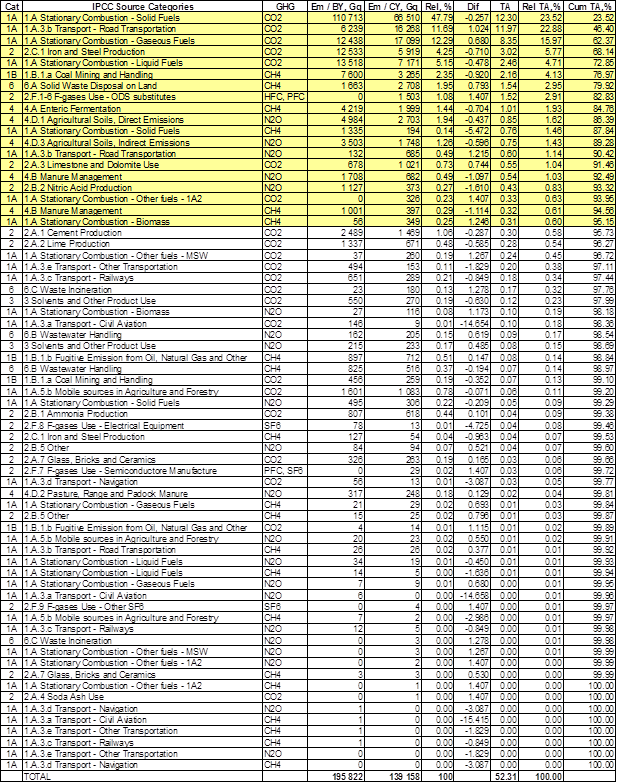
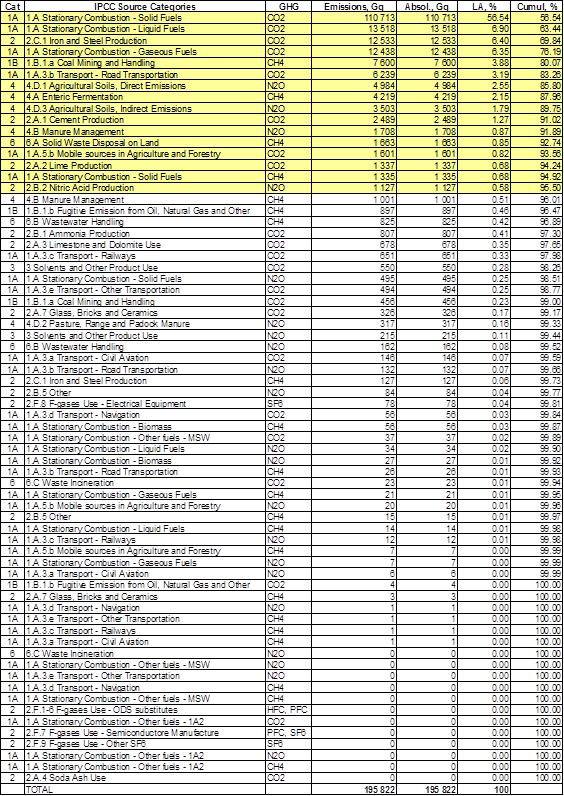
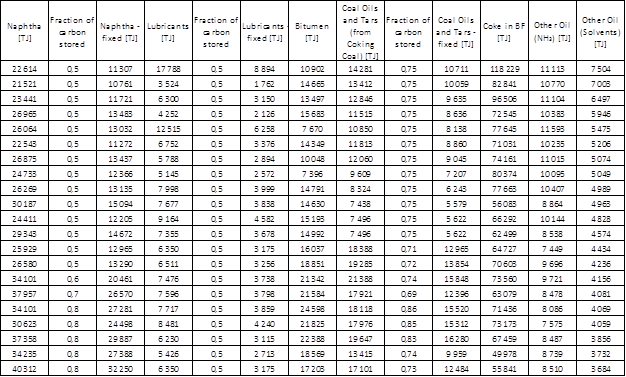
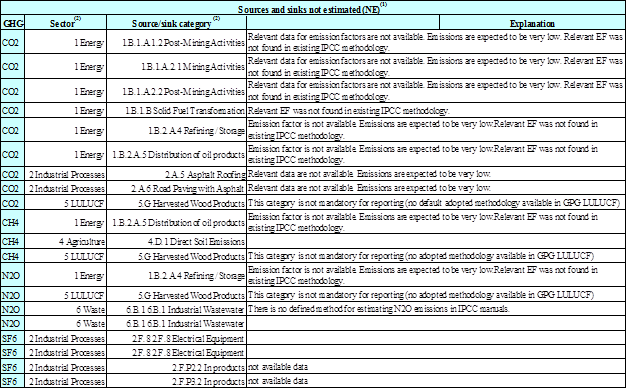
Executive Summary
As a Party to the United
Nations Framework Convention on Climate Change (UNFCCC), the Czech Republic
is required to prepare and regularly update national greenhouse gas (GHG)
inventories. In addition, as a
result of membership in the European Union, the Czech Republic must also fulfil
its reporting requirements concerning GHG emissions and removals following from
Decision of the European Parliament and Council No. 280/2004/EC. This
edition of the National Inventory Report
(NIR) deals with national greenhouse gas inventories for the 1990 to 2010
period with accent on the latest year 2010.
Inventories of emissions and removals of greenhouse
gases were prepared according to the IPCC methodology: Revised 1996 IPCC Guidelines (IPCC, 1997); Good
Practice Guidance (IPCC, 2000); Good
Practice Guidance for LULUCF (IPCC, 2003); application of this general
methodology on country specific circumstances will be described in
category-specific chapters. When a method
used to estimate emissions is improved or when some gaps are identified, a need
to recalculate the whole time series may arise in order to maintain
consistency. This means that data
presented this year can be changed in the next submission.
The National Inventory Report
is elaborated in accordance with the UNFCCC reporting guidelines (UNFCCC,
2006). However, Annex I Parties that are also Parties to the Kyoto Protocol are also required to
report supplementary information required under Article 7.1 of the Kyoto Protocol that is specified by
Decision 15/CPM.1. Thus the second part contains the Kyoto elements of the
report. The both parts of the National
Inventory Report, together with the data output - Common Reporting Format (CRF) Tables, are submitted annually by 15.
April.
The structure of this NIR follows new methodical handbook published by
the Secretariat “Annotated outline of the
National Inventory Report including elements under the Kyoto Protocol”
(UNFCCC, 2009).
In 2010, the most important GHG in
the Czech Republic was CO2 contributing 85.5 % to total
national GHG emissions and removals expressed in CO2 eq., followed
by CH4 7.8 % and N2O
5.6 %. PFCs, HFCs and SF6 contributed for 1.16 % to the overall
GHG emissions in the country. CO2 net emissions from LULUCF totalled
at -4.2 % from the overall GHG emissions.
Tab. ES 2‑1 provides data on GHG emissions in
comparison of overall trend from 1990 to 2010. For overview of GHG emission and
removals by categories please see chapter ES 3 on page 15.
Tab. ES 2‑1 GHG emission/removal overall trends
|
|
Base year
|
2010
|
Base year
|
2010
|
Trend
|
|
[Gg CO2 eq.]
|
[%]
|
|
CO2
emissions
|
165097
|
119866
|
85.9
|
89.7
|
-27.4
|
|
CO2 (LULUCF)
|
-3749
|
-5666
|
-2.0
|
-4.2
|
51.1
|
|
CO2 Total
|
161348
|
114200
|
83.9
|
85.5
|
-29.2
|
|
CH4
|
17914
|
10413
|
9.3
|
7.8
|
-41.9
|
|
2N2O
|
12865
|
7477
|
6.7
|
5.6
|
-41.9
|
|
F-gases
|
78
|
1549
|
0.04
|
1.16
|
19.9-times
|
|
Total
|
192204
|
133639
|
100
|
100
|
-30.5
|
Over the
period 1990 - 2010 CO2 emissions and removals decreased
by 30.5 %, CH4 emissions decreased by 41.9 % during the same
period mainly due to lower emissions from 1 Energy,
4 Agriculture and 6 Waste; N2O emissions decreased by 41.9 % over the same
period due to emission reduction in 4 Agriculture
and despite increase from the 1A3 Transport category. Emissions of
HFCs and PFCs increased by orders of magnitude, whereas SF6
emissions decreased significantly, resulting the overall F-gases trend at
almost 20-times increase in CO2 eq.
Emission and removal estimates of
GHGs for applicable KP-LULUCF activities in the years 2008, 2009 and 2010 are
presented in Tab. ES 2‑2.
Tab. ES 2‑2 Summary of GHG emissions and
removals for KP LULUCF activities [Gg CO2 eq.]
|
Year
|
Article 3.3 activities
|
Article 3.4 activities
|
|
Afforestration and Reforestration
|
Deforestation
|
Forest Management*
|
Cropland Management
|
Grazing Land
Management
|
Revegetation
|
|
2008
|
-272
|
160
|
-4404
|
NA
|
NA
|
NA
|
|
2009
|
-295
|
170
|
-6441
|
NA
|
NA
|
NA
|
|
2010
|
-322
|
207
|
-5096
|
NA
|
NA
|
NA
|
*)
Net emissions or removals / accounting quantity
Tab. ES 3‑1 Overview of GHG emission/removal
overall trends by categories
|
|
|
|
Base year
|
2010
|
Base year
|
2010
|
Trend
|
|
|
|
|
|
|
Category share [%]
|
[%]
|
|
1. Energy
|
157048.2
|
115204.9
|
81.7
|
86.2
|
-26.6
|
|
|
A. Fuel Combustion (Sectoral Approach)
|
148090.4
|
110954.0
|
94.3
|
96.3
|
-25.1
|
|
|
|
1. Energy Industries
|
58007.9
|
56251.1
|
36.9
|
48.8
|
-3.0
|
|
|
|
2. Manufacturing Industries and Construction
|
46885.4
|
23806.9
|
29.9
|
20.7
|
-49.2
|
|
|
|
3. Transport
|
7766.8
|
17448.4
|
4.9
|
15.1
|
124.7
|
|
|
|
4. Other Sectors
|
33802.9
|
12340.0
|
21.5
|
10.7
|
-63.5
|
|
|
|
5. Other
|
1627.5
|
1107.7
|
1.0
|
1.0
|
-31.9
|
|
|
B. Fugitive Emissions from Fuels
|
8957.7
|
4250.9
|
5.7
|
3.7
|
-52.5
|
|
|
|
1. Solid Fuels
|
8056.2
|
3524.7
|
5.1
|
3.1
|
-56.2
|
|
|
|
2. Oil and Natural Gas
|
901.5
|
726.2
|
0.6
|
0.6
|
-19.5
|
|
2. Industrial Processes
|
19602.8
|
12061.1
|
10.2
|
9.0
|
-38.5
|
|
|
A.
Mineral Products
|
4832.8
|
3428.4
|
24.7
|
28.4
|
-29.1
|
|
|
B.
Chemical Industry
|
2032.5
|
1110.7
|
10.4
|
9.2
|
-45.4
|
|
|
C.
Metal Production
|
12659.9
|
5973.0
|
64.6
|
49.5
|
-52.8
|
|
|
F.
Consumption of Halocarbons and
SF6
|
76.1
|
1549.0
|
0.4
|
12.8
|
1936.6
|
|
3. Solvent and Other
Product Use
|
764.8
|
502.7
|
0.4
|
0.4
|
-34.3
|
|
4. Agriculture
|
15733.2
|
7777.3
|
8.2
|
5.8
|
-50.6
|
|
|
A.
Enteric Fermentation
|
4219.4
|
1998.8
|
26.8
|
25.7
|
-52.6
|
|
|
B.
Manure Management
|
2709.6
|
1079.3
|
17.2
|
13.9
|
-60.2
|
|
|
D.
Agricultural Soils(3)
|
8804.2
|
4699.2
|
56.0
|
60.4
|
-46.6
|
|
5. Land Use,
Land-Use Change and Forestry
|
-3617.9
|
-5518.5
|
-1.9
|
-4.1
|
52.5
|
|
|
A. Forest Land
|
-4947.0
|
-5440.1
|
136.7
|
98.6
|
10.0
|
|
|
B. Cropland
|
1336.5
|
138.9
|
-36.9
|
-2.5
|
-89.6
|
|
|
C. Grassland
|
-127.9
|
-371.3
|
3.5
|
6.7
|
190.3
|
|
|
D. Wetlands
|
22.5
|
34.2
|
-0.6
|
-0.6
|
52.0
|
|
|
E. Settlements
|
86.1
|
117.5
|
-2.4
|
-2.1
|
36.5
|
|
|
G. Other
|
11.8
|
2.3
|
-0.3
|
0.0
|
-80.9
|
|
6. Waste
|
2673.2
|
3611.8
|
1.4
|
2.7
|
35.1
|
|
|
A.
Solid Waste Disposal on Land
|
1662.6
|
2708.2
|
62.2
|
75.0
|
62.9
|
|
|
B.
Waste-water Handling
|
987.0
|
720.5
|
36.9
|
19.9
|
-27.0
|
|
|
C.
Waste Incineration
|
23.6
|
183.1
|
0.9
|
5.1
|
676.2
|
|
Total CO2
Equivalent Emissions including LULUCF
|
192204.3
|
133639.4
|
100.0
|
100.0
|
-30.5
|
|
Total CO2
Equivalent Emissions excluding LULUCF
|
195822.25
|
139157.86
|
-
|
-
|
-
|
NO, NA, NE
sub-categories omitted
NO, NA, NE sub-categories omitted
In 2010, 115205 Gg CO2 eq.,
that are 86.2 % of national total emissions (including 5 Land Use, Land-Use Change and
Forestry) arose from 1 Energy;
96 % of these emissions arise from fuel combustion activities. The most
important sub-category of 1 Energy
with 49 % of total sectoral emissions in 2010 is 1A1 Energy Industries, 1A2 Manufacturing Industries and Construction responses
for 21 % and 1A3 Transport
for 15 % of total sectoral emissions. From 1990 to 2010 emissions from 1 Energy decreased by 26.6 %.
2 Industrial Processes is the second largest category with
9.0 % of total GHG emissions (including 5 Land
Use, Land-Use Change and Forestry) in 2010 (12061 Gg CO2 eq.);
the largest sub-category is 2C Metal Production with 50% of sectoral share. From 1990
to 2010 emissions from 2 Industrial
Processes decreased by 38.5 %.
In 2010, 0.4 % of total GHG
emissions (including 5 Land Use,
Land-Use Change and Forestry) in the Czech Republic (506 Gg CO2 eq.)
arose from the category 3 Solvent and Other Product Use. From 1990
- 2010 emissions from 3 Solvent and Other Product Use decreased by 34.3 %.
4 Agriculture is the third largest category in
the Czech Republic with 5.8 % share of total GHG emissions (including 5 Land Use, Land-Use Change and
Forestry) in 2010 (7 777 Gg CO2 eq.); 60 % of emissions is
coming from 4D Agricultural
Soils. From 1990 to 2010 emissions from 4 Agriculture
decreased by 50.6 %.
5 Land Use, Land-Use Change and
Forestry is the
only category where removals exceed emissions. Net removals from this category
increased from 1990 to 2010 by 52.5 % to 5518 Gg CO2 eq.
2.7 % of the national total GHG
emissions (including 5 Land Use,
Land-Use Change and Forestry) in 2010 arose from 6 Waste. 75 %
share of GHG emissions arose from 6C Solid waste disposal on land. Emissions
from 6 Waste increased
from 1990 to 2010 by 35.1 % to 3612 Gg CO2 eq.
Emission and removals estimates of GHGs for the KP LULUCF activities in the
years 2008, 2009 and 2010 are presented in Tab. ES 3‑2.
Tab. ES 3‑2 Summary
|
|
CO2 emissions
|
CO2 removals
|
CH4
|
N2O
|
|
|
|
2008
|
159.8
|
-4 834.2
|
6.8
|
0.05
|
|
|
2009
|
169.8
|
-6 869.6
|
5.8
|
0.04
|
|
|
2010
|
206.4
|
-5 559.7
|
6.11
|
0.04
|
|
Emission estimates of indirect GHGs
and SO2 for the period from 1990 to 2010 are presented in Tab. ES 4‑1.
Tab. ES 4‑1 Indirect GHGs and SO2
for 1990 to 2010 [Gg]
|
|
NOx
|
CO
|
NMVOC
|
SO2
|
|
1990
|
742
|
1 071
|
311
|
1 876
|
|
1991
|
732
|
1 157
|
273
|
1 772
|
|
1992
|
708
|
1 162
|
257
|
1 559
|
|
1993
|
691
|
1 194
|
233
|
1 469
|
|
1994
|
451
|
1 075
|
255
|
1 290
|
|
1995
|
430
|
932
|
215
|
1 095
|
|
1996
|
447
|
965
|
265
|
934
|
|
1997
|
471
|
981
|
272
|
981
|
|
1998
|
414
|
812
|
267
|
442
|
|
1999
|
391
|
726
|
247
|
269
|
|
2000
|
397
|
680
|
244
|
264
|
|
2001
|
333
|
687
|
220
|
251
|
|
2002
|
319
|
587
|
203
|
237
|
|
2003
|
326
|
630
|
203
|
232
|
|
2004
|
334
|
622
|
198
|
227
|
|
2005
|
279
|
556
|
182
|
219
|
|
2006
|
284
|
540
|
179
|
211
|
|
2007
|
286
|
584
|
174
|
217
|
|
2008
|
263
|
498
|
166
|
174
|
|
2009
|
253
|
454
|
151
|
173
|
|
2010
|
241
|
455
|
150
|
170
|
|
Trend [%]
|
-67.6
|
-57.5
|
-51.9
|
-90.9
|
|
NEC
|
286
|
-
|
220
|
283
|
Emissions of indirect greenhouse
gases decreased from the period from 1990 to 2010: for NOx by 67.6 %, for CO by 57.5 %, for
NMVOC by 51.9 % and for SO2 by 90.9 %. The most important
emission source for indirect greenhouse gases and SO2 are fuel
combustion activities.

This
edition is resubmitted version of National Greenhouse Gas Inventory Report of
the Czech Republic. The resubmission was recommended by ERT on 9 September 2012
in Saturday paper submitted to the Czech Republic with the list of Potential
Problems. Czech Republic provides in this version additional information or
revised estimates of emissions corresponding to the identified Potential Problems.
The first
potential problem is related to the Energy sector to the Stationary combustion.
The default emission factors given in 2006 Guidelines were replaced by default
emission factors given in Revised 1996 Guidelines. The revised estimates
influenced all tables containing the emission estimates and emission factors in
chapter 3 Energy, Specifically the tables 3-2, 3-3, 3-14 (See revised table
3-14 below) and also the chapter 3.7.1. For details please see attached
Saturday paper-response.
The
response to the potential problem related to the category 1.A.3.a Civil
Aviation is given in attached Saturday paper-response.
The
potential problem related to the emissions associated with charcoal use was
solved and the description is provided in response to the Saturday paper. These
emissions don’t influence final tables with emission estimates since the
biomass is not included in resulting CO2 emissions.
CH4
emissions from charcoal production were newly estimated. In the next submission
the explanation of this source of emission will be given in chapter for 1.B.1.b
Coal transformation category.
IPCC GPG
was applied and available information on production of crops (alfalfa and
clover) and national values were used to estimate N2O emissions in
response to the potential problem related to the 4.D.1.3 N-fixing crops
category. The emissions from Agricultural soils, Direct Soil Emissions,
N-fixing crops (4.D.1.3) reported in the last submission 2012 will be increased
by the amount of emissions calculated in terms of this recalculation. The
description will be given in next submission in chapter 6.4.
N2O
Direct Soil Emissions from Crop Residue (potatoes and sugarbeet) were estimated
applying the IPCC GPG and using available information on production of these
crops (potential problem for category 4.D.1.4). The detailed response to this
potential problem is given in Saturday paper-response. Detailed description
will be given in next submission in chapter 6.4.
The
response to the potential problems related to the 6.A Solid Waste Disposal and
6.C Waste Incineration given in attached Saturday paper-response.
All changes
provided in response to the Saturday paper influence also the chapter 12.5
Calculation of the Commitment Period Reverse. The calculation of five times the
most recent inventory (2010) is given below
5 x 139 523 382= 697 616 911 (t) CO2eq
Revised Tab. 3-14 Net caloricic
values (NCV), CO2 emission factors and oxidation factors used in the
Czech GHG inventory
|
Fuel (IPCC 1996 Guidelines
|
NCV
|
CO2 EF a)
|
Oxidation
|
CO2 EF b)
|
|
definitions)
|
[TJ/Gg]
|
[t CO2/TJ]
|
factor e)
|
[t CO2/TJ]
|
|
Crude Oil
|
42.40
|
73.33
|
0.99
|
72.60
|
|
Gas / Diesel Oil
|
42.75
|
74.07
|
0.99
|
73.33
|
|
Residual Fuel Oil
|
39.59
|
77.37
|
0.99
|
76.59
|
|
LPG
|
43.82
|
63.07
|
0.995
|
62.75
|
|
Naphtha
|
43.96
|
73.33
|
0.99
|
72.60
|
|
Bitumen
|
40.19
|
80.67
|
0.99
|
79.86
|
|
Lubricants
|
40.19
|
73.33
|
0.99
|
72.60
|
|
Petroleum Coke
|
37.50
|
100.83
|
0.98
|
98.82
|
|
Other Oil
|
39.82
|
73.33
|
0.99
|
72.60
|
|
Coking Coal d)
|
29.39
|
93.24
|
0.98
|
91.38
|
|
Other Bituminous Coal d)
|
23.19
|
93.24
|
0.98
|
91.38
|
|
Lignite (Brown Coal) d)
|
12.67
|
99.99
|
0.98
|
97.99
|
|
Brown Coal Briquettes
|
20.82
|
94.60
|
0.98
|
92.71
|
|
Coke Oven Coke
|
27.93
|
108.17
|
0.98
|
106.00
|
|
Coke Oven Gas
(TJ/mill. m3)
|
15.62c)
|
47.67
|
0.995
|
47.43
|
|
Natural Gas
(TJ/Gg)
|
57.22
|
56.10
|
0.995
|
55.82
|
|
Natural Gas
(TJ/mill. m3)
|
34.33c)
|
56.10
|
0.995
|
55.82
|
a) Emission
factor without oxidation factor
b) Resulting
emission factor with oxidation factor
c) TJ/mill. m3,
t= 15°C, p = 101.3 kPa
d) Country
specific values of CO2 EFs
e) Oxidation
factors values used for national inventory of greenhouse gases are 0.995 for
gaseous fuels, 0.99 for liquid fuels and 0.98 for solid fuels
Inventory related potential
problems identified by ERT during centralised UNFCCC review 2012
With reference to the Guidelines for review under Article 8 of the Kyoto Protocol,
the ERT requests that additional information and/or revised estimates for the
2010 greenhouse gas (GHG) inventory corresponding to the potential problems
identified in this paper (see attached tables) be forwarded to the ERT, through
the UNFCCC secretariat, not later than by 22 October 2012.
Should the Czech Republic decide to submit by 22 October
2012, in response to some or all potential problems, revised estimates of its
GHG emissions, the ERT requests that the revised estimates contain the
following:
·
Relevant background information and a
descriptive summary of the revisions made by the Czech Republic in its 2012
inventory submission, in particular in the year 2010 with respect to:
1.
CO2 emissions from 1.A Stationary Combustion
(liquid fuels);
2.
CO2, CH4 and N2O
emissions from 1.A.3.a Civil Aviation;
3.
CH4 and N2O emissions from
1.A.4.b Residential;
4.
CH4 emissions from 1.B.1.b Solid Fuel
Transformation;
5.
N2O emissions from 4.D.1.3 N-fixing
crops;
6.
N2O emissions from 4.D.1.4 Crop
residue;
7.
CH4 emissions from 6.A Solid Waste
Disposal;
8.
CH4 and N2O emissions from
6.C Waste Incineration;
·
A complete resubmission of the 2012 CRF tables,
reflecting the revised estimates;
·
Party’s revision of the calculation of the
commitment period reserve, based on the recalculated emissions reported for
2010, if the calculation of the commitment period reserve is based on the
inventory and not the assigned amount.
1. Stationary combustion, liquid
fuels (1.A)
According to the recommendation of ERT the recalculation of CO2
emissions from 1.A Stationary combustion were performed by using EF provided by
the 1996 Revised IPCC Guidelines for the period 1995-2010. The ERT recommended
recalculating only liquid fuels, but the party is convinced that it would lead
to inconsistencies in reporting and therefore are used emission factors given
by 1996 Revised IPCC Guidelines also for gaseous fuels and biomass. Country
specific emission factors are used for Coking Coal, Other Bituminous Coal and
for Brown Coal+Lignite; for the rest of solid fuels the default emission
factors given by 1996 Revised IPCC Guidelines are used. Because the 2006 IPCC
Guidelines emission factors were used for the period 1995-2010, the emissions
in1990-1994 period remains the same before and after this recalculation. Since
emission factors given by 1996 Revised IPCC Guidelines and by 2006 IPCC
Guidelines not differ too much, the distinction between original estimates and
corrected/recalculated estimates is not too significant.
1.A Stationary combustion
|
year
|
Original estimate (Gg CO2)
|
Corrected estimate (Gg CO2)
|
|
1990
|
145 893.92
|
145 893.92
|
|
1991
|
140 063.18
|
140 063.18
|
|
1992
|
124 431.60
|
124 431.60
|
|
1993
|
123 371.42
|
123 371.42
|
|
1994
|
113 653.39
|
113 653.39
|
|
1995
|
115 462.71
|
115 635.36
|
|
1996
|
119 294.50
|
119 461.86
|
|
1997
|
115 698.41
|
115 863.28
|
|
1998
|
109 440.37
|
109 589.65
|
|
1999
|
104 419.79
|
104 558.55
|
|
2000
|
113 232.44
|
113 376.53
|
|
2001
|
113 805.04
|
113 969.03
|
|
2002
|
110 521.69
|
110 676.04
|
|
2003
|
113 000.32
|
113 157.71
|
|
2004
|
114 029.53
|
114 175.45
|
|
2005
|
115 105.90
|
115 260.48
|
|
2006
|
115 807.16
|
115 976.74
|
|
2007
|
115 313.18
|
115 494.52
|
|
2008
|
110 997.99
|
111 193.95
|
|
2009
|
105 726.36
|
105 891.26
|
|
2010
|
109 181.21
|
109 353.56
|
2. Energy, Transport, Civil Aviation
(1.A.3.a)
The jet kerosene data were recalculated in last submission,
because there were several discrepancies and inconsistencies between years
relating to the consumption of jet kerosene in civil aviation (ERT foundation).
The total consumption of jet kerosene in the Czech Republic was divided into
five categories (Civil Aviation, Aviation Bunkers, Army, Industry and
Commercial/Institutional). The jet kerosene consumption as well as relevant
emissions from categories Army, Industry, Commercial/Institutional is not
reported in CRF Reporter in Transport sector 1A3 (or International Bunkers
1C1), but in sectors 1A5bi, 1A2f and 1A4a. Other two categories (Civil Aviation
1A3a and Aviation Bunkers 1C1a) were divided based on expert judgement in the
whole time period. The main criteria were passengers transport (now there is
only one regular domestic line between airports Praha and Ostrava) and
transport of goods. The regular domestic flights (36 TJ) using jet kerosene in
comparison with international flights (13 387 TJ) are represented in the Czech
Republic by a very small percentage. In IEA data (1 161 TJ) jet kerosene consumption
from categories Army, Industry, Commercial/Institutional is included in the
category Civil Aviation so it is not used for aviation or for transport at all.
More detailed description is given in the NIR 2012 on the page 114 (chapter
3.7.3 1A3 Mobile Combustion - Source-specific recalculations). The following
table shows the distribution of jet kerosene consumption in CRF tables in
comparison with IEA data. It is obvious that the total sum of jet kerosene is
the same in both cases.
Distribution of jet kerosene consumption in CRF Reporter
and IEA data.
|
CRF Reporter
|
|
|
[kt]
|
[TJ]
|
|
Total
|
|
330.00
|
14 289
|
|
Civil Aviation
|
1A3a
|
0.83
|
35.9
|
|
Aviation Bunkers
|
1C1a
|
309.17
|
13 387.0
|
|
Army
|
1A5bi
|
15.00
|
649.5
|
|
Industry
|
1A2f
|
2.00
|
86.6
|
|
Commercial/Institutional
|
1A4a
|
3.00
|
129.9
|
|
IEA data
|
|
|
[kt]
|
[TJ]
|
|
Total
|
|
330.00
|
14 289
|
|
Domestic Aviation
|
|
27.00
|
1 169.1
|
|
International Aviation
|
|
303.00
|
13 120.0
|
3. Energy, Other Sectors,
Residential (1.A.4.b)
According to the recommendation of ERT the
calculation of CH4 and N2O emissions associated with
charcoal use in category 1.A.4.b Residential were performed by using EF
provided by the 1996 Revised IPCC Guidelines (Table 1-7- in Volume 3 for CH4,
Table 1-8 in Volume 3 for N2O).
With respect to available data about imports and exports was calculated
apparent consumption of charcoal which was then used as activity data. Final
emissions from charcoal use were then included in emissions from biomass in
1.A4.b category. Please see the table for the results.
1.A.4.b Residential - Biomass
|
Original estimate
|
New estimate
|
Original estimate
|
New estimate
|
|
|
(Gg CH4 )
|
(Gg N2O)
|
|
1990
|
1.76
|
1.78
|
0.02
|
0.02
|
|
1991
|
1.73
|
1.74
|
0.02
|
0.02
|
|
1992
|
1.76
|
1.77
|
0.02
|
0.02
|
|
1993
|
1.50
|
1.51
|
0.02
|
0.02
|
|
1994
|
1.51
|
1.51
|
0.02
|
0.02
|
|
1995
|
7.20
|
7.20
|
0.10
|
0.10
|
|
1996
|
7.55
|
7.56
|
0.10
|
0.10
|
|
1997
|
7.46
|
7.46
|
0.10
|
0.10
|
|
1998
|
8.49
|
8.49
|
0.11
|
0.11
|
|
1999
|
8.64
|
8.66
|
0.12
|
0.12
|
|
2000
|
9.13
|
9.14
|
0.12
|
0.12
|
|
2001
|
10.06
|
10.07
|
0.13
|
0.13
|
|
2002
|
8.85
|
8.87
|
0.12
|
0.12
|
|
2003
|
10.35
|
10.38
|
0.14
|
0.14
|
|
2004
|
11.03
|
11.06
|
0.15
|
0.15
|
|
2005
|
11.12
|
11.17
|
0.15
|
0.15
|
|
2006
|
12.04
|
12.09
|
0.16
|
0.16
|
|
2007
|
13.98
|
14.04
|
0.19
|
0.19
|
|
2008
|
13.25
|
13.31
|
0.18
|
0.18
|
|
2009
|
13.05
|
13.11
|
0.17
|
0.17
|
|
2010
|
14.55
|
14.62
|
0.19
|
0.19
|
4. Energy, Fugitive Emissions from
Solid Fuels, Solid Fuel Transformation (1.B.1.b)
According to the
recommendation of ERT the calculation of CH4 emissions from charcoal
production were performed by using EF provided by the 1996 Revised IPCC
Guidelines (Table 1-14); the value of 1000 kg/TJ of charcoal produced were
used. Since there are no available official activity data about charcoal
production in the Czech Republic the un-official data from FAOSTAT statistics
were used. The missing data were extrapolated. The default net calorific value
30 MJ/kg (Table 1-13 in 1996 Revised IPCC Guidelines) was used to convert
activity data to the energy units. Resulting CH4 emissions please
see in the table.
1.B.1.b Solid Fuel Transfromation
|
|
Production
|
Production
|
CH4 emissions
|
|
|
Gg/year
|
TJ/year
|
Gg/year
|
|
1990
|
1.00
|
30.00
|
0.03
|
|
1991
|
1.00
|
30.00
|
0.03
|
|
1992
|
1.00
|
30.00
|
0.03
|
|
1993
|
1.00
|
30.00
|
0.03
|
|
1994
|
1.00
|
30.00
|
0.03
|
|
1995
|
1.00
|
30.00
|
0.03
|
|
1996
|
1.00
|
30.00
|
0.03
|
|
1997
|
1.00
|
30.00
|
0.03
|
|
1998
|
1.80
|
54.00
|
0.05
|
|
1999
|
2.60
|
78.00
|
0.08
|
|
2000
|
3.40
|
102.00
|
0.10
|
|
2001
|
4.20
|
126.00
|
0.13
|
|
2002
|
5.00
|
150.00
|
0.15
|
|
2003
|
6.00
|
180.00
|
0.18
|
|
2004
|
6.00
|
180.00
|
0.18
|
|
2005
|
6.00
|
180.00
|
0.18
|
|
2006
|
6.00
|
180.00
|
0.18
|
|
2007
|
6.00
|
180.00
|
0.18
|
|
2008
|
6.00
|
180.00
|
0.18
|
|
2009
|
6.00
|
180.00
|
0.18
|
|
2010
|
6.60
|
198.00
|
0.20
|
5. Agriculture, Agricultural soils,
Direct Soil Emissions, N-fixing crops (4.D.1.3)
IPCC GPG was applied
and available information on production of crops (alfalfa and clover) and
national values were used to estimate N2O emissions. The information
of production comes from Czech Statistical Office (CSO). The country-specific
data of the fraction of nitrogen (FracNCRBF); and the fraction of
dry matter content (FracDM) in aboveground biomass of forage crops
were applied to the emission inventory.
For the fraction of dry matter and fraction of nitrogen, the materials
(results of research projects) of Faculty of Agronomy, South Bohemia
University, were used.
Production data (tonnes)
|
Clover
|
Alfalfa
|
|
1990
|
1
344 264
|
1
087 610
|
|
1991
|
1
647 742
|
1
522 470
|
|
1992
|
1
311 256
|
1
278 921
|
|
1993
|
1
256 243
|
1
213 911
|
|
1994
|
1
068 677
|
1
203 048
|
|
1995
|
1
070 732
|
1
123 483
|
|
1996
|
982
389
|
1
036 611
|
|
1997
|
946
568
|
883
871
|
|
1998
|
708
666
|
742
565
|
|
1999
|
676
221
|
725
922
|
|
2000
|
697
727
|
755
398
|
|
2001
|
669
056
|
760
707
|
|
2002
|
504
406
|
661
588
|
|
2003
|
375
074
|
500
186
|
|
2004
|
485
900
|
672
700
|
|
2005
|
458
844
|
695
097
|
|
2006
|
433
989
|
667
758
|
|
2007
|
432
315
|
610
479
|
|
2008
|
386
358
|
583
724
|
|
2009
|
376
877
|
587
221
|
|
2010
|
337
526
|
527
413
|
|
FracDM*
|
FracNCRBF*
|
EF1**
|
|
Clover
|
0.15
|
0.19
|
0.0125
|
|
Alfalfa
|
0.18
|
0.21
|
0.0125
|
*data
www.zf.jcu.cz, Jeteloviny - study material of JCU
** default IPCC
2000, Table 4-17, page 4.60
These equations were
used to estimate direct N2O emissions from Agricultural soils -
N-fixing crops:
FBN = Crop * FracDM
* FracNCRBF
N2O
Emissions = FBN * EF1*44/28
The N2O
Direct Soil Emissions from N-fixing crops (clover and alfalfa production) are
presented in the following table.
|
N input (t N)
|
Emissions N2O (Gg)
|
Emissions CO2 eq. (Gg)
|
|
Clover
|
Alfalfa
|
Clover
|
Alfalfa
|
Total
|
Clover
|
Alfalfa
|
Total
|
|
1990
|
38
312
|
41
112
|
0.753
|
0.808
|
1.560
|
233.3
|
250.3
|
483.6
|
|
1991
|
46
961
|
57
549
|
0.922
|
1.130
|
2.053
|
286.0
|
350.4
|
636.4
|
|
1992
|
37
371
|
48
343
|
0.734
|
0.950
|
1.684
|
227.6
|
294.4
|
521.9
|
|
1993
|
35
803
|
45
886
|
0.703
|
0.901
|
1.605
|
218.0
|
279.4
|
497.4
|
|
1994
|
30
457
|
45
475
|
0.598
|
0.893
|
1.492
|
185.5
|
276.9
|
462.4
|
|
1995
|
30
516
|
42
468
|
0.599
|
0.834
|
1.434
|
185.8
|
258.6
|
444.4
|
|
1996
|
27
998
|
39
184
|
0.550
|
0.770
|
1.320
|
170.5
|
238.6
|
409.1
|
|
1997
|
26
977
|
33
410
|
0.530
|
0.656
|
1.186
|
164.3
|
203.4
|
367.7
|
|
1998
|
20
197
|
28
069
|
0.397
|
0.551
|
0.948
|
123.0
|
170.9
|
293.9
|
|
1999
|
19
272
|
27
440
|
0.379
|
0.539
|
0.918
|
117.4
|
167.1
|
284.4
|
|
2000
|
19
885
|
28
554
|
0.391
|
0.561
|
0.951
|
121.1
|
173.9
|
295.0
|
|
2001
|
19 068
|
28
755
|
0.375
|
0.565
|
0.939
|
116.1
|
175.1
|
291.2
|
|
2002
|
14
376
|
25
008
|
0.282
|
0.491
|
0.774
|
87.5
|
152.3
|
239.8
|
|
2003
|
10
690
|
18
907
|
0.210
|
0.371
|
0.581
|
65.1
|
115.1
|
180.2
|
|
2004
|
13
848
|
25
428
|
0.272
|
0.499
|
0.771
|
84.3
|
154.8
|
239.2
|
|
2005
|
13
077
|
26
275
|
0.257
|
0.516
|
0.773
|
79.6
|
160.0
|
239.6
|
|
2006
|
12
369
|
25
241
|
0.243
|
0.496
|
0.739
|
75.3
|
153.7
|
229.0
|
|
2007
|
12
321
|
23
076
|
0.242
|
0.453
|
0.695
|
75.0
|
140.5
|
215.5
|
|
2008
|
11
011
|
22
065
|
0.216
|
0.433
|
0.650
|
67.1
|
134.4
|
201.4
|
|
2009
|
10
741
|
22
197
|
0.211
|
0.436
|
0.647
|
65.4
|
135.2
|
200.6
|
|
2010
|
9
619
|
19
936
|
0.189
|
0.392
|
0.581
|
58.6
|
121.4
|
180.0
|
The emissions from Agricultural soils, Direct Soil
Emissions, N-fixing crops (4.D.1.3) reported in the last submission 2012 will
be increased by the amount of emissions calculated in terms of this
recalculation as shown in the last table column.
The recalculations
required by ERT in 4.D.1.3 category will cause an increase of Direct emissions
from agricultural soils of 6.6 %.
6. Agriculture, Agricultural soils;
Direct Soil Emissions, Crop Residue (4.D.1.4)
N2O Direct
Soil Emissions from Crop Residue (potatoes and sugarbeet) were estimated applying the IPCC GPG and using available
information on production of these crops. The source of information about crop
production is Czech Statistical Office (CSO). The default N2O EFs and default
values for other relevant parameters were used in accordance with the IPCC GPG
methodology.
The equation 4.29
(Tier 1b, GPG IPCC 2000, page 4.59) of the IPCC GPG was used to estimate these
emissions. The default N2O emission factor for both crops (Table
4-17, IPCC 2000 GPG, page 4.60), the default values for the fractions of
nitrogen in potatoes and sugarbeet (Table 4-16, IPCC 2000, page 4.58) and
default fraction of crop residue that is removed from the field as crop (Table
4-17, IPCC 1996, Reference Manual, page 4.85) were used. The country- specific
data for dry matter fraction was used: The value of FracDM for potatoes is
based on study Cabajova, MU LF Brno (2009) and corresponds to other available
sources. The value of FracDM for sugarbeet is based on study Blaha, CZU Praha
(1986) and corresponds to other available sources. Both national parameters
belong to interval of IPCC default values. The fraction of crop residue that is
burned on the field equals zero.
Production data (tonnes)
|
Potatoes
|
Sugarbeet
|
|
1990
|
1 755 000
|
4 026 000
|
|
1991
|
2 043 205
|
4 008 693
|
|
1992
|
1 969 233
|
3 871 498
|
|
1993
|
2 395 810
|
4 308 286
|
|
1994
|
1 231 035
|
3 240 124
|
|
1995
|
1 330 119
|
3 711 602
|
|
1996
|
1 800 272
|
4 315 566
|
|
1997
|
1 401 663
|
3 721 980
|
|
1998
|
1 519 768
|
3 479 426
|
|
1999
|
1 406 832
|
2 690 948
|
|
2000
|
1 475 992
|
2 808 839
|
|
2001
|
1 130 477
|
3 529 005
|
|
2002
|
900 843
|
3 832 466
|
|
2003
|
682 511
|
3 495 148
|
|
2004
|
861 798
|
3 579 280
|
|
2005
|
1 013 000
|
3 495 611
|
|
2006
|
692 189
|
3 138 300
|
|
2007
|
820 536
|
2 889 900
|
|
2008
|
769 561
|
2 884 645
|
|
2009
|
752 539
|
3 038 220
|
|
2010
|
665 176
|
3 064 986
|
|
FracNCRO
|
Res/Crop
|
FracDM
|
EF1
|
|
Potatoes
|
0.011
|
0.40
|
0.30
|
0.0125
|
|
Sugarbeet
|
0.004
|
0.20
|
0.12
|
0.0125
|
These equations were used to estimate direct N2O emissions
from Agricultural soils – Crop Residue:
FCR = Crop * Res/Crop * FracDM * FracNCRO*1 (Frac_burn, Frac_fuel etc. equal zero)
Emissions = FCR * EF1*44/28
|
N input (t N)
|
Emissions N2O
(Gg)
|
Emissions CO2
eq. (Gg)
|
|
Potatoes
|
Sugarbeet
|
Potatoes
|
Sugarbeet
|
Total
|
Potatoes
|
Sugarbeet
|
Total
|
|
1990
|
2317
|
386
|
0.046
|
0.008
|
0.053
|
14.1
|
2.4
|
16.5
|
|
1991
|
2697
|
385
|
0.053
|
0.008
|
0.061
|
16.4
|
2.3
|
18.8
|
|
1992
|
2599
|
372
|
0.051
|
0.007
|
0.058
|
15.8
|
2.3
|
18.1
|
|
1993
|
3162
|
414
|
0.062
|
0.008
|
0.070
|
19.3
|
2.5
|
21.8
|
|
1994
|
1625
|
311
|
0.032
|
0.006
|
0.038
|
9.9
|
1.9
|
11.8
|
|
1995
|
1756
|
356
|
0.034
|
0.007
|
0.041
|
10.7
|
2.2
|
12.9
|
|
1996
|
2376
|
414
|
0.047
|
0.008
|
0.055
|
14.5
|
2.5
|
17.0
|
|
1997
|
1850
|
357
|
0.036
|
0.007
|
0.043
|
11.3
|
2.2
|
13.4
|
|
1998
|
2006
|
334
|
0.039
|
0.007
|
0.046
|
12.2
|
2.0
|
14.2
|
|
1999
|
1857
|
258
|
0.036
|
0.005
|
0.042
|
11.3
|
1.6
|
12.9
|
|
2000
|
1948
|
270
|
0.038
|
0.005
|
0.044
|
11.9
|
1.6
|
13.5
|
|
2001
|
1492
|
339
|
0.029
|
0.007
|
0.036
|
9.1
|
2.1
|
11.1
|
|
2002
|
1189
|
368
|
0.023
|
0.007
|
0.031
|
7.2
|
2.2
|
9.5
|
|
2003
|
901
|
336
|
0.018
|
0.007
|
0.024
|
5.5
|
2.0
|
7.5
|
|
2004
|
1138
|
344
|
0.022
|
0.007
|
0.029
|
6.9
|
2.1
|
9.0
|
|
2005
|
1337
|
336
|
0.026
|
0.007
|
0.033
|
8.1
|
2.0
|
10.2
|
|
2006
|
914
|
301
|
0.018
|
0.006
|
0.024
|
5.6
|
1.8
|
7.4
|
|
2007
|
1083
|
277
|
0.021
|
0.005
|
0.027
|
6.6
|
1.7
|
8.3
|
|
2008
|
1016
|
277
|
0.020
|
0.005
|
0.025
|
6.2
|
1.7
|
7.9
|
|
2009
|
993
|
292
|
0.020
|
0.006
|
0.025
|
6.0
|
1.8
|
7.8
|
|
2010
|
878
|
294
|
0.017
|
0.006
|
0.023
|
5.3
|
1.8
|
7.1
|
The emissions from Agricultural soils, Direct Soil
Emissions, Direct Soil Emissions, Crop Residue (4.D.1.4) reported in the last
submission 2012, will be increased by the amount of emissions calculated in
terms of this recalculation as shown in the last table column.
The recalculations
required by ERT in 4.D.1.4 category will cause an increase of total Direct
emissions from agricultural soils of 0.3 %.
Detailed Agriculture recalculation comparison
|
OLD_Subm. 2012
|
NEW_recalculated
|
4D.1 - Direct emissions
from AS
|
|
4D.1.3
|
4D.1.4
|
4D.1.3
|
4D.1.4
|
OLD
|
NEW
|
INC (%)
|
|
1990
|
0.182
|
3.000
|
1.742
|
3.053
|
16.077
|
17.690
|
10.0
|
|
1991
|
0.237
|
2.672
|
2.290
|
2.733
|
13.420
|
15.534
|
15.8
|
|
1992
|
0.244
|
2.262
|
1.928
|
2.320
|
11.349
|
13.091
|
15.3
|
|
1993
|
0.269
|
2.244
|
1.874
|
2.314
|
10.081
|
11.756
|
16.6
|
|
1994
|
0.193
|
2.303
|
1.685
|
2.341
|
9.932
|
11.462
|
15.4
|
|
1995
|
0.171
|
2.233
|
1.605
|
2.274
|
10.069
|
11.544
|
14.6
|
|
1996
|
0.160
|
2.242
|
1.480
|
2.297
|
9.404
|
10.779
|
14.6
|
|
1997
|
0.123
|
2.331
|
1.309
|
2.374
|
9.604
|
10.833
|
12.8
|
|
1998
|
0.157
|
2.248
|
1.105
|
2.294
|
9.385
|
10.379
|
10.6
|
|
1999
|
0.142
|
2.323
|
1.060
|
2.365
|
9.414
|
10.374
|
10.2
|
|
2000
|
0.103
|
2.148
|
1.054
|
2.192
|
9.256
|
10.251
|
10.7
|
|
2001
|
0.113
|
2.440
|
1.052
|
2.476
|
9.714
|
10.689
|
10.0
|
|
2002
|
0.084
|
2.241
|
0.858
|
2.272
|
9.465
|
10.270
|
8.5
|
|
2003
|
0.087
|
1.916
|
0.668
|
1.940
|
8.439
|
9.044
|
7.2
|
|
2004
|
0.119
|
2.912
|
0.890
|
2.941
|
9.775
|
10.575
|
8.2
|
|
2005
|
0.135
|
2.557
|
0.908
|
2.590
|
9.142
|
9.948
|
8.8
|
|
2006
|
0.124
|
2.138
|
0.863
|
2.162
|
8.828
|
9.591
|
8.6
|
|
2007
|
0.093
|
2.369
|
0.788
|
2.396
|
9.178
|
9.900
|
7.9
|
|
2008
|
0.068
|
2.750
|
0.718
|
2.775
|
9.705
|
10.380
|
7.0
|
|
2009
|
0.089
|
2.587
|
0.736
|
2.612
|
9.090
|
9.762
|
7.4
|
|
2010
|
0.088
|
2.277
|
0.669
|
2.300
|
8.719
|
9.323
|
6.9
|
The total emissions in 4D.1 category (Direct
emissions from agricultural soils) increased after recalculation by 6.9 % in
2010 (the last column in the previous table).
7. Waste, Solid waste disposal (6.A)
Amount of sludge produced in the country is
estimated by using tier 1 method on the basis of population statistics. Basis
for sludge production from industrial waste water treatment is industry
production statistics. Wastewater treatment is split between sludge and water
streams. Both of these organic pollution streams are treated by mixture of
aerobic and anaerobic technologies which are accounted for in 6B – Wastewater
handling using tier 1 method.
Landfilling of raw sludge is NOT occurring in the
country and as such is prohibited by legislation. In actual fact ordinary MSW
landfills are not even capable to accept raw sludge as they have no technical
equipment to do so and direct application of sludge might damage landfill
equipment (LFG capturing system, compactors etc.). In addition every wastewater
treatment plant must have a sludge treatment facility (sludge digestion).
Landfills DO accept product from sludge digestion - sludge that already passed
process of methanisation.
Emissions from landfilling of digested sludge are
accounted for under 6A – Solid waste disposal on land as a fraction of the
whole landfilling emissions. GHG emissions from landfilling are based on
bottom-up data (waste actually delivered at landfilling sites by its mass) and
overall DOC (Degradable Organic Content) which has been determined in number of
case studies.
To prevent confusion: The fact that sludge does NOT
figure in landfils disposed waste composition (see NIR p.236) does NOT mean it
is not accounted for in DOC calculation. It is simply below the methodology
resolution – Overall landfilled mass reached 3185 kt/year compared to aprox. 6
kt/year of landfilled digested sludge (based on the table above).
Based on the facts above:
Czech republic party deems accounting of GHG
emissions from wastewater sludge in accord with IPCC methodology and the
current emission estimate to be accurate to the extent possible.
Summary:
• Emissions
from sludge treatment (digestion) are already estimated in 6B - Wastewater
handling using tier1 method.
• Table
in question displays landfilled digested sludge (i.e. sludge after treatment)
• Emissions
from landfilled sludge are correctly accounted for in 6A – Solid waste disposal
on land using tier2 (FOD) method.
8. Waste, Waste incineration (6.C)
For the purposes of national GHG inventories NIS
team relies on CENIA-CEHO statistics due to its obvious advantage in
comparability/usability and transparency over the others. In other words
CENIA-CEHO statistics (system ISOH) are based on bottom-up accounting. Data
obtained through CZSO (e.g. the table that was most unfortunately provided to
ERT) have very uncertain origin and validity (considering waste statistics).
During review week Czech republic party erroneously claimed that sludge
incineration is not occurring in the country. It was a misunderstanding on our
part. Nonetheless sludge incineration occurs in the country and it is already
accounted for in national GHG inventory.
Sludge is a very numerous family of wastes
(filtration cakes, flocculants remains, industrial processes sludge etc.) and
indeed some of them are incinerated. However there is not such detailed
classification of waste incinerated – as recognized by waste incineration there
are only two categories – “Hazardous” and “Other” (which is basically MSW). As
for incinerating facilities, there are accordingly 2 types - those which can
incinerate MSW and those which can incinerate hazardous waste (toxic, clinical,
industrial). Because of its instability (hygienically and chemically) sludge
can only be incinerated in facilities for hazardous waste. Having access to
bottom-up data from all waste incineration facilities NIS team chose approach
working with these two broad categories using aggregated facility-level data.
This is fairly accurate approach because incinerators do have certified weights
(they claim fees for mass incinerated) and every incinerated ton of waste gets
into the accounting system. Unfortunately there is no source of information on
incinerated waste composition so only emission estimation aproach based on
general aggregated emission factor could be used. Important fact is that the
incinerated sludge mass (however uncertain) is already present in currently
used activity data. Currently used approach slightly over-estimates the
emissions this fact is demonstrated in attached spreadsheet where a reference
calculation based on data from CZSO (table 3-29) have been conducted. CH4
EF used is from IPCC 2006 Guidelines (as it is not present in IPCC 1996
Guidelines or GPG), N2O and CO2 EFs are from GPG. If
emission estimate is conducted with the suggested methodology the result is
lower aggregated emissions by 1.74% in 2010 (category 6C). This is caused by
default EF for sludge being slightly higher for N2O and CH4
but considerably lower for fossil CO2. Czech republic party does not
desire to use this method to lower its GHG emissions due to unreliability of
incinerated sludge data source, which could only lead to higher overall
uncertainty.
Based on the facts above:
Czech republic party deems accounting of GHG
emissions from sludge incineration in accord with IPCC methodology and the
current emission estimate to be accurate to the extent possible.
Summary:
• Emissions
from sludge incineration are already reported in 6C as unspecified compound of
emissions from hazardous waste incineration.
• Use of
aggregated default emission factor does NOT lead to underestimation of
emissions from this waste stream. As a matter of fact the emissions are
slightly overestimated, pursuing the safety precautions of GHG inventory NOT
being underestimated.
Part 1: Annual inventory submission
Greenhouse gases
(i.e. gases that contribute to the greenhouse effect) have always been present
in the atmosphere, but now the concentrations of a number of them are
increasing as a result of human activity. Over the past century, the atmospheric concentrations
of carbon dioxide (CO2), methane (CH4), nitrous oxide (N2O) and halogenated
hydrocarbons, i.e. greenhouse gases, have increased as a consequence of human
activity. Greenhouse gases prevent the
radiation of heat back into space and cause warming of the climate. According to the Fourth
Assessment Report of the Intergovernmental Panel on Climate Change (IPCC,
2007), the atmospheric concentrations of CO2 have increased by
35 %, CH4 concentrations have more than doubled and N2O concentrations have
risen by 18 %, compared with the pre-industrial era. Ground-level ozone also contributes to the greenhouse
effect. The amount of ozone formed in the
lower atmosphere has increased as a result of emissions of nitrogen oxides,
hydrocarbons and carbon monoxide.
Relatively new,
man-made greenhouse gases that are entering the atmosphere cause further
intensification of the greenhouse effect. These include, in particular, a number of substances
containing fluorine (F-gases), among them HFCs (hydrofluorocarbons). HFCs are used instead of ozone-layer-depleting CFCs
(freons) in refrigerators and other applications, and their use is on the
increase. Compared with carbon dioxide,
all the other greenhouse gases occur at low (CH4, N2O) or very low
concentrations (F-gases). On the other
hand, these substances are more effective (per molecule) as greenhouse gases
than carbon dioxide, which is the main greenhouse gas.
The threat of
climate change is considered to be one of the most serious environmental
problems faced by humankind. The average surface temperature of the earth has risen by about
0.6–0.9 °C in the past 100 years and, according to the IPCC 4AR, will rise
by another 1.8–4.0 °C in the next 100 years, depending on the emission
scenario. The increase of the average
surface temperature of the Earth, together with the increase in the surface
temperature of the oceans and the continents, will lead to changes in the
hydrologic cycle and to significant changes in the atmospheric circulation,
which drives rainfall, wind and temperature on a regional scale. This will increase the risk of extreme weather events,
such as hurricanes, typhoons, tornadoes, severe storms, droughts and floods.
In consequence of scientific indications that human
activities influence the climate and an increasing public awareness about local
and global environmental issues during the middle of the 1980s, climate change
became part of the political agenda. The Intergovernmental Panel on
Climate Change (IPCC) was established in 1988 and, two years later, it
concluded that anthropogenic climate change is a global threat and asked for an
international agreement to deal with the problem. The United
Nations started negotiations to create a UN Framework Convention on Climate Change (UNFCCC), which came into
force in 1994. The long-term goal consisted in stabilizing the amount of
greenhouse gases in the atmosphere at a level where harmful anthropogenic
climate changes are prevented. Since
UNFCCC came into force, the Framework Convention has evolved and a Conference
of the Parties (COP) is held every year. The
most important addition to the Convention was negotiated in 1997 in Kyoto,
Japan. The Kyoto Protocol established binding obligations for the Annex I
countries (including all EU member states and other industrialized countries).
Altogether, the emissions of greenhouse gases by
these countries should be at least 5 % lower during 2008-2012 compared to
the base year of 1990 (for fluorinated greenhouse gases, 1995 can be used as a
base year). In 2001 the Czech Republic
ratified the Kyoto Protocol and it
came into force on February 16, 2005, even though it has not been ratified by
the United States.
Under the Kyoto
Protocol, the Czech Republic is committed to decrease its emissions of
greenhouse gases in the first commitment period, i.e. from 2008 to 2012, by
8 % compared to the base year of 1990 (the base year for F-gases is 1995).
Annual monitoring of
greenhouse gas emissions and removals is one of the obligations following from
the UN Framework Convention on Climate
Change and its Kyoto Protocol. In addition, as a result of membership
in the European Union, the Czech Republic must also fulfill its reporting
requirements concerning GHG emissions and removals following from Decision of
the European Parliament and Council No. 280/2004/EC.
This Decision also requires establishing a
National Inventory System (NIS) pursuant to the Kyoto Protocol (Art. 5.1)
from December 2005.
The Czech Hydrometeorological Institute
(CHMI) was appointed in 1995 by the Ministry
of Environment (MoE), which is the founder and supervisor of CHMI, to be
the institution responsible for compiling GHG inventories. Thereafter, CHMI has been the official
provider of Czech greenhouse gas emission data. The role of CHMI was improved following implementation of NIS in 2005,
when CHMI was designated by MoE as the coordinating institution of the official
national GHG inventory.
The inventory covers
anthropogenic emissions of direct greenhouse gases CO2, CH4,
N2O, HFC, PFC, SF6
and indirect greenhouse gases NOx,
CO, NMVOC and SO2. Indirect means that they do not contribute directly to the greenhouse
effect, but that their presence in the atmosphere may influence the climate in
various ways. As mentioned above, ozone
(O3) is also a greenhouse gas that is formed by the chemical
reactions of its precursors: nitrogen
oxides, hydrocarbons and/or carbon monoxide.
The obligations of
the Kyoto Protocol have led to an
increased need for international supervision of the emissions reported by the
parties. The Kyoto
Protocol therefore contains rules for how emissions should be estimated,
reported and reviewed. Emissions of the
direct greenhouse gases CO2, N2O,
CH4, HFCs, PFCs and SF6 are calculated as CO2
equivalents and added together to produce a total. Together with the direct greenhouse gases, also the
emissions of NOx, CO,
NMVOC and SO2 are reported to UNFCCC. These gases are not included in the obligations of the Kyoto Protocol.
The emission estimates and removals are reported
by gas and by source category and refer to 2010. Full time series of emissions
and removals from 1990 to 2010 are included in the submission.
Inventories of
emissions and removals of greenhouse gases were prepared according to the IPCC
methodology: Revised 1996 IPCC Guidelines (IPCC, 1997); Good
Practice Guidance (IPCC, 2000); Good
Practice Guidance for LULUCF (IPCC, 2003); application of this general
methodology under country-specific circumstances will be described in the
sector-specific chapters. When a method
used to estimate emissions is improved or when some gaps are identified, a need
to recalculate the whole time series may arise in order to maintain
consistency. This means that data
presented this year can change in the next submission.
At the beginning of 2009, the Secretariat published a methodical handbook
entitled “Annotated outline of the
National Inventory Report including elements under the Kyoto Protocol”
(UNFCCC, 2009), providing instructions on how to combine the existing
requirements on reporting pursuant to decision 18/CP.8 and 14/CP.11, see
(UNFCCC, 2006) with the requirements on reporting pursuant to Article 7.1 of
the Kyoto Protocol given in Decision 15/CMP.1. This report
attempts to follow this methodical handbook.
The current data
submission (2012) for UNFCCC and for the European Community contains all the
data sets for 1990 - 2010 in the form of the official UNFCCC software called CRF Reporter (version 3.4).
The National
Inventory System (NIS), as required by the Kyoto
Protocol (Article 5.1) and by Decision No. 280/2004/EC, has been in place since 2005. As approved
by the Ministry of Environment (MoE),
which is the single national entity with overall responsibility for the
national greenhouse gas inventory, the founder of CHMI and its superior
institution, the established institutional arrangement is as follows:
The Czech Hydrometeorological Institute
(CHMI), under the supervision of the Ministry
of the Environment, is designated as the coordinating and managing
organization responsible for the compilation of the national GHG inventory and
reporting its results. The
main tasks of CHMI consist in inventory management, general and cross-cutting
issues, QA/QC, communication with the relevant UNFCCC and EU bodies, etc. Mr.
Ondrej Minovsky is the representative of CHMI for NIS performance.
Sectoral inventories
are prepared by sector experts from sector-solving institutions, which are coordinated
and controlled by CHMI. The
responsibilities for GHG inventory compilation from the individual sectors are
allocated in the following way:
§ KONEKO MARKETING Ltd. (KONEKO), Prague, is responsible for compilation of
the inventory in sector 1, Energy, for stationary sources including
fugitive emissions
§ Transport Research Centre (CDV), Brno, is responsible
for compilation of the inventory in sector 1, Energy, for mobile sources
§ Czech Hydrometeorological Institute (CHMI), Prague, is
responsible for compilation of the inventory in sectors 2 and 3, Industrial
Processes and Product (Solvent) Use
§ Institute of Forest Ecosystem Research Ltd. (IFER), Jilové u Prahy, is responsible
for compilation of the inventory in sectors 4 and 5, Agriculture and Land Use,
Land Use Change and Forestry
§ Charles University Environment Centre (CUEC), Prague,
is responsible for compilation of the inventory in sector 6, Waste.
Official submission
of the national GHG Inventory is prepared by CHMI and approved by the Ministry of Environment. Moreover, the MoE secures contacts with
other relevant governmental bodies, such as the Czech Statistical Office, the Ministry
of Industry and Trade and the Ministry
of Agriculture. In addition, the MoE
provides financial resources for the NIS performance to the CHMI, which
annually concludes contracts with sector-solving institutions.
More detailed
information about NIS is given in the Initial
Report (MoE, 2006) and in the 5th National Communication (MoE, 2009).
UNFCCC, the Kyoto Protocol and the EU greenhouse gas
monitoring mechanism require the Czech Republic to annually submit a National Inventory Report (NIR) and Common Reporting Format (CRF) tables. The annual submission contains emission
estimates for the second but last year, so the 2012 submission contains
estimates for the calendar year of 2010. The organisation of the preparation
and reporting of the Czech greenhouse gas inventory and the duties of its
institutions are detailed in the previous section (1.2).
The preparation of
the inventory includes the following three stages:
1) inventory planning,
2) inventory
preparation and
3) inventory
management.
During the first
stage, specific responsibilities are defined and allocated: as mentioned before, CHMI coordinates
the national GHG inventory, including the planning period. Within the inventory system, specific
responsibilities, “sector-solving institutions”, are defined for the different
source categories, as well as for all activities related to the preparation of
the inventory, including QA/QC, data management and reporting.
During the second
stage, the inventory preparation process, experts from sector-solving
institutions collect activity data, emission factors and all the relevant
information needed for final estimation of emissions. They also have specific responsibilities regarding the
choice of methods, data processing and archiving. As part of the inventory plan, the NIS coordinator
approves the methodological choice. Sector-solving
institutions are also responsible for performing Quality Control (QC)
activities that are incorporated in the QA/QC plan, (see Chapter 1.5). All data collected, together with emission estimates,
are archived (see below) and documented for future reconstruction of the
inventory.
In addition to the
actual emission data, the background tables of the CRF are filled in by the
sector experts, and finally QA/QC procedures, as defined in the QA/QC plan, are
performed before the data are submitted to the UNFCCC.
For the inventory
management, reliable data management to fulfil the data collecting and
reporting requirements is necessary. As mentioned above, data are collected by the experts from the sector
solving institutions and the reporting requirements increase rapidly and may
change over time. The data and
calculation spreadsheets are stored in a central network server at CHMI, which
is regularly backed up to ensure data security. The inventory management includes a control system for all documents and
data, for records and their archives, as well as documentation on QA/QC
activities (see Chapter 1.5).
Collection of
activity data is based mainly on the official documents of the Czech Statistical Office (CzSO), which
are published annually, where the Czech
Statistical Yearbook is the most representative example. However for industrial processes,
because of the Czech Act on Statistics,
production data are not generally available when there are fewer than 4
enterprises in the whole country. In such
cases, inventory compilers have to rely either on specific statistical
materials edited by sectoral associations or, in some cases, inventory experts
have to carry out the relevant inquiries. In a few cases, the Czech register of individual sources and emissions,
called REZZO, is utilized as source of activity data.
Emission estimates
from Sector 1A Fuel Combustion Activities
are based on the official Czech Energy Balance, compiled by the Czech Statistical Office. Data from the Czech Energy balance are
processed both in the Reference Approach (TPES - primary sources data are used)
and in the Sectoral Approach (data for fuel transformations and final
consumptions). However, in the latter
case, some additional data are required (e.g. data on transportation
statistics).
So far, data from
the emission trading system has been used to only a limited degree in the Czech
national greenhouse gas inventory (e.g. in the sector of Industrial processes -
mineral products). It
was recommended to the Czech inventory team during the recent “in-country
review” that the data from EU ETS be used to a greater degree. For this purpose, the team began to prepare an
“improvement plan” to provide for gradual inclusion of the relevant EU ETS data
in the national inventory. The next part
of this “improvement plan” will consist in gradual introduction of higher tiers
into the national inventory. At the
present time, CHMI, in cooperation with MoE, is preparing a database of
activities and emission data from the EU ETS system, which could be used in
preparation of the national inventory. Consequently,
it can be expected that these data will be employed more extensively only in
future inventories.
Data Sector 1A Fuel Combustion Activities are processed
by the system of interconnected spreadsheets, compiled in MS Excel following
“Worksheets” presented in IPCC Guidelines,
Vol. 2. Workbook.
The system is extended by incorporating sheets
with modified energy balance: these
sheets represent an input data system. This
system was recently a bit modified to be more transparent.
Also, in the
majority of other sectors, data are processed in a similar way - by using a
system of joined spreadsheets taken from the Workbook and slightly modified in order to respect national
circumstances. The
following examples of such cases of processing can be mentioned: agriculture, waste, fugitive emissions. On the other hand, in some cases, e.g. for solvent
use, such a system is not as efficient and thus it is substituted by
spreadsheets inspired by the CORINAIR methodology. For LULUCF, a specific spreadsheet system is used,
respecting the national methodology.
Originally, the
calculation spreadsheets related to the individual sectors were stored only in
the relevant sector-solving institutions. On the basis of recommendations from the “in-country
review” in 2007, a quite simple system was developed for central archiving,
based on storage of documents from institutions participating in the national
system in electronic form in a central folder-structured FTP data box located
at CHMI. During the subsequent
“in-country review” in 2009, this system was evaluated as only partly
satisfactory and consequently it was decided to further improve the archiving
system using more sophisticated arrangements. Due to financial limitations and employment difficulties, development of
the new archiving system has been delayed. However, during the improvement plan generation period in 2011 a new
archiving scheme emerged. Full
implementation is planned after April 2012 (the end of submission period).
1.3.3.1
New archiving process scheme
The NIS coordinator is responsible
for the administration and functioning of the archive. The archiving system is
administered in accordance with the provisions of the Kyoto Protocol and the IPPC methodical recommendations.
Material archived by the sector-solving organizations
•
Input data in unmodified form
•
Files for transformation of original
data to calculation sheets (if used)
•
Calculation sheets
•
Outputs from CRF
•
Outputs from QA/QC
•
Other relevant documents
Material archived by the coordinator
•
All administrative agenda with text
outputs (contracts, orders, invoices)
•
Important correspondence related to
the operation and functioning of NIS
•
Outputs from QA/QC
•
Other relevant documents
Structural arrangements of the NIS Archive
The archiving system contains and
connects 4 individual units.
1) The archive of the sector-solving
organization
•
Functionality and administration are
based on contracts with the sector-solving
organizations
•
Administration is provided by the
sectoral organizations
2) Central storage site for sharing material in the context of NIS
•
Storage site accessible at
ftp://ftp.chmi.cz
•
Administered by the NIS coordinator
•
Contains working materials for
current submissions intended for archiving
3) Central closed archive of the NIS Coordinator
•
Internal central archive,
administered by the NIS coordinator
•
Contains all the officially archived
materials
•
The content of the archive is stored
in duplicate on special media designed for data archiving
•
The archive is located in the seat of
the coordinator (CHMI – Prague Komořany)
•
Entries in the archive are always
performed as of 30 June of the relevant year of submission and a detailed
records of them is also archived.
•
Entries in the archive are also performed
after the end of re-submissions or during any other unplanned intervention into
the database or text part of already archived submissions.
•
Prior to archiving, data for
archiving must be checked and authorized by the QA/QC guarantor of the relevant
sectoral organization.
4) Central accessible archive
•
Mirror image of the central closed
archive, available on the internet
•
Does not contain sensitive documents,
but does contain a complete list of archived files
•
Available at portal.chmi.cz
•
Administered by the NIS coordinator
•
Up-dating corresponds to the entries
in the Central closed archive, available a maximum of 3 working days after
completion of archiving.
The methods used in
the Czech greenhouse gas inventory are consistent with the IPCC methodology,
which has been prepared for the purpose of compilation of national inventories
of anthropogenic GHG emissions and removals. The existing and valid version of the IPCC methodology
consists of the Revised 1996 IPCC Guidelines (IPCC 1997), IPCC Good Practice
Guidance (IPCC 2000), IPCC Good Practice Guidance for LULUCF (IPCC 2003) and,
in well-founded cases (respecting national circumstances), also 2006 IPCC
Guidelines for National Greenhouse Gas Inventories (IPCC 2006).
Depending on the
complexity of the calculation and types of emission factors used (generally
recommended - default,
country-specific, site-specific and technology-specific), the approaches
described in the IPCC methodology consist of three tiers. Tier 1 is typically characterized
by simpler calculations, based on the basic statistical data and on the use of
generally recommended emission factors (default)
of global or continental applicability, tabulated directly in above mentioned
methodical manuals.
Tier 2 is based
on sophisticated calculation and usually requires more detailed and less
accessible statistical data. The emission factors (country-specific or technology-specific) are usually
derived using calculations based on more complex studies and better knowledge
of the source. Even in these cases, it is
sometimes possible to find the necessary parameters for the calculation in IPCC
manuals. Procedures in Tier 3 are usually
considered to consist in procedures based on the results of direct measurements
carried out under local conditions.
Methods of higher
tiers should be applied mainly for key categories. Key categories (key source categories) are defined as
categories that cumulatively contribute 90% or more to the overall uncertainty
either in level or in trend. Apparently,
procedures in higher tiers should be more accurate and should better reflect
reality. However, they are more demanding
in all respects, and especially they are more expensive. An overview of the methods and emission factors used by
the Czech Republic for estimation of emissions of greenhouse gases is given in
the CRF Table “Summary 3”.
Because of the
above-described problems encountered in the application of the methods of
higher tiers, these procedures have so far been introduced only for some key
categories. For example, for
combustion of fuels, country-specific factors are employed only for brown and
hard coal, while the default emission factors are employed for the other fuels.
Similarly, for Industrial Processes, only the
Tier 1 method is used for the production of iron and steel. In contrast, the methods of higher tiers and/or
country-specific factors are employed far more frequently for other key
categories. Chapter 10 describes the
“Improvement Plan”, which will also encompass gradual introduction of more
sophisticated methods of higher tiers.
All direct GHG
emissions can also be expressed in terms of total (or aggregated) values, which
are calculated as a sum of the emissions of the individual gases multiplied by
the Global Warming Potential values (GWP). GWP correspond to the factor by which the given gas is
more effective in absorption of terrestrial radiation than CO2 (1
for CO2, 21 for CH4 and 310 for N2O). The
total amount of F-gases is relatively small compared to CO2, CH4
and N2O; nevertheless
their GWP values are larger by 2-4 orders of magnitude. Consequently, total aggregated emissions to be reduced
according to the Kyoto Protocol are
expressed as the equivalent amount of CO2 with the same radiation
absorption effect as the sum of the individual gases.
On the other hand,
in preparing this inventory, somewhat less attention was paid to emissions of
the precursors NOx,
CO, NMVOC and SO2, which are covered primarily by the Convention on Long-Range Transboundary Air
Pollution (CLRTAP) and are not directly related to the Kyoto Protocol. Their inventories are compiled for the
purposes of CLRTAP by NFR (New Format of
Reporting) by another team at CHMI. Since
2001, emissions of precursors in the GHG inventory (CRF) have been fully taken
over and transferred from NFR to CRF. A
detailed description of the methodology used to estimate emissions of precursors is provided in the Czech Informative Inventory Report (IIR)
2010, Submission under the UNECE / CLRTAP Convention, published
in february 2012.
In September of
2011, the Czech national greenhouse gas inventory was subjected to the “in-country review”. The Czech national inventory team
learned of the contents of the draft of the relevant review report (ARR)
relatively late (on 16 February 2011) and was thus not able to fully take into
account the comments and recommendations of the international Expert Review
Team (ERT) in this submission. Therefore
in most cases, the comments and recommendations will be taken into account in
the 2012 submission.
Methodical aspects
will be described in greater detail in sector-oriented Chapters 3 to 8 and in
Chapter 10 “Recalculations and Improvements”. Chapter 10 will also be concerned with the reactions
of the Czech team to the comments and recommendations of the recent
international review organised by UNFCCC.
In the “in-country
review” in October of 2009, the original QA/QC was considered inadequate and
thus it is necessary to immediately establish a new conception of the QA/QC
plan, an outline of which is presented in this chapter.
The QA/QC system is
an integral part of the national system. It ensures that the greenhouse gas inventories and
reporting are of high quality and meet the criteria of transparency, consistency,
comparability, completeness, accuracy and timeliness set for the annual
inventories of greenhouse gases.
The objective of the
National Inventory System (NIS) is to produce high-quality GHG inventories. In the context of GHG inventories, high
quality provides that both the structures of the national system (i.e. all
institutional, legal and procedural arrangements) for estimating GHG emissions
and removals and the inventory submissions (i.e. outputs, products) comply with
the requirements, principles and elements arising from UNFCCC, the Kyoto Protocol, the IPCC guidelines and
the EU GHG monitoring mechanism (Decision of the European Parliament and of the
Council No 280/2004/EC).
The NIS coordinator
(NIS manager) from the Czech
Hydrometeorological Institute (CHMI) controls and facilitates the quality
assurance and quality control (QA/QC) process and nominates QA/QC guarantors
from all sector-solving institutions. The NIS coordinator cooperates with the archive administrator on
implementation and documentation of all the QA/QC procedures.
The Czech NIS team,
which consists of involved experts from CHMI and experts from sector-solving
institutions, cooperates in addressing QA/QC issues and in development and
improvement of the QA/QC plan. QA/QC issues are discussed regularly (about four times a year) by the CHMI
experts and the sectoral expert at bilateral meetings. At least once a year, a joint meeting of all the
involved experts is organised by CHMI (by the NIS coordinator). The work of the Czech inventory team is regularly
checked (at least three times a year) by the Ministry of the Environment (MoE) during supervisory days. At these times, the NIS coordinator provides MoE with
information about all QA/QC activities and discusses the potential for any
further improvements. MoE also annually
approves the QA/QC plan prepared by CHMI in cooperation with the sector-solving
institutions.
An electronic
quality manual including e.g. guidelines, plans, templates and checklists has
been developed by CHMI and is available to all participants in the national
inventory system via the Internet (FTP server of NIS). All the relevant documentation concerning QA/QC
activities is archived centrally at CHMI.
In addition to
consideration of the special requirements of the guidelines concerning
greenhouse gas inventories, the development of the inventory quality management
system follows the principles and requirements of the ISO 9001 standard. ISO 9001 certification was awarded to
CHMI in March 2007.
The CHMI ISO 9001
working manual encompasses the NIS segment, which is obligatory for the
relevant experts at CHMI and is also recommended for experts from the
sector-solving institutions. The NIS segment is developed in the form of flow-charts (diagrams) and
consists of three sub-segments: (i)
Planning and management of GHG inventories (ii) Preparation of sectoral
inventories (iii) Compilation of data and text outputs.
In this way, the NIS
segment defines the rules for cooperation between CHMI as coordinating
institution and the experts from the sector-solving institutions. This involves the phase of inventory
planning (including QA/QC procedures) and provides instructions for the
inventory compilation and for preparation of data and text outputs (CRF Tables,
NIR). All the main principles mentioned
above are also incorporated into the regular contracts between the CHMI and the
sector-solving institutions, which are renewed annually.
QA/QC plan has been
updated following one of the most serious findings of ERT during the 2011
“in-country” review. This
years’ amendment was focused mainly on documentation of performed QA/QC
procedures and improvement of the archiving system. A QA/QC plan has been developed in co-operation with the
sector-solving institutions with feasibility in mind. The next step is to properly incorporate the plan into
annual inventories.
The starting point for preparing a
high-quality GHG inventory consists in consideration of the expectations and
requirements directed at the inventory. The inventory principles defined in the
UNFCCC and IPCC guidelines, that is, transparency, consistency, comparability,
completeness, accuracy and timeliness, are dimensions of quality for the
inventory and form the set of criteria for assessing the output produced by the
national inventory system. In addition, the principle of continuous improvement
is included.
The inventory planning stage includes
the setting of quality objectives and elaboration of the QA/QC plan for the
coming inventory preparation, compilation and reporting work. The setting of
quality objectives is based on the inventory principles. Quality objectives are
concrete expressions about the standard that is aimed at in the inventory
preparation with regard to the inventory principles. The aim of the objectives
is to be appropriate and realistic while taking account of the available
resources and other conditions in the operating environment. Where possible,
quality objectives should be measurable.
The quality
objectives regarding all calculation sectors for the 2012 inventory submissions
are the following:
1. Continuous
improvement
·
Treatment of review feedback is systematic
·
Improvements promised in the National Inventory Report (NIR)
are introduced
·
Improvement of the inventory should be systematic. An
improvement plan for a longer time horizon focused on gradual implementation of
higher tiers for almost all key categories is being developed.
2. Transparency
·
Archiving of the inventory is systematic and complete
·
Internal documentation of calculations supports emission and
removal estimates
·
CRF tables and the National Inventory Report (NIR) include
transparent and appropriate descriptions of emission and removal estimates and
of their preparation.
3. Consistency
·
The time series are consistent
·
Data have been used in a consistent manner in the inventory.
4. Comparability
·
The methodologies and formats used in the inventory meet
comparability requirements.
5. Completeness
·
The inventory covers all the emission sources, sinks and
gases
6. Accuracy
·
The estimates are systematically neither greater nor less
than the actual emissions or removals
·
The calculation is correct
·
Inventory uncertainties are estimated.
7. Timeliness
- High-quality inventory reports reach their recipient
(EU / UNFCCC) within the set time.
The quality
objectives and the planned general QC and QA procedures regarding all the
calculation sectors are recorded as the QA/QC plan. The QA/QC plan specifies
the actions, the schedules for the actions and the responsibilities to attain
the quality objectives and to provide confidence in the Czech national system's
capability and implementation to perform and deliver high-quality inventories.
The QA/QC plan is updated annually.
The QC procedures, which aim at
attainment of the quality objectives, are performed by the experts during
inventory calculation and compilation according to the QA/QC plan.
The QC procedures used in the Czech
GHG inventory comply with the IPCC Good
Practice Guidance. General inventory QC checks (IPCC, 2000), Table 8.1 and
(IPCC 2003), Table 5.5.1 include routine checks of the integrity, correctness
and completeness of data, identification of errors and deficiencies and
documentation and archiving of inventory data and quality control checks. In
addition to general QC checks, category-specific QC checks including technical
reviews of the source categories, activity data, emission factors and methods
are employed on a case-by-case basis focusing on key categories and on
categories where significant methodological and data revisions have taken
place.
Once the experts have implemented the
QC procedures, they complete the QA/QC form for each source/sink category,
which provides a record of the procedures performed. The results of the
completed QC checks are recorded in the internal documents for the calculation
and archived in the expert organisations and at CHMI. Key findings are
summarised in the sector-specific chapters of NIR.
Specifically, QC procedures in the
sectors are organised as described below:
Each sector-solving institution –
KONEKO, CDV, CHMI (Industrial processes), IFER and CUEC – will suggest, to the
NIS coordinator (CHMI, Mr. Ondrej Minovsky), their QA/QC guarantors, responsible
for the compliance of all the QA/QC procedures in the given sector with the
IPCC Good Practice Guidance (IPCC,
2000) and (IPCC, 2003) and also with the QA/QC plan.
At the basic level of control (Tier
1), individual steps should be controlled according to the Table 8.1 (IPCC,
2000) and Table 5.5.1 (IPCC, 2003). The first step is carried out by the person
responsible for the respective sub-sector (auto-control). This is followed by
the 2nd step carried out by an expert familiar with the topic. The reporting on
the implemented controls is documented in a special form prepared by CHMI. The
completed form with all the records of the performed checks is, for QC, Tier 1,
submitted to the NIS coordinating institution – CHMI, together with data
outputs: (i) XML file generated by the CRF Reporter, (ii) detailed calculation
spreadsheet in MS Excel format, containing, in addition to all the calculation
steps, also all the activity data, emission factors and other parameters, as
well as further supplementary data necessary for emission determination in the
given category. All these files are then submitted to the central archive at
CHMI. The records of the performed QC checks, Tier 2, are submitted later.
The sectoral QA/QC guarantor, in
cooperation with the NIS coordinator, will assess the conditions for Tier 2 in
the given sector (e.g. comparison with EU ETS data or with other independent
sources). If everything is in order, the sectoral QA/QC guarantor organizes the
QC check according to Tier 2.
CHMI, as the NIS coordinating
institution, carries out mainly formal control of data outputs in the CRF
Reporter, similar to the ”Synthesis and Assessment“ control performed by the
UNFCCC Secretariat. Thus, CHMI controls the consistency of time series, and
possible IEF exceedance of the expected intervals (outliers), as well as the
completeness and suitability of the use of notation keys and commentaries in
the CRF Reporter (mainly for NE and IE), etc.
Quality assurance comprises a planned
system of review procedures. The QA reviews are performed after application of
the QC procedures to the finalised inventory. The inventory QA system comprises
reviews and audits to assess the quality of the inventory and the inventory
preparation and reporting process, to determine the conformity of the
procedures employed and to identify areas where improvements could be made.
While QC procedures are carried out annually and for all the sectors, it is
anticipated that QA activities will be performed by the individual sectors at
longer intervals. Each sector should be reviewed by a QA audit approx. once in
three years, as far as possible. In addition, QA activities should be focused
mainly on key categories.
Peer reviews (QA procedures) are
sector- or category-specific projects that are performed by external experts or
groups of experts. The reviewers should preferably be external experts who are
independent of the inventory preparation. The objective of the peer review is
to ensure that the inventory results, assumptions and methods are reasonable,
as judged by those knowledgeable in the specific field. More detailed
information about peer reviews will be given in the sector specific part of
this QA/QC plan.
Peer reviews may also be based on
bilateral collaboration. For example, the Czech and Slovak GHG inventory teams
have annual meetings about once a year to exchange information, experience and
views relating to the preparation of the national GHG inventories. This
collaboration also provides opportunities for bilateral peer reviews (QA
audits). An example of this collaboration is the QA audit focused on General
and crosscutting issues and on Transport, which was performed by Slovak GHG
inventory experts in November 2009. The objectives of this QA review were (i)
to judge the suitability of the General and crosscutting issues (including
uncertainty) and to check whether the national approach used for road transport
is in line with the IPCC methodology, and (ii) to recommend improvements in
both cases. Similar bilateral QA reviews concentrated more on individual
sectors are planned for the future with an anticipated frequency of one QA
audit for about a third of the sectors per year.
The annual UNFCCC inventory reviews
have similar and even more important impact on improving the quality of the
national inventory. Therefore, the Czech team very carefully analyzes the
comments and recommendations of the international Expert Review Team and
strives to implement them as far as possible.
The QA/QC procedures described to date are related particularly to
standard situations, where the emission data from previous years remain
unchanged and only emissions for the currently processed year are determined.
The IPCC methodology requires that, in
some cases, the emissions for previous years also be recalculated. These recalculations should be performed when an
attempt is made to increase the accuracy by introducing a new methodology for
the given category of sources or sinks, when more exact input data has been
obtained or when consistent application of control procedures has revealed
inadequacies in earlier emission determinations. In addition, recalculation should be performed in response to
recommendations of the international inspection teams organized by the bodies
of either the UN Framework Convention or the European Commission.
While new data are available roughly ten or eleven months after the end of
the monitored year for standard emission determinations for the previous year,
reasons for recalculation mostly arise well beforehand. If the methodology changes during recalculation, the
task becomes far more difficult than in standard determination of the previous
year, as the new method must be thoroughly studied and tested. In
addition, in order to maintain consistency of the time series, the
recalculation is generally introduced for the entire time period, i.e.
beginning with the reference year 1990. It is thus obvious that the danger of
potential errors or omissions is greater in recalculation than in standard
determination of the previous year using a well-tried methodology.
For these reasons, in recalculation, greater attention must be paid to
QA/QC control mechanisms where, in addition to technical QC control (Tier 1),
it is necessary to employ more demanding control procedures (Tier 2) and, where
possible, also independent QA control by an expert not participating in the
emission inventory in the given sector. While, for
standardly performed QA/QC procedures, longer time validity is assumed,
planning control procedures for recalculation must be tailored for the specific
recalculation by the sector manager in cooperation with the NIS coordinator and
QA/QC NIS guarantor.
Specific examples of recalculation are given in the sector-oriented
chapters and in Chapter 10.
The Good Practice Guidance (IPCC, 2000) and
(IPCC, 2003) provides two tiers of determining these key categories (key sources). Key
categories by definition contribute
to ninety percent of the overall uncertainty in a level (in emissions per year)
or in a trend. The procedure in the
Tier 2 follows from this definition, and requires thorough analysis of the
uncertainty and use of sophisticated statistical procedures and evaluation of
sources in terms of the appropriate characteristics. However, it is more difficult to obtain the necessary
data for this approach and this information is not yet used on the national
level.
The procedure of the
Tier 1 is based on the fact that ninety percent of the overall uncertainty
in a level or in a trend is usually caused only by those sources whose
contribution to total emissions does not exceed 95 %. This procedure is illustrated in Tab.
1.1 (determined on the basis of the level of
emissions, i.e., level assessment and on the basis of trends, i.e., trend
assessment). The sources or their
categories are for level assessment ordered on the basis of decreasing
contribution to total emissions. The key categories were considered to be
those whose cumulative contribution is less than 95 %. For trend assessment, a similar procedure is used;
with the difference that here the decisive quantity is defined as the product
of the relative contribution to the total emissions (determined in the previous
case) and the absolute value of the relative deviation of the individual trends
from the total trend.
In previous
submissions, only key sources
identification not considering the LULUFC sector based on Good Practice Guidance (IPCC, 2000), were performed. Starting with the 2008 submission, the key categories are identified according
to Good Practice Guidance for LULUCF
(IPCC, 2003), which also considers categories from LULUCF. However, for the right identification of key categories, also assessment without
consideration of the LULUCF categories was employed. It is obvious from Tab. 1.1 that no additional key category
was identified when the LULUCF categories were not considered.
On the whole, 25 key categories were identified either by
level assessment or by trend assessment. A summary of the assessed numbers
concerning key categories is given in
Tab. 1.2.
Tab. 1‑1 Identification of key categories by level
assessment (LA) and trend assessment (TA) for 2010 evaluated with and without
LULUCF (Tier 1)

Tab.1‑2 Figures for key categories assessed in
different ways
|
Key categories (KC) with LULUCF
|
25
|
KC assessed without LULUCF
|
22
|
|
KC assessed by LA
|
19
|
KC assessed by LA
|
17
|
|
KC
assessed by TA
|
23
|
KC assessed by TA
|
20
|
|
KC assessed by LA + TA concurrently
|
17
|
KC assessed by LA + TA concurrently
|
15
|
|
KC assessed by only LA
|
2
|
KC assessed by only LA
|
2
|
|
KC assessed by only TA
|
6
|
KC assessed by only TA
|
5
|
Of the overall
number of 25 key categories, some of them are right on the 95 % borderline
and thus appear only occasionally. This is particularly true of subcategories 2A2/CO2 (LA) and 4B/CH4
(TA).
Results of the uncertainty analysis for
2010 are given in Tab. 1.3
Uncertainty analysis of Tier 1,
which is presented in this volume of NIR, employs the same source
categorization as used in key categories
assessment. In previous submissions, only sectors without LULUCF have so far
been considered. Starting with the 2008 submission, the LULUCF sector is also
considered.
The reported results are based on
“default” uncertainty data presented in the Good
Practice Guidance, combined with uncertainties based on “expert judgment”.
Uncertainty data from the LULUCF sector are explained in Chapter 7. To achieve
more reliable results, it is necessary to gather more relevant uncertainty data
concerning both the activity data and the emission factors. As soon as more
precise uncertainty estimates appear, they will be immediately inserted in the
calculation spreadsheet.
Results of uncertainty assessment
were obtained (i) for all sectors including LULUCF and (ii) for comparison also
for all sectors without LULUCF. The estimated overall uncertainty in level assessment
(case with LULUCF) reached 3.79 %. The corresponding uncertainty in trend is
2.40. When LULUCF is not considered in uncertainty analysis, the results are
similar: uncertainty evaluated by level assessment is 3.50 % and uncertainty
evaluated by trend assessment is 2.35 %
The same source categories used in
key sources assessment have also been used even in uncertainty analysis. In
this way, the uncertainty analysis result will be used later for Tier 2
key source analysis, which might be more suitable.
Tab.1‑3 Uncertainty analysis in level and
trend assessments for 2010 (Tier 1)
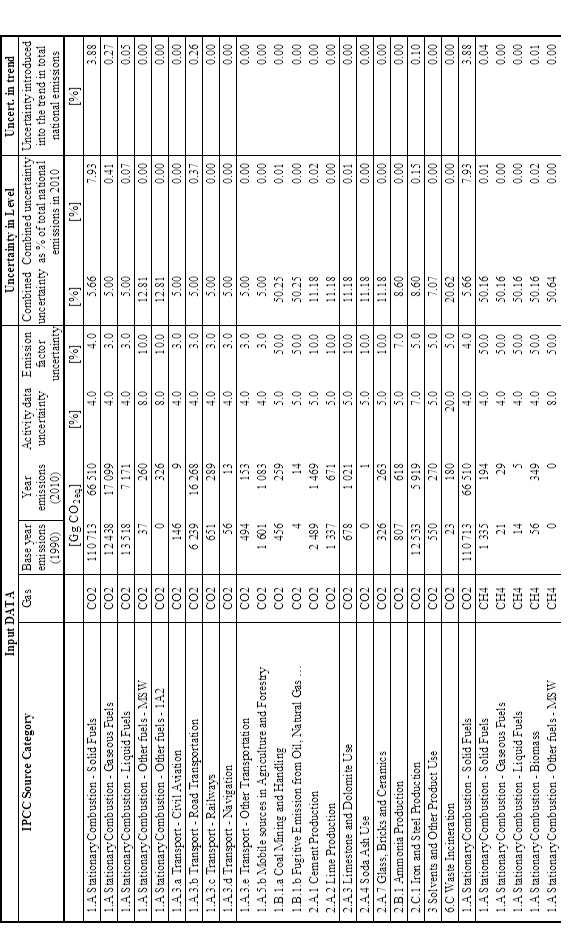
Tab.1‑4 Uncertainty analysis in levels and
trend assessments for 2010 (Tier 1), continuation
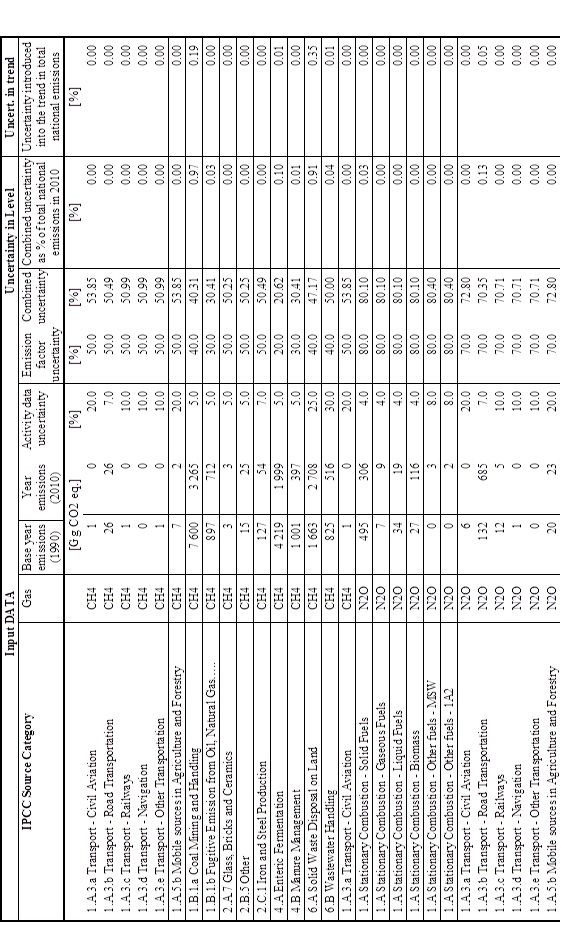
Tab.1‑5 Uncertainty analysis in levels and
trend assessments for 2010 (Tier 1), continuation

CRF Table 9 (Completeness) has been
used to give information on the aspect of completeness. This part of the text
includes additional information. All the categories of sources and sinks
included in the IPCC Guidelines are covered. No additional sources and sinks
specific to the Czech Republic have been identified. Both direct GHGs as well
as precursor gases are covered by the Czech inventory. The geographic coverage
is complete.
The sources and sinks not considered
in the inventory but included in the IPCC Guidelines are clearly indicated and
the reasons for this exclusion are explained. In addition, the notation keys
presented below are used to fill in the blanks in all the CRF tables. Notation
keys are used according to the UNFCCC guidelines on reporting and review
(FCCC/CP/2002/8).
Allocations to categories may differ
from Party to Party. The main reasons for different category allocations are
different allocations in the national statistics, insufficient information on
the national statistics, national methods, and the impossibility of
disaggregating the reported emission values.
IE (included elsewhere):
“IE” is used for emissions by sources
and removals by sinks of greenhouse gases that have been estimated but included
elsewhere in the inventory instead of in the expected source/sink category.
Where “IE” is used in the inventory, the CRF completeness table (Table 9)
indicates where (in the inventory) these emissions or removals have been
included. This deviation from the expected category is explained.
NE (not estimated):
“NE” is used for existing emissions
by sources and removals by sinks of greenhouse gases that have not been
estimated. Where “NE” is used in an inventory for emissions or removals, both
the NIR and the CRF completeness table indicate why the emissions or removals
have not been estimated. For emissions by sources and removals by sinks of
greenhouse gases marked by “NE”, check-ups are in progress to establish if they
actually are “NO” (not occurring). As part of the improvement programme of the
inventory, it is planned that these source or sink categories will be either
estimated or allocated to “NO”.
Overview of
not estimated (NE) categories of sources and sinks and categories included
elsewhere (IE) and the relevant explanations are given in CRF Table 9(a).
2
Trends in
Greenhouse Gas Emissions
According
to the Kyoto Protocol, Czech national GHG emissions have to be 8 % below
base year emissions during the five-year commitment period from 2008 to 2012.
The Czech Republic is in a good direction to meet its goal.
Tab. 2‑1 presents a summary of GHG emissions
excl. bunkers for the period from 1990 to 2010. For CO2, CH4 and N2O the base year is 1990; for F-gases the base
year is 1995.
Tab. 2‑1 GHG emissions from 1990-2010 excl.
bunkers [Gg CO2 eq.]
|
|
CO2[6]
|
CH46
|
N2O6
|
HFCs
|
PFCs
|
SF6
|
Total emissions
|
|
incl. LULUCF
|
excl. LULUCF
|
|
1990
|
165097
|
17914
|
12865
|
NO
|
NO
|
78
|
192204.31
|
195822.25
|
|
1991
|
154604
|
16277
|
10932
|
77
|
172749.67
|
181786.95
|
|
1992
|
140228
|
15339
|
9804
|
77
|
154554.54
|
165341.47
|
|
1993
|
136191
|
14420
|
8644
|
77
|
149781.45
|
159214.31
|
|
1994
|
127173
|
13575
|
8534
|
76
|
142097.27
|
149238.34
|
|
1995
|
128158
|
13398
|
8821
|
1
|
0
|
75
|
143131.38
|
150341.49
|
|
1996
|
132663
|
13277
|
8449
|
101
|
4
|
78
|
146811.26
|
154431.90
|
|
1997
|
129782
|
13022
|
8575
|
245
|
1
|
95
|
144911.29
|
151572.13
|
|
1998
|
123403
|
12574
|
8452
|
317
|
1
|
64
|
137680.82
|
144678.78
|
|
1999
|
115851
|
11978
|
8296
|
267
|
3
|
77
|
129195.79
|
136350.82
|
|
2000
|
125908
|
11177
|
8389
|
263
|
9
|
142
|
138251.22
|
145775.46
|
|
2001
|
125669
|
10887
|
8557
|
393
|
12
|
169
|
137694.60
|
145572.52
|
|
2002
|
122319
|
10502
|
8312
|
391
|
14
|
68
|
133850.87
|
141483.41
|
|
2003
|
125726
|
10446
|
7873
|
590
|
25
|
101
|
138867.45
|
144610.10
|
|
2004
|
127245
|
10156
|
8506
|
600
|
17
|
52
|
140255.41
|
146438.37
|
|
2005
|
127057
|
10514
|
8196
|
594
|
10
|
86
|
139640.50
|
146326.00
|
|
2006
|
128770
|
10817
|
8044
|
872
|
23
|
83
|
144983.54
|
148448.20
|
|
2007
|
128790
|
10471
|
8093
|
1606
|
20
|
76
|
148121.44
|
148848.26
|
|
2008
|
123725
|
10534
|
8232
|
1262
|
27
|
47
|
138889.76
|
143662.62
|
|
2009
|
115848
|
10206
|
7691
|
1042
|
27
|
50
|
127859.19
|
134722.30
|
|
2010
|
119866
|
10413
|
7477
|
1503
|
29
|
16
|
133639.37
|
139157.86
|
|
% [7]
|
-29.22
|
-41.87
|
-41.88
|
2046.8
times
|
240.2
times
|
-79.12
|
-30.47
|
-28.94
|
Note: Global
warming potentials (GWPs) used (100 years time horizon): CO2 = 1; CH4
= 21; N2O = 310; SF6
= 23 900; HFCs and PFCs consist of different substances, therefore GWPs
have to be calculated individually depending on substances
GHG
emissions and removals have significantly decreased in the period 1990 – 1994,
mainly driven by the economy transition and pursuing major dropdown in heavy
industry activities in the country. The fast decrease has stopped around 140000
Gg CO2 eq.and continues fluctuating ever since (see fig. Fig. 2‑1
Total GHG emissions (incl. LULUCF) for the period from 1990-2010 [Gg CO2 eq.]). From 2009 to 2010 the total GHG
emissions (incl. LULUCF) increased by
4.52 % or 5780.18 Gg CO2 eq. resulting in total emissions of
133 639.37 Gg CO2 eq. The increase was caused by CO2, CH4,
HFC and PFC emissions (raised by 4.9 %; 2.0 %; 44.3 % and 8.4 %
respectively) and despite decrease in N2O
and SF6 emissions (lowered by 2.8 % and 67.3% respectively) compared
to previous year. The total GHG emissions and removals in 2010 were 30.47 %
below the base year level including LULUCF
and 28.94 %, when excluding LULUCF.
In 1989
“then” Czechoslovak economy was one of the centrally planed economies with high
level of monopolization. All economic processes were controlled through central
planning. For all practical purposes, there was no real market and this
situation resulted in an ever depending economic and technological lag which
results in high energy and material inefficiency. Since 1989 to the present the
economy transformed successfully to a developed market-driven economy. The
transformation led to a decline in production, investment in environmental
protection, energy efficiency, fuel switch and increased use of renewable
energy.
Greenhouse
gases emission trend passed between 2007 and 2009 a significant change driven
mainly by economic recession. It is noteworthy that in 2009 some of the
industrial subsectors reached it’s lowest amounts of emitted GHGs according to
the whole reported time-series.
Trend
between 2009 and 2010 increased significantly, indicating slight recovery from
recesion driven decrease in previous years.
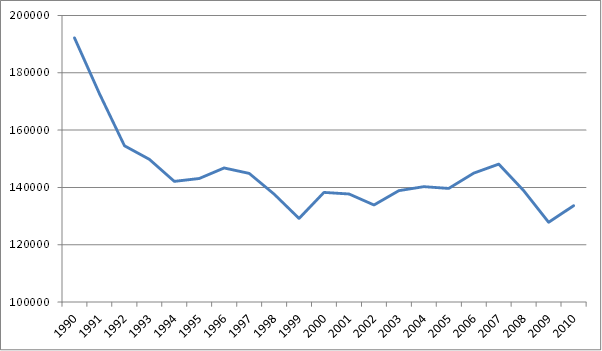
Fig. 2‑1 Total GHG emissions (incl. LULUCF)
for the period from 1990-2010 [Gg CO2 eq.]
The major
greenhouse gas in the Czech Republic is CO2, which represents 85.5%
of total GHG emissions and removals in 2010, compared to 83.9% in the base
year. It is followed by CH4 (7.8 % in 2010, 9.3 % in the base year), N2O (5.6 % in 2010, 6.7 %
in the base year) and F-gases (1.16 % in 2010, 0.04 % in the base
year).
The trend
of individual gas emissions is presented in Fig. 2‑2 and Fig. 2‑3 relative to emissions in the
respective base years[8].
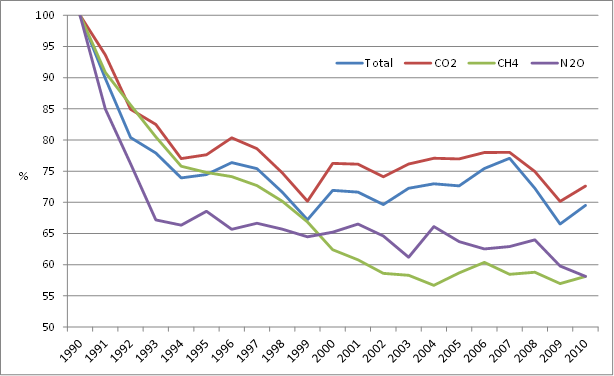
Fig. 2‑2 Trend in CO2, CH4 and N2O emissions 1990-2010 in index form (base year =
100 %)
CO2 emissions have been rapidly
decreasing in early 90’s, after 1994 the emissions have kept at aprox. 70-75 %
of the amount produced in 1990. Between 2007 and 2009 emissions of CO2
dropped to it’s lowest value among the whole reported period. Inter-annual increase
in CO2 emissions (excl. LULUCF)
from 2009 to 2010 by 3.3 % results the total decrease to 28.9 % from
1990 to 2010 (30.5 % decrease incl. LULUCF).
Quoting in absolute figures, CO2 emissions and removals decreased
from 165 097 to 119 866 Gg CO2 eq. in the period from 1990 to
2010, mainly due to lower emissions from the 1 Energy category (mainly 1A2 Manufacturing Industries
& Construction, 1A4A Commercial / Institutional
and 1A4B Residential).
The main
source of CO2 emissions is fossil fuel combustion; within the
1A Fuel Combustion
category, 1A1 Energy Industry
and 1A2 Manufacturing
Industries & Construction sub-categories are the most important. CO2
emissions increased remarkably between 1990 and 2007 from the 1A3 Transport category from
7 767 to 17 448 Gg CO2.
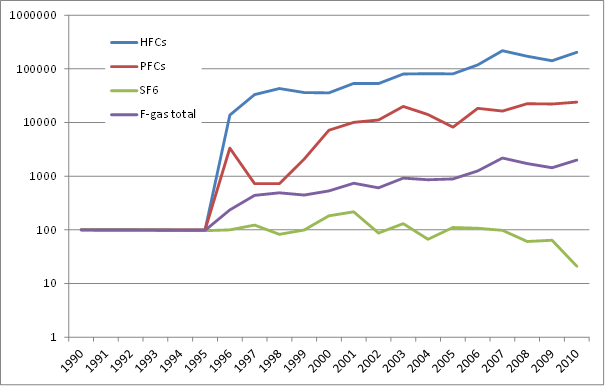
Fig. 2‑3 Trend in HFCs, PFCs (1995 – 2010) and SF6 (1990 – 2010)
actual emissions in index form (base year = 100 %)
Fig. 2‑4 Percentual share of GHGs (Y-axis begins at 80% - part of energy share
is hidden)
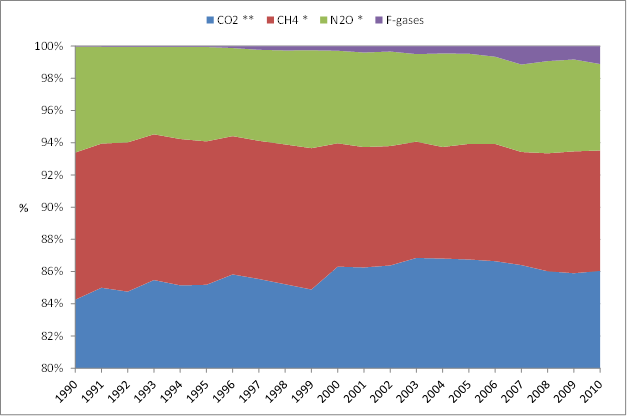
CH4 emissions share decreased almost
steadily during the period from 1990 to 2004, slightly increase from 2004 to
2006 and decrease by 7.9 % between 2006 and 2009 recently CH4
increased slightly resulting the overall share at 7.79 %. In 2010 CH4 emissions were 41.87 % below
the base year level, mainly due to lower contribution of 1B Fugitive Emissions
from Fuels and emissions from 4 Agriculture and despite increase from the 6 Waste category.
The main
sources of CH4 emissions are 1B Fugitive Emissions
from Fuels (solid fuel), 4 Agriculture (4A Enteric Fermentation and
4B Manure Management) and 6 Waste (6A Solid Waste Disposal on Land and 6B Waste-water Handling).
N2O
emissions strongly decreased from 1990 to 1994 by 33.9 % over this period
and then shows slow decreasing trend with inter-annual fluctuation. N2O emissions decreased
between 1990 and 2010 from 12 865 to 7 477 Gg CO2 eq. In
2010 N2O emissions
were 41.88 % below the base year level, mainly due to lower emissions from
4 Agriculture and
2B. Chemical Industry and despite
increase from the 1A3 Transport
category.
The main
source of N2O emission
is category 4D Agricultural Soils
(others less important sources are 1A Fossil Fuel Combustion and 2 Industrial Processes -
2B Chemical Industry).
HFCs actual
emissions increased remarkably between 1995 and 2010 from 0.7 to 1
503.4 Gg CO2 eq. Emissions of HFCs have been increasing since
the base year 1995 (except 2008 and 2009), when they were started to use. In
2010, HFCs emissions were more than 2000-times higher than in the base year
1995.
The main
sources of HFCs emissions are Refrigeration and Air Conditioning
Equipment.
PFCs actual
emissions show very similar trend as HFCs emissions to the year 2009 as they
increased remarkably between 1995 and 2010 from 0.12 to 29.4 Gg CO2 eq.
In 2010, PFCs emissions are over 200 times higher than in the base year 1995.
HFCs and PFCs have not been imported and used before 1995.
The main
sources of PFCs emissions are Semiconductor Manufacture, Refrigeration
and Air Conditioning Equipment.
SF6 actual emissions in 1995 amounted
for 75.2 Gg CO2 eq. Between 1995 and 2010 they inter annually
fluctuated with maximum of 168.7 Gg CO2 eq. in 2001 and minimum of
47.0 Gg CO2 eq. in 2008. In 2010, they reached whole
time-span minimum of 16.22 Gg, the level was below the base year level by
79.1 %.
The main
sources of SF6 emissions are Electrical Equipment; Semiconductor Manufacture and Filling
of Insulate Glasses.
Tab. 2‑2 presents a summary of GHG emissions
by categories for the period from 1990 to 2010:
Category 1. Energy
Category 2. Industrial
Processes
Category 3. Solvent
and Other Product Use
Category 4.
Agriculture
Category 5. Land Use,
Land-Use Change and Forestry
Category 6. Waste
The
dominant category is the 1 Energy
category, which caused for 86.2% of total GHG emissions in 2010
(81.7 % in 1990) excluding LULUCF, followed by the categories 2 Industrial
Processes and 4 Agriculture,
which caused for 9.0 % and 5.8 % of total GHG emissions in 2009, (10.2 %
and 8.2 % in 1990, resp.) 6 Waste
category covered 2.7 %, 3 Solvent
and Other Product Use 0.4 % and 5 LULUCF
category removed 5518Gg CO2eq.
The trend
of GHG emissions by categories is presented in Fig. 2‑5 (relative to the base year).
Tab. 2‑2 Summary of GHG emissions by
category 1990-2010 [Gg CO2 eq.]
|
|
1 Energy
|
2 IP
|
3 Solvents
|
4 Agri
|
5 LULUCF
|
6 Waste
|
|
1990
|
157048
|
19603
|
765
|
15733
|
-3618
|
2673
|
|
1991
|
149761
|
14619
|
728
|
13956
|
-9037
|
2723
|
|
1992
|
133657
|
16069
|
691
|
12191
|
-10787
|
2733
|
|
1993
|
132205
|
12923
|
651
|
10686
|
-9433
|
2750
|
|
1994
|
122009
|
13856
|
616
|
9898
|
-7141
|
2859
|
|
1995
|
123775
|
13188
|
596
|
9875
|
-7210
|
2908
|
|
1996
|
127529
|
13893
|
587
|
9540
|
-7621
|
2882
|
|
1997
|
123796
|
14847
|
585
|
9377
|
-6661
|
2967
|
|
1998
|
117260
|
14850
|
580
|
8977
|
-6998
|
3012
|
|
1999
|
111588
|
12103
|
578
|
9053
|
-7155
|
3029
|
|
2000
|
119801
|
13561
|
569
|
8786
|
-7524
|
3058
|
|
2001
|
120105
|
12886
|
550
|
8919
|
-7878
|
3113
|
|
2002
|
116449
|
12546
|
540
|
8706
|
-7633
|
3242
|
|
2003
|
118957
|
13672
|
525
|
8127
|
-5743
|
3329
|
|
2004
|
119865
|
14274
|
519
|
8502
|
-6183
|
3277
|
|
2005
|
121400
|
12980
|
514
|
8135
|
-6686
|
3297
|
|
2006
|
122414
|
14156
|
513
|
8013
|
-3465
|
3351
|
|
2007
|
121559
|
15265
|
512
|
8179
|
-727
|
3333
|
|
2008
|
117196
|
14085
|
515
|
8374
|
-4773
|
3492
|
|
2009
|
111587
|
11175
|
506
|
7926
|
-6863
|
3529
|
|
2010
|
115205
|
12061
|
503
|
7777
|
-5518
|
3612
|
|
%
|
3.24
|
7.93
|
-0.68
|
-1.88
|
-19.59
|
2.36
|
|
%
|
26.64
|
38.47
|
34.28
|
50.57
|
52.53
|
-35.11
|
Fig. 2‑5 Emission trends in 1990-2010 by categories in index form (base year =
100)
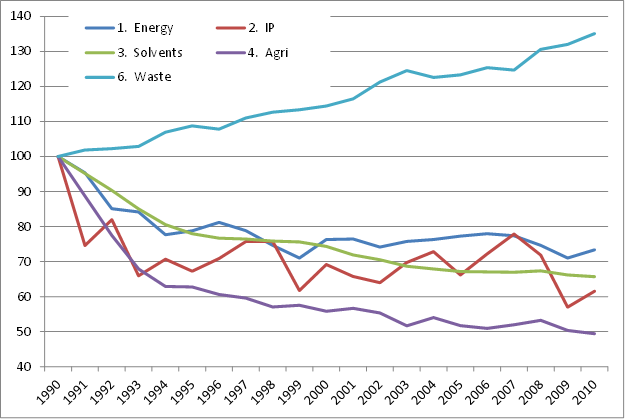
Fig. 2‑6 Percentual share of GHG emissions by categories (y-axis begins at 80% -
part of energy share is hidden)
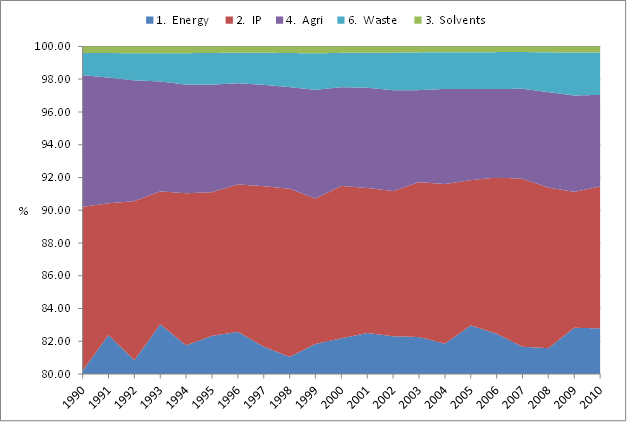
The trend
for GHG emissions from 1 Energy
category shows decreasing trend of emissions. They strongly
decreased from 1990 to 1994 and than fluctuated by 2002. After 2002 they stayed
relatively stable by 2007. In the period 2002 – 2007 emissions stayed from
around 120 000 Gg CO2 eq. Total decrease between 1990 and 2009 is
26.64 %. Between 2009 to 2010 emissions from category 1 Energy slightly increased by 3.24 %.
From the
total 115 205 Gg CO2 eq. in 2010 96.3 % comes from 1A Fuel Combustion, the rest are 1B Fugitive Emissions from Fuels
(mainly solid fuels). 1B Fugitive
Emissions from Fuels is the
largest source for CH4, which represented around 38.2 % of all CH4
emissions in 2010. 44 % of all CH4 emissions in 2010 originated
from Energy category.
CO2
emission from fossil fuel combustion (category 1 Energy) is
the main source of emissions in CR inventory with a share of 81.70 % in
national total emissions (incl. LULUCF).
CO2 contributes for 95.04 % to total GHG emissions from 1 Energy category, CH4 for 4.0 % and N2O for 1.0 % in 2010.
GHG
emissions from the 2 Industrial Processes category
fluctuated during the period 1990 to 2010. In early 90’s emissions decreased
very rapidly, then fluctuated with minimum in 1999 and subsequently fluctuated
with total minimum in 2009 (successful implementation abatement technology).
Between 1990 and 2010 emissions from this category decreased by 38.47%. In 2010
emissions amounted for 12 061 Gg CO2 eq.
The main
categories in the 2 Industrial Processes category are
2C Metal Production (49.1 %),
2A Mineral Products (28.4 %), 2B Chemical Industry (5.1 %) and 2F Consumption of
Halocarbons and SF6 (12.8 %) of the sectoral emissions in
2010.
The most
important GHG of the 2 Industrial Processes category was
CO2 with 82.6 % of sectoral emissions, followed by F-gases (12.1 %),
N2O (3.9 %), CH4
(0.7 %).
In 2010,
0.4 % of total GHG emissions (502.68 Gg CO2 eq.) arose from the
3 Solvent and Other Product Use category. Emissions generally
decreased steadily in the period from 1990 to 2010, but has steadily kept
it’s 0.4% share over all the years. In 2010 GHG emissions from 3 Solvent and Other Product Use were -34.3 % below the
base year level. 53.7 % of these emissions were CO2, N2O emissions contributed by 46.3 %.
GHG
emissions from the category 4 Agriculture decreased relatively
steadily near over the all period from 1990 to 2003 and then fluctuated. In
2010 emissions reached the minimum level. In 2010 emissions were by 50.6 %
below the base year level.
They amounted
7 777 Gg CO2 eq. in 2010 which corresponds to 5.8 % of national
total emissions (excluding LULUCF). The most important sub-category agricultural
soils (N2O emissions)
contributed by 60.4 % to sectoral total in 2010, followed by the
enteric fermentation (CH4 emissions, 25.7 %) and manure
management (CH4 and N2O
emissions, 5.1 % and 8.8 % respectively).
4 Agriculture
is the
largest source for N2O
and second largest source for CH4 emissions: 72 % of all N2O emissions and 23 %
of all CH4 emissions in 2010 originated from this category.
GHG
removals from the 5 Land Use, Land-Use Change and Forestry category
vary through the whole time series with minimum of 730 Gg CO2 eq. in
2007 and maximum 10 794 CO2 eq. in 1992. In 2010 removals were by
52.53 % above the base year level.
Emissions
and removals amounted to -5518.5 Gg CO2 eq. in 2010, which
corresponds to - 4.1 % to national total emissions. Emissions and
removals are calculated from all categories and according to GPG for LULUCF;
IPCC 2003.
LULUCF category is the largest sink for CO2.
CO2 removals from this category amounted to 5952.63 Gg in 2010, CH4
emissions amounted for 128.21 Gg CO2 eq., N2O to 19.41 Gg CO2 eq.
GHG emissions
from 6 Waste category slowly increased during the whole
period. In 2010 emissions amounted for 3611.8 Gg CO2 eq., which is 35.1 %
above the base year level. The increase of emissions is mainly due to higher
emissions of CH4 from 6A Solid
Waste Disposal on Land (and partly due to increase of N2O emissions from 6B Waste-water Handling), which is
the most important category. As a result of CH4 recovery systems
installed in 6B Waste-water Handling
emissions decreased in this category by 27 % compared to the base year. The
share of category 6 Waste in total
emissions was 2.7 % in 2010 (excluding LULUCF).
The main
source is solid 6A Solid Waste
Disposal on Land, which caused for 75.0 % of sectoral emissions in 2010,
followed by 6B Waste-water Handling
(CH4 - 14.3 % and N2O
- 5.7 %) and 6C Waste Incineration (CO2 – 5.0 %; CH4
- negligible and N2O -
0.1 %).
89.3 %
of all emissions from Waste category are CH4
emissions; CO2 contributes by 5.0 % and N2O by 5.8 %.
Emission
estimates for NOx, CO,
NMVOC and SO2 are also reported in the CRF. The following chapter
summarizes the trends for these gases.
A detailed description of the methodology used to estimate these emissions
was provided in the Czech Informative Inventory Report (IIR) 2010,
Submission under the UNECE / CLRTAP Convention, which was
published in March 2012.
Tab. 2‑3 presents a summary of emission
estimates for indirect GHGs and SO2 for the period from 1990 to 2010
and the National Emission Ceilings (NEC) as set out in the 1999 Gothenburg
Protocol to Abate Acidification, Eutrophication and Ground-level Ozone.
These reduction targets should be met by 2010 by Parties to the
UNECE / CLRTAP Convention signed this Protocol.
Emissions
of indirect greenhouse gases decreased from the period from 1990 to 2010 (NMVOC
by 51.9 %, CO by 57.5 % and NOx
by 67.6 %). SO2 emissions decreased by 90.9 % compared to
1990 level.
Tab. 2‑3 Emissions of indirect GHGs and SO2
1990-2010 [Gg]
|
|
NOx
|
CO
|
NMVOC
|
SO2
|
|
1990
|
742.4
|
1071.8
|
311.3
|
1875.5
|
|
1991
|
732.2
|
1157.6
|
273.0
|
1772.2
|
|
1992
|
708.3
|
1162.9
|
257.5
|
1559.1
|
|
1993
|
690.8
|
1194.6
|
233.0
|
1468.9
|
|
1994
|
450.9
|
1075.8
|
255.3
|
1290.2
|
|
1995
|
430.2
|
933.5
|
215.3
|
1095.3
|
|
1996
|
446.7
|
966.7
|
265.2
|
934.5
|
|
1997
|
470.8
|
982.7
|
271.9
|
980.8
|
|
1998
|
414.2
|
814.0
|
267.1
|
442.2
|
|
1999
|
391.1
|
728.0
|
247.2
|
268.9
|
|
2000
|
396.7
|
681.5
|
244.3
|
264.4
|
|
2001
|
332.9
|
688.7
|
219.9
|
250.9
|
|
2002
|
319.5
|
589.2
|
202.9
|
237.4
|
|
2003
|
325.8
|
632.4
|
203.3
|
232.1
|
|
2004
|
333.6
|
624.4
|
198.5
|
227.2
|
|
2005
|
279.2
|
558.0
|
181.7
|
218.6
|
|
2006
|
283.8
|
542.1
|
178.6
|
211.2
|
|
2007
|
285.9
|
584.3
|
174.0
|
217.0
|
|
2008
|
262.8
|
498.4
|
165.7
|
174.3
|
|
2009
|
252.8
|
454.1
|
151.1
|
173.5
|
|
2010
|
240.8
|
455.1
|
149.9
|
170.2
|
|
%
|
-67.6
|
-57.5
|
-51.9
|
-90.9
|
|
NEC
|
286
|
-
|
220
|
283
|
NOx
emissions decreased from 742 to 241 Gg during the period from 1990 to 2010. In
2010 NOx emissions
were 67.6 % below the 1990 level. Nearly 99 % of NOx emissions originate from
1 Energy, mainly subsectors 1A1 Energy Industries, 1A3 Transport (road),
1A2 Manufacturing Industries and Construction and 1A5 Other.
CO
emissions decreased from 1,071 to 455 Gg during the period from 1990 to 2010.
In 2010 CO emissions were 57.5 % below the 1990 level. In 2010,
approximately 86 % of total CO emissions originated from 1 Energy (subsectors 1A3 Transport, 1A2 Manufacturing Industries and Construction and
1A4 Other Sectors (Commercial / Institutional, Residential,
Agriculture / Forestry / Fisheries), followed by
5A Forest land (11.0 %) and Industrial Processes (2.6 %).
NMVOC
emissions decreased from 311 to 150 during the period from 1990 to 2010. In
2010 NMVOC emissions were 51.9 % below the 1990 level. There are two main
emission source categories, first is 3 Solvent and Other Product Use (50 %
of the national total) and second is 1 Energy (40 % - mainly
subsectors 1A3 Transport (20 %), and 1A4 Other Sectors (Commercial / Institutional,
Residential, Agriculture / Forestry / Fisheries) 10 %).
SO2
emissions decreased from 1 876 to 169 Gg during the period from 1990 to
2010. In 2009 SO2 emissions were 87 % below the 1990 level. In
2010, 99.6 % of total SO2 emissions originated from 1 Energy mainly subsectors 1A1 Energy Industries, 1A2 Manufacturing Industries and Construction and
1A4 Other Sectors (Commercial / Institutional, Residential,
Agriculture / Forestry / Fisheries)).
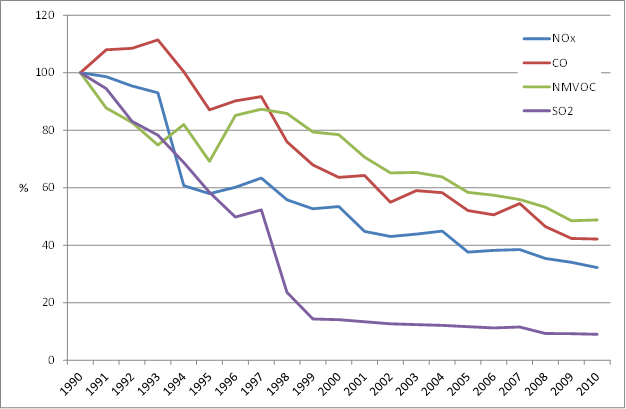
Fig. 2‑7 Emissions of indirect GHGs and SO2 1990 – 2010
Sinks from Forest Management
dominate the emissions and removals estimates of the KP LULUCF activities (see Tab. 2‑4). They were positively affected by
the absence of disturbances requiring sanitary logging, which significantly
reduced sinks in 2007 and partly also in 2008.
Tab. 2‑4 Summary of GHG emissions and removals for KP LULUCF activities [Gg CO2
eq.]
|
|
Article
3.3 activities
|
Article
3.4 activities
|
|
Afforestration
and Reforestration
|
Deforestation
|
Forest Management*
|
Cropland Management
|
Grazing Land Management
|
Revegetation
|
|
2008
|
-272.0
|
160.2
|
-4 404.0 / -4 404.0
|
NA
|
NA
|
NA
|
|
2009
|
-294.7
|
170.2
|
-6 441.1 / -5 866.7
|
NA
|
NA
|
NA
|
|
2010
|
-322
|
207
|
-5 237.4 / -5 096.0
|
NA
|
NA
|
NA
|
*)
Net emissions or removals / accounting quantity

The energy
sector in the Czech Republic is mainly driven by the combustion of fossil fuels
in stationary and mobile sources; however fugitive emissions must also be
considered. The two main categories are 1A
Fossil Combustion and 1B Fugitive
Emissions from Fuels.
Activity
data for treating the whole sector are based on the energy balance of the Czech
Republic prepared by the Czech Statistical Office. Data from the energy
balance form the basic framework for processing greenhouse gas emissions from
combustion in stationary and mobile sources. Greenhouse gas emissions from
stationary sources are calculated from the activity data and the emission factors.
CO2 emissions from mobile sources are calculated from the emission
factors, while data on CH4 and N2O
emissions are calculated using the special model developed by Transport
research centre (CDV).
Processing
of the activity data is based on the total energy balance of the Czech
Republic. The energy balance is prepared by CzSO, and is divided into chapters
for solid fuels, liquid fuels, natural gas, renewable energy sources and
production of heat and electrical energy. Information on the energy balance
forms the basis for preparing a database of activity data in the Reference and
Sectoral Approaches. The Reference Approach is based on data from the source
part of the energy balance; the Sectoral Approach involves processing of data
on fuel consumption in a structure corresponding to the requirements of the
IPCC categorization.
Inventories
of CO2, CH4 and N2O
emissions are performed using a different procedure in subsector 1A3 Transport
and in the other subsectors: combustion of fuels in stationary sources (1A1,
1A2, 1A4) and other mobile sources (1A5). The CDV model is used for mobile
sources in subsector 1A3 Transport. A calculation procedure based on the
activity data and on the country-specific or default emission factors are used
for the other subsectors. Another procedure is used for category 1A1a – Other
Fuels, which contains Waste Incineration for energy purposes. Detailed
description please see in chapter 3.3.1.1 1A1a Public electricity and heat production.
Fugitive
emissions in sector 1B are determined by calculation from activity data and
country-specific or default emission factors. The activity data are obtained
from the sector statistics and annual targeted surveys.
Combustion
processes included in category 1A make a decisive contribution to total
emissions of greenhouse gases. Almost all emissions of carbon dioxide, with the
exception of decomposition of carbonate materials, occurring, e.g., in cement
production, are derived from the combustion of fossil fuels in stationary and
mobile sources. Consequently, the greatest attention is paid in the IPCC
Guidelines (IPCC, 1997) to inventories of emissions from these categories.
On the
whole, 9 key sources have been identified in sector 1A, the most important of
which are the first 3 in Table 3.1. This group of sources contributes 71.9 % to
total greenhouse gas emissions (without LULUCF).
It is
apparent from the table that the first three categories are of fundamental importance
for the level of greenhouse gas emissions in the Czech Republic and, of these,
the combustion of solid fuels constitutes a decisive source. This consists
primarily in the combustion of solid fuels for the production of electricity
and supply of heat. Another important category consists in the combustion of
liquid fuels in the transport sector and the combustion of Natural Gas has
approximately the same importance. This corresponds mostly to the direct
production of heat for buildings in the private and public sector and for
households. Consequently, increased attention is paid to it.
The results
of the inventory, including the activity data, are submitted in the standard
CRF format. For direct greenhouse gases, the consumption of fuels and “implied”
emission factors are also given. However, for stationary sources, the fuel
consumption is given in the CRF format in aggregated structure, i.e. as solid,
liquid and gaseous fuels according to IPCC definition. All the CRF tables in
sector 1A were appropriately completed for the entire required time interval of
1990 to 2010.
Tab. 3‑1 Overview of key categories in
Sector 1A (2010)
|
Category
|
Character of
category
|
Gas
|
% of total GHG*
|
|
1A
|
Stationary Combustion - Solid Fuels
|
KC (LA, TA, LA*, TA*)
|
CO2
|
47.8
|
|
1A
|
Stationary Combustion - Gaseous Fuels
|
KC (LA, TA, LA*, TA*)
|
CO2
|
12.3
|
|
1A3b
|
Transport - Road Transportation
|
KC (LA, TA, LA*, TA*)
|
CO2
|
11.7
|
|
1A
|
Stationary Combustion - Liquid Fuels
|
KC (LA, TA, LA*, TA*)
|
CO2
|
5.2
|
|
1A5b
|
Mobile sources in Agriculture and Forestry and Other
|
KC (LA, LA*)
|
CO2
|
0.8
|
|
1A3b
|
Transport - Road Transportation
|
KC (LA, TA, TA*)
|
N2O
|
0.5
|
|
1A
|
Stationary Combustion – Other Fuels (1A2)
|
KC (TA, TA*)
|
CO2
|
0.2
|
|
1A
|
Stationary Combustion - Biomas
|
KC (TA, TA*)
|
CH4
|
0.2
|
|
1A
|
Stationary Combustion – Solid Fuels
|
KC (TA, TA*)
|
CH4
|
0.1
|
* assessed
without considering LULUCF
KC: key
category, LA, LA*: identified by level assessment with and without considering
LULUCF, respectively
TA, TA*:
identified by trend assessment with and without considering LULUCF,
respectively.
In 2009,
the Expert Review Team (ERT) introduced the requirement of unification of the
activity data for the Energy sector with the data that CzSO reports in its
official questionnaires for IEA – EUROSTAT – UNECE (FCCC/ARR/2009/CZE, Section
41). Unification of the data is considered to be important to facilitate
control of the activity data employed in preparing the emission balance in the
ENERGY sector. The same requirement was also introduced during the in-country
review in August/September 2011 (FCCC/ARR/2011/CZE, Section 73) in Prague. This
requirement was accepted in the 2011 submission and the activity data were
modified according to these questionnaires for the time series from 1995. In
this year’s submission, data from the questionnaires, provided by CzSO in
December 2011, were used for 2010.
This step
represents substantial progress in refinement of the activity data.
In 2010,
there was a further expansion of cooperation with CzSO. An internal workshop
was held in August of 2010, at which, in addition to the workers of the
responsible team and the coordination workplace (CHMI), representatives of
CzSO, the Ministry of the Environment and Ministry of Industry and Trade also
participated. The meeting included
discussion of the methodology for conversion of data from the structure of the
IEA – EUROSTAT questionnaires to the structure required for drawing up activity
data in the Sectoral and Reference Approaches. Simultaneously, suggestions were
made for expanding cooperation between the responsible team of NIS and CzSO. In
connection with these suggestions, a meeting was held between the Ministry of
the Environment and CzSO with participation by representatives of the
responsible team and NIS coordinator. This meeting led to an addendum to the
original agreement on cooperation between CHMI and CzSO. The addendum defines
the terms and means of submitting data for preparation of the emission
inventories of greenhouse gases in the ENERGY sector and performance of
subsequent control procedures. Unfortunately a workshop similar to the one in
2009 was not held in 2011. Instead, a number of meetings were held with CzSO,
where current problematic issues were resolved. These meetings were just on at
the KONEKO - CzSO level, but they contributed positively to the preparation of
this submission.
Since 2003,
the balance of fuel consumption has been supplemented by consumption of Other
Fuels and the corresponding greenhouse gas emissions. As this consists exclusively
of consumption in cement-plant furnaces, this consumption and emissions were
included in category 1A2f.
The CzSO
Questionnaires (IEA/OECD, Eurostat, UN Questionnaires) represent the official
reports of the Czech Republic, for international purposes, on the consumption
of the individual kinds of fuel. They consist in a set of data on liquid, solid
and gaseous fuels in independent datasets. They contain source and consumption
parts of the energy balance in a structure that permits processing of activity data
in the CRF structure. The use of these reports is advantageous especially
because they provide a very similar data structure to CRF. The transition from
the final CzSO balance to the use of these reports does not affect the
consistency of the time series, as the same data are involved.
The overall
energy balance for 2010 is given in Annex 4.
The fact
that only CzSO data were employed constitutes a substantial improvement in the
methodology of processing activity data. The data of other institutions and
organizations were used for control. These consisted in documents of the
Ministry of Industry and Trade (MIT), the Czech Association of the Petroleum
Industry (CAPPO), Czech Gas Association (CGA) and other organizations.
Emissions
Trends
CO2
emissions from the 1A sector decreased by 25.2 % from 146 Tg CO2 in
1990 to 109 Tg CO2 in 2010.
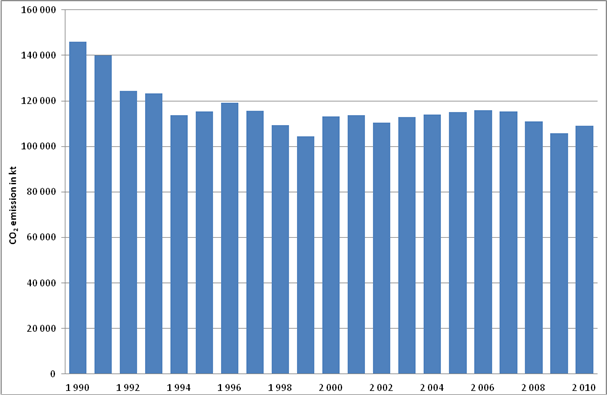
Fig. 3‑1 Trend total CO2 (Sectoral
Approach) in period 1990 – 2010
Tab. 3‑2 Emissions of greenhouse gases and their trend
from 1990 – 2010 from IPCC Category 1A Energy
|
|
CO2 [Gg]
|
CH4 [Gg]
|
N2O [Gg]
|
|
1990
|
146354
|
474
|
2368
|
|
1991
|
140464
|
409
|
2251
|
|
1992
|
124831
|
389
|
2111
|
|
1993
|
123753
|
371
|
2128
|
|
1994
|
114026
|
349
|
2088
|
|
1995
|
115830
|
344
|
2306
|
|
1996
|
119650
|
339
|
2433
|
|
1997
|
116049
|
332
|
2467
|
|
1998
|
109787
|
319
|
2518
|
|
1999
|
104740
|
288
|
2552
|
|
2000
|
113561
|
256
|
2766
|
|
2001
|
114143
|
241
|
2917
|
|
2002
|
110865
|
221
|
3059
|
|
2003
|
113334
|
218
|
3376
|
|
2004
|
114355
|
210
|
3573
|
|
2005
|
115431
|
229
|
3718
|
|
2006
|
116152
|
242
|
3780
|
|
2007
|
115625
|
225
|
3923
|
|
2008
|
111305
|
224
|
3828
|
|
2009
|
105994
|
211
|
3743
|
|
2010
|
109454
|
218
|
3768
|
|
Trend 1990/2010
|
-25.2 %
|
-54%
|
59.1 %
|
Emission
trends by subcategories
The
individual subsectors have different contributions to trends in emissions. Fig.
3.2 illustrates the trends in emissions on the example of CO2
emissions.
The
greatest increase in emissions was recorded in subsector 1A3 Transport between
1990 and 2007, when emissions increased by 145%. In absolute values, this
corresponded to an increase from 7.5 Tg CO2 in 1990 to 18.5 Tg in
2007. A slight decrease has been apparent since 2008, by 1.7 Tg in 2010.
Emissions from subsector 1A1 Energy Industries were practically constant with
slight fluctuations over the entire period; the greatest reduction occurred in
subsectors 1A2 and 1A4 from 46.6 and 32.3 Tg CO2 in 1990 to 23.6 and
11.7 Tg CO2 in 2010, respectively.
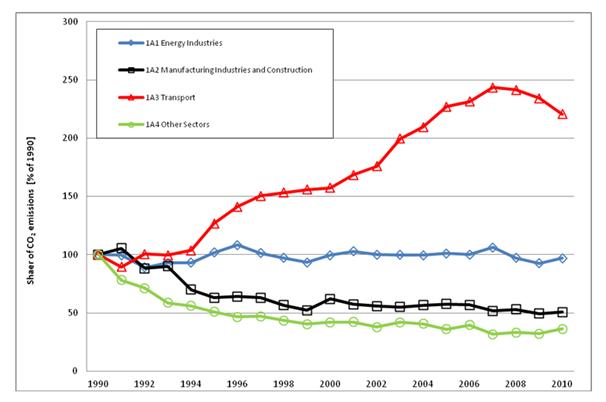
Fig. 3‑2 Share of CO2 emissions from 1990 - 2010 in individual
sub-sectors
Tab. 3‑3 Total GHG emissions in [Gg CO2
equivalent] from 1990 – 2010 by sub categories of energy.
|
|
1
|
1A
|
1A1
|
1A2
|
1A3
|
1A4
|
1A5
|
1B
|
1B1
|
1B2
|
|
1990
|
157 048
|
148 090
|
58 008
|
46 885
|
7 767
|
33 803
|
1 628
|
8 958
|
8 056
|
902
|
|
1991
|
149 761
|
141 854
|
57 697
|
49 442
|
6 949
|
26 333
|
1 432
|
7 906
|
7 136
|
770
|
|
1992
|
133 657
|
126 128
|
51 554
|
41 349
|
7 820
|
24 063
|
1 342
|
7 528
|
6 818
|
710
|
|
1993
|
132 205
|
124 881
|
53 806
|
42 254
|
7 746
|
19 778
|
1 297
|
7 324
|
6 631
|
693
|
|
1994
|
122 009
|
115 045
|
53 991
|
32 814
|
8 098
|
18 835
|
1 306
|
6 964
|
6 284
|
679
|
|
1995
|
123 775
|
116 929
|
59 056
|
29 587
|
9 896
|
17 179
|
1 211
|
6 846
|
6 165
|
681
|
|
1996
|
127 529
|
120 811
|
62 826
|
30 022
|
11 022
|
15 781
|
1 159
|
6 718
|
5 982
|
737
|
|
1997
|
123 796
|
117 200
|
58 748
|
29 605
|
11 747
|
15 891
|
1 209
|
6 595
|
5 871
|
725
|
|
1998
|
117 260
|
110 851
|
56 360
|
26 541
|
12 001
|
14 659
|
1 290
|
6 409
|
5 647
|
762
|
|
1999
|
111 588
|
105 727
|
54 217
|
24 445
|
12 225
|
13 567
|
1 273
|
5 861
|
5 114
|
746
|
|
2000
|
119 801
|
114 637
|
57 809
|
29 086
|
12 366
|
14 114
|
1 262
|
5 164
|
4 455
|
709
|
|
2001
|
120 105
|
115 260
|
59 720
|
26 945
|
13 253
|
14 122
|
1 220
|
4 845
|
4 178
|
667
|
|
2002
|
116 449
|
111 942
|
58 031
|
26 184
|
13 880
|
12 681
|
1 166
|
4 507
|
3 814
|
693
|
|
2003
|
118 957
|
114 558
|
57 849
|
25 802
|
15 760
|
14 064
|
1 084
|
4 400
|
3 763
|
637
|
|
2004
|
119 865
|
115 659
|
57 746
|
26 590
|
16 572
|
13 619
|
1 132
|
4 207
|
3 614
|
592
|
|
2005
|
121 400
|
116 788
|
58 594
|
27 000
|
17 946
|
12 129
|
1 119
|
4 612
|
3 908
|
704
|
|
2006
|
122 414
|
117 592
|
58 063
|
26 730
|
18 282
|
13 419
|
1 098
|
4 822
|
4 107
|
715
|
|
2007
|
121 559
|
117 094
|
61 636
|
24 323
|
19 236
|
10 788
|
1 110
|
4 466
|
3 751
|
715
|
|
2008
|
117 196
|
112 727
|
56 393
|
24 876
|
19 075
|
11 225
|
1 159
|
4 469
|
3 814
|
655
|
|
2009
|
111 587
|
107 442
|
53 702
|
23 201
|
18 501
|
10 896
|
1 143
|
4 145
|
3 450
|
695
|
|
2010
|
115 205
|
110 954
|
56 251
|
23 807
|
17 448
|
12 340
|
1 108
|
4 251
|
3 525
|
726
|
|
Total Trend
|
-26.6%
|
-25.1%
|
-3.0%
|
-49.2%
|
124.7%
|
-63.5%
|
-31.9%
|
-52.5%
|
-56.2%
|
-19.5%
|
|
1990 - 2010
|
Table 3.3
gives the trends in GHG emissions in the individual subcategories of the Energy
sector. It is apparent from the table that there was a considerable increase in
the area of transport and a substantial reduction in the processing industry
and in households, as well as the areas of Commercial and Institutional and
Agriculture, Forestry and Fishing.
Combustion
of fuels is in CRF divided into the individual subsectors prescribed by the
IPCC methodology. The fuel consumption in the individual subsectors yields the
activity data for subsequent calculation of greenhouse gas emissions. The fuel
consumption is taken from the energy balance of the
Czech
Republic and is transformed to the IPCC structure. Transformation of data is
described in Chapter 3.2.6 under the descriptions of the individual subsectors.
Consumption of the other kinds of fuels (Other fuels) was taken from the
national ETS system (ETS, 2011, http://www.svcement.cz/).
According
to IPCC methodology (IPCC, 1997), carbon dioxide emissions are calculated in
two ways: Sectoral and Reference Approach.
The Sectoral
Approach. This method is considerably more demanding than Reference
Approach in relation to input data and requires information on fuel consumption
according to kind in the individual consumer sectors. It has an advantage in
the possibility of analyzing the structure of the origin of emissions. As the
emission factors employed are specific for each kind of fuel burned,
calculations using this method should be more exact.
In Sectoral
Approach are calculated CO2 emissions in sectors
·
1A1
Energy industries
·
1A2
Manufacturing Industries and Construction
·
1A3
Other transportation (combustion of part of Natural Gas during its transport in
compressors)
·
1A4
Other sectors – excl. mobile sources in the Agriculture/Forestry/Fishing sector
·
1A5
Other – other mobile sources not included elsewhere
In the
Sectoral Approach, CO2 emissions are derived from the consumption of
the individual kinds of fuel in the individual subcategories using emission and
oxidation factors.
The Reference Approach is calculated on the basis of
total domestic consumption of the individual fuels. This relatively simple method is based on the
assumption that almost all the fuel consumed is burned in combustion processes
in energy production. It does not require a large amount of input activity data
and the basic values of the sources included in the national energy balance and
some supplementary data are sufficient. It provides information only on total emissions
without any further classification in the consumer sector. The emission factors
are related to those kinds of fuel that enter domestic consumption at the level
of sources, without regard to specific kinds of fuel burned in the consumer
part of the energy balance. Thus, for liquid fuels, this means that the
emissions are determined practically only on the basis of domestic petroleum
(crude oil) consumption.
In the
previous submission, data on production of Other Fuels was accidentally
included in the
Reference
Approach in CRF (the “Production” line for 2003 - 2010). These data were
removed from the current submission.
The resulting emissions are determined by the Sectoral
Approach (SA), while the Reference Approach (RA) is used for control.
Comparison of both approaches is given in the Annex 4. It follows from the
analysis in this Annex that the differences in the overall results from the two
methods are insignificant.
In the
Czech Republic, this corresponds only to the storage of Kerosene Jet Fuel for
international air transport since the Czech Republic does not have an ocean
fleet.
Basic
activity data are available in the CzSO energy balance (CzSO, 2011). Table 3.4
gives the amount of stored Kerosene Jet Fuel.
Tab. 3‑4 Kerosene Jet Fuel in
international bunkers
|
Year
|
1990
|
1991
|
1992
|
1993
|
1994
|
1995
|
1996
|
1997
|
1998
|
1999
|
2000
|
|
[TJ/year]
|
7 197
|
5 919
|
6 856
|
5 706
|
7 112
|
7 664
|
5 789
|
6 676
|
7 880
|
7 417
|
8091
|
|
Year
|
2001
|
2002
|
2003
|
2004
|
2005
|
2006
|
2007
|
2008
|
2009
|
2010
|
|
|
[TJ/year]
|
8 599
|
7 424
|
9 983
|
12 835
|
13 338
|
13 833
|
14 512
|
15 361
|
14 046
|
13155
|
|
The energy
balance of the Czech Republic encompasses a number of items that contain
information on the consumption of fuel used as a raw material for production of
other kinds of fuels. This corresponds mainly to petroleum, which is given in
the source part of the energy balance; however, its entire volume undergoes
transformation to other kinds of fuel, so that petroleum itself does not enter
the fuel balance as activity data in CRF for the calculation of greenhouse
gases.
In the
energy balance structure, improvement of fuels is included in the Transformation
Sector chapter. This chapter contains information on the amounts of fuel used
for the production of electrical energy and heat and simultaneously also for
conversion (improvement) of the original fuels to other kinds (e.g. Coke,
Briquettes, Coal Gases, etc.). Fuels from the Transformation Sector chapter
employed for the production of electrical energy and heat are transferred
directly to the CRF structure as activity data to sector 1A1 – Energy Industry.
Fuels and other items in the Transformation Sector chapter need to be seen as
raw materials for production of the derived fuels and this amount from the
energy balance does not enter the CRF structure as activity data, as no
greenhouse gases are formed from them in this stage.
The
classification in the energy balance in the Transformation sector is dependent
on the kind of fuel.
The
following survey gives those items of the Transformation sector that correspond
to raw material inputs into the improvement processes.
Tab. 3‑5 Transformation sector for
Solid and Liquid fuels
|
Solid fuels
|
Liquid fuels
|
|
Transformation
Sector
|
Transformation
Sector
|
|
Patent Fuel
Plants (Transformation)
|
Gas Works
(Transformation)
|
|
Coke Ovens
(Transformation)
|
For Blended
Natural Gas
|
|
BKB Plants
(Transformation)
|
Coke Ovens
(Transformation)
|
|
Gas Works
(Transformation)
|
Blast Furnaces
(Transformation)
|
|
Blast Furnaces
(Transformation)
|
Patent Fuel
Plants (Transformation)
|
|
Coal
Liquefaction Plants (Transformation)
|
Non-specified
(Transformation)
|
Natural Gas
is not currently used as a raw material in the Czech Republic. Things were
different at the beginning of the 1990’s, when Natural Gas was used as a raw
material in the production of Coal Gas.
Biofuels
are not used in transformation processes.
The
decomposition of Petroleum also leads to a number of products that are not
intended for energy use. This corresponds to the production of plastics,
Lubrication Oils and other Lubricants, solvents for production of coatings and
other uses in the Solvent Use sector, production of Bitumen, etc.
Part of
these material fluxes become waste, while part is used up irreversibly and this
carbon must be considered to be carbon stored permanently.
Naphtha - another part of fossil carbon is used as raw
material for the manufacture of plastics. Plastics end up in waste incineration
plants or in landfills. In incineration plants, the carbon in the plastics is
converted to CO2. In managed landfills, plastics very slowly
decompose through biochemical processes. For detailed explanations please see
relevant chapter for Other Fuels (1A1a).
However,
part of plastics stores carbon from petrochemical raw materials for a long
time. At the beginning of the monitored period, the fraction of carbon stored
for naphtha was expertly estimated at 50 %. This value was obtained by expert
estimate of a sectoral expert.
The
remaining 50 % of carbon was considered to oxidize to CO2. Recently,
plastics have been increasingly recycled. The recycled material obtained is
used to manufacture products with considerably long lifetimes. In 2004 was
decided to increase the fraction of carbon stored 50 % to the value given in
IPCC methodology. The fraction of stored carbon has been gradually increased
from a value of 50 % to a value of 80 %. The value of 80% is given in Revised
1996 IPCC methodology (section 1.37).
The following survey depicts the gradual increase.
Tab. 3‑6 Naphtha - fraction of stored
carbon
|
1990 - 2003
|
2004
|
2005
|
2006
|
2007
|
2008
|
2009
|
2010
|
|
0.5
|
0.6
|
0.7
|
0.8
|
0.8
|
0.8
|
0.8
|
0.8
|
Starting in
2007, a constant value of 80 % is used in subsequent years.
Lubricating
oils and other
lubricants are not produced primarily as energy production materials.
However,
part of the oils is returned to the energy system after the end of their
lifetimes as lubricants.
They are
then converted to alternative fuels and burned. The CRF structure specifies 50
% recovery as fuels over the entire time series from 1990. Value of 50% is
given in Revised 1996 IPCC methodology.
Asphalt
(Bitumen) is a
product of petroleum processing. As it is used primarily for treating the
surfaces of roadways, its entire volume must be considered to be permanently
stored carbon that is100% fixed over the entire time series.
Coal
Tars are utilized primarily as a raw material for the
production of soot as a filler for rubber for production of tires. Part of the
Tars is used as additive fuel in energy-production installations for production
of electricity and heat. This part has been reported separately in the energy
balance since 2003. This permits estimation of the ratio between Tar for
energy-production and other uses. Up until 2002, the fraction of Tars for
non-energy use was estimated at 75%; since 2003, the fraction has been determined
on the basis of information from the CzSO – EUROSTAT – IEA questionnaires
(CzSO, 2011) in the following way:
Tab. 3‑7 Coal Tars - fraction of
non-energy use
|
2003
|
2004
|
2005
|
2006
|
2007
|
2008
|
2009
|
2010
|
|
71.8
|
74.1
|
69.2
|
85.7
|
85.2
|
82.9
|
74.2
|
73.0
|
These values
were used to complete CRF in the 1AD Feedstocks and non-energy use of fuels
chapter.
Changes
in 1AD Feedstock and non-energy use in 1995 - 2009
In
connection with changes in the activity data in the Sectoral Approach and
Reference Approach, the relevant changes in the activity data were also
performed in section 1AD. The changes were performed in the 1995 – 2009 time
series.
Not
performed in the Czech Republic.
The
country-specific conditions in the Czech Republic are determined primarily by
the specific properties of the solid fuels mined in this country. Specific CO2
emission factors are determined for these kinds of solid fuels. A survey of
these emission factors, incl. NCV and oxidation factors is given in Table 3.8.
Tab. 3‑8 Average Net caloricic values
(NCV), CO2 emission factors and oxidation factors used in the Czech
GHG inventory - 2010
|
Fuel (IPCC 1996
Guidelines
|
NCV
|
CO2
EF a)
|
Oxidation
|
CO2
EF b)
|
|
definitions)
|
[TJ/Gg]
|
[t CO2/TJ]
|
factor
|
[t CO2/TJ]
|
|
Coking Coal
|
29.3
|
93.24
|
0.98
|
91.38
|
|
Other Bituminous Coal
|
24.7
|
93.24
|
0.98
|
91.38
|
|
Lignite (Brown Coal)
|
12.9
|
99.99
|
0.98
|
97.99
|
a) Emission
factor without oxidation factor
b) Resulting
emission factor with oxidation factor
Other
country-specific conditions are employed in sector 1B, where the
country-specific emission factors are used in the calculation of CH4
and CO2 emissions from underground mining. In addition, methane
emissions in the Natural Gas sector are calculated according to the
country-specific approach.
More
details are given in chapter 3.9. Fugitive emissions.
All CO2
emissions from metallurgical coke used in blast furnaces are reported under the
industrial processes sector and estimated according to the amount of carbon in
the coke. Most of the blast furnace gas is combusted in the three metallurgical
plants and is not used elsewhere. From this reason we consider this method to
be right.
In a
similar way part of liquid fuels are reallocated into 2 Industry sector where
it is used for production of hydrogen which is used for ammonia production.
The
fraction of CO2 emissions in sector 1A1 in CO2 emissions
in the ENERGY sector equaled 51% in 2010.
Under
source category 1A1a, "Public electricity and heat production", the
energy balance includes district heating stations and electricity and heat
production of public power stations.
This
category encompasses all facilities that produce electrical energy and heat
supplies, where this production is their main activity and they supply their
products to the public mains. Examples include the power plants of the ČEZ,
a.s. company, DALKIA, a.s. power plants and heating plants, ENERGY UNITED, a.s.
and a number of others in the individual regions and larger cities in the Czech
Republic.
The
fraction of CO2 emissions in subsector 1A1a in CO2 emissions
in sector 1A1 equaled 96% in 2010. It contributed 49% to CO2
emissions in the whole ENERGY sector.
Figure 3.3
shows the correlation of fuel consumption in category 1A1a and total
electricity production. Electricity production should have a similar trend to
consumption in category 1A1a. Very good
correlation can be seen at the end of the period, where the same change is
apparent in 2007. Overall, the correlation after 2000 can be considered as very
good agreement. Some changes are apparent in the previous period, however the
trend is also considered to be similar.
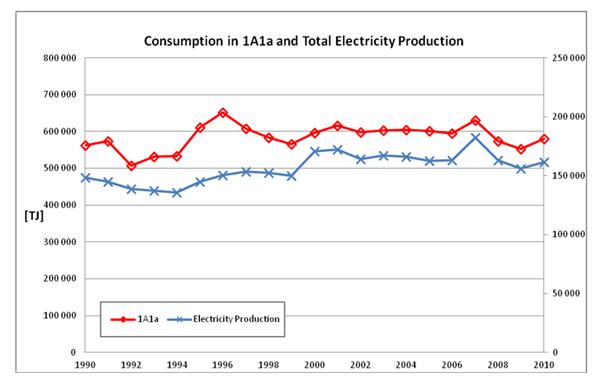
Fig. 3‑3 Correlation of 1A1a and Electricity production
In the final energy balance of CzSO (CzSO, 2011), the
consumption of the individual kinds of fuels in this sector is reported in
section Transformation Sector under the items:
·
Main
Activity Producer Electricity Plants
·
Main
Activity Producer CHP Plants
·
Main
Activity Producer Heat Plants
In the
previous submissions autoproducers were also included in this category. This
was discovered as a methodological mistake and this inaccuracy was corrected in
current submission together with recalculation of 1A2 category. Detailed
descriptions please see in relevant chapter for recalculation.
The category includes consumption of all kinds of fuels in enterprises
covered by the NACE Rev. 2:
·
35.11 Production of
electricity
·
35.30 Steam and air
conditioning supply (production, collection and distribution of steam and hot
water for heating, power and other purposes)
The
following figure presents an overview of development of CO2
emissions in source category 1A1a:
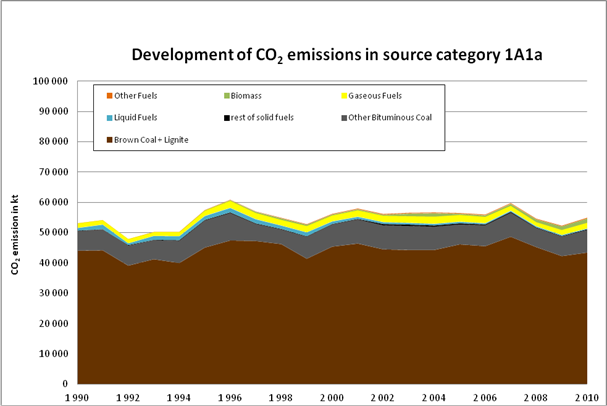
Fig. 3‑4 Development of CO2 emissions in 1A1a
category
Overall
emissions show more or less stagnate trend with only a few oscillations. The
decrease at the end of period is probably caused by reallocation of
autoproducers to category 1A2.
The trend
in emissions is mainly shaped by the development and structures of the
electricity generation installations involved, since these installations
account for the majority of the pertinent emissions. As is clear from the
figure, solid fuels are the main driving forces for emissions in this source
category. Brown Coal + Lignite are most important, with average consumption of
452 PJ, corresponding to 44 357 kt CO2/year on an average for
the whole 1990 – 2010 period. The second largest consumption is indicated for
Other Bituminous Coal with an average consumption value of 78 PJ, corresponding
to 7 169 kt CO2/year on an average for the whole 1990 – 2010 period.
The remaining solid fuels do not correspond to any significant consumption in
this category.
Since 2007,
the country-specific emission factor has been equal to 27.27 t C/TJ for Brown
Coal + Lignite; a country-specific emission factor equal to 25.43 t C/TJ for
Other Bituminous Coal and Coking Coal has been used to calculate CO2
emissions. As mentioned above, this means that approximately 95% of the
emissions from fuels in this category were determined using country-specific
emission factors, i.e. at the level of Tier III.
Liquid
fuels play a minor role in the electricity supply of the Czech Republic. They
are used for auxiliary and supplementary firing in power stations – for
instance stabilization of burners. Use of liquid fuels has decreased by more
than half since 1990.
Natural Gas
also plays a role in this source category. Use of NG does not exhibit a
substantially changing trend. At the beginning of the period, it shows
increasing trend, but later only minor changes were observed, which can be
considered insignificant.
The item
Other Fuels in Figure 3.4 represents waste consumption for waste incineration.
A specific
question about the coal gasification facility was raised during the 2011
in-country review in Prague. The coal gasification facility originally produced
town gas that was intended for distribution through the gas distribution
system. Until 1995, consumption of this town gas was reported in different
subsectors (1A1, 1A2 and 1A4) according to the purpose of use. In 1996,
production of this town gas for the gas distribution system was stopped (it was
completely replaced by natural gas). At the same time, the pressure
gasification facility was reconstructed to a steam-gas cycle. Since 1996, the
gas produced by pressure gasification (energy gas) is combusted in gas turbines
for production of electricity and heat. Consequently, its consumption is
reported under category 1A1a. The team is convinced that this reporting is in
agreement with the methodology.
Other Fuels: Waste Incineration for energy
purposes (1A1a)
This
category consists of emissions caused by incineration of municipal solid waste
for energy purposes. Originally this chapter was part of 6 C waste incineration
but, based on the suggestion of ICR (in-country review), this chapter was
shifted under the energy sector. This chapter is still prepared by CUEC
(Charles University Environment Center) – the organization responsible for the
waste sector.
This
category consists of emissions of CO2 from incinerated fossil carbon
in MSW and emissions of methane and N2O
from incineration of MSW.
There are
three municipal solid waste (MSW) incineration plants in the Czech Republic.
One is located in Prague (ZEVO Malesice), one in Brno (SAKO) and the newest one
in Liberec (Termizo). The incinerator in Brno was recently reconstructed
(previous reporting year) and its former annual capacity of 240 Gg of MSW was
decreased to 224 Gg of MSW. In actual fact, the new technology actually allowed
the facility to be used to the full potential (the old stokers were regularly
out of order and the real former capacity of the plant was about one third of
the maximum value).
Tab. 3‑9 Capacity of municipal waste incineration
plants in the Czech Republic, 2010
|
Incinerator
|
Capacity (Gg)
|
|
TERMIZO
|
96
|
|
Pražské služby a.s.
|
310
|
|
SAKO a.s.
|
224
|
There are also
76 other facilities incinerating or co-incinerating industrial and hazardous
waste, with a total capacity 600 Gg of waste. This waste is reported under 6C.
All the
parameters and calculations are shown in the following Tab. 3‑12
Tab. 3‑10 Parameters and emissions from waste
incineration 1990-2010

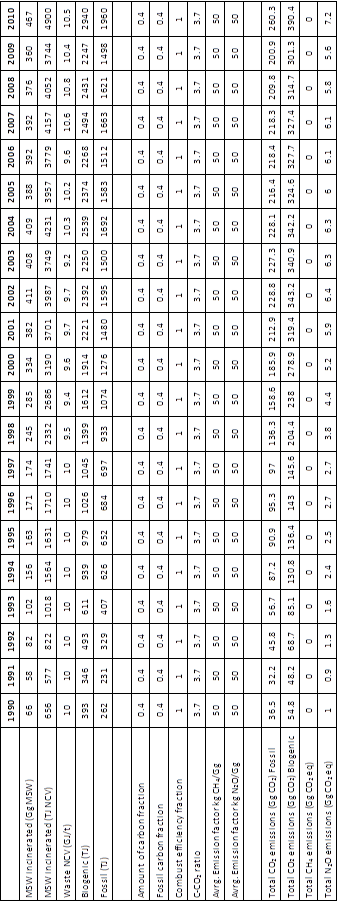
3.3.1.2
1A1b
Petroleum refining
This
category includes all facilities that process raw petroleum imported into this
country as their primary raw material. Domestic petroleum constitutes
approximately 3.5 % of the total amount. All fuels used in the internal
refinery processes, internal consumption (reported by companies as “own use”)
for production of electricity and heat and heat supplied to the public mains
are included in emission calculations in this subcategory. This corresponds
primarily to the Česká rafinérská, a.s. company in the Czech Republic. Fugitive
CH4 emissions are included in category 1B2Fugitive Emissions from Fuels - Oil.
The
fraction of CO2 emissions in subsector 1A1c in CO2
emissions in sector 1A1 equalled 2 % in 2010. It contributed 1 % to CO2
emissions in the whole ENERGY sector.
In the CzSO
Questionnaire (CzSO, 2011), the consumption of the individual kinds of fuels in
this sector is reported under the item:
·
Refinery
Fuel
·
Relevant
NACE Rev. 2 code: 19.20 - Manufacture of refined petroleum products
Greenhouse
gas emissions in this subcategory are calculated using the national default
emission factors at the Tier II level – see Table
3.11 – 3.14 net caloric values (NCV), CO2 emission factors and
oxidation factors used in the Czech GHG inventory.
Figure 3.5
depicts the correlation of CO2 emissions in category 1A1b and CO2
emissions from Crude Oil in the Reference Approach. These two features should
have same trend and this is visible in the figure. The same trend is apparent
in both categories at the end of the period; there is a peak in 2008 and the
same shape of the curves between 2004 and 2006. At the beginning of nineties
there were a great many technical innovations provided in refineries. The older
technological facilities from the previous period were reconstructed, resulting
in a decrease of energy intensity. This decrease in the energy intensity is
connected with lower consumption of fuels even when the amount of processed oil
was increasing.
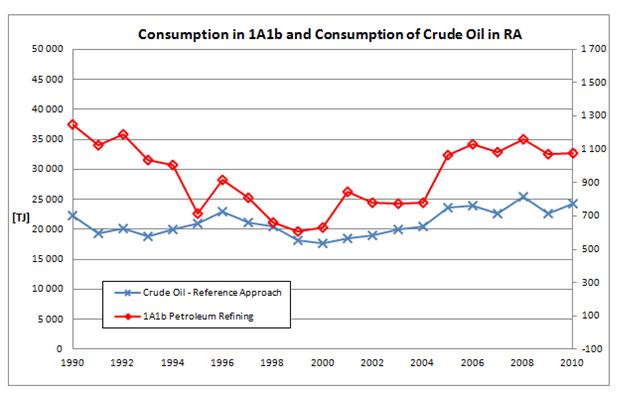
Fig. 3‑5 Correlation of CO2 emission from 1A1b and from Crude Oil
given in Reference Approach
The
following figure shows an overview of emissions trends in source category 1A1b:

Fig. 3‑6 Development of CO2 emissions
in 1A1b category
It is apparent that no consumption of solid fuels occurred in this
category.
Liquid fules are of the greatest importance and exhibit a decreasing trend
at the beginnig and increasing trend at the end of the period. The fluctuations
that have occurred over the years can be explained as resulting from differences
in production quantities. The maximum production equal to 923 kt CO2
occurred in 1990, followed by a value of
910 kt CO2 in 2008. Thereafter, production decreased to the
resulting level of 856 kt CO2 in 2010.
The second greatest role is played by Natural Gas, with emissions in the
range between 207 kt CO2 in 2003 and 364 kt CO2 in 1997
and resulting with 221 kt CO2 in 2010.
3.3.1.3
1A1c
Manufacture of solid fuels and other energy industries
This category includes all facilities that process solid fuels from mining
through coking processes to the production of secondary fuels, such as
Brown-Coal Briquettes, Coke Oven Gas or Producer Gas. It also includes fuels
for the production of electrical energy and heat for internal consumption
(reported by companies as “own use”).
There are a number of companies in the Czech Republic that belong in this
category. These are mainly companies performing underground and surface mining
of coal and its subsequent processing, located in the vicinity of coal
deposits. The category also includes Coke plants and the production of Producer
Gas. Other energy industries, such as facilities for extraction of Natural Gas
and Petroleum are of minor interest in the Czech Republic.
The fraction of CO2 emissions in subsector 1A1b in CO2
emissions in sector 1A1 equaled 2.31 % in 2010. It contributed only 1.18 % to CO2
emissions in the whole ENERGY sector.
In the CzSO
Questionnaire (CzSO, 2011), the consumption of
the individual kinds of fuels in this sector is reported in capture Energy Sector
under the items:
·
Coal Mines
·
Oil and Gas Extraction
·
Coke Ovens (Energy)
·
Gas Works (Energy)
·
Patent Fuel Plants (Energy)
·
BKB Plants (Energy)
·
Non-specified (Energy)
There are embodied the fuels of
economic part according to NACE Rev. 2
·
05.10 Mining of Hard
Coal
·
05.20 Mining of
Lignite
·
06.10 Extraction of
Crude Oil
·
06.20 Extraction of
Natural Gas
·
19.10 Manufacture of
Coke oven products (operation of Coke ovens, production of Coke and Semi-Coke,
production of Coke Oven Gas)
·
19.20 Manufacture of
refined petroleum products (this class also includes: manufacture of Peat
Briquettes, manufacture of Hard-coal and Lignite fuel Briquettes)
The following figure provides an overview of emission trends in source
category 1A1c:
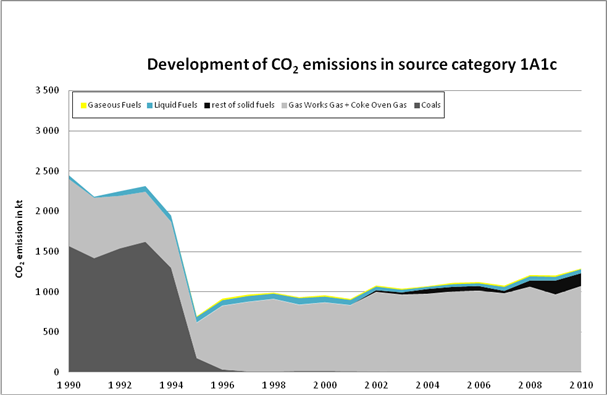
Fig. 3‑7 Development of CO2 emissions
in 1A1c category
The figure clearly shows a slow increase in emissions in 1995 – 2010
period. The use of coal predominated at the beginning of the period (i.e. Other
Bituminous Coal, Brown Coal + Lignite and Coking Coal) and were later replaced
by Gas Works Gas and Coke Oven Gas. There is very low use of liquid fuels and
Natural Gas in this category.
Sokolovská Uhelná a.s makes the greatest contribution to the consumption
of solid fuels . The section for processing Brown Coal was established in 1950
and also produced Gas Works Gas and other chemical products. Formally, the existence of this combine ended
in 1974 when this facility was moved under the Hnědouhelné doly a briketárny
company. Together with this step was established Fuel combine Vřesová. The new
combined-cycle power station started to operate in 1996. This led to a sharp
decrease in coal consumptions in 1994 – 1996 (http://www.suas.cz).
Coke Oven Gas is produced in the Ostrava area where are Coke Plants
operating.
The fraction of CO2
emissions in sector 1A2 in CO2 emissions in the ENERGY sector
equaled 22 % in 2010.
This source category consists of
several sub-source categories defined in close harmony with the IPCC
categorisations (CRF) and includes all stationary combustion emission sources
that are not included in categories 1A1 and 1A4. It is described in detail via
the relevant sub-chapters.
In previous submission the data for
1990 – 2002 period were reported as a sum for the entire sub-category group.
Since 2003, the inventory has been performed in the detailed CRF structure. The
originally used data from the national energy balance did not permit division
of the fuel consumption into subsectors 1A2a to 1A2f and thus the data were
reported for the entire category 1A2 Manufacturing industries and construction,
in the CRF Reporter under subcategory 1A2f. This fact caused many question by
ERTs and recommendations to disaggregate data and report them under relevant
subcategories. Last recommendation was raised during the In country reviev in
Prague in August/September 2011. Based on this recommendation it was prepared
recalculation of this category and the data were disaggregated into relevant
subcategories. Detailed explanations are given chapter for recalculation of
this category.
Transition to the new format of
source data (CzSO, 2011) permitted utilization of the data for more detailed
classification in this subcategory.
·
1A2a Iron and steel
·
1A2b Non-ferrous metals
·
1A2c Chemicals
·
1A2d Pulp, paper and print
·
1A2e Food processing, beverages and tobacco
·
1A2f Other
The following figure shows developments in CO2 emission trends
in source category 1A2:
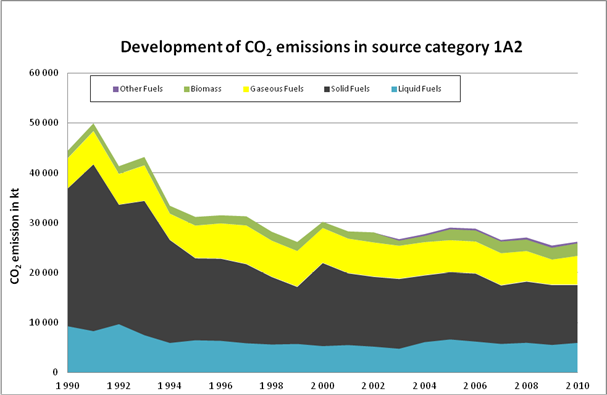
Fig. 3‑8 Development of CO2 emissions
in 1A2 category
It is clearly visible in the figure that solid fuels played the main role
in emissions at the beginning of the period; however, the importance of solid
fuels decreased over time. Currently, they are still of the greatest
importance, but do not play such a dominant role in comparison with other
fuels. Liquid Fuels indicate steady trend over the whole period – there is only
a slight decrease at the beginning of the period. Natural Gas is also an
important fuel in category 1A2.
3.3.2.1
1A2a
Iron and steel
This category includes manufacturing in the area of pig iron (blast
furnaces), rolling steel, casting iron, steel and alloys and is related only to
ferrous metals. In the
CzSO Questionnaire (CzSO, 2011), the consumption
of the individual kinds of fuels in this sector is reported in capture Industry
Sector under the item: Iron and Steel There are embodied the fuels of economic
part according to NACE Rev. 2 Iron and steel: NACE Divisions 24.1 – 24.3 and 24.51, 24.52
Important facility belongs to this category is ArcelorMittal Ostrava, a.s.
The fraction of CO2
emissions in subsector 1A2a in CO2 emissions in sector 1A2 equaled
15 % in 2010. It contributed only 3 % to CO2 emissions in the whole
ENERGY sector.
Fig. 3‑9. depicts the correlation of fuel
consumption in category 1A2a Iron and Steel and production of pig iron (source: hz.cz). Obviously these two
features should be correlated. A dissimilar trend is apparent at the beginning
of the period, probably caused by inaccuracy in the activity data. In the next
submission, we will exert an effort to improve these data. On the other hand,
is apparent that the curve has the same shape in 1999, indicating good
correlation.
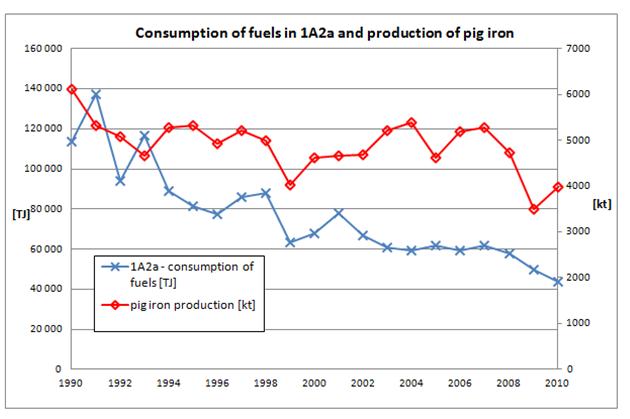
Fig. 3‑9 Correlation of fuel consumption in 1A2a with production of pig iron
3.3.2.2
1A2b
Non-ferrous metals
This category encompasses combustion processes in
various areas of production of nonferrous metals.In the Czech Republic, this
corresponds mainly to foundry processes; primary production of nonferrous
metals is not performed on an industrial scale in this country. In the CzSO
Questionnaire (CzSO, 2011), the consumption of the individual kinds of fuels in
this sector is reported in capture Industry Sector under the item:
·
Non-Ferrous
Metals
·
There
are embodied the fuels of economic part according to NACE Rev. 2
·
Non-ferrous
metals: NACE Divisions 24.4 , 24.53, 24.54
Important
facility belongs to this category is Kovohutě Příbram. The fraction of CO2
emissions in subsector 1A2b in CO2 emissions in sector 1A2 equaled
0.5 % in 2010. It contributed only 0.1 % to CO2 emissions in the
whole ENERGY sector.
3.3.2.3
1A2c
Chemicals
This
subcategory includes all the processes in the organic and inorganic chemical
industry and all related processes, incl. petrochemistry.
In the CzSO
Questionnaire (CzSO, 2011), the consumption of the individual kinds of fuels in
this sector is reported in capture Industry Sector under the item:
·
Chemical
(including Petrochemical)
·
There
are embodied the fuels of economic part according to NACE Rev. 2
·
Chemicals:
NACE Division 20
The
fraction of CO2 emissions in subsector 1A2c in CO2
emissions in sector 1A2 equaled 50 % in 2010. It contributed 11 % to CO2
emissions in the whole ENERGY sector.
Figure
3.10. depicts the correlation of fuel
consumption in category 1A2c Chemicals and production of chemicals – source DEVELOPMENT OF OVERALL AND SPECIFIC
CONSUMPTION OF FUELS AND ENERGY IN RELATION TO PRODUCT provided by CzSO.
These two features should be correlated. There are also some dissimilarities in
the trends, which we will try to correct in future submissions. The figure
shows good agreement of both features after 2002.

Fig. 3‑10 Correlation of fuel consumption in 1A2c with production of chemicals
3.3.2.4
1A2d
Pulp, paper and print
This
subcategory includes all manufacturing processes related to the production of
paper, cardboard and in printing plants. There are two primary paper production
factories in the Czech Republic with a high consumption of waste wood from
production processes. The other plants select the kind of fuel on the basis of
the same criteria as the rest of the processing industry.
In the CzSO
Questionnaire (CzSO, 2011), the consumption of the individual kinds of fuels in
this sector is reported in capture Industry Sector under the item:
·
Paper,
Pulp and Printing
·
There
are embodied the fuels of economic part according to NACE Rev. 2
·
Pulp,
paper and print: NACE Divisions 17 and 18
The
fraction of CO2 emissions in subsector 1A2d in CO2
emissions in sector 1A2 equaled 4 % in 2010. It contributed 1 % to CO2
emissions in the whole ENERGY sector.
3.3.2.5
1A2e
Food processing, beverages and tobacco
This
subcategory includes all manufacturing processes related to the production of
foodstuffs, beverages and foodstuff preparations. The subcategory also includes
fuel consumption in the tobacco industry. The nature of the production
processes permits the use of a relatively high fraction of biofuels.
In the CzSO
Questionnaire (CzSO, 2011), the consumption of the individual kinds of fuels in
this sector is reported in capture Industry Sector under the item:
·
Food,
Beverages and Tobacco
·
There
are embodied the fuels of economic part according to NACE Rev. 2
·
Food
processing, beverages and tobacco: NACE Divisions 10, 11 and 12
The
fraction of CO2 emissions in subsector 1A2e in CO2
emissions in sector 1A2 equaled 5 % in 2010. It contributed 1 % to CO2
emissions in the whole ENERGY sector.
Fig. 3‑11 depicts correlation of fuel
consumption in category 1A2e Food processing, beverages and tobacco and
production of food and beverages - source
DEVELOPMENT OF OVERALL AND SPECIFIC CONSUMPTION OF FUELS AND ENERGY IN RELATION
TO PRODUCT provided by CzSO. These two quantities apparently exhibit
similar development over the whole time series.
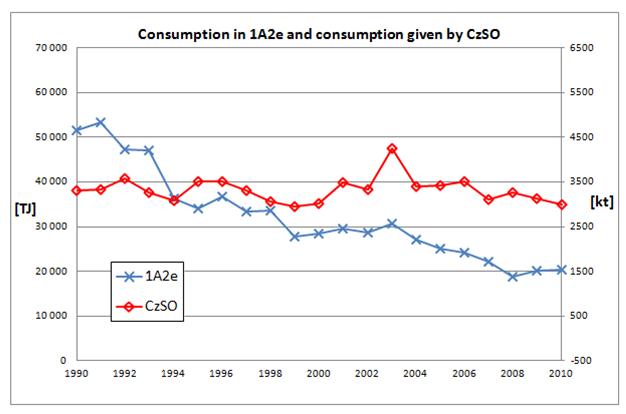
Fig. 3‑11 Correlation of fuel consumption in 1A2e with production of food and
beverages
3.3.2.6
1A2f
Other
This
subcategory includes the remaining enterprises in the processing industry not
included in subcategories 1A2a to 1A2e. This is an energy-demanding branch with
high fuel consumption, such as the cement industry, lime production, the glass
industry, production of ceramic materials, the textile and leather industry,
wood processing and subsequent production processes, the entire machine
industry, incl. production of means of transport and the construction industry.
In the CzSO
Questionnaire (CzSO, 2011), the consumption of the individual kinds of fuels in
this sector is reported in capture Industry Sector under the item:
·
Non-Metallic
Minerals
·
Transport
Equipment
·
Machinery
·
Mining
(excluding fuels) and Quarrying
·
Wood
and Wood Products
·
Construction
·
Textiles
and Leather
·
Non-specified
(Industry)
There are
embodied the fuels of economic part according to NACE Rev. 2 Other: NACE
Divisions 05 – 09, 13 – 16, 21 – 23, 25 – 33 and 41 - 43
In this
year’s submission, this subcategory also includes the combustion of other kinds
of fuel (Other Fuels). Activity data and data on CO2 production were
taken from the national ETS system (ETS, 2011), while CH4 and N2O emissions were
calculated using the default emission factors for solid and liquid fuels. The fraction
of CO2 emissions in subsector 1A2f in CO2 emissions in
sector 1A2 equaled 26 % in 2009. It contributed 6 % to CO2 emissions
in the whole ENERGY sector. Overall emissions
indicate decrease since 1990. Solid fuels had at the beginnig of the period big
importance, which constantly decrease untill 2010. Liquid fuels also constatnly
descrease since 1990. Natural Gas has also apparent importance in this
category.
Fig. 3‑12 Correlation of fuel consumption in 1A2f with production of
cement and lime shows the
correlation of fuel consumption in category 1A2f with production of cement and
lime - source DEVELOPMENT OF OVERALL AND SPECIFIC
CONSUMPTION OF FUELS AND ENERGY IN RELATION TO PRODUCT provided by CzSO.
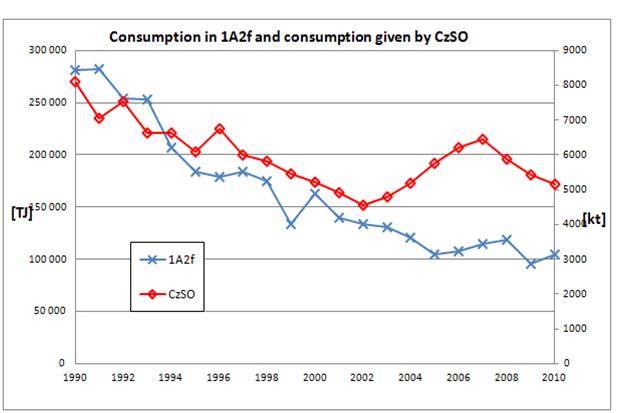
Fig. 3‑12 Correlation of fuel consumption in 1A2f with
production of cement and lime
Source
category description
The categories of means of transport for the purposes of calculations of
greenhouse gas emissions did not change compared to 2008. The criteria for
inclusion of a certain means of transport in a particular category consist in
the kind of transport, the fuel employed and the type of emission standard that
the particular vehicle must meet (in road transport). The categories of
vehicles are not as detailed for non-road transport.
The categories of mobile sources are following:
3.3.3.1
1A3a Civil Aviation
·
airplanes fuelled by aviation gasoline
·
airplanes fuelled by jet kerosene
3.3.3.2
1A3b
Road transportation
·
motorcycles,
·
passenger and light duty gasoline vehicles conventional,
·
passenger and light duty gasoline vehicles with EURO 1
limits,
·
passenger and light duty gasoline vehicles with EURO 2
limits,
·
passenger and light duty gasoline vehicles with EURO 3
limits,
·
passenger and light duty gasoline vehicles with EURO 4
limits,
·
passenger and light duty diesel vehicles conventional,
·
passenger and light duty diesel vehicles with EURO 1 limits,
·
passenger and light duty diesel vehicles with EURO 2 limits,
·
passenger and light duty diesel vehicles with EURO 3 limits,
·
passenger and light duty diesel vehicles with EURO 4 limits,
·
passenger cars using LPG, CNG and biofuels (separately),
·
heavy duty diesel vehicles and buses, conventional,
·
heavy duty diesel vehicles and buses, with EURO 1 limits,
·
heavy duty diesel vehicles and buses, with EURO 2 limits,
·
heavy duty diesel vehicles and buses, with EURO 3 limits,
·
heavy duty diesel vehicles and buses with EURO 4 limits,
·
heavy duty diesel vehicles and buses using LPG, CNG and
biofuels (separately).
3.3.3.3
1A3c
Railways
·
diesel locomotives
3.3.3.4
1A3d
Navigation
·
ships with diesel engines
3.3.3.5
1A3e
Other transportation
The
consumption of Natural Gas for powering compressors for the transit gas
pipeline is included in this subcategory under mobile combustion sources, but
in fact it is stationary combustion.
This consumption is reported in the IEA – CzSO (CzSO, 2011)
Questionnaire in the capture Transport Sector
under the item:
·
Pipeline
Transport
There are
embodied the fuels of economic part according to NACE Rev. 2 Pipeline
Transport: NACE Divisions 35.22, 49.50
This
category includes all the combustion processes in the sub categories described
below. They can be generally defined as heat production processes for internal
consumption.
The fraction
of CO2 emissions in sector 1A4 in CO2 emissions in the
ENERGY sector equaled 11 % in 2010.
The following figure depicts CO2
emission trends in category 1A4:

Fig. 3‑13 Development
of CO2 emissions in 1A4 category
The main driving force for CO2 emissions in category 1A4 is
energy consumption for purposes of space heating. The fluctuations in
consumption then can be ascribed to differences in cold winter periods. The
trend of decreasing CO2 emissions is a result of higher standards
for new buildings and of successful execution of energy-efficiency-oriented
modernisations of existing buildings. The trend has also been supported by
shifting to fuels with lower CO2 emissions (emission factors).The
importance of solid fuels at the beginning of the period, which constantly
decreases in time, is apparent in the figure. On the other hand, the
consumption of Natural Gas increased during the period as did Biomass
consumption. Liquid fuels play a minor role in this category.
At the beginning of the period, a majority of households in the Czech
Republic used coal as a heating fuel (mainly brown coal + lignite). This habit
has changed over time and Natural Gas is beginning to be used more than solid
fuels. The same trend appears in the institutional sphere. The number of households and institutions using biomass for
heating (biomass boilers) in the Czech Republic has increased in the last few
years. This trend is also apparent in the figure.
The winter of 2006 was colder than in other years, which also affected the
consumption of fuels. Higher consumption of fuels for heating in households and
institutions is apparent in this year. Significantly lower temperatures were
recorded in the winter months in 2006 than in other years. The same trend is
apparent in 2010.
3.3.4.1
1A4a
Commercial/Institutional
This
subcategory includes all combustion sources that utilize heat combustion for
heating production halls and operational buildings in institutions, commercial
facilities, services and trade.
In the CzSO
Questionnaire (CzSO, 2011), the consumption of the individual kinds of fuels in
this sector is reported in capture Industry Sector under the item:
·
Commercial
and Public Services
Where fuel
consumption is reported here under the item:
·
Non-specified
(Other)
It is
included under 1A4a Commercial/Institutional on the basis of an agreement with
CzSO. There are embodied the fuels of economic part according to NACE Rev. 2
Commercial/Institutional : NACE Divisions 35 excluding 1A1a and 1A3e, 36 – 39,
45 – 99 excluding 1A3e and 1A5a
The
fraction of CO2 emissions in subsector 1A4a in CO2
emissions in sector 1A4 equaled 31 % in 2010. It contributed 3 % to CO2
emissions in the whole ENERGY sector.
3.3.4.2
1A4b
Residential
Fuel
consumption in households is determined on the basis of the results of the
statistical study “Energy consumption in households”, published in 1997 and
2004 by the Czech Statistical Office according to the PHARE/EUROSTAT method.
In the CzSO
Questionnaire (CzSO, 2011), the consumption of the individual kinds of fuels in
this sector is reported in capture Industry Sector under the item:
·
Residential
The
fraction of CO2 emissions in subsector 1A4b in CO2
emissions in sector 1A4 equaled 67 % in 2009. It contributed 7 % to CO2
emissions in the whole ENERGY sector.
3.3.4.3
1A4c
Agriculture/Forestry/Fisheries
This
subcategory contains combustion sources at stationary facilities for heating
buildings, breeding and other operational facilities. The subcategory does not
include fuel consumption for powering off-road means of transport and
machinery. They are reported in category 1A5b Mobile - Agriculture, Forestry
and Fishing.
In the CzSO
Questionnaire (CzSO, 2011), the consumption of the individual kinds of fuels in
this sector is reported in capture Industry Sector under the item:
·
Agriculture/Forestry
·
Fishing
There are
embodied the fuels of economic part according to NACE Rev. 2
Agriculture/Forestry/Fisheries: NACE Divisions 01 - 03
The
fraction of CO2 emissions in subsector 1A4c in CO2 emissions
in sector 1A4 equaled 2 % in 2009. It contributed 0.21 % to CO2
emissions in the whole ENERGY sector.
The
fraction of CO2 emissions in sector 1A5 in CO2 emissions
in the ENERGY sector equaled 0.99 % in 2009.
3.3.5.1
1A5b
Other – mobile sources
For
reporting consumption of motor fuels, that was not report in sector 1A3
Transport and could not be reported in the other sectors as consumption of
fuels in stationary sources is in CRF used this subcategory.
The
original data on the final national energy balance from CzSO (series of data in
the 1990 – 1995 time series) were taken for the CRF structure directly in TJ.
The time series from 1995 was constructed on the basis of data from the CzSO
Questionnaire (CzSO, 2011), where the data on fuel consumption are given in
various ways. Data are available for solid and liquid fuels in mass units (kt
p.a.), where the net caloric values of these fuels are also tabulated. The
consumption of gaseous fuels derived from fossil fuels is given in TJ p.a.
Natural Gas is given in thousand m3 and the consumption in TJ is
also tabulated; however, in this case it is calculated using the gross caloric
value.
Consequently,
the original calculation model was extended to include use of the net caloric
value for processing data in the 1995 – 2010 time series. In 2011 we got from
CzSO calorific values for liquid fuels for the whole time series and these are
now assumed to be right (agreed by CzSO) and therefore used for conversion of activity
data from natural units to energy units.
One
recalculation was performed in this submission. The main reason for the
recalculation was an attempt to extend data division into each subcategory in
category 1A2 back to 1990. The data available in the CzSO Questionnaires for
1990 – 1994 are not sufficiently reliable for emission calculation; therefore,
the recalculation was performed for the 1995 – 2009 period using the data from
CzSO and, before 1995, the summary values which were originally in subcategory
1A2f Other were disaggregated into each subcategory according to the
development of the relevant branch of industry and other indicators. It was
also necessary to perform this recalculation for other source categories to
ensure consistency of data use. Therefore, the recalculation was also performed
in categories 1A1, 1A3e, 1A4, 1A5, 1AD using the activity data from the CzSO
Questionnaires in the 1995 – 2009 period. For the 1990 – 1994 period, the
original data on the final national energy balance calculated according to the
CzSO methodology were used. Detailed descriptions of recalculations are given
in chapter 3.7.1.
The
principles of preparation of the emission inventory are further specified in
detail for the individual phases of data preparation and processing and
subsequent utilization of the results of calculations with subsequent storage.
Collection of activity data
In
collection of activity data, all the background data are stored at the
workplace of the sector compiler, where possible in electronic form. These
consist primarily in datasets obtained from CzSO as officially submitted data
for drawing up the activity data. The datasets are unambiguously designated and
cited under this designation.
If the data
are taken from the Internet, the relevant passages (texts, tables) are stored
in separate files with designation of the web site where they were obtained and
the date of acquisition.
Data taken
from printed documents are suitably cited, the written documents are stored in
printed form at the workplace of the sector compiler and, where possible, the
relevant passages (texts, tables) are scanned and stored in electronic form.
When the
stage is completed, all the stored data are transferred to electronic media
(CD, external HD, flash disks, etc.) and stored with the sector compiler; the
most important working files that contain data sources, calculation procedures
and the final results are submitted in electronic form for storage at the
coordination workplace.
Conversion of activity data to the CRF format
The
activity data are converted from the energy balance to the CRF structure in the
EXCEL format.
Each
working file has a “Title page” as the first sheet.
The Title
page shall contain particularly the following information:
·
the
name and description of the file
·
the
author of the file
·
the
date of creation of the file
·
the
dates of the latest up-dating, in order
·
the
source of the data employed
·
description
of transfer of specific data from the source files
·
the
means of aggregation of the data base employed in conversion
·
explanations
and comments.
The working
files shall also contain a compulsory “Activity Data” Sheet. The Activity Data
Sheet shall contain:
·
complete
division of the data into IPCC (SA) sectors and subsectors or individual fuels
for
·
RA,
in structure compatible with CRF
·
complete
time series
- the units in which the activity data
balance is drawn up
The
conversion shall be performed in two separate sets for the Sectoral Approach
(SA) and Reference Approach (RA). If the data conversion requires recalculation
from natural units to energy units, the calorific values of the individual
kinds of fuels used is included in the calculation. The calorific values
employed are stored.
Calculations
of emissions
These
values are given in the following sheets of the working files, which also
contain the “Emission Factors” sheet, the “Oxidation Factors” sheet and
calculation sheets for the individual GHG gases. The necessary aggregations for
transfer of the data to the CRF reporter are included.
Original
activity data are given in kilotons. It means that it is necessary to convert
these values to energy units – terajoules. For this conversion are used
calorific values. In 2011 it was new calorific values for liquid fuels agreed
by CzSO and are therefore used for calculation of emissions. Comparison of old
and new calorific values is given in table 3.12.
Tab. 3‑11 Net caloricic values used in
the Czech GHG inventory – 2010
|
NCV [TJ/Gg]
|
1A1a
|
1A1b
|
1A1c
|
1A2
|
1A4a
|
1A4b
|
1A4c
|
1A5
|
|
|
|
Refinery Gas
|
|
42.23
|
|
|
|
|
|
|
|
|
LPG
|
|
|
|
43.82
|
43.82
|
43.82
|
43.82
|
|
|
|
Naphtha
|
|
|
|
43.96
|
|
|
|
|
|
|
Gasoline
|
|
|
|
|
|
43.40
|
|
43.40
|
|
|
Kerosene Jet
Fuel
|
|
|
|
|
43.30
|
|
|
43.30
|
|
|
Other kerosene
|
|
|
|
0.00
|
42.80
|
|
|
|
|
|
Diesel Oil
|
|
|
42.75
|
42.75
|
|
|
|
42.75
|
|
|
Heating and
Other Gasoil
|
42.60
|
|
42.60
|
42.60
|
42.60
|
|
42.60
|
|
|
|
Fuel Oil - Low
Sulphur
|
39.70
|
39.70
|
|
39.70
|
39.70
|
|
39.70
|
|
|
|
Fuel Oil - High
Sulphur
|
|
|
|
39.49
|
|
|
|
|
|
|
Lubricants
|
|
|
|
40.19
|
|
|
|
|
|
|
Other Oil
|
|
39.82
|
|
39.82
|
|
|
|
|
|
|
Anthracite
|
|
|
|
30.00
|
|
|
|
|
|
|
Other
Bituminous Coal
|
22.55
|
|
|
23.19
|
28.45
|
28.45
|
28.45
|
|
|
|
Brown Coal +
Lignite
|
12.47
|
|
12.67
|
12.67
|
13.84
|
13.84
|
13.84
|
|
|
|
Coke
|
|
|
|
27.99
|
28,06
|
28,06
|
28,06
|
|
|
|
Coal Tars
|
|
|
36.94
|
36.94
|
|
|
|
|
|
|
Brown Coal
Briquettes
|
23.00
|
|
|
|
|
20.74
|
|
|
|
Tab. 3‑12 Comparison of calorific values used in previous and current submission (part 1)
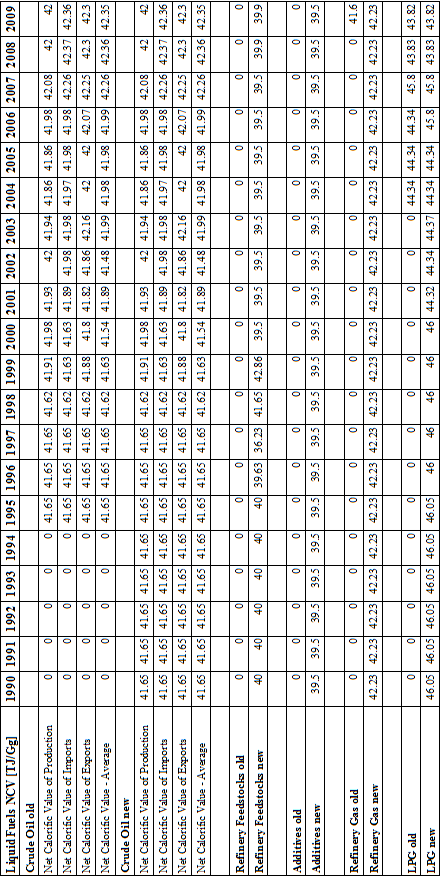
Tab. 3‑12
Comparison of calorific values used in previous and current submission (part 2)
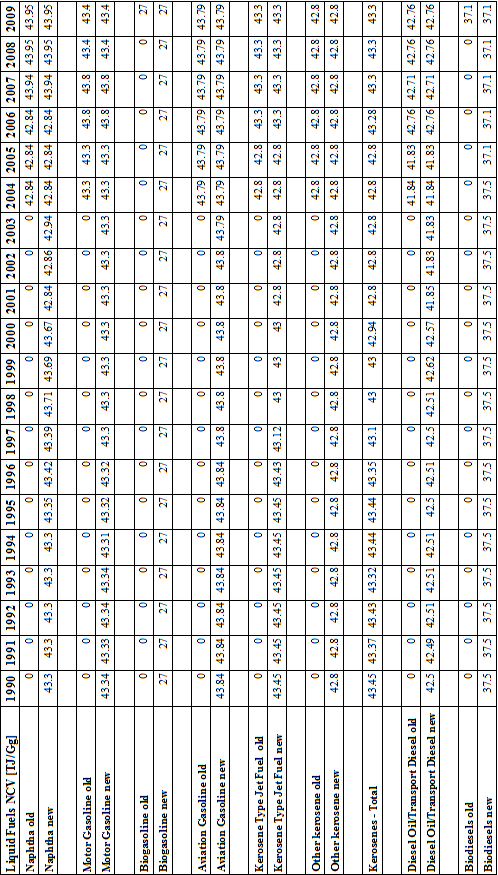
Tab. 3‑12
Comparison of calorific values used in previous and current submission (part 3)
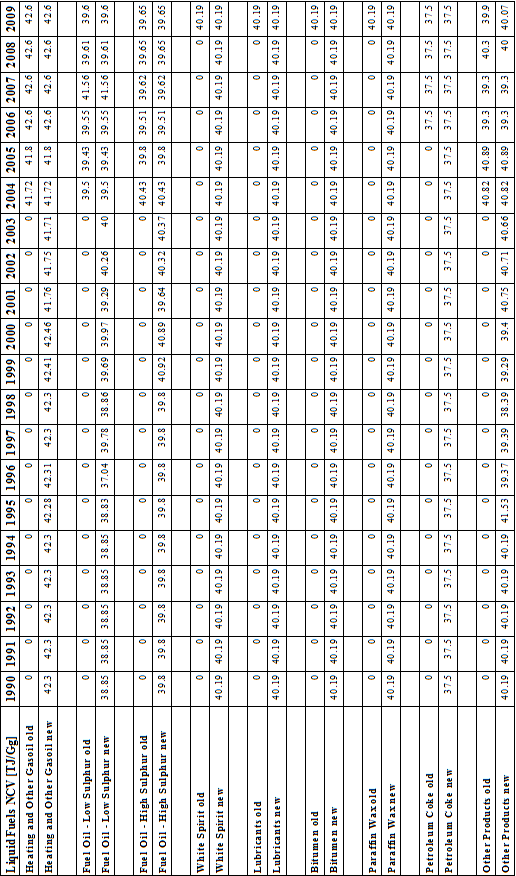
Tab. 3‑12 Comparison of calorific
values used in previous and current submission (part 4)
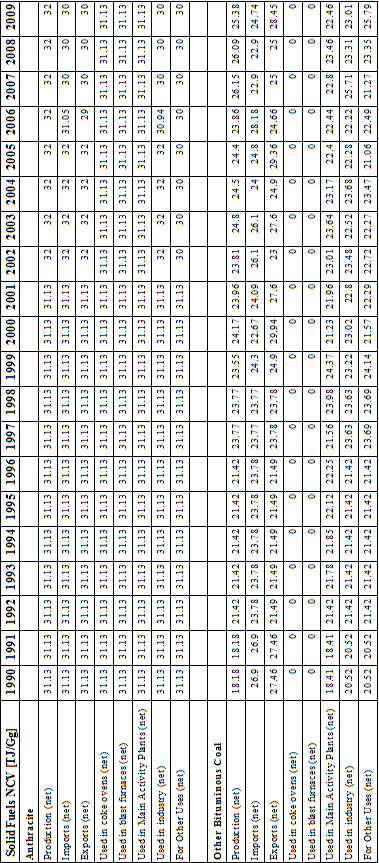
Tab. 3‑12
Comparison of calorific values used in previous and current submission (part 5)
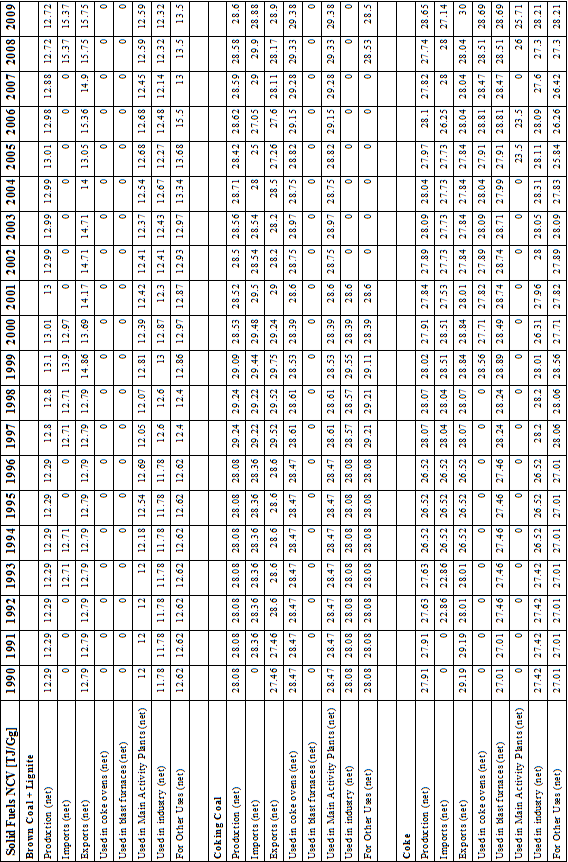
Tab. 3‑12
Comparison of calorific values used in previous and current submission (part 6)
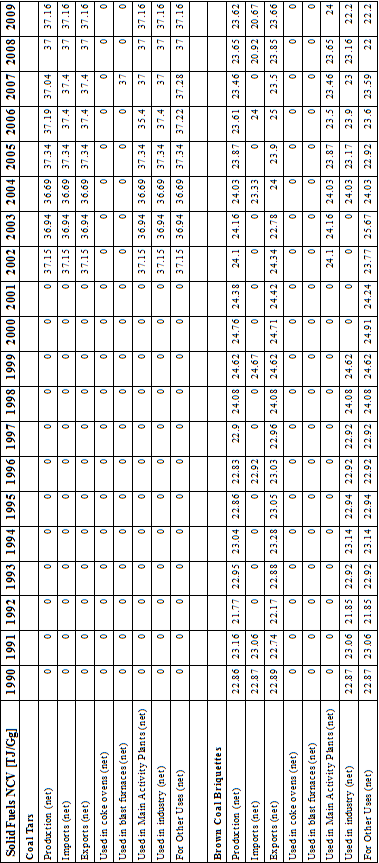
Coke Oven
Gas, Gas Works Gas and biofuels in the CzSO Questionnaires are given directly
in terajoules, so that calorific values are not used in these cases. The data
for Coke Oven Gas and Gas Works Gas in TJ were calculated using the gross
calorific values, so it is necessary to recalculate these values to net
calorific values.
Natural Gas
is given in the statistic reporting in the CzSO Questionnaire (CzSO, 2011) in
thousand m3 and in TJ; however, the data in TJ was calculated using the gross
caloric value.
Information
on the average values of the gross caloric value and the net caloric value of
Natural Gas are given in Tab. 3‑13.
Recalculation
of volume units to mass units for Natural Gas was performed using the density
0.69 kg/m3 (t = 15 °C, p = 101.3 kPa).
Tab. 3‑13 Average values of the gross caloric
value and the net caloric value of Natural Gas – Questionnaire IEA – CzSO (CzSO,
2011), 2010
|
[TJ/Gg]
|
GCV
|
NCV
|
GCV/NCV
|
|
Indigenous Production
|
38.32
|
34.49
|
1.11
|
|
Associated Gas
|
39.03
|
35.13
|
1.11
|
|
Non-Associated Gas
|
36.88
|
33.19
|
1.11
|
|
Total Imports (Balance)
|
38.14
|
34.32
|
1.11
|
|
Total Exports (Balance)
|
38.13
|
34.32
|
1.11
|
|
Stock Changes (National Territory)
|
38.20
|
34.38
|
1.11
|
|
Inland Consumption (Calculated)
|
38.15
|
34.33
|
1.11
|
|
Inland Consumption (Observed)
|
38.14
|
34.33
|
1.11
|
|
Opening Stock Level (National Territory)
|
38.25
|
34.43
|
1.11
|
|
Closing Stock Level (National Territory)
|
38.30
|
34.47
|
1.11
|
The values
of consumption of Natural Gas were taken from this statistical report in TJ and
the values were then divided by a coefficient of 1.11 for recalculation from
the gross caloric value to the net caloric value.
The
greenhouse gas emissions were calculated as the product of the activity data
and the relevant emission factor. A survey of the emission factors employed for
CO2 is given in Table 3.14. The experimentally determined
country-specific values of the emission factors were used for Coal and Lignite
(Fott, 1999); for the other fuels, the default emission factors from the IPCC
methodology (IPCC, 1997) were used. Oxidation factors used in the national
inventory are the default values taken from the IPCC methodology (IPCC, 1997).
Tab. 3‑14 Net caloricic
values (NCV), CO2 emission factors and oxidation factors used in the
Czech GHG inventory – 2010
|
Fuel (IPCC 1996 Guidelines
|
NCV
|
CO2 EF a)
|
Oxidation
|
CO2 EF b)
|
|
definitions)
|
[TJ/Gg]
|
[t CO2/TJ]
|
factor e)
|
[t CO2/TJ]
|
|
Crude Oil
|
42.4
|
73.33
|
0.99
|
72.59
|
|
Gas / Diesel Oil
|
42.75
|
74.10
|
0.99
|
73.35
|
|
Residual Fuel Oil
|
39.59
|
77.40
|
0.99
|
76.62
|
|
LPG
|
43.82
|
63.10
|
0.995
|
62.78
|
|
Naphtha
|
43.96
|
73.30
|
0.99
|
72.56
|
|
Bitumen
|
40.19
|
80.67
|
0.99
|
79.86
|
|
Lubricants
|
40.19
|
73.30
|
0.99
|
72.56
|
|
Petroleum Coke
|
37.50
|
97.5
|
0.98
|
95.55
|
|
Other Oil
|
39.82
|
73.30
|
0.99
|
72.56
|
|
Coking Coal d)
|
29.39
|
93.24
|
0.98
|
91.37
|
|
Other Bituminous Coal d)
|
23.19
|
93.24
|
0.98
|
91.37
|
|
Lignite (Brown Coal) d)
|
12.67
|
99.99
|
0.98
|
97.99
|
|
Brown Coal Briquettes
|
20.82
|
97.49
|
0.98
|
95.54
|
|
Coke Oven Coke
|
27.93
|
106.99
|
0.98
|
104.85
|
|
Coke Oven Gas
(TJ/mill. m3)
|
15.62c)
|
44.4
|
0.995
|
44.17
|
|
Natural Gas
(TJ/Gg)
|
57.22
|
56.10
|
0.995
|
55.81
|
|
Natural Gas
(TJ/mill. m3)
|
34.33c)
|
56.10
|
0.995
|
55.81
|
a) Emission
factor without oxidation factor
b) Resulting
emission factor with oxidation factor
c) TJ/mill. m3,
t= 15°C, p = 101.3 kPa
d) Country
specific values of CO2 EFs
e) Oxidation
factors values used for national inventory of greenhouse gases are 0.995 for
gaseous fuels, 0.99 for liquid fuels and 0.98 for solid fuels
Methane
emissions from fuel combustion from stationary sources do not constitute key
sources. Relatively the largest contribution comes from fuel combustion in
local heating units.
The means
of determining methane emissions is similar in many respects to the method of
the individual consumption categories for carbon dioxide emissions. The
simplest level (Tier 1) (IPCC, 1997) includes only summary fuel categories:
·
coal-type
solid fuels
·
gaseous
fuels
·
liquid
fuels
·
wood
fuel (biomass)
·
other
biomass.
Only the
first four categories were filled with activity data in the inventory. These
data were aggregated directly from the connected working sheets for the
calculation of carbon dioxide by the consumption sector method.
Tab. 3‑15 CH4 emission
factors in the individual sectors used in the Czech GHG inventory (1990 – 2010)
|
[kg CH4/TJ]
|
1A1
|
1A2*)
|
1A3e
|
1A4a
|
1A4b
|
1A4c
|
|
Liquid fuels
|
3
|
2
|
|
10
|
10
|
10
|
|
Solid fuels
|
1
|
10
|
|
10
|
300
|
300
|
|
Gaseous fuels
|
1
|
5
|
5
|
5
|
5
|
5
|
|
Biomass
|
30
|
30
|
|
300
|
300
|
300
|
*) The emission
factors are also valid for the other kinds of fuels (Other Fuels).
N2O
emissions from stationary sources do not belong amongst key sources in the CR.
In 2008 N2O
emissions from combustion of all kinds of fuel were recalculated using the
default emission factors over the entire time series.
This submission employed the emission factors for N2O in all the sectors as
tabulated below (uniformly for the entire sector of stationary combustion
sources):
|
Liquid fuels
|
0.6 kg N2O/TJ
|
|
Solid fuels
|
1.4 kg N2O/TJ
|
|
Gaseous fuels
|
0.1 kg N2O/TJ
|
|
Biomass
|
4.0 kg N2O/TJ
|
A
considerable part of the non-energy consumption consists in non-energy
consumption of petroleum (lubricating and special oils, asphalt and particular
petrochemical raw materials used for the production of plastic materials,
etc.). Non-energy products formed from Bituminous Coal in Coke plants and from
Brown Coal in the production of coal gas (historical) and energy gas (fuel for
the combined steam-gas cycle) are also important.
In this
context, emphasis is placed on the correct determination of the fraction of
stored (fixed) carbon in the non-energy use of fossil fuels. Calculation of its
amount is based on the assumption that a certain amount of the carbon contained
non-energy raw materials remains fixed in the long term and is not released as CO2.
In the energy balance CzSO (CzSO, 2010), this consists in:
- petrochemical raw materials (Naphtha)
mainly used for the production of plastic materials
- lubricating oils (Lubricants)
- Coal Tars from coking of Bituminous Coal
and from gasification of Brown Coal
- asphalt (Bitumen)
Part of the
intermediate products from pyrolysis of petrochemical raw materials is used
directly as heating gases and oils, part of the final products (plastic
materials) are also burned after use in municipal waste incinerators, but part
ends up in land-fills. Thus, a considerable part of the input carbon remains
bonded for a longer time in plastic materials. As plastic materials are being
increasingly recycled, the fraction of carbon stored in plastics has been
gradually increased from 50% to 80% between 2003 and 2006 (in period 1990 -
2002 this fraction was considered constant, 50%).
In
addition, most lubricating and special oils are finally used as heating oils or
are burned during their use (lubricating oils for combustion motors). Part of
the oils is used for production of alternative fuels and part is burned in
incinerators, but at least half remains permanently anchored in lubricants.
Consequently,
a fraction of stored carbon of 50% is used in the balance.
Coal tars
have a similar fate and are also used for impregnation of roofing materials and
for soot (additive in the production of rubber). Consequently, a value of
stored carbon fraction of 75 % is used.
Practically
one hundred percent fixation is assumed for asphalt.
Data on the
consumption of other fuels are newly used in the greenhouse gas inventories.
Information on the consumption of Other Fuels was taken from the national ETS
database (ETS, 2009) and is related only to the use of these fuels in cement
production.
In the
submission 2009, the data on consumption of Other Fuels was processed for the
first time and the time series from 2003 to 2008 was drawn up. Data were
employed as provided by the Federation of Cement Producers of the Czech
Republic (Federation of Cement Producers of the Czech Republic, 2009). The
database contains detailed information on consumption of the individual kinds
of alternative fuels, their calorific values and emission factors. The same data
source was also employed for processing data for 2010 (Federation of Cement
Producers of the Czech Republic, 2011). The default emission factors were
employed for calculation of the CH4 and N2O emissions according to the character of the
relevant fuel.
Tab. 3‑16 Consumption and EF – Other fuels in the cement
industry in 2010
|
Kind of
|
Consumption
|
EF
|
|
Fuel
|
[TJ/year]
|
[t CO2/TJ]
|
[kg CH4/TJ]
|
[kg N2O/TJ]
|
|
Solid
|
3224.48
|
83.52
|
10
|
1.4
|
|
Liquid
|
707.57
|
80.40
|
2
|
0.6
|
Tab. 3‑17 CO2, CH4 and N2O Emissions from use of
Other fuels in the cement industry in 2010
|
Kind of
|
Emission [kt/year]
|
|
Fuel
|
CO2
|
CH4
|
N2O
|
|
Solid
|
269.3
|
0.0322
|
0.00451
|
|
Liquid
|
56.9
|
0.0014
|
0.00042
|
|
Total
|
326.2
|
0.0337
|
0.00494
|
Other Fuels (1A1a)
This
category follows Tier 1 methodology for emissions from waste incineration.
Consistent with the 1996 Guidelines (IPCC, 1997), only CO2 emissions
resulting from oxidation, during incineration and open burning of carbon in waste
of fossil origin (e.g., plastics, certain textiles, rubber, liquid solvents,
and waste oil) are considered in the net emissions and should be included in
the national CO2 emissions estimate.
Estimation
of CO2 emissions from waste incineration is based on the Tier 1
approach (Good Practice Guidance, 2000). It assumes that total fossil carbon
dioxide emissions are dependent on the amount of carbon in waste, on the
fraction of fossil carbon and on the combustion efficiency of the waste
incineration. As no country-specific data were available for the necessary
parameters, the default data for the calculation were taken from the IPCC Good
Practice Guidance. All parameters and calculations are shown in the Table 3.10.
1A3e Other transportation
An emission
factor of 15.3 t C/TJ was used for the estimate.
According
to the ERT recommendation of 2009, default emission factors are used for CH4
and N2O in the entire
time series.
Important information about the International Bunkers category and its
subcategories was verified in 2010. On the recommendation of ERT, the
subcategories Aviation Gasoline and Marine Diesel Oil in International Bunkers
were verified. No more information about fuel consumption, passenger transport
or transport of goods is available in any of these categories (MTC, 2000; MTC,
2006; MTC, 2011) in the Czech Republic. Based on this fact, notation keys “NO”
in the Marine category were retained and notation keys in the Aviation Gasoline
category were changed from “NE” to “NO”. The important problem with
inconsistent data on fuel consumption of Jet Kerosene in Aviation (Domestic and
International) was solved and described in Chapter 3.7.2. (recommended by ERT).
CO2 emissions
Carbon dioxide emissions were calculated on the basis of the total
consumption of the individual automotive fuels used in transport (i.e.
gasoline, diesel oil, LPG, CNG, biofuels and aviation fuels) and the emission
factors for the weight of CO2 corresponding to 1 kg of fuel burned. Consumption
of the individual kinds of fuel by road, railway and water transport was
determined on the basis of cooperation with the CzSO. Consumption in road transport was further divided up
into the following categories of means of transport on the basis of statistics
on transport output:
·
gasoline-fuelled passenger vehicles;
·
diesel vehicles for passenger and light freight transport;
·
diesel vehicles for heavy freight transport and buses;
·
passenger and light vehicles fuelled by LPG, CNG and biofuels
(separately);
·
heavy trucks and buses fuelled by LPG, CNG and biofuels
(separately).
The share of transport in total CO2 emissions has exhibited an
increasing trend in the Czech Republic during the 90’s and this growth is
continuing until 2007. Individual road and freight transport make the greatest
contribution to energy consumption in transport. The amount of
fuel sold is monitored annually and constitutes the main input data for
calculation of energy consumption.
In 2008,
for the first time, emissions of carbon dioxide from transport exhibited a
decrease, which started a downward trend continuing until 2010 (Jedlicka et al,
2009). The reduction in carbon dioxide emissions was a result primarily of a
reduction in the consumption of gasoline and diesel oil, which is interpreted as
being a consequence of the global economic crisis. The downward trend in fuel
consumption is evaluated very favourably from viewpoint of greenhouse gases.
There was a
decrease in fuel consumption in 2010, continuing the downward trend of 2009.
However, this persistent downward trend may no longer be a consequence of the
economic crisis. This phenomenon may be caused by the cross-border purchases of
gasoline and especially diesel fuel. The price of diesel fuel in the Czech
Republic is much higher than in neighbouring countries and is one of the
highest in Europe. The increase in fuel prices is related to the excise tax
imposed by the Czech legislation. The greenhouse gas emission balance reflects
not only the scenario of consumption of alternative fuels, but also the
scenario of trends in the transport infrastructure, further construction of the
throughway network in different variants, urban bypasses, further construction
of railway corridors, etc.
The
consumption of gasoline has fluctuated around 2 million tonnes since 2002.
Since 2008, the consumption of gasoline also has included the consumption of
bioethanol, which has been added to all gasoline in an amount of 2 % since
January 1, 2008. The fraction of bioethanol as a renewable resource in gasoline
reached a value 4.1 % in 2010 and will continue to increase in the coming
years. Thus the actual consumption of gasoline without inclusion of biofuels is
less by the percentage of bioethanol. These facts (reduction in consumption and
increasing the share of bio-components) have a favourable impact on CO2
emissions.
Mobile sources used for purposes other than transport – gasoline-powered
lawn mowers, chain saws, construction machinery, etc. – make a
smaller contribution to the increasing consumption of gasoline and diesel oil.
In relation to CO2 emissions from air transport, it can be
stated that domestic transport makes a very small contribution to these
emissions – about 1 %, as it is limited mainly to flights between the
three largest cities in the Czech Republic, Prague, Brno and Ostrava. Similar
to road transport and consumption of aircraft fuel, this is not monitored
centrally by the Czech Statistical Office. Aircraft are
fuelled mainly by jet kerosene, while the consumption of and CO2
emissions from aviation gasoline are limited to small aircraft used in
agriculture and in sports and recreational activities.
The total consumption of the army and the consumption of the domestic
transport (estimated on the basis of the number of flights, distances between
destinations and the specific consumption of fuels per the unit of distance in
the LTO regime and the cruise itself) were subtracted from the total kerosene
consumption. The remaining kerosene consumption is related to the
international air transport.
Carbon dioxide emissions for the 2000 – 2006 time series were recalculated
in 2008. The reasons for the recalculation and more detailed information are
given in the Chapter 10.1.3.
Tab. 3‑18 CO2 emissions calculation from
mobile sources in 1990 – 2010 [Gg CO2]
|
|
Aviation
(without Bunkers)
|
Road
Transportation
|
Railways
|
Navigation
|
Other Transport
Pipeline transport
|
Other Mobile
Agric. and others
|
Total
|
|
1.A3a
|
1.A3b
|
1.A3c
|
1.A3d
|
1.A3e
|
1.A5b
|
1.A3 + 1.A5
|
|
1990
|
145.9
|
6 239
|
651.5
|
56.4
|
494.4
|
1 601
|
9 188
|
|
1991
|
40
|
5 616
|
580.2
|
56
|
501.5
|
1 409
|
8 203
|
|
1992
|
40.7
|
6 494
|
492.4
|
54.6
|
547.4
|
1 321
|
8 950
|
|
1993
|
24.8
|
6 610
|
413.6
|
54.1
|
442.6
|
1 276
|
8 821
|
|
1994
|
22.9
|
7 147
|
333.4
|
53.3
|
312.5
|
1 285
|
9 154
|
|
1995
|
14
|
9 180
|
332.7
|
55
|
36.5
|
1 191
|
10 809
|
|
1996
|
15.9
|
10 227
|
328
|
45.8
|
88.8
|
1 141
|
11 847
|
|
1997
|
10.4
|
10 997
|
282.1
|
38.4
|
76.2
|
1 189
|
12 593
|
|
1998
|
10.2
|
11 167
|
354.6
|
37.7
|
58.9
|
1 264
|
12 892
|
|
1999
|
13.2
|
11 391
|
329.5
|
22
|
63.0
|
1 245
|
13 064
|
|
2000
|
11.3
|
11 521
|
326.4
|
15.7
|
58.8
|
1 235
|
13 168
|
|
2001
|
8.2
|
12 375
|
304.4
|
25.1
|
60.1
|
1 194
|
13 967
|
|
2002
|
11.1
|
12 966
|
295
|
12.6
|
62.3
|
1 140
|
14 487
|
|
2003
|
11.4
|
14 759
|
288.7
|
12.6
|
58.9
|
1 061
|
16 192
|
|
2004
|
12.3
|
15 520
|
285.6
|
18.8
|
56.8
|
1 107
|
17 000
|
|
2005
|
9.2
|
16 840
|
288.7
|
15.7
|
69.4
|
1 094
|
18 317
|
|
2006
|
9.8
|
17 146
|
301.2
|
18.8
|
74.3
|
1 074
|
18 624
|
|
2007
|
9.8
|
18 029
|
298.1
|
15.7
|
120.2
|
1 085
|
19 558
|
|
2008
|
8.6
|
17 826
|
329.5
|
12.6
|
147.6
|
1 133
|
19 457
|
|
2009
|
8
|
17 290
|
298.1
|
15.7
|
153.1
|
1 117
|
18 882
|
|
2010
|
9.1
|
16 268
|
288.7
|
12.6
|
152.8
|
1083
|
17 814
|
CH4 emissions
For road transportation, the method of methane emission calculation
corresponds to the Tier 2 level, because different road vehicles produce
different amounts of methane. It can be stated that methane emissions
from road transportation exhibit the same differences as total hydrocarbons.
Mobile emission sources were divided up into
several categories according to the fuel used, the transport mode and the
emission limit that a particular vehicle must meet. This division is more detailed because there are
larger differences in methane production by individual vehicles. These categories are described in detail in Chapter
3.3.1 "Source category description".
The total consumption of gasoline, diesel oil, LPG, CNG and biofuels has
been determined from the statistical surveys of the CzSO. The
next step consisted in separation of these fuel consumptions into the vehicle
categories described above, according to their transport outputs acquired in
the last National Traffic Census performed in the Czech Republic once every
five years, last in 2005. The emission factors were the IPCC default values
and, from 2004, the country-specific values as CDV became part of the emission
inventory team.
The Czech Republic has been very successful in stabilizing and decreasing
methane emissions derived from transport-related greenhouse gas emissions. The
annual trends in these emissions are constantly decreasing and are very similar
to other hydrocarbons emissions, which are limited in accordance with UN ECE
regulations. New vehicles must fulfill
substantially higher EURO standards for hydrocarbons than older vehicles
(currently the EURO IV standard). The
greatest problems are associated with the slow renewal of the freight transport
fleet. There has been almost no decrease
in the number of older trucks in this country and these older vehicles are frequently
used in the construction and food industries (Adamec et al, 2005a).
Methane emissions from mobile sources are now calculated using methane
emission factors taken from the internal database, containing both data from
Czech emission measurements (mostly obtained from the Motor Vehicle Research
Institute - TÜV UVMV) and internationally accepted values from the IPCC
methodology, European Environmental Agency - Emission Inventory Guidebook,
CORINAIR, etc. The resultant emission factors were calculated using
the weighted averages of all data classified according to transport vehicle
categories. The following categories were
included: conventional gasoline-fuelled
passenger cars, gasoline-fuelled passenger cars fulfilling EURO limits,
diesel-fuelled passenger cars, light-duty vehicles, heavy-duty vehicles, diesel
locomotives, diesel-fuelled watercraft, aircraft fuelled by aviation gasoline
and kerosene-fuelled aircraft (Adamec et al, 2005b).
Emissions of CH4 from mobile sources are given in Table 3.15 CH4
emissions calculation from mobile sources in 1990 – 2010 [Mg CH4]
Tab. 3‑19 CH4
emissions calculation from mobile sources in 1990 – 2010 [Mg CH4]
|
Aviation
(without Bunkers)
|
Road
Transportation
|
Railways
|
Navigation
|
Other Transport
Pipeline transport
|
Other Mobile
Agric. and others
|
Total
|
|
1.A3a
|
1.A3b
|
1.A3c
|
1.A3d
|
1.A3e
|
1.A5b
|
1.A3 + 1.A5
|
|
1990
|
28.58
|
1 260
|
40.86
|
3.54
|
44.29
|
335.7
|
1 712.98
|
|
1991
|
7.8
|
1 098
|
36.39
|
3.51
|
44.92
|
291.9
|
1 482.55
|
|
1992
|
7.92
|
1 318
|
30.89
|
3.43
|
49.04
|
270.1
|
1 679.33
|
|
1993
|
4.79
|
1 336
|
25.95
|
3.39
|
39.65
|
262.0
|
1 671.79
|
|
1994
|
4.38
|
1 449
|
20.91
|
3.34
|
28.00
|
264.0
|
1 769.58
|
|
1995
|
2.71
|
1 638
|
20.87
|
3.45
|
3.27
|
242.8
|
1 911.08
|
|
1996
|
3.2
|
1 798
|
20.57
|
2.87
|
7.96
|
221.0
|
2 053.61
|
|
1997
|
1.92
|
1 883
|
17.69
|
2.41
|
6.83
|
191.0
|
2 102.86
|
|
1998
|
1.88
|
1 851
|
22.24
|
2.36
|
5.28
|
144.7
|
2 027.48
|
|
1999
|
2.48
|
1 839
|
20.67
|
1.38
|
5.65
|
98.6
|
1 967.75
|
|
2000
|
2.16
|
1 716
|
20.47
|
0.98
|
5.27
|
84.6
|
1 829.47
|
|
2001
|
1.55
|
1 739
|
19.9
|
1.57
|
5.38
|
82.0
|
1 849.37
|
|
2002
|
2.13
|
1 630
|
18.5
|
0.79
|
5.58
|
81.3
|
1 738.33
|
|
2003
|
2.18
|
1 681
|
18.11
|
0.79
|
5.27
|
74.1
|
1 781.43
|
|
2004
|
2.32
|
1 598
|
17.91
|
1.18
|
5.09
|
78.3
|
1 702.81
|
|
2005
|
1.72
|
1 610
|
18.11
|
0.98
|
6.22
|
77.9
|
1 714.94
|
|
2006
|
1.82
|
1 517
|
18.9
|
1.18
|
6.65
|
75.0
|
1 620.56
|
|
2007
|
1.82
|
1 517
|
18.7
|
0.98
|
10.77
|
78.3
|
1 627.53
|
|
2008
|
1.61
|
1 462
|
20.67
|
0.79
|
13.22
|
81.4
|
1 579.65
|
|
2009
|
1.52
|
1 393
|
18.7
|
0.98
|
13.72
|
81.2
|
1 509.10
|
|
2010
|
1.7
|
1 224
|
18.11
|
0.79
|
13.68
|
76.4
|
1 334.71
|
N2O emissions
Nitrous
oxide emissions decreased in 2008 similar to carbon dioxide emissions as a
consequence of reduced consumption of gasoline and diesel oil. Newer vehicles
exhibit higher emissions compared to older models, because they are equipped
with 3-way catalytic converters, which reduce only NOx emissions but not N2O emissions. However, this effect is suppressed
in the new vehicles as a consequence of production of vehicles with lower fuel
consumption. Between 2008 and 2010, the downward trend in N2O emissions still
continued in a similar to carbon dioxide emissions.
Road transport was identified as a key source of N2O emissions over the past 4 years, as the share
of vehicles with high N2O
emissions has been increasing over this time. Consequently, N2O emissions from mobile
sources represent a somewhat more important contribution than CH4
emissions. In calculation of N2O emissions from mobile sources,
the most important source according to the IPCC methodology seems to be
passenger automobile transport, especially gasoline-fuelled passenger cars with
catalysts. The vehicle categories for the
nitrous oxide calculation are the same as for methane (see above).
Because of big differences between national N2O measurement results and values recommended in
IPCC methodology, the special verification including the statistical evaluation
has been performed. The resulted values of N2O emission factors from mobile sources are
approaching to recommended IPCC values. The
emissions factors for N2O
for vehicles with diesel motors and for vehicles with gasoline motors without
catalysts are not very high and were taken in the standard manner from the
methodical instructions (IPCC default values). The situation is more complex for vehicles with gasoline motors equipped
with three-way catalysts. The IPCC
methodology (IPCC, 1997) gives three pairs of emission factors for passenger
cars with catalysts (for new and deactivated catalysts). The value for a deactivated catalyst is approximately
three times that for a new catalyst. The
pair of values recommended on the basis of Canadian research was selected
because of the lack of domestic data; in addition, American and French
coefficients are presented in the IPCC
Reference Manual, Box 3 (IPCC, 1997). The arithmetic mean of the values for new and older used catalysts was
taken as the final emission factor for passenger cars with catalysts.
A partial increase in N2O
emissions can be expected in this category in connection with the growing
fraction of vehicles equipped with three-way catalysts. This approach
described above was recently revised and modified by CDV, which is a member of
the Czech national GHG inventory team from 2005. CDV has been providing the
transport data for the official Czech inventory since 2004. The CDV approach is
based on combination of measurements performed for some cars typically used in
the Czech Republic with widely used EFs values taken from literature (Dufek,
2005).
The situation in relation to reporting N2O
emissions is rather complicated, as some of the measurements performed in the
past in the Czech Republic were substantially different from the
internationally recognized emission factors. Consequently,
control measurements were performed on N2O
emissions from the commonest cars in the Czech passenger vehicle fleet (Skoda
Felicia, Fabia and Octavia) during 2004 - 2006 years. These corrections brought the results closer to those
obtained using IPPC emission factors than the older data, leading to better
harmonization of the results of the nitrous oxide emission inventory per energy
unit with those obtained in other countries. The locally measured data for measurements of N2O emissions in exhaust gases were verified by
assigning weighting criteria for each measurement; the most important of these
criteria were the number of measurements, the analysis method, the type of
vehicle and the fraction of these vehicles in the Czech vehicle fleet. (Dufek, 2005 and Jedlicka et al, 2005).
Nitrous oxide emission factors were obtained using a similar method to
that employed for methane, by statistical evaluation of the weighted averages
of the emission factors for each category of vehicle (see Chapter 3.1.3), employing
the interactive database.
This database now encompasses the results of the
Czech measurements performed in 2004 and 2005 (Adamec et al, 2005b). Emissions of N2O
are given in Tab. 3‑20 N2O
emissions calculation from mobile sources in 1990 – 2010 [Mg N2O].
Tab. 3‑20 N2O
emissions calculation from mobile sources in 1990 – 2010 [Mg N2O]
|
Aviation
(without Bunkers)
|
Road
Transportation
|
Railways
|
Navigation
|
Other Transport
Pipeline transport
|
Other Mobile
Agric. and others
|
Total
|
|
1.A3a
|
1.A3b
|
1.A3c
|
1.A3d
|
1.A3e
|
1.A5b
|
1.A3 + 1.A5
|
|
1990
|
20.19
|
425
|
37.37
|
3.24
|
0.89
|
63.2
|
549.89
|
|
1991
|
5.53
|
377.5
|
33.28
|
3.21
|
0.90
|
55.0
|
475.45
|
|
1992
|
5.63
|
479.9
|
28.25
|
3.13
|
0.98
|
51.1
|
568.99
|
|
1993
|
3.43
|
522.9
|
23.73
|
3.1
|
0.79
|
50.0
|
603.96
|
|
1994
|
3.17
|
610.3
|
19.12
|
3.6
|
0.56
|
49.7
|
686.44
|
|
1995
|
1.93
|
759.1
|
19.9
|
3.16
|
0.07
|
46.3
|
830.49
|
|
1996
|
2.19
|
875.5
|
18.81
|
2.63
|
0.16
|
44.9
|
944.17
|
|
1997
|
1.44
|
954.4
|
16.18
|
2.2
|
0.14
|
53.7
|
1028.02
|
|
1998
|
1.41
|
1049.8
|
20.34
|
2.16
|
0.11
|
75.6
|
1149.38
|
|
1999
|
1.83
|
1161.9
|
18.9
|
1.26
|
0.11
|
81.0
|
1265.05
|
|
2000
|
1.56
|
1255.5
|
18.72
|
0.9
|
0.11
|
82.6
|
1359.41
|
|
2001
|
1.14
|
1408.5
|
17.46
|
1.44
|
0.11
|
80.0
|
1508.63
|
|
2002
|
1.53
|
1588.5
|
16.92
|
0.72
|
0.11
|
78.2
|
1685.93
|
|
2003
|
1.58
|
1893.1
|
16.56
|
0.72
|
0.11
|
71.8
|
1983.85
|
|
2004
|
1.7
|
2059.6
|
16.38
|
1.8
|
0.10
|
75.5
|
2155.07
|
|
2005
|
1.27
|
2203.4
|
16.56
|
0.9
|
0.12
|
74.9
|
2297.17
|
|
2006
|
1.36
|
2234.8
|
17.28
|
1.8
|
0.13
|
72.7
|
2328.06
|
|
2007
|
1.36
|
2338.1
|
17.1
|
0.9
|
0.22
|
74.9
|
2432.54
|
|
2008
|
1.18
|
2299.7
|
18.9
|
0.72
|
0.26
|
78.0
|
2398.73
|
|
2009
|
1.1
|
2258.9
|
17.1
|
0.9
|
0.27
|
77.4
|
2355.71
|
|
2010
|
1.26
|
2208.4
|
16.56
|
0.72
|
0.27
|
73.7
|
2300.96
|
Emission factors
On the basis of the ERT recommendation, tables of emission
factors for all the greenhouse gases were added. The first table is for road
transportation and is divided in detail as to vehicle category, fuel used and
EURO standard. The second table contains information about the emission factors
of non-road transportation, particularly railways, navigation and civil
aviation. Civil aviation is divided into two modes (LTO and CRUISE). The
emission factors were derived from the internal database of the Transport
Research Centre, which contains the emission factors taken from the IPCC and
EIG databases (CO2 and N2O), and also those that have
country-specific character (CH4). The last missing emission factors
for nitrous oxide for LPG and CNG (IPCC, 2007) were added in 2010 and the
calculated emission factor for biomass was taken as the weighted average for
gasoline and diesel oil, taking into account the real vehicle fleet on roads
(recommended by ERT). Calculation of the emission factors for biomass for other
greenhouse gases also takes into account the amount of renewable components in
the fuel. The CDV methodology employs emission factors in unit g/kg fuel but
not g/TJ energy, because the country-specific measured data in this unit are in
the internal database.
Tab. 3‑21 Emission factors of CO2, N2O and CH4 from
road transport in 2010 [g/kg fuel]
|
Vehicle type
|
Fuel type
|
European emission
standard
|
EF CO2
|
EF N2O
|
EF CH4
|
|
g/kg fuel
|
g/kg fuel
|
g/kg fuel
|
|
Motorcycles
|
Gasoline
|
PRE-EURO and
higher
|
3183
|
0.06
|
4.10
|
|
PC+LDV
|
Gasoline
|
PRE-EURO
|
3183
|
0.31
|
0.90
|
|
PC+LDV
|
Gasoline
|
EURO I and EURO
II
|
3183
|
0.70
|
0.40
|
|
PC+LDV
|
Gasoline
|
EURO III and
higher
|
3183
|
0.90
|
0.10
|
|
PC+LDV
|
Diesel Oil
|
PRE-EURO
|
3138
|
0.10
|
0.08
|
|
PC+LDV
|
Diesel Oil
|
EURO I and EURO
II
|
3138
|
0.20
|
0.08
|
|
PC+LDV
|
Diesel Oil
|
EURO III and
higher
|
3138
|
0.25
|
0.08
|
|
PC+LDV
|
LPG
|
PRE-EURO and
higher
|
3030
|
0.01
|
1.02
|
|
PC+LDV
|
CNG
|
PRE-EURO and
higher
|
2770
|
0.15
|
0.20
|
|
PC+LDV
|
Biomass
|
PRE-EURO and
higher
|
3021
|
0.35
|
0.06
|
|
HDV
|
Diesel Oil
|
PRE-EURO
|
3138
|
0.10
|
0.60
|
|
HDV
|
Diesel Oil
|
EURO I and EURO
II
|
3138
|
0.20
|
0.20
|
|
HDV
|
Diesel Oil
|
EURO III and
higher
|
3138
|
0.25
|
0.15
|
|
HDV
|
CNG
|
PRE-EURO and
higher
|
2770
|
0.15
|
0.20
|
|
HDV
|
Biomass
|
PRE-EURO and
higher
|
3021
|
0.35
|
0.06
|
|
Bus
|
Diesel Oil
|
EURO II and
older
|
3138
|
0.18
|
0.60
|
|
Bus
|
Diesel Oil
|
EURO III and
higher
|
3138
|
0.10
|
0.15
|
|
Bus
|
CNG
|
PRE-EURO and
higher
|
2770
|
0.15
|
0.20
|
|
Bus
|
Biomass
|
PRE-EURO and
higher
|
3021
|
0.35
|
0.06
|
Tab. 3‑22 Emission factors of CO2, N2O and CH4 from
non-road transport in 2010 [g/kg fuel]
|
Transport type
|
Fuel type
|
EF CO2
|
EF N2O
|
EF CH4
|
|
g/kg fuel
|
g/kg fuel
|
g/kg fuel
|
|
Railways
|
Diesel Oil
|
3138
|
0.18
|
0.20
|
|
Navigation
|
Diesel Oil
|
3138
|
0.18
|
0.20
|
|
Civil Aviation
- LTO
|
Aviation Gasoline
|
3211
|
0.44
|
0.63
|
|
Civil Aviation
- Cruise
|
Aviation
Gasoline
|
3211
|
0.44
|
0.63
|
|
Civil Aviation
- LTO
|
Kerosene
|
3230
|
0.44
|
0.53
|
|
Civil Aviation
- Cruise
|
Kerosene
|
3211
|
0.44
|
0.53
|
The
emission inventory was based on 2 types of data accompanied by different levels
of uncertainty:
·
Activity
data (consumption of individual kinds of fuels)
·
Emission
factory
Activity data
Information
on fuel consumption is taken from CzSO (CzSO, 2011).
Uncertainties:
a) on the part of CzSO in collecting
and processing the primary data
b) on the part of the sector compiler
in interpretation of CzSO data
ad a) CzSO does not explicitly state the
uncertainties in the published data. However, the uncertainty differs for the
individual groups of data – statistical reports from the individual enterprises
(economic units with more than 20 employees); consumption by the population is
calculated on the basis of models and reports by suppliers of network energy
(gas, electricity), production of the individual kinds of fuels (especially
automotive fuels) and customs reports (imports, exports); the remainder is
calculated so that the fuel consumption is balanced. Each step is accompanied
by a different level of uncertainty.
Uncertainties
also arise during data processing. CzSO obtains data in mass units – tons per
year (1st level of uncertainty). The resultant balance is expressed
in energy units – TJ p.a. Recalculation from mass units to energy units must be
performed using the fuel calorific value. The determination of these values is
accompanied by uncertainties following from the method employed (mostly
laboratory expertise) (2nd level of uncertainty). The average fuel
calorific value valid for all of the Czech Republic must be determined for each
kind of fuel. Because the calorific value differs substantially in dependence
on the mine location, it is necessary to determine the average calorific value
on the basis of a weighted average – 3rd level of uncertainty.
ad b) The sector compiler introduced uncertainty
into the processing that can be based on an elementary error in interpreting
the data. However, because routine control procedures are employed and no fuel
may be missing or calculated twice in the final balance, this uncertainty can
be considered to be less than 1 % (approx. 0.5 %).
Emission factors
For calcualtions were applied
a) Default emission
factors
b) Country specific
emission factors
ad a) The
uncertainty of the default emission factors is mostly given in the Guidelines.
ad b) The
country-specific emission factors were determined on the basis of experimental
data and this uncertainty can be estimated at approx. 2.5 %.
Total evaluation of uncertainties is shown in table 3.23.
Tab. 3‑23 Uncertainty data from Energy
for uncertainty analysis
|
|
|
Activity
|
Emission
|
Combined
|
|
IPCC Source Category
|
Gas
|
data
|
factor
|
uncertainty
|
|
|
|
uncertainty
|
uncertainty
|
|
|
1.A Stationary
Combustion - Gaseous Fuels
|
CO2
|
4
|
3
|
5.0
|
|
1.A Stationary
Combustion - Liquid Fuels
|
CO2
|
4
|
3
|
5.0
|
|
1.A Stationary
Combustion - Solid Fuels
|
CO2
|
4
|
4
|
5.7
|
|
1.A.3.a
Transport - Civil Aviation
|
CO2
|
4
|
3
|
5.0
|
|
1.A.3.b
Transport - Road Transportation
|
CO2
|
4
|
3
|
5.0
|
|
1.A.3.c
Transport - Railways
|
CO2
|
4
|
3
|
5.0
|
|
1.A.3.d
Transport - Navigation
|
CO2
|
4
|
3
|
5.0
|
|
1.A.3.e
Transport - Other Transportation
|
CO2
|
4
|
3
|
5.0
|
|
1.A.5.b Mobile
sources in Agriculture and Forestry
|
CO2
|
4
|
3
|
5.0
|
|
1.B.1.b
Fugitive Emission from Oil, Natural Gas and Other
|
CO2
|
5
|
50
|
50.2
|
|
1.A Stationary
Combustion - Other fuels
|
CO2
|
8
|
10
|
12.8
|
|
1.A Stationary
Combustion - Biomass
|
CH4
|
4
|
50
|
50.2
|
|
1.A Stationary
Combustion - Gaseous Fuels
|
CH4
|
4
|
50
|
50.2
|
|
1.A Stationary
Combustion - Liquid Fuels
|
CH4
|
4
|
50
|
50.2
|
|
1.A Stationary
Combustion - Solid Fuels
|
CH4
|
4
|
50
|
50.2
|
|
1.B.1.a Coal
Mining and Handling
|
CH4
|
5
|
40
|
40.3
|
|
1.B.1.b
Fugitive Emission from Oil, Natural Gas and Other
|
CH4
|
5
|
30
|
30.4
|
|
1.A.3.b
Transport - Road Transportation
|
CH4
|
7
|
50
|
50.5
|
|
1.A Stationary
Combustion - Other fuels
|
CH4
|
8
|
50
|
50.6
|
|
1.A.3.c
Transport - Railways
|
CH4
|
10
|
50
|
51.0
|
|
1.A.3.d
Transport - Navigation
|
CH4
|
10
|
50
|
51.0
|
|
1.A.3.e
Transport - Other Transportation
|
CH4
|
10
|
50
|
51.0
|
|
1.A.3.a
Transport - Civil Aviation
|
CH4
|
20
|
50
|
53.9
|
|
1.A.5.b Mobile
sources in Agriculture and Forestry
|
CH4
|
20
|
50
|
53.9
|
|
1.A Stationary
Combustion - Biomass
|
N2O
|
4
|
80
|
80.1
|
|
1.A Stationary
Combustion - Gaseous Fuels
|
N2O
|
4
|
80
|
80.1
|
|
1.A Stationary
Combustion - Liquid Fuels
|
N2O
|
4
|
80
|
80.1
|
|
1.A Stationary
Combustion - Solid Fuels
|
N2O
|
4
|
80
|
80.1
|
|
1.A.3.b
Transport - Road Transportation
|
N2O
|
7
|
70
|
70.3
|
|
1.A Stationary
Combustion - Other fuels
|
N2O
|
8
|
80
|
80.4
|
|
1.A.3.c
Transport - Railways
|
N2O
|
10
|
70
|
70.7
|
|
1.A.3.d
Transport - Navigation
|
N2O
|
10
|
70
|
70.7
|
|
1.A.3.e
Transport - Other Transportation
|
N2O
|
10
|
70
|
70.7
|
|
1.A.3.a
Transport - Civil Aviation
|
N2O
|
20
|
70
|
72.8
|
|
1.A.5.b Mobile
sources in Agriculture and Forestry
|
N2O
|
20
|
70
|
72.8
|
Time - series consistency
The time
series consistency is regularly monitored by the sector compiler and evaluated
as an instrument for revealing potential errors. As the sector compilers create
the data time series from external CzSO data, they cannot affect the variation
in the time series of activity data during processing.
However,
feedback to the primary data processor does exist. If an anomaly is identified
in the time series, CzSO is informed about this fact and is requested to
provide an explanation.
So far, no
means have been found for consistent and systematic verification of the
consistency of time series at CzSO and for analysis of the causes of
fluctuations. Rather than elementary errors, preliminary analysis indicates
that the anomalies are caused solely by the methodology for ordering the
statistical data in the energy balance structure. Assignment of the statistical
data on fuel consumption to the individual energy balance chapters is performed
by the valid methodology according to CZ-NACE (the former Czech equivalent was
OKEC – Branch Classification of Economic Activities). The CZ-NACE code is
assigned to economic entities on the basis of their Id.No. (Identification
Numbers). This can result in substantial inter-annual changes in the individual
subcategories.
Example:
The
decisive CZ-NACE code for entity A is that for chemical production. He operates
a large boiler with a substantial fraction of fuel in the entire 1A2c
subsector. The energy production is split off to independent entity B, whose
main activity is production and supply of heat. In the final analysis, the
reported fuel consumption is shifted from 1A2c to 1A1a.
In the
Czech Republic, the 1990’s and beginning of the 20th century were a period when
a route to rational utilization of means of production was sought and changes
in the ownership structure of energy-production facilities were quite frequent.
Consequently, consistency of the time series is interrupted in some
subcategories. Justification for the exact causes of each such change lies
outside the current capabilities of the sector compiler.
Changes in
the consistency of time series of emission data must follow changes in activity
data. If different anomalies occur, these anomalies are verified and any errors
in the determination of the emission data are immediately eliminated.
Other Fuels (1A1a) - Uncertainties and
time-series consistency
The time
series is consistent, as it comes from a single data source – time-series
produced by MTI. There are no country-specific uncertainties yet, as all the
factors used in the equations are default IPCC factors. In upcoming
inventories, we plan to have the uncertainty in the activity data checked by
expert questionnaires
In spite of the fact
that verification has been performed, the N2O
emission factors remain the greatest source of uncertainty for this pollutant,
because the emission factors from various data sources differ. In checking the
consistency of data series, attention was focused since 2006 primarily on
emissions from internal air transport; particularly older data on internal
flights is very difficult to obtain.
The plan of
QA/QC procedures in the company KONEKO Ltd. is based on the internal system of
quality control ensuing from the general part of the QA/QC plan for GHG
inventory in the Czech
Republic
and is harmonized with the QA/QC system of the Transport research centre (CDV).
As the basic data sources for the processing of activity data are based on the
energy balance of the Czech
Republic
the main emphasis is given to close cooperation with the Czech statistical
office (CzSO). This cooperation is based on the contract between CHMI, as the
NIS coordination workplace, and CzSO. CzSO is a state institution established
for statistical data processing in the Czech Republic, which has its own
control mechanisms and procedures to ensure data quality.
Sectoral guarantor
of QA/QC procedures, Vladimir Neuzil (KONEKO manager):
·
processes
and updates the sectoral QA/QC plan
·
organizes
QC procedure (Tier 1)
·
ensures
QC procedure (Tier 2) and is responsible for its realization
·
is
responsible for the submission of all documents and data files for the storing
in the coordinating institution suggests external experts for QA procedure
·
is
responsible for the compliance of all QA/QC procedures with the IPCC Good
Practice Guidance (GPG) and QA/QC plan.
Sectoral administrator, Eva Krtkova:
·
ensures
data input in the CRF Reporter
·
carries
out auto-control (1st step of QC procedure, Tier 1)
·
ensures
and is responsible for the storing of documents
The QC
procedures at the Tier 1 are related to the processing, manipulation,
documentation, storing and transmission of information. The first step of the
control (auto-control) is carried out by the expert responsible for the
Sectoral Approach (Eva Krtkova), followed up by the control carried out by the
QA/QC expert familiar with the topic (Vladimir Neuzil or other colleague who is
familiar with problematic). At this control level (Tier 1) individual steps are
controlled according to the table 8.1 (GPG 2000).
Data
transmission to the CRF Reporter is accomplished by the data administrator.
After data transmission to the CRF Reporter the control of correct data
transmission based on the summary values of activity data and emission data is
carried out. If there are any discrepancies, the erroneous data are detected
and corrected.
QC
procedures at the Tier 2 are included upon the suggestion of the QA/QC sectoral
guarantor after the consultation with the NIS coordinator. They are aimed
mainly at the comparison with independent data sources that are not based on
data processing from the CzSO energy balance. The relevant independent sources
in the Czech Republic are represented by data published and verified within the
EU Emission
Trading Scheme (ETS), from the national system REZZO, used for the registration
of ambient air pollutants, and based mainly on data collection from individual
plants. In addition to emission data the REZZO database includes also activity
data, independent of CzSO data. The way how to optimally use the above data
sources has to be determined on the basis of systematic research and will be
covered in the national inventory improvement plan.
Also
external employees of KONEKO familiar with the assessed topic participate in
the QC procedures (Tier 2). The cooperation is based on ad hoc contracts
ensured by the QA/QC sectoral guarantor. As already mentioned above, also
experts from CzSO, closely cooperating with CHMI and KONEKO, take part in the
control procedures.
The QA
procedures are planned in a way described in the general part of the QA/QC
plan, i.e. approximately once in three years.
Other
Fuels (1A1a) - QA/QC and verification
Transport
research centre (CDV) is a sector-solving institution responsible for this
category.
The plan of
QA/QC procedures in CDV is based on the inner quality control procedure system,
which is harmonised with the QA/QC system of KONEKO company. Since the
transport sector belongs to the energy sector, there is been a close
co-operation of CDV and KONEKO in the field of energy and fuel consumption data
as well as specific energy data used (in MJ/ kg fuel). The KONEKO company in
close co-operation with CzSO ensures that Transport research centre works with
the most updated data about total energy and specific energy consumed.
The
sectoral guarantor of QA/QC procedures for mobile sources, Jiri Jedlicka (Head
of the Infrastructure and Environment Department in CDV):
·
is
responsible for the sectoral QA/QC plan and the compliance of all QA/QC
procedures with IPCC Good Practice Guidance,
·
provides
for the QC procedure (Tier 2) and is responsible for its implementation.
Sectoral
administrator, Jakub Tichy:
·
performs
the emission calculations for the transport in emission model,
·
provides
for data import in the CRF Reporter,
·
provides
for and is responsible for the storing of documents,
·
carries
out auto-control (1st step of QC procedure, Tier 1) and control of data
consistency.
The inner
quality assurance and quality control procedure consists of the designation of
responsible persons for emission calculation – Researcher Mr. Jakub Tichy and
Head of the Infrastructure and Environment Department, Mr. Jiri Jedlicka. Mr.
Tichy implements the calculations and is responsible for all the work with the
Common Reporting Format (CRF). This work involves data input (emissions of
greenhouse gases, energy consumption) from its own emission calculation model
to CRF and year-to-year comparison of implied emission factors calculated in
CRF. In addition, the QC Tier 2 is planned through checking of the official GHG
emission data with the data calculated according to the CORINAIR methodology.
Mr. Jedlicka is responsible for checking of the results and their consistency.
Recalculation of 1A
Energy – stationary combustion
The 2012
submission included recalculation of categories 1A1, 1A2, 1A3e, 1A5 and 1AD.
This recalculation resulted from the recommendations of the Expert Review
Teams; the latest one was raised during the in-country review in August/
September 2011 in Prague. The same recommendation was stated in ARR 2010, para
44. The main requirement was to extend the data series in subcategories 1A2a –
1A2f back towards 1990. In the previous submission, the data in 1A2 category were
divided into individual subcategories only in the 2003 - 2009 period. Prior to
2003, the values were reported as summary values under 1A2f Other. This was
because the data in the CzSO Questionnaires before 2003 were not suitable for
use as consumption in each subcategory. After a number of similar
recommendations, a study was performed on existing data in the CzSO
Questionnaires before 2003 and we realized that it would be possible to perform
the recalculation back to 1995. To this year, the data are suitable for use to
calculate the emissions in each subcategory. The data for 1990 – 1994 for these
subcategories are not sufficiently reliable for calculation of consumptions and
emissions. To ensure consistency of data division into subcategories, the sum values
in 1990 – 1994 reported in 1A2f in the previous submission were divided
according to other factors, such as development of the relevant branch of
industry and other indicators.
Recalculation
of one category also entails recalculation of the other categories to ensure
consistency of the time series and of the source used. The recalculation was
performed in category 1A1 using data from the CzSO Questionnaires in the 1995 -
2009 period. The previous values were retained according to the Energy balance of
the Czech Republic, which was processed by the CzSO methodology. The change in CO2
emissions is apparent in the graph below.
One
exception was made in the recalculation in category 1A1. The data for 1995 –
1998 in subcategory 1A1c – liquid fuels were not credible for development in
this subcategory. Consequently, we decided to use the data from the previous
submission and the recalculation was performed for this category only for the
1999 – 2009 period.

Fig. 3‑14 Development of CO2 emissions in 1A1 category before and
after recalculation
The next
two graphs depict the changes in CH4 and N2O emissions.
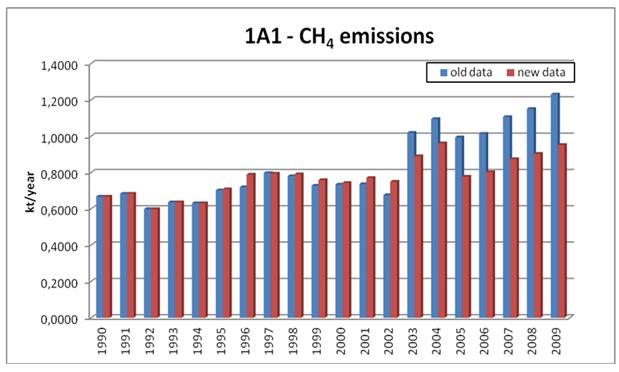
Fig. 3‑15 Development of CH4 emissions in 1A1 category before and
after recalculation
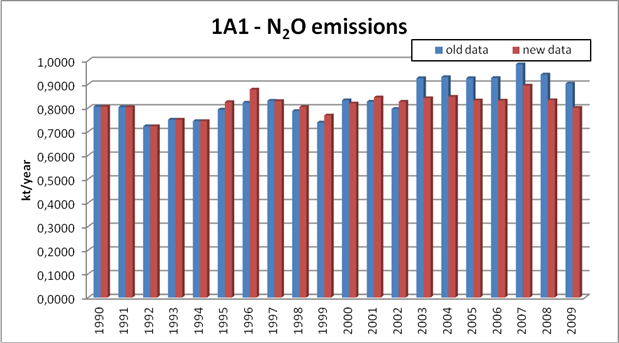
Fig. 3‑16 Development of N2O
emissions in 1A1 category before and after recalculation
There are a
number of reasons for the change in the data after 2003. One is the new calorific
values of liquid fuels that we obtained in 2011 for the whole time series. The
change was obvious for some fuels. Another reason for the decrease in emissions
after 2003 consisted in a methodological mistake in the previous inventories;
autoproducers were reported in this category. This year we discovered this
discrepancy and, together with the recalculation, these consumptions were
reallocated to category 1A2. An increase in emissions is then apparent in 1A2
category. A detailed description can be found below under the description of
recalculation of category 1A2. A third possible reason for changes in emissions
could consist in specification of data directly by CzSO.
Graphs and
tables for emission changes in category 1A2 are given below. As mentioned above,
similar to the decrease in emissions in category1A1 after 2003, the emissions
increase is apparent here. In the initial data files, consumptions for
autoproducers are shown as summary values. These values were proportionally
divided into individual subcategories 1A2a Iron and Steel, 1A2b Non – Ferrous
metals, 1A2c Chemicals, 1A2d Pulp, Paper and Print, 1A2e Food, Beverages and
Tobacco and 1A2f Other according to other available indicators, such as
development and trends in the relevant branches of industry.
In the
previous submissions, all the data in category 1A2 were reported under category
1A2f. Only in 2003 – 2009 were the data reported in each subcategory. In an
attempt to extend the data series, the data from the CzSO Questionnaires were used from
1995. However, an effort was made to extend the data series in this category
back towards 1990 (in order to have consistent reporting of consumption in all
these subcategories as in the other categories – 1A1 and 1A4). Expert estimates
were made in 1990 – 1994 according of developments in the relevant branch of
industry.
Table 3.24a
gives the changes in CO2 emission before and after the
recalculation. No change is apparent before 1994. Table 3.24b shows the changes
in emissions after 2003 caused by reallocation of autoproducers as mentioned
above.
Tab. 3‑24a Comparison of CO2
emissions in 1A2 before and after recalculation
|
1A2 CO2 [Gg]
|
1990
|
1991
|
1992
|
1993
|
1994
|
1995
|
1996
|
1997
|
1998
|
1999
|
|
Recalculated
|
|
|
|
|
|
|
|
|
|
|
|
SUM
|
46 616
|
49 140
|
41 106
|
41 997
|
32 609
|
29 405
|
29 842
|
29 424
|
26 377
|
24 298
|
|
Liquid Fuels
|
9 110
|
8 218
|
9 775
|
7 316
|
6 072
|
6 515
|
6 398
|
5 914
|
5 662
|
5 770
|
|
Solid Fuels
|
31 522
|
34 338
|
25 246
|
27 628
|
21 348
|
16 422
|
16 449
|
15 844
|
13 521
|
11 424
|
|
Gaseous Fuels
|
5 984
|
6 583
|
6 084
|
7 053
|
5 190
|
6 468
|
6 995
|
7 666
|
7 193
|
7 105
|
|
Biomass
|
1 497
|
1 552
|
1 555
|
1 662
|
1 584
|
1 738
|
1 630
|
1 842
|
1 786
|
1 826
|
|
Other Fuels
|
|
|
|
|
|
|
|
|
|
|
|
|
|
|
|
|
|
|
|
|
|
|
|
Before recalculation
|
|
|
|
|
|
|
|
|
|
|
SUM
|
46 616
|
49 140
|
41 106
|
41 997
|
32 609
|
32 766
|
36 626
|
29 069
|
28 588
|
29 956
|
|
Liquid Fuels
|
9 110
|
8 218
|
9 775
|
7 316
|
6 072
|
6 885
|
7 870
|
3 962
|
5 424
|
7 496
|
|
Solid Fuels
|
31 522
|
34 338
|
25 246
|
27 628
|
21 348
|
19 159
|
20 704
|
17 529
|
15 692
|
15 258
|
|
Gaseous Fuels
|
5 984
|
6 583
|
6 084
|
7 053
|
5 190
|
6 722
|
8 051
|
7 577
|
7 472
|
7 202
|
|
Biomass
|
1 497
|
1 552
|
1 555
|
1 662
|
1 584
|
1 590
|
1 666
|
1 803
|
1 386
|
1 638
|
|
Other Fuels
|
|
|
|
|
|
|
|
|
|
|
|
|
|
|
|
|
|
|
|
|
|
|
|
difference [Gg]
|
|
|
|
|
|
|
|
|
|
|
|
SUM
|
0
|
0
|
0
|
0
|
0
|
-3 361
|
-6 784
|
356
|
-2 211
|
-5 658
|
|
Liquid Fuels
|
0
|
0
|
0
|
0
|
0
|
-370
|
-1 472
|
1 952
|
238
|
-1 726
|
|
Solid Fuels
|
0
|
0
|
0
|
0
|
0
|
-2 737
|
-4 255
|
-1 685
|
-2 171
|
-3 835
|
|
Gaseous Fuels
|
0
|
0
|
0
|
0
|
0
|
-254
|
-1 057
|
89
|
-278
|
-97
|
|
Biomass
|
0
|
0
|
0
|
0
|
0
|
149
|
-35
|
39
|
399
|
188
|
|
Other Fuels
|
|
|
|
|
|
|
|
|
|
|
Tab. 3.24b
Comparison of CO2 emissions in 1A2 before and after recalculation
|
1A2 CO2 [Gg]
|
2000
|
2001
|
2002
|
2003
|
2004
|
2005
|
2006
|
2007
|
2008
|
2009
|
|
Recalculated
|
|
|
|
|
|
|
|
|
|
|
|
SUM
|
28 916
|
26 785
|
26 020
|
25 654
|
26 437
|
26 830
|
26 559
|
24 163
|
24 711
|
23 041
|
|
Liquid Fuels
|
5 339
|
5 543
|
5 234
|
4 814
|
6 138
|
6 675
|
6 249
|
5 780
|
6 001
|
5 575
|
|
Solid Fuels
|
16 646
|
14 378
|
13 980
|
13 980
|
13 360
|
13 445
|
13 619
|
11 705
|
12 267
|
11 998
|
|
Gaseous Fuels
|
6 931
|
6 864
|
6 806
|
6 557
|
6 578
|
6 361
|
6 334
|
6 376
|
6 030
|
5 014
|
|
Biomass
|
1 248
|
1 456
|
2 024
|
1 090
|
1 322
|
2 227
|
2 282
|
2 417
|
2 366
|
2 429
|
|
Other Fuels
|
|
|
|
302
|
361
|
349
|
358
|
303
|
413
|
454
|
|
|
|
|
|
|
|
|
|
|
|
|
|
Before recalculation
|
|
|
|
|
|
|
|
|
|
|
|
SUM
|
28 185
|
29 432
|
27 912
|
18 623
|
18 576
|
18 975
|
17 708
|
16 845
|
15 994
|
15 614
|
|
Liquid Fuels
|
6 164
|
5 313
|
4 881
|
3 704
|
4 664
|
4 870
|
4 170
|
3 974
|
3 910
|
3 532
|
|
Solid Fuels
|
15 214
|
16 524
|
15 770
|
8 721
|
7 748
|
8 105
|
7 428
|
6 677
|
6 108
|
7 100
|
|
Gaseous Fuels
|
6 807
|
7 594
|
7 262
|
5 895
|
5 803
|
5 652
|
5 751
|
5 891
|
5 563
|
4 527
|
|
Biomass
|
1 943
|
1 940
|
2 546
|
971
|
1 180
|
1 761
|
1 823
|
1 858
|
1 808
|
1 807
|
|
Other Fuels
|
|
|
|
302
|
361
|
349
|
358
|
303
|
413
|
454
|
|
|
|
|
|
|
|
|
|
|
|
|
|
difference [Gg]
|
|
|
|
|
|
|
|
|
|
|
|
SUM
|
732
|
-2 646
|
-1 892
|
7 032
|
7 861
|
7 855
|
8 851
|
7 319
|
8 717
|
7 427
|
|
Liquid Fuels
|
-825
|
230
|
354
|
1 110
|
1 474
|
1 806
|
2 078
|
1 806
|
2 091
|
2 043
|
|
Solid Fuels
|
1 432
|
-2 146
|
-1 790
|
5 259
|
5 613
|
5 340
|
6 190
|
5 027
|
6 159
|
4 897
|
|
Gaseous Fuels
|
124
|
-730
|
-456
|
662
|
775
|
709
|
583
|
485
|
467
|
487
|
|
Biomass
|
-695
|
-485
|
-522
|
120
|
143
|
466
|
460
|
559
|
558
|
621
|
|
Other Fuels
|
|
|
|
0
|
0
|
0
|
0
|
0
|
0
|
0
|
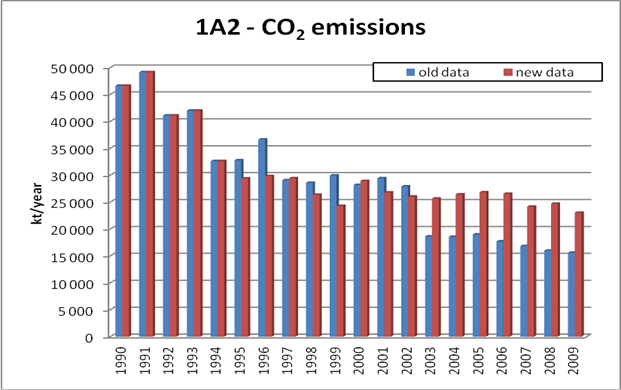
Fig. 3‑17 Development of CO2 emissions in 1A2 category before and
after recalculation
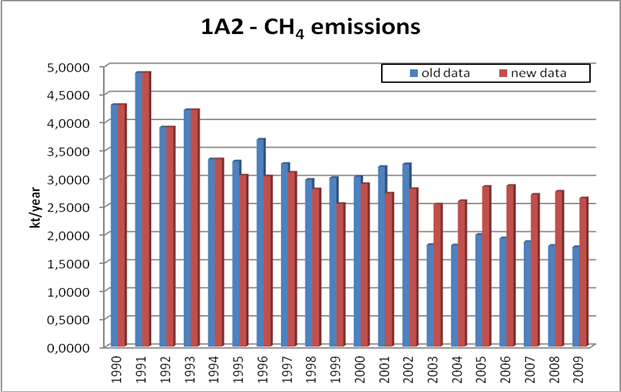
Fig. 3‑18 Development of CH4 emissions in 1A2 category before and
after recalculation
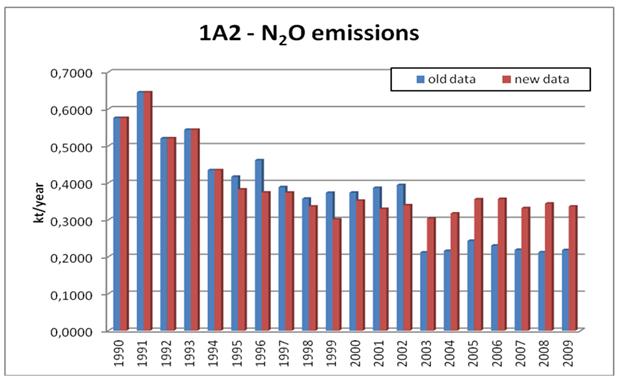
Fig. 3‑19 Development of N2O
emissions in 1A2 category before and after recalculation
This graph
(below) shows that total emissions in category 1A didn’t change much after
2003. Thus, the decrease in total emissions in category 1A1 and increase in
category 1A2 did not have any overall effect. The small changes are caused by
new calorific values, corrections in emission factors and some corrections in the initial data
by CzSO.
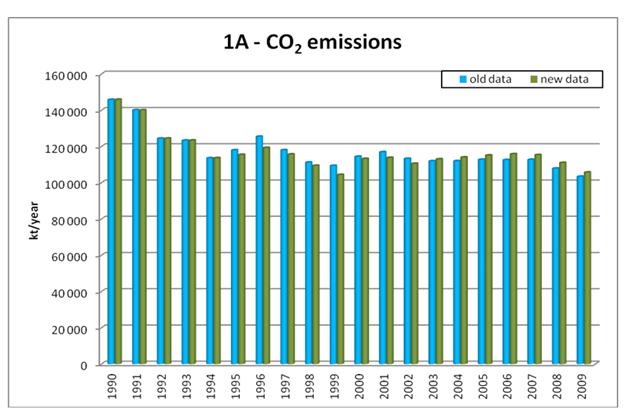
Fig. 3‑20 Development of CO2 emissions in 1A category before and after
recalculation
The next
three graphs depict changes in emissions in category 1A4. This category was
also recalculated according to the CzSO Questionnaires. The data from the
questionnaires were used for calculation of emissions in the 1995 – 2009
period. The data before (1990 – 1994) were left according to the Energy balance
of the Czech Republic, which was processed by the CzSO methodology. Good
agreement is visible in this category after 2003 (i.e. 2003 – 2009). Where
there are some differences, these are because of changes in the emission
factors or corrections to the activity data by CzSO. Another discrepancy is
caused by the use of different calorific values for liquid fuels during
recalculation from kt to TJ. We obtain new calorific values for all the liquid
fuels in all the time series from CzSO that were used for calculations during
recalculation.
Overall,
this can be considered to correspond to very good agreement, as it was
expected.
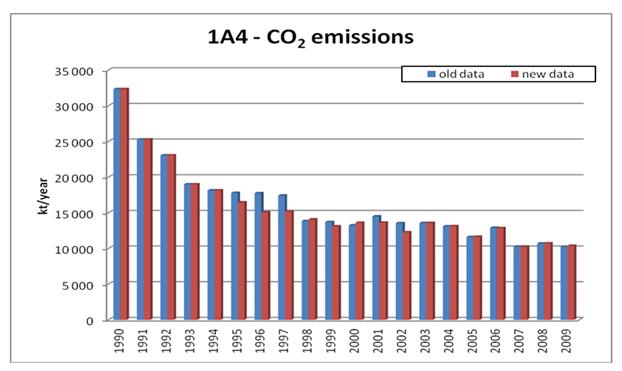
Fig. 3‑21 Development of CO2 emissions in 1A4 category before and
after recalculation
CRF gives comments for all the recalculated categories. The comments are
explained below:
AD recalculation 1995 -2009 – for 1A1, 1A4 and 1A3e – Pipeline
transport categories; data from CzSO Questionnaires were used for 1995 – 2009. In the previous submission,
these data were used only back to 2003 and earlier data were taken from the
preliminary energy balance of the Czech
Republic. Now these time series were prolonged back to 1995.
AD recalculation 1995 -2009, 1990 – 1994
disaggregation of sum values –for category 1A2 were recalculate whole time series. Data for 1995 –
2009 were taken from the CzSO Questionnaires; summary data were used for
1990 – 1994 (previously all in 1A2f) and these data were proportionally
disaggregated into individual categories according to trends in each branch of
industry.
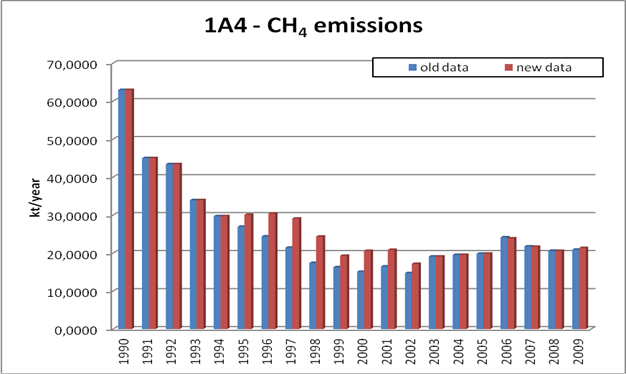
Fig. 3‑22 Development of CH4 emissions in 1A4 category before and
after recalculation
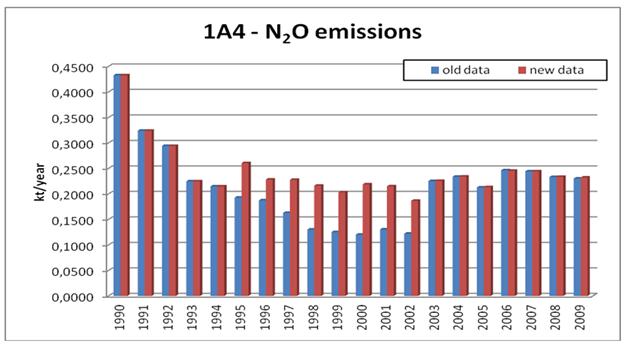
Fig. 3‑23 Development of N2O
emissions in 1A4 category before and after recalculation
AD
recalculation 1995 -2009, 1995-1998 expert estimate -
used for category 1A5b.
Emission factors
Emission
factors were also checked together with the recalculation.
The CO2 emission factors employed were checked with the default emission factors and the
consistency in the whole time series was examined. Country-specific EFs were
used for Coking Coal, Other Bituminous Coal and Brown Coal – Lignite. Default
emission factors were used for the rest of fuels. It was decided to use the
default emission factors given by the Revised 1996 IPCC Guidelines for the 1990 – 1994 period and the emission factors given in the 2006 IPCC Guidelines for the 1995 – 2009 period. These emission factors
were considered to agree better with the conditions in the Czech Republic and are therefore used consistently in the data
series in which the recalculation was performed.
The
emission factor for methane was also checked. According to preliminary
recommendations, we consistently used the emission
factors given in the Revised 1996 IPCC Guidelines. It was not clear whether the
emission factor for liquid or for gaseous fuel should be used for LPG - the
emission factor for liquid fuels was used in the calculation.
Calorific values
Some
differences in values after 2003 could be caused by different calorific values
of liquid fuels. In 2011, new calorific values were obtained from CzSO for all the liquid fuels reported in the CzSO Questionnaires. The calculations from
kt to TJ were performed using these calorific values, which are almost all
different from the previous calorific
values.
Reference Approach
The
Reference Approach was recalculated in the same way as for the categories in the Sectoral Approach. It was necessary to use
the same data source for the Sectoral and Reference Approaches. Thus, the data
in the Reference Approach were
recalculated according to the CzSO
Questionnaires from 1995 to 1999. Some QC activities were also performed during
the calculations. It was found that Other
fuels are reported in the Reference
Approach. It was discovered that these fuels are Other fuels simultaneously
reported under 1A2f so they should not be reported again in the Reference Approach. This mistake was
corrected in this submission.
One of the
repeated recommendations (the last one in
CZE_SA-II_2011vers2) was about imports and exports of crude oil for 1990. CRF
data for crude oil include net imports while IEA data show imports and exports.
Using new calorific values taken from the CzSO Questionnaires (i.e. IEA data),
new values were also calculated for import and export for crude oil for the years before 1995. Thus the values for 1990
– 1994 were also changed together with the recalculation after 1995.
Consequently, the whole time series was changed for crude oil.
A similar
problem was also encountered for export of natural gas in 1990. Exports are
reported in the CRF, while they are zero in the IEA data. Export for this year
was corrected according to the CzSO
Questionnaire. The value in CRF is now zero.
Zero values
were discovered for some fuels in the final database. It would be preferable to
report these zero exports/imports as a notation key. This methodological
mistake will be corrected in next submission. Some inconsistencies in notation
keys use will also be corrected in the next
submission.
The entire
category is considered to be recalculated for reporting purposes. In fact, this
chapter is identical to the previous 6C MSW incineration chapter. In this
respect no recalculations were added.
In 2010, the data for greenhouse gas emissions in the entire transport sector
were recalculated for the 1990 – 2009 time period. The main reason for this
recalculation consisted in refinement and harmonization of net calorific values
for the whole time period with the KONEKO company and, in some
cases, with the IEA – CzSO Questionnaire (CzSO, 2011). The new activity data
consequently affected calculation of both transport energy values [TJ] and
greenhouse gas emissions.
Several discrepancies relating to the
consumption of kerosene in aviation appeared when compared with the IEA database (found by ERT). It was necessary to employ expert engineering
assessment, because of the substantial differences in the consumption values in
some years. The consumption of kerosene under the administration of KONEKO
(other sources) was separated every year from the total consumption of
kerosene. The consumption of kerosene under the administration of CDV
(international bunkers and civil aviation) was divided into domestic and
international aviation on the basis of passengers transport and transport of
goods in the whole time period (MTC, 2000; MTC, 2006; MTC, 2011).
The recalculation also encompassed
control of values not included in the trends in the monitored GHG. On the basis
of the determined results, corrections were performed for 1995 – 2009 (see the
elaboration below). The refinement was performed for every category of fuel by
supplementing decimal points.
Specification of the adjusted values:
1A3b gasoline correction of energy values and CO2,
CH4 and N2O
emission values in 1995 – 1999, 2002 – 2006 and 2008
1A3b diesel
oil correction of energy values and CO2,
CH4 and N2O
emission values in 1998 – 2005 and 2008 – 2009
1A3b LPG correction of energy values and CO2,
CH4 and N2O
emission values in 1995 – 1999
1A3b CNG correction of energy values and CO2,
CH4 and N2O
emission values in 1995 – 1997 and 2006
1A3c diesel
oil correction of energy values and CO2,
CH4 and N2O
emission values in 1998 – 1999 and 2005
1A3d diesel
oil correction of energy values and CO2,
CH4 and N2O
emission values in 1998 – 1999
The planned improvement consists primarily in a
further increase in cooperation with CzSO. As mentioned in the introduction, a
new addendum was created for the agreement between the Ministry of the
Environment and CzSO. In the framework of this addendum, the parties agreed to
hold regular meetings at least 3x annually to deal with coordination of work on
the national energy balance, so that this is in accordance with the
requirements on processing of activity data for greenhouse gas emission
inventories. Simultaneously, the parties agreed to continue in the practice
established in 2010 and to hold an annual workshop to discuss in detail current
problems and methodical procedures for preparing fuel and emission balances.
This effort still remains.
Attention is constantly devoted to obtaining data from
the ETS national database for use in performing QA/QC procedures. At the
present time, the creation of this database is included in the plan of the
Ministry of the Environment. As a certain part of the reports on the individual
enterprises are currently available only in printed form, the data cannot be
converted as distortion could occur.
It is assumed, that following systematic comparison of
activity data obtained in various ways, it will be possible to refine the
national GHG inventories in the ENERGY sector using “bottom-up” data, or at
least to use this data for the QA/QC procedures.
Another improvement is planned for QA procedures. QA
should be performed by an independent expert who does not participate in processing
the National Inventory of Greenhouse Gases. It is intended to establish a
“working group”, which will consist of independent experts from different
branches of industry and energy production. Members of the group should be
officially named by a letter of appointment from CHMI as the coordination
workplace.
Special attention was paid in 2011 to trends in the
country-specific emission factor for Natural Gas. Unfortunately sufficient data
were not obtained. Efforts to obtain country-specific emission factors will
continue in 2012.
The planned
improvements are related mainly to performance of projects to measure
country-specific emission factors in key categories of road transportation. The greatest emphasis will be placed on acquisition of sufficient data
for CO2 and N2O
emission calculation and refinement of methodologies for each category of
transport.
Mining,
treatment and all handling of fossil fuels are sources of fugitive emissions.
In the Czech Republic, CH4 emissions from underground mining of Hard
Coal are significant, while emissions from surface mining of Brown Coal, Oil
and Gas production, distribution, storage and distribution are less important.
The current
inventory includes CH4 emissions for the following categories:
- 1B1 Solid fuels
- 1B2 Oil and Natural Gas
In 1B Fugitive Emissions from Fuels
category, especially 1B1a Coal
Mining and Handling was evaluated as a key
category (Table 3.25). Category 1B2 also was identified as a key category by the latest assessment,
but only in one from the four tests (LA). Moreover, identifiers placed this
category just over the borderline between key
and non-key categories.
Fig. 3‑24 depicts methane emissions trends
from selected categories from the sector 1B Fugitive
Emissions from Fuels.
Tab. 3‑25 Overview of significant
categories of sources in this sector (2010)
|
Category
|
Character
of category
|
Gas
|
%
of total GHG*
|
|
1B1a
Fugitive Emissions from Coal Mining and Handling
|
KC (LA, TA, LA*, TA*)
|
CH4
|
2.4
|
|
1B2
Fugitive Emissions from Oil & Gas operations
|
KC (LA, LA*)
|
CH4
|
0.5
|
* assessed
without considering LULUCF (without * means considering LULUCF)
KC: key
category, LA: identified by level assessment, TA: identified by trend
assessment

Fig. 3‑24 Methane emissions trends from the sector Fugitive
Emissions from Fuels [Gg CH4]
The source
category 1B1 Solid Fuels consists of three sub – source categories:
source category 1B1a
Coal
mining and Handling,
source category 1B1b Coal transformation and source category 1B1c
Other.
The main
process that emits more than 80 % of methane emissions from the category 1B1Solid
Fuels category is underground mining of Hard Coal in the Ostrava-Karviná
area. A lesser source consists in Brown Coal mining by surface methods
and post-mining treatment of Hard and Brown Coal. Coal mining
(especially Hard Coal mining) is accompanied by an occurrence of methane.
Methane, as a product of the coal-formation process is physically bonded
to the coal mass or is present as the free gas in pores and cracks in
the coal and in the surrounding rocks.
Abandoned
mines
In the Czech
Republic there are also abandoned mines occurring. All of them have CH4
recovery systems. There is company, which has established mining areas for
mining of fire-damp in Ostrava-Karviná area. In the abandoned mines there are
automatic suction devices and firedamp stations. Firedamp arises from abandoned
mining pits and surface boreholes into abandoned areas. Mined firedamp is used
at the place of mining in autonomous cogeneration units (aggregate for
electricity energy production with an ignition combustion engine)(
http://www.dpb.cz/).
3.9.1.1
Source
category description
1B1a Coal
mining and Handling
In
underground Hard Coal mining, CH4 is released from the coal mass and
from the surrounding rocks into the mine air and must be removed to the surface
to prevent formation of dangerous concentrations in the mine.
1B1a1
Underground Mines
In the
Czech Republic, mainly Hard Coal is mined in underground mines (i.e. Hard Coal:
Coking Coal and Bituminous Coal). Presently, underground mines are in operation
in the Ostrava-Karviná coalmining area. In the past, Hard Coal was also mined
in the vicinity of the city of Kladno. These mines were closed in 2003. Brown
Coal is mined in only one underground mine in the Northern Bohemia. Emissions
from this mine are reported together with surface mining of Brown Coal –
Lignite in subcategory 1B1a2 Surface
Mines.
1B1a11
Mining Activities
The data of
CzSO in the report CZECH_COAL.xls (CzSO, 2011) can be used for control
purposes.
Hard-coal
mining is the principal source of fugitive emissions of CH4. The
mine ventilation must be regulated according to the amounts of gas released to
keep its concentration on safe level. At the end of 1950’s mine gas removal
systems were introduced in opening new mines and levels in the Ostrava- Karviná
coal-mining area, which permitted separate exhaustion of partial methane
released in the mining activity in the mixture containing the mine air. The
total amount of methane emitted can be balanced quite accurately from the
methane concentrations in the mine air and their total annual volume.
1B1a12
Post-Mining Activities
The
activity data are the same as in category 1B1a11 Mining Activities. It
is assumed that the entire mined volume undergoes manipulation during which
residual methane is released.
1B1a2 Surface Mines
1B1a21 Mining Activities
Brown Coal
and Lignite are mined in surface mines in the Czech Republic. Brown Coal is
mined primarily in the Northern Bohemia area, while Lignite mines are located
in Southern Moravia.
1B1a22 Post-Mining Activities
The activity
data are the same as in category 1B1a21 Mining Activities. It is assumed
that the entire mined volume undergoes treatment during which residual methane
is released.
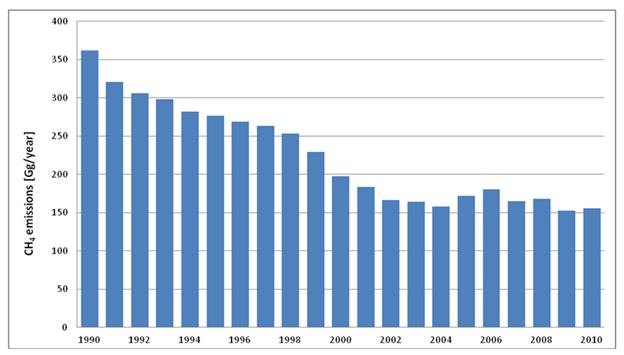
Fig. 3‑25 Methane emissions trends from the sector Fugitive
Emissions from Solid fuels [Gg CH4]
1B1b Coal
transformation
The
subcategory includes
a) production of Coke from Coking Coal
Fugitive
methane emissions from coal treatment prior to the actual coking process are
listed under 1B1a12 Post-Mining Activities. Emissions from the actual
production of Coke are given under 2. Industry.
b) production of briquettes from Brown Coal
Fugitive
methane emissions from coal treatment prior to the actual briquetting process
are listed under 1B1a22 Post-Mining Activities. CO2 emissions from the actual production
of briquettes are included in subcategory 1A2f.
For these
reasons, none of the activity data or methane emissions are included in this
subcategory
(notation
key IE). Fugitive CO2 emissions are not estimated or are negligible
and no known method is available for their determination (notation key NE).
Fugitive N2O emissions
are not estimated because, according to the current state of knowledge, these
emissions cannot occur (notation key NA).
1B1c Other
No other
subcategory of fugitive methane emissions is known in the Czech Republic.
3.9.1.2
Methodological
issues
1B1a1
Underground Mines
1B1a11
Mining Activities
National
emission factors were determined for calculation of fugitive methane emissions
in underground mines in the second half of the 1990’s: the ratio between mining
and the volume of methane emissions is given in Table 3.26, see (Takla and
Nováček, 1997).
Tab. 3‑26 Coal mining and CH4
emissions in the Ostrava - Karvina coal-mining area
|
|
Coal mining
|
CH4
emissions
|
Emission factors
|
|
[mil.
t / year]
|
[mil. m3 / year]
|
[m3 / t]
|
|
1960
|
20.90
|
348.9
|
16.7
|
|
1970
|
23.80
|
589.5
|
24.7
|
|
1975
|
24.11
|
523.8
|
21.7
|
|
1980
|
24.69
|
505.3
|
20.5
|
|
1985
|
22.95
|
479.9
|
20.9
|
|
1990
|
20.6
|
381.1
|
19.0
|
|
1995
|
15.60
|
270.7
|
17.4
|
|
1996
|
15.10
|
276.0
|
18.3
|
|
Total
|
167.31
|
3 375.3
|
20.2
|
|
1990 till 1996
|
50.76
|
927.8
|
18.3
|
Only the
values for 1990, 1995 and 1996 were used from this table to determine the
emission factors.
The average
value of the emission factor of 18.3 m3/t was recalculated to 12.261
kg/t using a density of methane of 0.67 m3/kg. This emission
factor is used for coal mined in the Ostrava-Karviná coalmining area for years
1990 - 1999. The emission factor set by estimation at 50 % of this value was
used for the remaining Hard Coal from deep mines in other areas. This is valid
for coal with minimum coal gas capacity (coal from the Kladno area to 2002 and
coal from the Žacléř area from 1998).
The
emission factors given in table 3.30 in the recalculation chapter are used for
2000 – 2008. After 2008, the emission factor calculated as the average value
from the values for 2000-2008, i.e. 8.12
t/kt, is used. According to the ERT recommendation, a survey was
performed to update these emission factors, which consequently caused other
recalculation which are described in detail in the relevant chapter
1B1a12
Post-Mining Activities
Methane
emissions in the subcategory of Post-Mining Activities are calculated using a
uniform emission factor based on the default value of 1.64 kg CH4/t
coal; the activity data are employed at the same level as in subcategory 1B1a11
Mining Activities.
Tab. 3‑27 contains a summary of fugitive
methane emissions during the actual underground mining of Hard Coal and during
post-mining operations.
Tab. 3‑27 Used emissions
factors and calculation of CH4 emissions from underground coal
mining in 2010
|
|
Amount of Coal
|
Emission
|
Methane
|
|
|
Produced
|
Factor
|
Emissions
|
|
|
[million t]
|
[kg CH4/t]
|
[Gg CH4]
|
|
OKR*)
(tier III)
|
11.001
|
8.8
|
96.3
|
|
Other - tier
I
|
0.000
|
6.7
|
0.0
|
|
Mining (tier
III)
|
11.001
|
8.8
|
96.3
|
|
OKR*)
(tier I)
|
11.001
|
1.6
|
18.1
|
|
Other - tier I
|
0.000
|
0.6
|
0.0
|
|
Post-Mining
(tier I)
|
11.001
|
1.6
|
18.1
|
|
Total
sub-sector 1B1a1
|
11.001
|
10.4
|
114.3
|
*
Ostrava-Karviná coal-mining area
1B1a2 Surface Mines
1B1a21 Mining Activities
Data from
the source part of the questionnaire completed in the CzSO Questionnaire (CzSO,
2011), was employed to determine activity data on extraction of Brown Coal and
Lignite. The mining yearbooks and other data sources continue to be used only
for control purposes.
During
surface mining, escaping methane is not related to specific flow of air and
thus it is far more difficult to monitor the amount of methane escaping into
the air. Consequently, default IPCC emission factors are employed to calculate
methane emissions from surface mining and from post-mining treatment (IPCC,
1997).
Table 3.20
illustrates the calculation of fugitive emissions of methane from surface coal
mining activities.
Tab. 3‑28 Emission factors employed and
calculation of CH4 emissions from surface coal mining in 2010
|
|
Amount of Coal
|
Emission
|
Methane
|
|
|
Produced
|
Factor
|
Emissions
|
|
|
[million t]
|
[kg CH4/t]
|
[Gg CH4]
|
|
Mining
(tier I)
|
43.774
|
0.77
|
33.7
|
|
Post-Mining
(tier I)
|
43.774
|
0.07
|
2.93
|
|
Total sub-sector 1B2a1
|
43.774
|
0.84
|
36.63
|
3.9.1.3
Uncertainty
and time-series consistency
The inventory methods used in this inventory were consistently employed
across the whole reporting period from the base year of 1990 to 2010.
The
uncertainties in the activity rate result primarily from inaccuracies in
weighing of extracted coal.
Uncertainties
in determining the activity data are estimated at 5 %.
Uncertainties
in calculating methane emissions further follow from the emission factors
employed.
The
emission factors for determining emissions from deep mining of hard coal are
based on measurement of the methane concentrations in the air ventilated from
underground mines in the second half of the 1990’s. The precision of methane
emissions varies at a level of 5 %. The uncertainty in the default emission
factors is considered to be at a level of 80 %. Overall, the uncertainty in the
emission factors in category 1B1 Solid fuels is estimated to equal 40 %.
Consistency
of the time series is apparent from the graphs in Fig. 3‑24. Minor fluctuations are caused by
climatic variations in the individual years. The trends towards a substantial
decrease in emissions in the 1990’s decreased during the first decade of the 21st
century.
3.9.1.4
Source
specific QA/QC and verification
General
quality control and source-specific quality control (Tier 1 and Tier 2), in
conformance with the requirements of the QSE handbook and its associated
applicable documents, have been performed to the full extent.
QC
activities at the level of Tier 1 were performed according to the QA/QC plan by
the sector compiler. Routine control was performed in the framework of the
following activities:
- activity data employed,
- emission factors employed,
- calculation procedures employed,
- transfer of numerical data from the
working set to the CRF Reporter.
During
control of the activity data, the CzSO data were compared with the data from
the Mining Yearbook. Good agreement was found.
In control
of the emission factors employed, the emission factors used in the Czech Republic
methodology were compared with the emission factors of Slovakia, Poland and
Germany in the context with the default emission factors. It was found that the
emission factors employed for calculation of emissions in the Czech Republic
methodology correspond, in their range, to the emission factors employed in the
other countries. Comparison of the emission factors used in the
Czech
Republic with the emission factors of the surrounding countries corresponds to
the level of Tier 2.
Control
that the transfer of numerical data from the working set to the CRF Reporter
does not reveal any differences. The final working set in EXCEL format is
locked to prevent intentional rewriting of values and archived at the
coordination workplace. The protocols on the performed QA/QC procedures are
stored too.
3.9.1.5
Source-specific
recalculations
1B1a – Coal Mining and Handling
Two
recalculations were performed on the basis of ERT recommendations.
A. Recalculation of CH4 emissions from underground mining of hard coal
Recalculation
was performed on the basis of a recommendation in FCCC/ARR/2008/CZE of March 25
2009 in paragraph 37. This recommendation suggests that the CH4
emission factor for underground coal mining be updated.
In
connection with this requirement, the management of OKD, a.s. (Ostrava-Karviná
mines, joint share company) was contacted. The company monitors in very detail
the problematic about methane production.
In response to a request from the reporting team, the company provided a
document in which the total amount of gas released by OKD mines was determined,
together with the amount of methane withdrawn by degassing, the amounts of
methane used for industrial purposes, venting of methane from degassing and the
total amount of methane released into the atmosphere.
Tab. 3‑29 Methane production from gas
absorption of mines and its use
|
|
mil.m3
CH4 * year-1
|
|
year
|
total amount
|
pumped out by
|
industrial
|
venting from gas absorption
|
released into the
|
|
|
of gas
|
gas absorption
|
use
|
into the atmosphere
|
atmosphere - total
|
|
2000
|
236.7
|
84.1
|
77.9
|
6.2
|
158.8
|
|
2001
|
210.7
|
73.9
|
71.1
|
4.0
|
140.8
|
|
2002
|
210.0
|
81.0
|
70.3
|
1.3
|
130.3
|
|
2003
|
200.6
|
74.8
|
72.8
|
2.0
|
127.8
|
|
2004
|
194.6
|
77.1
|
73.4
|
3.2
|
120.7
|
|
2005
|
207.7
|
73.9
|
70.3
|
3.6
|
137.4
|
|
2006
|
221.1
|
76.9
|
75.9
|
0.8
|
145.0
|
|
2007
|
194.7
|
71.5
|
71.0
|
0.5
|
123.7
|
|
2008
|
199.5
|
68.8
|
68.5
|
0.3
|
131.0
|
This information was used to calculate the emission factors
and to determine the average emission factor, which is used for the period
after 2000-2008.
Tab. 3‑30 Calculation of emission factors from
OKD mines for period 2000 onwards
|
year
|
OKD mining
|
CH4
emissions
|
EF
|
|
|
[kt/year]
|
[t/year]
|
[t/kt]
|
|
2000
|
11 514
|
106 396
|
9.24
|
|
2001
|
11 844
|
94 336
|
7.96
|
|
2002
|
12 049
|
87 301
|
7.25
|
|
2003
|
11 301
|
85 626
|
7.58
|
|
2004
|
10 901
|
80 869
|
7.42
|
|
2005
|
10 822
|
92 058
|
8.51
|
|
2006
|
11 656
|
97 150
|
8.33
|
|
2007
|
10 153
|
82 879
|
8.16
|
|
2008
|
10 030
|
87 770
|
8.75
|
|
2000 - 2008
|
100 270
|
814 385
|
8.12
|
For years
2000 – 2008 were used emission factors given in table for calculation of emission
factors from OKD mines. For years onwards 2008 is used average emission factors
from the period 2000-2008; 8.12 t/kt of
mined hard coal, for period before 1999 the value is same as in previous
submission 12.3 t/kt of mined coal (Takla and Nováček, 1997).
This
emission factor can be considered as emissions factor on the level Tier III –
it is country-specific emission factor, which is applicable for Ostrava-Karviná
area.
For other
mines in the Czech Republic where hard coal was also mined, the value of 6.7
t/kt was used – the same as in previous submissions. However it is necessary to
remind that underground mining in the mines of other areas than OKD is really
minor and at the end of the first decade of 21st century was
completely stopped.
In
comparison with the previous submission, the recalculation leads to lower CH4
emissions after 2000. Comparison of the primary values from the whole subsector
1B1 Solid Fuels (Coal Mining and Handling) can be seen in the figure.
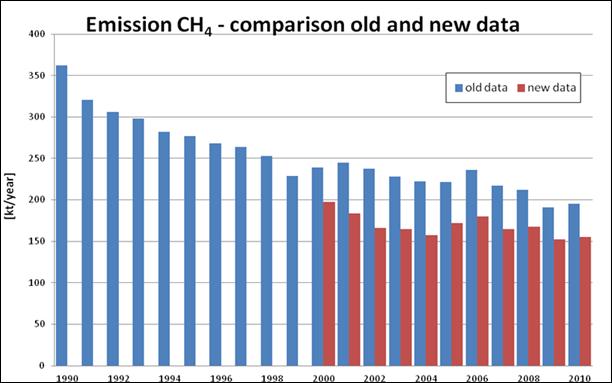
Fig. 3‑26 Source: Hok Petr: “Účelový materiál pro řešení inventarizace
skleníkových plynů o emisích metanu z dolů OKD v letech 2000 až 2008,
OKD, a.s., Ostrava 28. 8. 2009”
B. New
data about CO2 emissions from underground
mining of hard coal
A
recommendation to estimate CO2
emissions for underground and surface coal mining followed from
FCCC/ARR/2010/CZE of February 16 2011 (paragraph 41) and from the response of
ERT to the in-country review in August/September 2011 in Prague .
Calculation
of CO2 emissions for underground mining was considered to be a
priority. It was necessary to calculate new data for CO2 emissions
from underground hard coal mining. This calculation was based on the fact that
the mine drainage gas also contained CO2. Both gases (CH4
and CO2) represent a danger for human health in mines and are
therefore monitored and their amounts in mine drainage gas are evaluated. An
extra study was performed to determine
the CO2 emission factor for underground hard coal mining.
Monthly data on the concentrations and amounts of CO2 were processed
for all the exhaust air shafts in the OKD area for 2009, 2010 and for part of 2011.
These data yielded an average value of the emission factor, which is related to
the volume of mining. The emission factor is equal to 22.75 t/kt of mined coal and this emission factor is country
specific – Tier III level. This value is valid for the OKD area. The author of
the study recommended that the determined emission factor for 1990 – 2009 be
used. He determined an emission factor 22.68
t/kt of mined coal for 2010 and it was recommended that this value also be used
for the subsequent years.
These
emission factors were used to extend the data for CO2 emissions for
underground hard coal mining; the values are given in the table.
Tab. 3‑31 Emission factors and
emissions from deep mining of hard coal
|
|
production
|
emission
|
emission of
|
|
year
|
OKD
|
factor
|
CO2
|
|
|
[kt/year]
|
[t/kt]
|
[kt CO2/year]
|
|
1990
|
20 059
|
22.75
|
456.3
|
|
1991
|
17 371
|
22.75
|
395.1
|
|
1992
|
17 271
|
22.75
|
392.9
|
|
1993
|
16 419
|
22.75
|
373.5
|
|
1994
|
15 942
|
22.75
|
362.6
|
|
1995
|
15 661
|
22.75
|
356.2
|
|
1996
|
15 109
|
22.75
|
343.7
|
|
1997
|
14 851
|
22.75
|
337.8
|
|
1998
|
14 620
|
22.75
|
332.6
|
|
1999
|
13 468
|
22.75
|
306.4
|
|
2000
|
13 855
|
22.75
|
315.2
|
|
2001
|
14 246
|
22.75
|
324.1
|
|
2002
|
14 200
|
22.75
|
323.0
|
|
2003
|
13 614
|
22.75
|
309.7
|
|
2004
|
13 272
|
22.75
|
301.9
|
|
2005
|
13 227
|
22.75
|
300.9
|
|
2006
|
14 280
|
22.75
|
324.8
|
|
2007
|
12 886
|
22.75
|
293.1
|
|
2008
|
12 622
|
22.75
|
287.1
|
|
2009
|
11 001
|
22.75
|
250.2
|
|
2010
|
11 435
|
22.68
|
259.3
|
Source: Prokop
Pavel: Zpracování emisních faktorů a emisí CO2 při hlubinné těžbě
černého uhlí v OKR, Technická univerzita Ostrava, Ostrava, říjen 2011
Consultations
with experts on surface mining showed that similar data for determination of CO2
emissions are not available. However, experience from an area where surface
mining was recently active suggests that the amount of CO2 released
by lignite - brown coal mining is absolutely minor.
Comments are given in CRF for the recalculated categories. Explanation of
comments is given below:
Note raised
by ERT during ICR 2011 – used for 1B1A11 Mining Activities, CH4
Emissions – Recovery. During the in-country review in September 2011, a
question was raised about recovery from abandoned mines. We pointed out that abandoned
mines exist in the country and that all of them have CH4 recovery
systems. The recommendation was to elaborate in next annual submission how the
recovered CH4 emissions from each abandoned mine are treated.
Consequently, it is not possible to leave notation key NO in the CRF Reporter.
Update -
used for 1B1A11 Mining Activities, CH4 Emissions 2000 – 2009. This
change follows from a recommendation raised in document FCCC/ARR/2008/CZE
(March 25 2009), paragraph 37, where it is recommended to update the CH4
emission factor for underground mines – mining activities.
Available
new AD - used for 1B1A11 Mining Activities, CO2 Emissions 1990 –
2009. This recommendation was raised in FCCC/ARR/2010/CZE (February 16 2011),
paragraph 41 and by ERT during the in-country review in September 2011. It was
recommended to estimate CO2 emissions from underground mining and
surface mining.
3.9.1.6
Source-specific
planned improvements
No
improvements are planned at the present.
Source
category 1B2 Oil and Natural Gas consists of four source subcategories: source
category 1B2a
Oil, source category 1B2b Natural
Gas, 1B2c Venting and flaring and source subcategory 1B2d Other.
Approximately
10 % of emissions are formed in the Czech Republic from gas industry in
extraction, storage, transport and distribution of Natural Gas and in its final
use. Crude Oil extraction and refining processes are less important.
Determination
of methane emissions from the processes of refining of Crude Oil is based on
the recommended (default) emission factors according to the IPCC methodology.
Methane
emissions from the gas industry were determined using national emission factors
based on the specific emission factors for the individual parts of the gas
industry system (Alfeld, 1998).
The graph
in Fig. 3‑27 gives an overview of the trend in
emissions in this category in the time series since 1990.
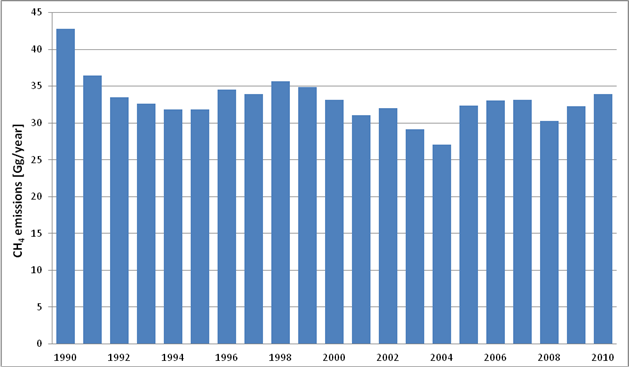
Fig. 3‑27 Methane emissions trends from the sector
Fugitive Emissions from Oil and Natural Gas [Gg
CH4]
3.9.2.1
Source
category description
1B2a Oil
CH4 emissions from Crude Oil
transport and refining and from Crude Oil mining, which is performed in the
Czech Republic in combination with mining of Natural Gas, are reported in this
category. CO2 emissions from the refinery resulting from combustion
processes (including flaring) are included in
1A1b
Crude Oil Refining.
1B2a1
Exploration
Exploration
is not systematically performed in the Czech Republic.
1B2a2
Production
Crude Oil
is mined in the Czech Republic in Southern Moravia. The following table gives
the amount of mined Crude Oil in the territory of the Czech Republic.
Tab. 3‑32 Crude Oil mining in the CR in
2000 – 2010
|
Year
|
2000
|
2001
|
2002
|
2003
|
2004
|
2005
|
2006
|
2007
|
2008
|
2009
|
2010
|
|
[kt/year]
|
175
|
183
|
265
|
317
|
306
|
313
|
265
|
246
|
242
|
222
|
176
|
1B2a3
Transport
Transport
of Crude Oil in the territory of the Czech Republic is performed only in closed
systems (pipeline transport). So far, emissions from this subsector have not
been evaluated. In the context of internal control procedures, this fact was
identified as an inadequacy and thus default emission factors were sought for CH4 and CO2 emissions and were used to calculate
fugitive emissions in this subsector.
1B2a4
Refining / Storage
Crude Oil
is processed in the territory of the Czech Republic in two main refinery
facilities. Tab. 3‑33 gives the total volume of Crude Oil
processed in the Czech Republic.
Tab. 3‑33 Total Crude Oil
input to rafineries in CR in 2000 – 2009 [kt/year]
|
Year
|
2000
|
2001
|
2002
|
2003
|
2004
|
2005
|
2006
|
2007
|
2008
|
2009
|
2010
|
|
Refinery Intake
|
5 871
|
6 072
|
6 238
|
6 573
|
6 704
|
7 746
|
7 866
|
7 394
|
8 249
|
7 376
|
7 901
|
1B2a5
Distribution of oil products
The final
products after processing Crude Oil no longer contain dissolved methane or
carbon dioxide and thus fugitive emissions are not considered in this
subcategory. For completeness, activity data corresponding to the volume of
processed Crude Oil in the individual years were recorded in CRF.
1B2a6
Other
No other
operations are considered.
Tab. 3‑34 summarizes the activity data and emission
factors used, including calculation of total methane emissions in this
subcategory.
|
|
|
A
|
B
|
C
|
D
|
|
Category
|
Tier
|
Activity
|
Emission Factors
|
CH4
Emissions
|
Emissions CH4
|
|
|
|
|
|
(kg CH4)
|
(Gg CH4)
|
|
|
|
|
|
C = (A x B)
|
D = (C/106)
|
|
Production - OIL
|
|
PJ oil
produced
|
kg CH4/PJ
|
|
|
|
domestic
production
|
3
|
7.46
|
5 287
|
39 441
|
0.039
|
|
Transport
|
|
PJ oil
refined
|
kg CH4/PJ
|
|
|
|
transport of
Crude Oil
|
|
335
|
146
|
48 910
|
0.049
|
|
Refining
|
|
PJ oil
refined
|
kg CH4/PJ
|
|
|
|
processing of
Crude Oil
|
1 - 2
|
335
|
1 150
|
385 250
|
0.385
|
|
|
|
|
|
CH4
from Oil
|
0.474
|
1B2b Natural Gas
1B2b1
Exploration
Emissions
formed at exploratory boreholes are reported in this subcategory. This activity
is not performed in the Czech Republic, or is completely random.
1B2b2
Production
Natural Gas
is extracted in the Czech Republic in the area of Southern Moravia,
accompanying extraction of Crude Oil, and in Northern Moravia, where it is
derived from degassing of hard coal deposits. The following Tab. 3‑24 gives the amount of extracted
Natural Gas in the territory of the Czech Republic.
Tab. 3‑35 Extraction of Natural Gas in
the CR in 2000 - 2010
|
Year
|
2000
|
2001
|
2002
|
2003
|
2004
|
2005
|
2006
|
2007
|
2008
|
2009
|
2010
|
|
[mill. m3/year]
|
219
|
160
|
153
|
168
|
215
|
201
|
194
|
201
|
199
|
178
|
203
|
This
subcategory contains estimations of emissions formed during the actual
technical operations during mining, with the exception of venting and flaring.
1B2b3
Transmission
A transit
gas pipeline runs through the territory of the Czech Republic, transporting
Natural Gas from Russia to the countries of Western Europe, with a length of
2,455 km. In addition to this central gas pipeline, a system of high-pressure
gas pipelines is in operation in the territory of the Czech Republic, providing
supplies of Natural Gas from the transit gas pipeline and underground gas
storage tanks to centres of consumption. In 2010, the high-pressure gas
pipelines had an overall length of 16 645 km.
This length
is gradually increasing. This subcategory also includes all the technical
equipment on high-pressure gas pipelines. On the transit gas pipeline, this
consists primarily of compressor stations and transfer stations, while
measuring and regulation stations are located on domestic long-distance gas
pipelines.
Emissions
formed during controlled technical discharge of Natural Gas at compressor
stations, during inspections and repairs to pipelines and emissions from
pipeline accidents are estimated. These emissions are recorded by the gas
companies. In addition, escapes of Natural Gas from leaks in the entire
pipeline system, including technical equipment, are also evaluated.
1B2b4
Distribution
Emissions
from distribution gas pipelines, with an overall length in 2010 of 59 190 km,
and during consumption at the end consumer are reported in this category. The
distribution networks are being continuously lengthened and the number of
customers is increasing.
1B2b5
Other Leakage – 1B2b51 at industrial plants and power stations
Emissions
from storage (injection and mining) of Natural Gas in the territory of the
Czech Republic are reported in this subcategory. The total turnover (injection
and mining) of Natural Gas in underground storage areas corresponded to
2 781 mil. m3 in 2010.
1B2b5
Other Leakage – 1B2b52 in residential and commercial
sectors
No
emissions were identified in subcategory 1B2b52 Other leakage in the
residential and commercial sectors in the Czech Republic and thus the
notation NO is employed.
Activity
data, emission factors and the resultant emission data are given in Table 3.26
for the entire 1B2b Natural Gas sector.
Tab. 3‑36 Calculation of CH4
emissions from Gas in 2010 in structure IPCC
|
|
|
A
|
B
|
C
|
D
|
|
Category
|
Tier
|
Activity
|
Emission Factors
|
CH4
Emissions
|
Emissions CH4
|
|
|
|
|
|
(kg CH4)
|
(Gg CH4)
|
|
|
|
|
|
C = (A x B)
|
D = (C/106)
|
|
Production/Processing
|
|
PJ gas produced
|
kg CH4/PJ
|
|
|
|
(domestic
production NG)
|
3
|
6.91
|
39 354
|
272 020
|
0.272
|
|
Transmission and Storage
|
|
PJ gas transported
|
kg CH4/PJ
|
|
|
|
(transit
transport and high press pipeline)
|
2
|
1 356.60
|
10 088.16
|
13 685 599
|
13.69
|
|
Distribution
|
|
PJ gas distributed
|
kg CH4/PJ
|
|
|
|
(low pressure
pipeline)
|
|
163.76
|
109 937.15
|
18 002 757
|
18.00
|
|
Other Leakage
|
|
PJ gas stored
|
kg CH4/PJ
|
|
|
|
(underground
storage)
|
3
|
94.68
|
14 758
|
1 397 252
|
1.4
|
|
|
|
TOTAL CH4 from Gas
|
33.36
|
1B2c
Venting and Flaring
In this
category the default EFs from the IPCC Good Practice Guidance (table 2.16,
pages 2.86-2.87) were used. The EF value of 2.7 E-04 Gg per 103 m3
was used for conventional oil production, which was taken from the “Oil
Production, Conventional Oil, Fugitives” part of table. Owing to the fact that
activity data are required in kg/PJ, the value was converted to 7 327.9 kg/PJ
by using the typical value of density for crude oil of 880 kg/t and NCV = 41.87 MJ/kg (this value was calculated as the
weighted average for the 1990 – 2008 period from the CzSO questionnaires for
IEA).
In
addition, the estimations of CO2, CH4 and N2O emissions from venting
and flaring in the course of oil production were obtained by using the default
EFs provided by the IPCC Good Practice Guidance (see table 2.16, page 2.86). In
this case the following EFs were taken (from the part of the table for “Oil
Production, Conventional Oil, Venting and Oil Production, Conventional Oil,
Flaring”):
1. B. 2.
c. Venting
CH4:
6.2E-05 to 270E-05 Gg per 103 m3
conventional oil production
CO2:
1.2E-05 Gg per 103 m3
conventional oil production
1. B. 2.
c. Flaring
CH4:
0.5E-05 to 27E-05 Gg per 103 m3
conventional oil production
CO2:
6.7E-02 Gg per 103 m3
conventional oil production
N2O: 6.4E-07 Gg per 103 m3 conventional
oil production
As in the
previous case (1.B.2.a.ii), the EFs were converted to kg/PJ by using the same
values for the oil density and NCV.
For CH4,
only the minimum and maximum values of the EF range are given. Taking into
account that the range is rather wide, we assumed lognormal distribution; see
2006 IPCC Guidelines, Vol. 1: General Guidance and Reporting, Chapter 3.2.2.4
Good practice guidance for selecting probability density functions, p. 3.23.
Therefore, the average of the logarithms was used for evaluation of the EFs for
venting and flaring:
1. B. 2.
c. Venting
CH4:
11 104 kg/PJ
CO2:
325.7 kg/PJ
1. B. 2.
c. Flaring
CH4:
997.2 kg/PJ
CO2:
1 818 399 kg/PJ
N2O: 17.4 kg/PJ
Table 3.38
gives the CH4 and CO2 emissions from Venting for domestic
extraction of petroleum; N2O
emissions are not included in this subcategory since no emission factor is
available for their calculation.
Table 3.38
further contains CH4, CO2 and N2O emissions from Flaring in domestic extraction
of petroleum.
Tab. 3‑37 Emissions of CH4, CO2
and N2O from Venting
and Flaring in 1990 – 2010
|
|
Venting - emissions [t/year]
|
Flaring - emissions [t/year]
|
|
|
CH4
|
CO2
|
CH4
|
CO2
|
N2O
|
|
1990
|
23.4
|
0.688
|
2.1
|
3 839
|
0.037
|
|
1991
|
31.5
|
0.924
|
2.8
|
5 162
|
0.049
|
|
1992
|
37.7
|
1.107
|
3.4
|
6 180
|
0.059
|
|
1993
|
51.0
|
1.495
|
4.6
|
8 346
|
0.080
|
|
1994
|
59.4
|
1.744
|
5.3
|
9 735
|
0.093
|
|
1995
|
67.5
|
1.974
|
6.1
|
11 022
|
0.105
|
|
1996
|
70.3
|
2.055
|
6.3
|
11 476
|
0.110
|
|
1997
|
75.4
|
2.204
|
6.8
|
12 306
|
0.118
|
|
1998
|
82.7
|
2.419
|
7.4
|
13 505
|
0.129
|
|
1999
|
85.2
|
2.490
|
7.6
|
13 904
|
0.133
|
|
2000
|
81.6
|
2.385
|
7.3
|
13 317
|
0.127
|
|
2001
|
85.2
|
2.492
|
7.7
|
13 911
|
0.133
|
|
2002
|
123.6
|
3.614
|
11.1
|
20 176
|
0.193
|
|
2003
|
147.6
|
4.316
|
13.3
|
24 099
|
0.230
|
|
2004
|
142.2
|
4.159
|
12.8
|
23 220
|
0.222
|
|
2005
|
145.5
|
4.254
|
13.1
|
23 751
|
0.227
|
|
2006
|
123.5
|
3.612
|
11.1
|
20 168
|
0.193
|
|
2007
|
114.9
|
3.361
|
10.3
|
18 764
|
0.179
|
|
2008
|
112.9
|
3.300
|
10.1
|
18 425
|
0.176
|
|
2009
|
103.5
|
3.037
|
9.3
|
16 902
|
0.161
|
|
2010
|
82.9
|
2.430
|
7.4
|
13 570
|
0.130
|
3.9.2.2
Methodological
issues
1B2a Oil
During the
1990’s, Czech refineries have undergone a quite extensive process of innovation
and reconstruction, to decrease technical losses of raw materials and final
products. Comprehensive verification has been carried out of the seals of the
individual fittings, pumps and all the technical equipment. This entire
process, which was carried out mainly for economic reasons, also led to a
decrease in overall emissions, especially of NMVOCs. Consequently, the emission
factors taken from the IPCC methodology (IPCC, 1997) can be considered to
correspond to the current technical condition of refineries in this country. In
this connection, it should be pointed out that fugitive emissions from refinery
technology couldn’t be determined by direct measurements, as they are not
connected with specific air outlets or chimneys. Thus, they can be determined
only on the basis of professional estimates from balance losses or using
emission factors. The resultant emissions of the individual substances were compared
with the data in the national emission database and are of the same order of
magnitude.
In general,
it can be stated that fugitive greenhouse gas emissions occur in this
subcategory only in operations in which Crude Oil saturated in carbon dioxide
and methane is in contact with the atmosphere. All operations involving Crude
Oil in the Czech Republic are hermetically sealed. Thus, fugitive emissions are
formed only through leaks in the technical equipment. Following thermal
treatment of Crude Oil, the resultant products no longer contain any dissolved
gases and no fugitive emissions need be considered in subsequent operations.
1B2a1
Exploration
Activity
data: number of mined boreholes – notation key NO, default emission factors
have not been published for CO2 and CH4 – notation key NO; this notation key
was corrected in this submission on the basis of an ERT (in-country review
2011) recommendation. N2O
emissions: notation key NA: N2O
emissions are practically not formed in exploratory work.
1B2a2
Production
Activity
data for determining CH4 emissions are taken from the CzSO – IEA
questionnaires and controlled using data from the Mining Yearbook. CH4
emissions are determined as the product of annual Crude Oil mining and the
emission factor. The emission factor has a value of 5,287 kg/PJ and was
determined on the basis of published data in (Zanat et al.,1997). The
emission factor was determined as the sum of the individual emission factors
from pumping of raw Crude Oil and from storage of raw Crude Oil. These data
were obtained by direct measurement. The resultant emission factor was
increased by an estimate of fugitive emissions at mining boreholes (probes).
1B2a3
Transport
In this
case, the activity data correspond to the total amount of petroleum transported
through the territory of the Czech Republic by the pipeline system in the
individual years. This amount corresponds to the Total Crude Oil input to
refineries. The default emission factors from IPCC Good
Practice
Guidance Table 2.16, page 2.87 are employed to calculate the CH4 and
CO2 emissions.
EF CH4
– 0.00015 kt/PJ, EF CO2 – 0.00001 kt/PJ. These emission factors were
used to calculate fugitive emissions for the years since 1990.
1B2a4
Refining / Storage
Methane
emissions from refining are calculated using IPCC Tier 1 methodology (Table
4.2.4 in 2006 IPCC Guidelines for National Greenhouse Gas Inventories).
Emissions are calculated by multiplying the amount of Crude Oil input to
refinery by the emission factor. The emission factor value used was 1,150
kg/PJ.
The IPCC
method does not give any EF for CO2 or N2O. Consequently, the notation key NE is used in
CRF.
1B2a5
Distribution of oil products
The
available IPCC methodology does not provide any EF for CO2, CH4
or N2O – notation key
– NE. The products which originate during oil processing cannot contain CO2
or CH4. There isn’t known process by which could arise fugitive CO2
or CH4 emissions during the distribution of oil products.
1B2a6 Other
Activity data: notation key: NO; CH4
and CO2 emissions – notation key NO.
1B2b
Natural Gas
Leakages in
the distribution network and household distribution pipes can be considered to
constitute the most serious source of emissions. In the 1990's, the
distribution network was newly constructed almost entirely from welded plastics
and the old pipeline was reconstructed to a major degree in the same manner.
Household distribution pipes are subject to strict standards and any poor seals
can be identified by the characteristic smell. In addition to safety aspects,
all leakages also have an economic impact both for the distribution company and
for the end user, so this aspect is carefully monitored and, as soon as
possible, immediately remedied. As a whole, the gas distribution in the CR is
at a high technical level and it can be stated that all leakages are carefully
sought out and eliminated.
As a method
was developed in the last few years for determining methane emissions in the
gas industry using specific emission factors, this sophisticated method of
calculation continues to be used, although, from the standpoint of ref. (Good
Practice Guidance, 2000), calculation using default values would probably
suffice. Qualified estimation of methane emissions is thus carried out using
specific emission factors for the individual parts of the gas industry system
(Alfeld, 1998). The total emission value given corresponds to about 0.3 % of
the total consumption of Natural Gas in the Czech Republic. The detailed
calculation given corresponds to Tier 2.
In general,
it can be stated that the determined methane emissions in category 1B2 Gas are
basically formed in several ways:
·
through
poor seals in the flanges and joints, fittings, probes in mining and storage
fields and other parts of the pipeline system,
·
through
pipeline perforation,
·
through
technical discharge of gas into the air,
·
through
accidents.
1B2b1
Exploration
Exploration
is not performed in the Czech Republic and thus the notation key NO is used in
the CRF Report for the emissions and activity data.
·
1B2b2
Production
·
1B2b3
Transmission
·
1B2b4
Distribution
·
1B2b5
Other Leakage – 1B2b51 storage of Natural Gas
Fugitive
methane emissions are calculated in these subcategories using an internal
calculation model based on the methodology proposed in 1997 in IGU (Alfeld,
1998). Calculations of emissions are supplemented by data from the national
Integrated Pollution Register (IPR) and investigations at individual
distribution companies on registered units of Natural Gas.
Tab. 3‑38 Model calculation of CH4 emissions
in the Natural Gas sector (2010)
|
|
EF
|
Activity data
|
Emissions
|
|
|
value
|
units
|
value
|
units
|
mil.m3/year
|
|
production
|
0.20
|
% vol.
|
203.0
|
mil. m3
|
0.406
|
|
high pressure pipelines
|
600
|
m3/km.year
|
16 645
|
km
|
9.987
|
|
compressors
|
|
|
|
|
10.439
|
|
storage
|
0.075
|
% vol.
|
2 781
|
mil. m3
|
2.085
|
|
regulation stations
|
1 000
|
m3/station
|
4 432
|
pcs
|
4.432
|
|
distribution network
|
300
|
m3/km.year
|
59 190
|
km
|
17.757
|
|
final comsumption
|
2
|
m3/consumer
|
2 340 339
|
pcs
|
4.681
|
|
Total
|
|
|
|
|
49.79
|
|
|
Emissions in Gg
(0.67 kg/m3)
|
33.36
|
Emissions
calculated in this model are then transformed to the structure of the sectors
and subsectors according to the IPCC methodology.
3.9.2.3
Uncertainty
and time-series consistency
The
inventory methods used in this inventory were consistently employed across the
whole reporting period from the base year of 1990 to 2009.
Uncertainties
in determining the activity data are estimated at 5 %. This estimate is based
on the precision of measurement of the volumes of Crude Oil, Crude Oil products
and Natural Gas.
Uncertainties
in calculating methane emissions further follow from the emission factors
employed.
The
emission factors for determining emissions in extraction of Natural Gas and
Crude Oil are based on specific measurements, accompanied by an error of
approx. 10 %. Emission factors used to determine emissions in transport and
distribution of Natural Gas are based on isolated measurements and estimates by
experts in the gas industry. The uncertainty in these emission factors is
considered to be at the level of 25 %. Determination of gas leaks in technical
operations, starting-up of compressors and accidents, as appropriate, are
evaluated on the basis of calculations with knowledge of the necessary
technical parameters, such as the gas pressure, pipeline volume, etc. The
uncertainties then correspond to knowledge of these technical parameters – 10
%. The other emission factors were taken from the IPCC methodology as default
values, considered to have an uncertainty of 80 % in this methodology. Overall,
the uncertainty in the emission factors in category 1B2 Oil and Natural Gas is
estimated to equal 30 %.
Consistency
of the time series is apparent from the graph in Fig. 3‑27. The fluctuations in total
emissions in the individual years is caused by climatic fluctuations and the
simultaneous action of factors of growth in consumption of both media and
gradual improvement in the technical level of technical and technological means
in the Crude Oil and Natural Gas industry.
3.9.2.4
Source
specific QA/QC and verification
General
quality control and source-specific quality control (Tier 1 and Tier 2), in
conformance with the requirements of the QSE handbook and its associated
applicable documents, have been performed to the full extent. performed to the
full extent
QC
activities at the level of Tier 1 were performed according to the QA/QC plan by
the sector compiler. Routine control was performed in the framework of the
following activities:
·
activity
data employed,
·
emission
factors employed,
·
calculation
procedures employed,
·
transfer
of numerical data from the working set to the CRF Reporter.
In control
of the activity data, the CzSO data were compared with the data from the Mining
Yearbook (Mining Yearbook, 2010) and with data obtained by an investigation at
the individual gas distribution companies. Good agreement was found. In control
of the emission factors employed, the emission factors used in the Czech
Republic methodology were compared with the emission factors of Slovakia,
Poland and Germany in the context with the default emission factors. It was
found that the emission factors employed for calculation of emissions in the
Czech Republic methodology correspond, in their range, to the emission factors
employed in the other countries. Comparison of the emission factors used in the
Czech Republic with the emission factors of the surrounding countries
corresponds to the level of Tier 2.
Control of
the transfer of numerical data from the working set to the CRF Reporter did not
reveal any differences.
The final working
set in EXCEL format was locked to prevent intentional rewriting of values and
archived at the coordination workplace.
The
protocols on the performed QA/QC procedures are stored in the archive of the
sector compiler.
3.9.2.5
Source-specific
recalculations
1B2a2 Oil
Production, 1B2c11 Venting-Oil, 1B2c21 Flaring – Oil
Based on
newly available data and QC, two corrections were performed.
The
activity data for Oil Production were corrected. Activity data from the CzSO
Questionnaires since 1995 were used for 1B2a2 Oil Production, 1B2c11 Venting
and 1B2c21 Flaring and a new calculation from kt to PJ using new calorific
values for each year was performed. This also led to a change in CO2,
CH4 and N2O
emissions.
Based on
QC, the emission factor in 1B2a2 Oil Production was corrected from the
incorrect value of 7327.9 kg CO2/PJ to the value 7305.2 kg CO2/PJ.
CRF contains comments for the recalculated categories. Explanation
of the comments follows:
AD recalculation 1995 -2009, Update of
calorific values –
used for 1B2a2 Oil Production, 1B2c11 Venting and 1B2c21 Flaring, the
recalculation was performed because of new data – using CzSO Questionnaires
since 1995 and newly available calorific values
3.9.2.6
Source-specific
planned improvements
Specific
attention will be paid to uncertainty determination and assessment.
This category includes emissions from
actual processes and not from fuel combustion used to supply energy for
carrying out these processes. For example, in the production of cement,
consideration is given only to emissions derived from the thermal decomposition
of mineral raw materials (specifically CO2 emissions from the
decomposition of limestone) and not from fuel used to heat the rotary kiln
(considered in category 1A2f). However, the situation in iron and steel
production is more complicated. Evaluation of the CO2 emissions is
based on consumption of metallurgical coke in blast furnaces, where coke is
used dominantly as a reducing agent (iron is reduced from iron ores), even
though the resulting blast furnace gas is also used for energy production,
mainly in metallurgical plants.
Direct greenhouse gases in this sector consist
mainly of CO2 emissions in the production of iron and steel and
mineral products (cement, lime, glass and ceramic production, limestone and
dolomite use). N2O
emissions, which come from chemical industry (nitric acid production) and F-gas
emissions and consumption are a bit less but also
important. Iron and steel, Cement production, F-gases Use, Limestone and
Dolomite Use, Lime production and Nitric acid production can be considered to
be key categories (KC) according to
IPCC good practice (IPCC, 2000, IPCC,
2003). Tab. 4‑1 gives a summary of the main sources of direct
greenhouse gases in this sector, shows share of national emissions in 2010 and
lists type of key category analysis for key categories.
Tab. 4‑1 Overview of main categories in sector Industrial processes (2010)
|
Category
|
Character of category
|
Gas
|
% of total GHG*
|
|
2C1 Iron and steel
|
KC (LA, TA, LA*, TA*)
|
CO2
|
4.3
|
|
2A1 Cement production
|
KC (LA, TA, LA*, TA*)
|
CO2
|
1.1
|
|
2F1-6 F-gases Use - ODS substitutes
|
KC (LA, TA, LA*, TA*)
|
HFCs, PFCs
|
1.1
|
|
2A3 Limestone and Dolomite Use
|
KC (LA, TA, LA*, TA*)
|
CO2
|
0.7
|
|
2A2 Lime production
|
KC (LA, TA)
|
CO2
|
0.5
|
|
2B1 NH3 production
|
Non-KC
|
CO2
|
0.4
|
|
2B2 Nitric acid production
|
KC (TA, TA*)
|
N2O
|
0.3
|
* assessed
without considering LULUCF
KC: key
category, LA, LA*: identified by level assessment with and without considering
LULUCF, respectively
TA, TA*:
identified by trend assessment with and without considering LULUCF,
respectively
This chapter describes the emissions of greenhouse gases in more
disaggregated way than chapter 2: Trends
in Greenhouse Gas Emissions on page 52.
GHG emissions in this category are driven mainly by economic
development, supply and demand of products, where abatement technology is used
only in specific cases (e.g. nitric acid production) or the driving force is
different e.g. – ozone depleting substances.
GHG emission trends for the principal categories of industrial processes
are depicted on Fig. 4‑1 and Fig. 4‑2 Emissions in 2009 and 2010 were rather
influenced by the economic crisis. A brief description of the relevant category
trends is provided for all the categories in the following chapters.
Fig. 4‑1 GHG emissions trends from industrial processes, in 1990 – 2010 [Gg CO2
eq]
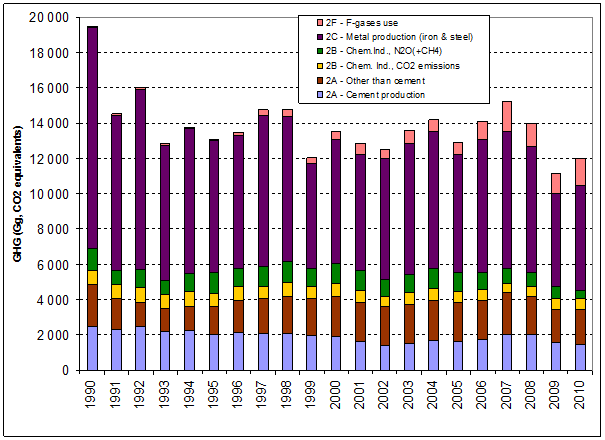
Category 2A (Mineral processes) includes practically only emissions of CO2,
similarly to category 2C (Metal production). CO2 emissions from the
chemical industry are produced by ammonia production, while the production of
nitric acid is a source of N2O
emissions. CH4 emissions from the Industrial processes sector are
not significant. Emissions from the use of F-gases (category 2F) are classified
in greater detail in the following figure.
Fig. 4‑2 HFC, PFC and SF6
emissions trends from industrial processes (sector 2F), in 1990 – 2010 [Gg]
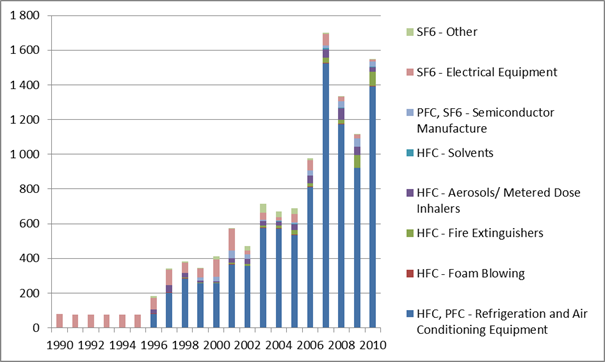
This category describes GHG emissions
from the non-fuel emissions from cement and lime production, limestone and
dolomite use, glass and ceramics production.
CO2
emissions from cement production have decreased since 1990 having the lowest
value in 2002. The decrease in the emissions during 1990’s was caused by the
transition from planed economy to market economy. This led to decrease in
industrial production and also emissions. Since 2003, the cement production
began to recover and production increased. Decrease in emissions since 2008 was
caused by the economic crisis and related construction constraints.
Cement production is one of the
traditional anthropogenic sources of carbon dioxide included in inventories;
however, its importance is incomparably smaller than the total combustion of
fossil fuels. Process-related CO2 is emitted during the production
of clinker (calcination process) when calcium carbonate (CaCO3) is heated
in a cement kiln up to temperatures of about 1 300 °C. During this
process, calcium carbonate is converted into lime (CaO - calcium oxide) and
carbon dioxide. CO2 emissions from combustion processes taking place
in the cement industry (especially heating of rotary kilns) have been reported
in IPCC category 1A2f. Limestone (and dolomite) contains also small amount of
magnesium carbonate (MgCO3) and fossil carbon (C), which will also
calcinate or oxidize in the process causing CO2 emissions.
CO2 emissions from 2A1 Cement production can be
calculated according to the 2000 GPG from the production of cement
(Tier 1) or clinker (Tier 2). New IPCC Guidelines (IPCC, 2006)
describes a new approach based on direct data from individual operators of
cement kilns (Tier 3). Since 2006 submission methodology equal to the
Tier 3 has been employed. CO2 emissions are based on data
submitted by the cement kiln operators for preparation and standard operation
of the EU ETS system, which includes all the cement kilns in Czech Republic.
Information from individual kilns is reported to the competent authority. This
data covers years 1990, 1996, 1998 - 2002 and 2005 -
2010. For other years the EF was extrapolated.
The methodology used for CO2
emissions must be in accordance with national legislation (Vyhláška 12/2009 o
stanovení postupu zjišťování, vykazování a ověřování množství emisí
skleníkových plynů / Decree 12/2009 establishing a procedure for identifying,
reporting and verifying emissions of greenhouse gases) and the EU legislation
(Commission Decision of 18 July 2007 establishing guidelines for the monitoring
and reporting of greenhouse gas emissions pursuant to Directive 2003/87/EC of
the European Parliament and of the Council). The total reported CO2
emissions from all (5) Czech installations are above 50 kt per year. Two of
them reported emissions above 500 kt per year. In all cases, limestone/cement
flow is the key parameter, which has the greatest impact on the total emissions
from the installation. The content of calcium/magnesium oxide (CaO/MgO) and
composition of the limestone and dolomite are measured and independently
verified. These parameters are used for calculation of the CO2
emissions and, therefore, substantial attention is devoted to their
determination.
All operating cement plants in the
Czech Republic are equipped with dust control technology and the dust is then
recycled to the kiln. Only in one cement plant is a small part of the CKD
discarded, for technical reasons. Use of dolomite or amount of magnesium
carbonate in the raw material, as well as fissile carbon (C) content is known,
all above mentioned variables are used for emissions estimates in the EU ETS system. For reasons of confidentiality, it is not possible to make public available
all above mentioned data, but only total emission estimates.
Data on cement clinker production is
published by the Czech Cement Association (CCA) (CCA, 2010), which associates
all Czech cement producers. Clinker production data together with extrapolated
EF was used for years without direct data from cement kiln operators. IEF,
which is calculated based on CO2 emissions and clinker production,
varies from 0.5267 to 0.5534 t CO2 / t clinker.
All uncertainty estimates of activity
data and emission factors have so far been based on expert judgment (see Tab.1‑3, Tab.1‑4 and
Tab.1‑5 in
Chapter 1.7 on
page 47).
Time series consistency is ensured as
the above mentioned methodology are employed identically across the whole
reporting period from the base year 1990 to 2010.
General QA/QC procedures and various
source specific approaches are used for QA/QC:
·
Inter-annual
changes of IEF are analyzed.
The EU ETS
emissions reports from individual installations are verified by independent
verifiers.
Total
emissions generated as the sum of emissions from non-combustion processes
reported by individual cement kiln operators to the competent authority are
compared with the data provided by the Czech Cement Association. Discrepancies
are discussed.
No recalculations are applicable for
this year.
It is planed to process all available
information about uncertainty form the EU ETS and provide category and national
specific uncertainty assessment.
CO2
emissions from lime production have decreased considerably since 1990 and were
lowest in 2009 (625 Gg CO2). The decrease in emissions between 1990
and 1991 was caused by the transition from a planned economy to a market
economy and closing of lime kilns, together with a decrease in industrial
production. Since then, lime production has varied slightly around 1 100
kt/year, except for 2009, when production dropped to a minimum for the whole
period of 853 kt. Lime production has reached 915 kt in 2010.
CO2 in this category is
emitted during the calcination step. Calcium carbonate (CaCO3) in
limestone and calcium / magnesium carbonates in dolomite rock (CaCO3•MgCO3)
are decomposed to CO2 and quicklime (CaO) or dolomite quicklime
(CaO•MgO), respectively.
Emissions from lime production were
calculated in accordance with 2000 GPG. Only CO2 emissions generated
in the process of the calcination step of lime treatment are considered under
category 2A2. CO2 emissions from combustion processes (heating of
kilns and furnaces) are reported under category 1A2f. National EF reflects the
production of lime and quick lime (0.7884 t CO2 / t lime) (Vácha,
2004). Furthermore, it is taken into account the average purity (93%) (Vácha,
2004) of lime produced in Czech Republic.
Activity data are based on statistics
from the Czech Lime Association (CLA, 2011), which publishes data on pure lime
production, so that these data were considered to be more accurate in
comparison with data from the Czech Statistical Office, which do not
differentiate between lime and hydrated lime.
Tab. 4‑2 Comparison of CO2 emissions from lime production 2005
– 2010shows
comparison of CO2 emissions calculated according to IPCC methodology
and process-related emissions reported for EU ETS. ETS data closely corresponds
to the IPCC methodology and national circumstances.
Tab. 4‑2 Comparison of CO2 emissions from
lime production 2005 – 2010
|
|
Lime produced
[t / year]
|
Process-specific CO2
emissions
[Gg]
|
|
IPCC methodology
|
EU ETS
|
|
2005
|
1 040
|
763
|
738
|
|
2006
|
1 034
|
758
|
748
|
|
2007
|
1 083
|
794
|
772
|
|
2008
|
1 012
|
742
|
717
|
|
2009
|
853
|
625
|
596
|
|
2010
|
915
|
671
|
646
|
All uncertainty estimates of activity
data and emission factors have so far been based on expert judgment (see Tab.1‑3, Tab.1‑4 and
Tab.1‑5 in
Chapter 1.7 on
page 47).
Time series consistency is ensured as
the inventory approaches concerned are employed identically across the whole
reporting period from the base year 1990 to 2010.
General QA/QC procedures and various
source specific approaches are used for QA/QC:
The reports
on EU ETS emissions from the individual installations have been verified by
independent verifiers. The methodology used for estimation of CO2
emissions must be in accordance with the national legislation (Vyhláška 12/2009
o stanovení postupu zjišťování, vykazování a ověřování množství emisí
skleníkových plynů / Decree 12/2009 establishing a procedure for identifying,
reporting and verifying emissions of greenhouse gases) and the EU legislation
(Commission Decision of 18 July 2007 establishing guidelines for the monitoring
and reporting of greenhouse gas emissions pursuant to Directive 2003/87/EC of
the European Parliament and of the Council).
Emission
estimates are compared with the sum of emissions from non-combustion processes
reported by individual lime kiln operators to the competent authority and with
the data provided by the Czech Lime Association (CLA 2011, Yearbook of the
Association). Discrepancy was discussed and preliminary result shows that the value
of average purity is probably slightly above-estimated.
No recalculations are applicable for
this year.
It is planed to process all available
information about uncertainty form the EU ETS and provide category and national
specific uncertainty assessment.
Category 2A3 Limestone and Dolomite Use includes emissions from sulphur
removal using limestone and emissions from limestone and dolomite use in sintering
plants. Emissions from sulphur removal have increased since 1996, when the
first sulphur-removal unit came into operation. All Czech thermal power plants
have been equipped with sulphur-removal units since 1999. Since 1999, these
emissions have varied between 0.5 and 0.6 Mt CO2 according to
electricity production from thermal (brown coal) power plants. Emissions from
limestone and dolomite use in sintering plants have fluctuated and were influenced by the transition from a
planned economy to a market economy, and restructuring and modernization of the
iron and steel industry. The decrease in emissions in 2008 and 2009 was caused
by the economic crisis. In 2010 a slight improvement in the economy followed by
an increase in emissions was observed.
From the chemical standpoint, sulphur
removal from combustion products in coal combustion, using limestone, is a
related source of CO2 emissions, although it is not of great
importance. Here, it holds that one mole of SO2 removed releases one
mole of CO2 without
regard to the sulphur-removal technology employed and the stoichiometric
excess. Limestone and dolomite are added to sinter where they are calcined, the
products subsequently acting as slag formers in blast furnaces.
Emissions from limestone and dolomite
which are used for cement production are reported under cement production,
similarly to lime and glass production. There is no other known production or
process which uses limestone and/or dolomite and produces CO2
emissions in the CR.
CO2 emissions from sulphur
removal were calculated from coal consumption for electricity production, the
sulphur content and the effectiveness of sulphur removal units between 1996,
when the first sulphur removal units came into operation, and 2005. In 2005,
these data were verified by comparison with data from the individual power
plants, which were collected for EU ETS preparation and which cover the years
1999 – 2005. The EU ETS data form has been used since 2006. The methodology
used for estimation of the CO2 emissions must be in accordance with
the national legislation (Vyhláška 12/2009 o stanovení postupu zjišťování,
vykazování a ověřování množství emisí skleníkových plynů / Decree 12/2009
establishing a procedure for identifying, reporting and verifying emissions of
greenhouse gases) and the EU legislation (Commission Decision of 18 July 2007
establishing guidelines for the monitoring and reporting of greenhouse gas
emissions pursuant to Directive 2003/87/EC of the European Parliament and of
the Council). Fig. 4‑3 shows
comparison of the two methodologies. Tab. 4‑3
lists data for this category.
Emissions from limestone and dolomite
use in sintering plants were new source, in 2006 submission, which was
identified in the process of preparation of the EU Emission Trading Scheme.
Only 2 sintering plants have existed in the CR in recent times. CO2
emissions from this category are calculated on the basis of data from
statistics (The Steel Federation, Inc - production of agglomerate / sinter) and
the EF value, which was derived from EU ETS CO2 emission data based
on the limestone and dolomite compositions and consumptions (0.08 t CO2 / t
sinter). Tab 4.3 lists data for this category.
In the CRF tables emissions and
activity data for sulphur removal with limestone and emissions from limestone
and dolomite use in sintering plants are reported together in the category 2A3
Limestone and Dolomite Use.
Tab. 4‑3 CO2 emissions from Limestone and Dolomite Use in
desulphurization unit, sinter plant, in 1990 – 2010 [Gg]
|
|
CO2
emissions from desulfurization
|
CO2
emissions from sinter plant
|
|
CO2
emissions from desulfurization
|
CO2
emissions from sinter plant
|
|
1990
|
NO
|
678
|
2001
|
551
|
482
|
|
1991
|
NO
|
605
|
2002
|
551
|
492
|
|
1992
|
NO
|
283
|
2003
|
560
|
473
|
|
1993
|
NO
|
251
|
2004
|
551
|
494
|
|
1994
|
NO
|
291
|
2005
|
589
|
467
|
|
1995
|
NO
|
519
|
2006
|
587
|
483
|
|
1996
|
76
|
587
|
2007
|
614
|
492
|
|
1997
|
241
|
510
|
2008
|
607
|
411
|
|
1998
|
417
|
492
|
2009
|
600
|
345
|
|
1999
|
537
|
438
|
2010
|
651
|
370
|
|
2000
|
540
|
468
|
|
|
|
All uncertainty estimates of activity
data and emission factors have so far been based on expert judgment (see Tab.1‑3, Tab.1‑4 and
Tab.1‑5 in
Chapter 1.7 on
page 47).
Time series consistency is ensured
for the limestone and dolomite use in sintering plants as the inventory
approaches concerned are employed identically across the whole reporting period
from the base year 1990 to 2010. Time series for sulphur removal with limestone
is not fully consistent as the methodology was changed. The Fig. 4‑3 shows
differences between estimates based on coal consumption for electricity
production, sulphur content and the effectiveness of sulphur removal and
estimates provided for EU ETS.
Fig. 4‑3 Emission estimates comparison for Limestone and Dolomite Use in
desulphurization unit, in 1990 – 2010 [Gg]
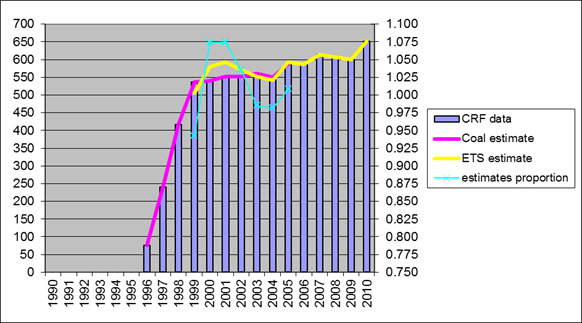
In the limestone and dolomite use
category general QA/QC procedures are used.
No recalculations are applicable for
this year.
It is planed to process all available
information about uncertainty form the EU ETS and provide category and national
specific uncertainty assessment.
A CO2
emissions from Soda Ash Production and Use (2A4) category come only from soda
ash use. Soda ash is not produced in the CR. Except for the Glass production
category, soda ash is used in only one other installation. CO2
emissions from this category are small and insignificant (approximately 0.4 Gg CO2)
compared to the other categories.
For each mole of soda ash use, one mole of CO2
is emitted, so that the mass of CO2 emitted from the use of soda ash
can be estimated from a consideration of the consumption data and the
stoichiometry of the chemical process.
The data about the amount and purity of the
soda ash used were obtained directly from the installation operator.
All
the uncertainty estimates related to the activity data and emission factors
have so far been based on expert judgment (see Tab.1‑3, Tab.1‑4 and Tab.1‑5 in Chapter 1.7 on page 47).
Time
series consistency is ensured as the inventory approaches concerned are
employed identically across the whole reporting period from the base year of
2001, when the use of soda started, to 2010.
General
QA/QC procedures are used in the 2A4 Soda Ash Use and Production category.
No
recalculations are applicable for this year.
There are no plans concerning this category.
The 2A7 Other category summarizes emissions from Glass Production (2A7.1 – CO2) and from Brick and Ceramics Production (2A7.2 – CO2
and CH4). CO2 emissions from 2A7.1 Glass production equalled 143 Gg in 2010. Emissions (CO2
and CH4) from Brick and
Ceramics Production (2A7.2) amounted to 123 kt CO2 eq. in 2010.
4.2.5.1
Source
category description
CO2 emissions from Glass Production (2A7.1) are derived
particularly from the decomposition of alkaline carbonates added to
glass-making sand. CO2 and CH4 emissions from Brick and
Ceramics Production, are derived particularly from the decomposition of
alkaline carbonates, fossil and biogenic carbon based substances
included in the raw materials.
The emission factor value of
0.14 t CO2 / t glass was taken from the new
version of the guidebook (EMEP / CORINAIR Atmospheric Emission
Inventory Guidebook, 1999). Activity data are collected and published by the
Association of the Glass and Ceramic Industry of the Czech Republic.
Emissions from 2A7.2 Brick and Ceramics Production are derived particularly
from the decomposition of alkaline carbonates fossil and biogenic carbon based substances included in the raw materials. The EF value was derived from individual
installation data collected for EU ETS (emissions) and from CzSO (production).
The calculation is based on the total production of ceramic products (fine
ceramics, tiles, roofing tiles, and bricks) and the EF value.
All uncertainty estimates of activity
data and emission factors have so far been based on expert judgment (see Tab.1‑3, Tab.1‑4 and
Tab.1‑5 in
Chapter 1.7 on
page 47).
Time series consistency is ensured as
the inventory approaches concerned are employed identically across the whole
reporting period from the base year 1990 to 2010.
In the 2A7 Other category general
QA/QC procedures are used.
No recalculations are
applicable for this year.
It is planned to process all the
available information about uncertainty from the EU ETS and to provide category
and national specific uncertainty assessments. Also it is planned to verify emission
estimates with data from the EU ETS system and other available sources.
Of the categories of sources classified under the Chemical industry
(2B), categories 1B1, 1B2 and 1B5 are relevant for the Czech Republic, where
adipic acid (1B3) and carbides (1B4) are not produced here.
The production of ammonia constitutes an important source of CO2
derived from non-energy use of fuels in the chemical industry. CO2
emissions from ammonia production in 2010 equalled 617.8 Gg of CO2,
corresponding to approx. 0.5% of total greenhouse gas emissions without LULUCF.
These emissions decreased by 23% compared to 1990; however, emissions up to
2010 are almost constant, with slight fluctuations. Ammonia production (CO2
emissions) was not identified as a key category this year (in contrast to some
previous years). However, it remains just under the threshold value in the
determination by level assessment.
4.3.1.1 Source category description
Industrial ammonia production is based on the catalytic reaction between
nitrogen and hydrogen: N2
+ 3H2 = 2NH3
Nitrogen is obtained by cryogenic rectification of air and hydrogen is
prepared using starting materials containing bonded carbon (such as, e.g.,
natural gas, residual oil, heating oil, etc.). Carbon dioxide is generated in
the preparation of these starting materials.
In the Czech Republic, hydrogen for ammonia production is derived from
residual oil from petroleum refining, which undergoes partial oxidation in the
presence of water vapour. In order to increase the hydrogen production, the
second step involves conversion of carbon monoxide, which is formed by partial
oxidation, in addition to carbon dioxide and hydrogen. The final products of
this two-step process are hydrogen and carbon dioxide. The production
technology has practically not changed since 1990.
4.3.1.2 Methodological Issues
Emissions are calculated from the corresponding amount of ammonia
produced, using the technologically-specific emission factor 2.40 Gg CO2 / Gg
NH3 (Markvart and Bernauer, 2005 - 2010). This emission factor was
derived from the relevant technical literature - Ullman’s Encyclopedia (Wiley, 2005) corresponding to the ammonia
production employed in the Czech Republic, including information required for
deriving the carbon dioxide emission factor: 56.25 t NH3 are
produced from 44 t of residual oil containing 84.6% C. Simple stoichiometric
calculation yields the value of the emission factor EF CO2 = 2.402 t
CO2/t NH3. This emission factor includes the efficiency
of the conversion of carbon contained in the starting material to carbon
dioxide, equal to 99% (i.e. an oxidation factor of 0.99).
A potential uncertainty in the emission factor for ammonia would not
influence the total sum of CO2 emissions because a corresponding
amount of oil is not considered in the energy sector. The relevant activity
data and corresponding emissions are given in Tab. 4‑4 Activity data and CO2 emissions
from ammonia production in 1990 – 2010
Tab. 4‑4 Activity data and CO2 emissions
from ammonia production in 1990 – 2010
|
Year
|
1990
|
1991
|
1992
|
1993
|
1994
|
1995
|
1996
|
1997
|
|
Residual fuel
oil used for NH3 product., [TJ]
|
11113
|
10770
|
11104
|
10383
|
11593
|
10235
|
11015
|
10095
|
|
Ammonia
produced, [kt]
|
335.9
|
325.5
|
335.6
|
313.8
|
350.4
|
309.3
|
332.9
|
305.1
|
|
CO2
from 2B1, [Gg]
|
806.8
|
781.9
|
806.1
|
753.8
|
841.6
|
743.0
|
799.7
|
732.9
|
|
|
|
|
|
|
|
|
|
|
|
Year
|
1998
|
1999
|
2000
|
2001
|
2002
|
2003
|
2004
|
2005
|
|
Residual fuel
oil used for NH3 product., [TJ]
|
10407
|
8864
|
10144
|
8538
|
7449
|
9696
|
9721
|
8478
|
|
Ammonia
produced, [kt]
|
314.5
|
267.9
|
306.6
|
258.0
|
225.1
|
293.0
|
290.8
|
253.6
|
|
CO2
from 2B1, [Gg]
|
755.5
|
643.6
|
736.5
|
619.9
|
540.8
|
703.9
|
698.7
|
609.3
|
|
|
|
|
|
|
|
|
|
|
|
Year
|
2006
|
2007
|
2008
|
2009
|
2010
|
|
|
Residual fuel
oil used for NH3 product., [TJ]
|
8086
|
7575
|
8487
|
8739
|
8510
|
|
|
Ammonia
produced, [kt]
|
241.9
|
226.6
|
256.5
|
264.1
|
257.2
|
|
|
CO2
from 2B1, [Gg]
|
581.1
|
544.4
|
616.3
|
634.4
|
617.8
|
|
4.3.1.3 Uncertainty and time consistency
All uncertainty estimates of
activity data and emission factors have so far been based on expert judgment (see
Tab.1‑3, Tab.1‑4 and
Tab.1‑5 in
Chapter 1.7 on
page 47).
Time series consistency is
ensured as the above mentioned methodology are employed identically across the
whole reporting period from the base year 1990 to
2010.
4.3.1.4 Source-specific QA/QC and
verification
The sector-specific QA/QC plan
follows from the overall plan described in Chapter 1. Attention was focused on
identifying gaps and imperfections using the reporting software (CRF Reporter),
specifically by observing trends in figures and by checking IEFs. Attention was
also focused on checking sources from inter-sector boundaries (Energy,
Industry) that they are neither omitted nor counted twice. Therefore CO2
emissions from residual oil used for ammonia production are not taken into
account in Energy sector. This part of QA/QC procedure is carried out in
cooperation with experts from KONEKO.
4.3.1.5 Source-specific recalculations
No recalculations were
employed in this category in this submission.
4.3.1.6 Source-specific planned improvements
It is planed to continue
improvement of the uncertainty data.
The production of nitric acid constitutes one of the most important
sources of N2O in the
chemical industry. N2O
emissions from production of nitric acid in 2010 equalled 1.21 Gg N2O, corresponding to
approx. 0.4 % of total greenhouse gas emissions without LULUCF. These emissions
have decreased by 67% compared to 1990; the substantial decrease in recent
years has been a consequence of the gradual introduction of mitigation
technology and improving its effectiveness. In 2010, the production of nitric
acid (N2O emissions)
was identified as a key category by trend assessment. In former years, when N2O emissions reached
greater values, this category was identified as a key source by level
assessment.
The production of nitric acid is one of the traditional production
processes in the Czech Republic. It is produced in three factories, where one
of them manufactures more than 60% of the total amount. Nitric acid is produced
by the classical method by high-temperature catalytic oxidation of ammonia and
subsequent absorption of nitrogen oxides in water. Nitrous (dinitrogen) oxide
is formed in the production of the acid as an unwanted side product.
The production process is performed in the Czech Republic at three
pressure levels (at atmospheric pressure, slightly elevated pressure (approx.
0.4 MPa) and at elevated pressure (0.7 - 0.8 MPa). While production processes
prior to 2003 mostly progressed at atmospheric pressure and only to a lesser
degree at medium elevated pressure, the process at elevated pressure had
predominated since 2004.
All the production processes in the Czech Republic are equipped with
technologies for removal of nitrogen oxides, NOx,
based on selective or non-selective catalytic reduction. Non-selective
catalytic reduction also makes a substantial contribution to removal of N2O. Since 2004, technology
to reduce N2O
emissions, based on catalytic decomposition of this oxide, has been gradually
introduced at units working at elevated pressure. It has been possible to
substantially improve the effectiveness of this process in recent years.
Nitrous oxide emissions from 2B2 Nitric Acid Production are
generated as a by-product in the catalytic process of oxidation of ammonia. It
follows from domestic studies (Markvart and Bernauer, 1999, 2000, 2003),
describing conditions prior to 2004, that the resulting emission factor depends
on the technology employed: higher emission factor values are usually given for
processes carried out at normal pressure, while lower values are usually given
for medium-pressure processes. Two types of processes were carried out in this
country before 2004, at pressures of 0.1 MPa and 0.4 MPa. The amount of nitrous
oxide in the exit gases is also affected by the type of process employed to
remove nitrogen oxides, NOx
(i.e. NO and NO2). In this country, the process of Selective
Catalytic Reduction (SCR) is mostly used, which slightly increases the amount
of N2O, and also to a
certain degree Non-Selective Catalytic Reduction (NSCR), which also removes N2O to a considerable
degree.
Studies (Markvart and
Bernauer, 2000, 2003) recommend the following
emission factors for various types of production technology and removal
processes that are given in Tab. 4‑5. The emission factors for the basic process (without
DENOX technology) are in accord with the principles given in the above-cited IPCC methodology. The effect of the NOx removal technology on
the emission factor for N2O
was evaluated on the basis of the balance calculations presented in studies
(Markvart and Bernauer, 2000, 2003).
Tab. 4‑5 Emission factors for N2O
recommended by (Markvart and Bernauer, 2000) for 1990 - 2003
|
Pressure in HNO3
production
|
0.1 MPa
|
0.4 MPa
|
|
Technology DENOX
|
--
|
SCR
|
NSCR
|
--
|
SCR
|
NSCR
|
|
Emission factors N2O [kg N2O / t HNO3]
|
9.05
|
9.20
|
1.80
|
5.43
|
5.58
|
1.09
|
Collection of activity data
for HNO3 production is more difficult than for cement production
because of the present legislation, which complicates the releasing of
statistical data on manufactured products where the number of producers is
smaller than (or equal to) three. Therefore, it was necessary to obtain them by
questioning all three producers in the Czech Republic, see (Markvart and
Bernauer, 2000, 2003, 2004).
During 2003, conditions
changed substantially as a result of the installation of new technologies
operating under higher pressure of 0.7 MPa. At the same time, some older units
operating under atmospheric pressure of 0.1 MPa were phased out. These changes
in technology were monitored in the study of Markvart and Bernauer (Markvart
and Bernauer, 2005). This study presents a slightly modified table of N2O emission factors, while
those for new technologies were obtained from a set of continuous emission
measurements lasting several months. Other values are based on several discrete
measurements. A table of these technology-specific emissions factors is given
below.
Tab. 4‑6 Emission factors for N2O recommended by Markvart
and Bernauer, for 2004 and thereafter
|
Pressure
|
0.1 MPa
|
0.4 MPa
|
0.4 MPa
|
0.7 MPa
|
|
DENOX process
|
SCR
|
SCR
|
NSCR
|
SCR
|
|
EF, kg N2O / t HNO3
(100 %)
|
9.05
|
4.9
|
1.09
|
7.8 a)
|
a) EF without N2O
mitigation. Cases of N2O
mitigation in 2005 -2008 are shown in Tab. 4‑7
In the last quarter of 2005, a
new N2O mitigation
unit based on catalytic decomposition of N2O
was experimentally installed for 0.7 MPa technology, and became the most important
such unit in the Czech Republic. As a consequence of this technology, the
relevant EF decreased from 7.8 to 4.68 kg N2O/t
HNO3 (100 %). Therefore, the mean value in 2005 for the 0.7 MPa
technology was equal to 7.02 kg N2O/t
HNO3 (100 %), (Markvart and Bernauer, 2006)
In 2006 - 2010, the mitigation
unit described above was utilized in a more effective way, see (Markvart and
Bernauer, 2007 - 2011). The decrease in the emission factor for 0.7 MPa
technology as a result of installation of the N2O
mitigation unit and gradual improvement of the effectiveness is given in Tab. 4‑7.
Two high temperature N2O
decomposition catalytic systems were used in the above-mentioned high pressure
nitric acid technology (0.7 MPa) in 2009; these systems were more efficient in
comparison with the catalytic systems used in previous years. The first system consisting of
Raschig rings provided by Heraeus was used in the January-June 2009 period and
the measured EF N2O
was 3.10 kg N2O/ t HNO3
(100 %); in the July-November 2009
period, EF N2O
was 3.30 kg N2O/ t HNO3
(100 %). The second system
consisting of high temperature N2O
decomposition catalyst developed by YARA company, decreased EF N2O
in the November-December 2009 period to the value 0.95 kg N2O/ t HNO3
(100 %) in a high-pressure nitric plant. The catalytic activity of the high temperature decomposition system has decreased slightly due to both
increasing selectivity of the Pt-Rh ammonia oxidation
catalyst towards N2O
and slow deactivation of the N2O decomposition catalyst. Thus, the mean
value of EF N2O for
this high pressure nitric acid technology in 2009 was assessed at a value of
2.85 kg N2O/ t HNO3
(100 %) (Tab. 4‑7).
The most efficient decomposition catalyst provided
by YARA was used in this high pressure nitric acid technology during whole year of 2010. It is expected
that, if high temperature N2O decomposition catalyst (i.e.
YARA catalyst) is employed, the EF N2O
could be approximately close to 1.3 kg N2O/ t HNO3
(100 %).
Tab. 4‑7 Decrease in the emission factor for 0.7 MPa technology due to
installation of the N2O
mitigation unit
|
Year
|
2004 a)
|
2005
|
2006
|
2007
|
2008
|
2009
|
2010
|
|
EF, kg N2O / t HNO3
(100 %)
|
7.8
|
7.02
|
5.94
|
4.37
|
4.82
|
2.85
|
1.29
|
|
Effectiveness of
mitigation, %
|
-
|
10
|
23.9
|
43.9
|
38.2
|
63.4
|
83.4
|
a) EF without N2O mitigation.
The
emission factors used in the Czech Republic are compared with the EFs presented
in the IPCC methodology (IPCC, 2000) in the Tab. 4‑8.
Tab. 4‑9 gives
the N2O emissions from
production of nitric acid, including the production values.
Tab. 4‑8 Comparison of emission factors for N2O
from HNO3 production
|
Production process
|
N2O Emission factor (kg N2O/t
100% HNO3)
|
Reference
|
|
Canada
Plants without NSCR
Plants with NSCR
|
8.5
<2
|
(IPCC, 2000)
|
|
USA
Plants without NSCR
Plants with NSCR
|
9.5
2
|
(IPCC, 2000)
|
|
Norway
Process-integrated N2O destruction
Atmospheric pressure plant
Medium pressure plant
|
<2
4–5
6–7.5
|
(IPCC, 2000)
|
|
Other countries
Dual-pressure plant (European
design)
Older plants (pre-1975), without
NSCR
|
8–10
10–19
|
(IPCC, 2000)
|
|
Czech Republic
Atmospheric pressure plants
Medium pressure plants with SCR
Medium pressure plants with NSCR
High pressure plants SCR (no N2O decomposition)
High pressure plants SCR (with N2O decomposition)
|
9.05
4.9
1.09
7.8
4.82 – 1.29
|
(Markvart and Bernauer, 2009,
2010)
|
Tab. 4‑9 Emission trends for HNO3 production and N2O emissions
|
|
Production of HNO3,
[Gg HNO3 (100 %)]
|
Emissions of N2O [Gg N2O]
from HNO3 production
|
|
1990
|
530.0
|
3.63
|
|
1991
|
349.6
|
2.37
|
|
1992
|
439.4
|
2.98
|
|
1993
|
335.9
|
2.27
|
|
1994
|
439.8
|
2.94
|
|
1995
|
498.3
|
3.37
|
|
1996
|
484.8
|
3.06
|
|
1997
|
483.1
|
3.33
|
|
1998
|
532.5
|
3.59
|
|
1999
|
455.0
|
2.95
|
|
2000
|
505.0
|
3.36
|
|
2001
|
505.1
|
3.32
|
|
2002
|
437.1
|
2.87
|
|
2003
|
500.6
|
2.86
|
|
2004
|
533.7
|
3.27
|
|
2005
|
532.2
|
3.09
|
|
2006
|
543.1
|
2.76
|
|
2007
|
554.2
|
2.28
|
|
2008
|
507.0
|
2.14
|
|
2009
|
505.2
|
1.63
|
|
2010
|
441.7
|
1.21
|
All
uncertainty estimates for the activity data and emission factors have so far
been based on expert judgment (see Tab.1‑3, Tab.1‑4 and
Tab.1‑5 in
Chapter 1.7 on
page 47).
Their improvement is ongoing and some uncertainty values for HNO3
production have been recently revised and used in the two last submissions:
uncertainty in activity data was lowered from 10 % to 5 % and
uncertainty of the mean N2O
EF was lowered from 25 % to 20 %.
Time series consistency is
ensured as inventory approaches concerned are employed identically across the
whole reporting period from the base year of 1990 to 2010.
The sector-specific QA/QC plan
follows from the overall plan described in Chapter 1.
Attention is focused on identifying gaps and imperfections using the
reporting software (CRF Reporter), specifically by observing trends in figures
and by checking IEFs.
According to the QA/QC plan,
data and calculations are provided by the external consultants (M. Markvart and
B. Bernauer) are checked by the experts from CHMI and vice versa.
Technology-specific methods
for N2O emission
estimates have been improved by incorporating direct emission measurements,
especially for new technology (0.7 MPa), which is now predominant in the Czech
Republic.
No recalculations in the 2B2 category were employed in this submission.
It is planed to continue
improvement of the uncertainty data.
4.3.3.1 Source category description
This category includes methane emissions from the production of carbon
black, ethylene, dichloroethylene, styrene, methanol and N2O emissions from the
production of caprolactam. These are all less important sources.
4.3.3.2 Methodological issues
Default emissions from the IPCC methodology (IPCC, 1997) are employed to
determine methane emissions from the production of carbon black, ethylene,
dichloroethylene, styrene and methanol.
CH4 emissions from the production of carbon
black
The nominal capacity is currently 300 t p.a. Exact information on activity data is not
available for the individual years; thus, the data were taken as the expert
estimates mentioned in the study (Markvart and Bernauer, 2011), taking into
account the increase in carbon black consumption in the rubber industry:
1990-2000 200 t
carbon black p.a.
2001-2005 250 t
carbon black p.a.
2006-2010 300 t
carbon black p.a.
The emission factor taken from the IPCC method equals 0.11 kt CH4/kt
carbon black, so that the highest value of methane emissions over the past few
years is practically insignificant (0.0033 Gg).
CH4 emissions from the production of
ethylene
Reliable data for the production of ethylene are available from CzSO.
The IPCC methodology yields a value of 0.001 kt/kt for the default emission
factor for methane. In 1990 – 2010, methane emissions varied between 0.3 and
0.5 Gg CH4 (emissions equalled 0.455 Gg CH4 in 2010).
CH4 emissions from the production of
dichloroethylene
While CzSO does not publish information on the amount of
dichloroethylene produced, it does give data on the amount of PVC produced. The
study (Markvart and Bernauer, 2011) recommends multiplying the amount of PVC
produced by a coefficient of 1.23 derived from the stoichiometry. The IPCC
methodology yields a value of 0.0004 kt/kt for the default emission factor for
methane. Because of the low emission factor value, the values of methane emissions
varied in 1990 – 2010 between 0.04 and 0.06 Gg CH4 – and this is
thus a not very significant value. Emissions equalled 0.054 Gg CH4
in 2010.
CH4 emissions from the
production of styrene
Because of the growing consumption of polystyrene, the production of
styrene has gradually increased since 1990. CzSO also does not publish any
information on the production of styrene. Thus, the necessary activity data
were estimated on the basis of production capacities:
1990-1998 70 kt
styrene p.a.
1999 80
kt styrene p.a.
2000-2003 110 kt
styrene p.a.
2004 140
kt styrene p.a.
2005-2009 150 kt
styrene p.a.
from 2010 170 kt
styrene p.a.
These estimates of data on the amount of styrene produced, mentioned in
the study (Markvart and Bernauer, 2011), are based on the data given in the
article (Dvořák and Novák, 2010). The emission factor taken from the IPCC
method equals 0.004 kt CH4/kt styrene. In 1990 – 2010, methane
emissions varied between 0.3 and 0.7 Gg CH4 (emissions equalled 0.68
Gg CH4 in 2010).
Methanol is not produced in the Czech Republic and thus the symbol “NO”
applies to the entire time period from 1990.
Production of caprolactam
As mentioned in the references (Markvart and Bernauer, 2004 – 2011),
there is only one caprolactam production plant in the Czech Republic; this is
not a very important source of N2O
emissions. CzSO does not monitor production data on the production of
caprolactam; however, the series of studies by Markvart and Bernauer (Markvart
and Bernauer, 2004 – 2011), based on a study in the production factory, yields
an approximate value of 0.27 Gg N2O
for the period to 2005 and, following 2006, a value of 0.305 Gg N2O, based on increased
production capacity. More exact data should be available in the coming years,
when the N2O emissions
from the production of caprolactam will be continuously measured from 2012 as a
consequence of inclusion of the production in the emission trading scheme (EU
ETS) and thus recording in the relevant register.
4.3.3.3 Uncertainty and time consistency
In relation to the relatively insignificant greenhouse gas emissions
from category 2B5, uncertainties derived from the sources included in this
category have no great impact on the overall uncertainty in the determination
of GHG emissions in the Czech Republic Thus, it does not matter greatly that
the uncertainty in emissions from these sources was determined by an expert
estimate; the numerical values are given in Tab.1‑3, Tab.1‑4 and
Tab.1‑5 in
Chapter 1.7 on
page 47.
4.3.3.4 QA/QC and verification
In relation to the relatively unimportant greenhouse gas emissions from
category 2B5, only QC, Tier 1 procedures were used, in accordance with the
QA/QC plan.
4.3.3.5 Recalculations
In former submissions, CH4 emissions were reported for the
production of carbon black, dichloroethylene and styrene only following 2008
because of the lack of the activity data required for determining emissions.
However, the authors of the study (Markvart, Bernauer, 2011) recently managed
to obtain the data required for determining CH4 emissions from 1990
(see the “Methodical Issues” section). The newly determined values (replacing
symbol “NE”) must be seen as recalculations. This increase in the completeness
of the inventory has resolved the repeated recommendations of the international
inspection team over the past years.
4.3.3.6 Source-specific planned improvements
More exact data on N2O
emissions should be available in the coming years, when the N2O emissions from the
production of caprolactam will be continuously measured beginning in 2012 as a
consequence of inclusion of the production in the emission trading scheme (EU
ETS) and thus recording in the relevant register. No further improvement is
planned for methane emissions in this category.
This
category includes mainly CO2 emissions from 2C1 Iron and Steel Production. CO2 emissions from
iron and steel are identified as a key category (by both level and trend
assessments). A small amount of CH4 is also emitted.
Ferro-alloys were manufactured
in limited amounts in a small production unit in the Czech Republic; this
process could constitute an unsubstantial source of CO2 emissions.
Unfortunately, CzSO does not monitor any data on this production process.
Investigation revealed one smaller production plant, which reported that
aluminium was used as a reducing agent; this did not lead to CO2
emissions. In 2009 this production was stopped.
Iron is produced in the Czech Republic in two large metallurgical works
located in the cities of Ostrava and Třinec in the Moravian-Silesian Region, in
the north-eastern part of the Czech Republic. Both these metallurgical works
employ blast furnaces and also lines for the production of steel, coking
furnaces and other supplementary technical units. Another large steel plant is
located immediately next to the metallurgical works in Ostrava, taking raw iron
(in the liquid state) from the nearby blast furnaces (located in the area of
the Ostrava metallurgical works).
CO2 emissions were
determined for category 2C1 using a procedure corresponding to Tier 1 of
the Good Practice Guidance for 2C1.
This calculation was based on the amount of coke consumed in blast furnaces.
The calculation was carried out using NCV = 27.87 MJ/kg in 2010 (NCV interval
for period 1990 - 2010 is (27.9 - 28.8 MJ/kg) and using the carbon emission
factor for coke, 29.5 t C / TJ, which is the IPCC default value (IPCC, 1997). As the final
products in metallurgical processes are mostly steel and iron with very low
carbon contents, the relevant correction for the amount of carbon remaining in
the steel or iron was taken into account by using factor 0.98, i.e. the same
factor that is standardly used for combustion of solid fuels (the oxidation
factor). The major part of CO2 emissions calculated in this manner
is, in reality, emitted in the form of the products of combustion of
blast-furnace gas occurring mainly in metallurgical plants, while a smaller
part is emitted from heat treatment of pig iron during its transformation to
steel.
The relevant activity data and
corresponding emissions are given in Tab. 4‑10 Activity data and CO2 emissions
from iron and steel in 1990 - 2010.
Tab. 4‑10 Activity data
and CO2 emissions from iron and steel in 1990 - 2010
|
Year
|
1990
|
1991
|
1992
|
1993
|
1994
|
1995
|
1996
|
1997
|
|
Coke consumed
in blast furnaces, [kt]
|
4 222
|
2 959
|
3 447
|
2 582
|
2 724
|
2 857
|
2 701
|
2 846
|
|
CO2 from 2C1, [Gg]
|
12 533
|
8 781
|
10 230
|
7 690
|
8 231
|
7 523
|
7 861
|
8 520
|
|
|
|
|
|
|
|
|
|
|
|
Year
|
1998
|
1999
|
2000
|
2001
|
2002
|
2003
|
2004
|
2005
|
|
Coke consumed
in blast furnaces, [kt]
|
2 750
|
1 941
|
2 327
|
2 175
|
2 252
|
2 459
|
2 628
|
2 260
|
|
CO2 from 2C1, [Gg]
|
8 233
|
5 945
|
7 027
|
6 625
|
6 861
|
7 484
|
7 798
|
6 687
|
|
|
|
|
|
|
|
|
|
|
|
Year
|
2006
|
2007
|
2008
|
2009
|
2010
|
|
|
Coke consumed
in blast furnaces, [kt]
|
2 480
|
2 570
|
2 366
|
1 742
|
2 004
|
|
|
CO2 from 2C1, [Gg]
|
7 573
|
7 757
|
7 151
|
5 298
|
5 919
|
|
Estimation of CH4
from metal production is based on the CORINAIR methodology. Metal production
emits only 2.3 – 6.0 Gg of methane.
Emissions of methane in 2010
equaled 2.6 Gg, of which 1.3 Gg corresponds to the contribution of methane
emissions from coke production. In this case, the relevant activity data
correspond to the amount of coke produced from the Energy Balances of the CR
are given in CRF Tables. In contrast, the activity data used for calculation of
CO2 emissions, correspond to the amount of coke consumed in blast
furnaces. These data were determined from the CzSO material “Energy intensity
of manufacture of selected products". It should be pointed out that these
two series are not completely identical (e.g. part of the coke produced is used
for other purposes and imported coke can also be used in blast furnaces).
Emission estimates of
precursors for the relevant subcategories have been transferred from NFR to
CRF, as described in previous chapters.
The uncertainty estimates were
based on expert judgment (see Tab.1‑3, Tab.1‑4 and
Tab.1‑5 in
Chapter 1.7 on
page 47).
Their improvement is ongoing and is planned for inclusion in the next NIR.
Consistency
of the time series is ensured as the inventory approaches concerned are
employed identically across the whole reporting period from the base year of
1990 to 2010.
The sector-specific QA/QC plan
follows from the overall plan described in Chapter 1. The greatest attention
was focused on identifying gaps and imperfections using the new reporting
software (CRF Reporter), specifically by observing trends in figures and by
checking IEFs. Attention was also focused on checking sources from inter-sector
boundaries (Energy, Industry) that they are neither omitted nor counted twice. CO2
emissions from coke used in blast furnaces are not considered in Energy sector.
Activity data available in the
official CzSO materials in relation to QA/QC were independently determined by
experts from CHMI and KONEKO and were mutually compared. Experts at CHMI
additionally checked most of the calculations carried out by experts at KONEKO
and vice versa.
In the 2011 submission, the recalculation for the 2003 - 2008 period was
performed for CO2 emissions from 2C1 (Iron and steel production).
Estimation of these emissions in the Czech Republic is based on the amount of
coke consumed in blast furnaces. This amount (directly in TJ) was originally
taken from the document provided by the Czech Statistical Office (CzSO)
“Development of overall and specific consumption of fuels and energy in
relation to product”.
For this recalculation, the other official document of CzSO “CzSO
(2010): Energy Questionnaire - IEA / Eurostat (CZECH_COAL, CZECH_OIL,
CZECH_GAS, CZECH_REN), Prague 2010” was used as a source of data on
metallurgical coke consumed in blast furnaces. This approach, which is more
consistent with that used for the Energy sector since 2003, was recommended by
experts from CzSO because of better accuracy and reliability of coke data.
However, differences between the two sources of data are not very substantial:
e.g. for 2003, the recalculated CO2 emission value is 1.2% lower
than the original value, for 2008 the recalculated CO2 emission
value is 3.8% lower than the original value and for 2009 the newly estimated CO2
emission value is 4.4% higher than the value that would be obtained by the
older approach.
In the 2012 submission (i.e. in this submission), the above mentioned
recalculation was extended for the 1995 – 2002 period. With exception of 1995
and 1998, differences in CO2 emissions calculated from the two
sources are less the 2%. Similarly as in the case of 2011 submission, the
present recalculations were also harmonized with recalculations in the sector Energy.
It is planned to implement
uncertainty assessment. Moreover, application of more advanced Tier 2
methodology for Iron and steel production is planned in the future. At the
present time, options are being explored for obtaining the relevant data for
this purpose.
In this sector are reported only
indirect GHGs and SO2 from sectors Pulp and Paper; Food and Drink.
Halocarbons and SF6 are
not produced in Czech Republic.
Emissions of F-gases (HFCs, PFCs, SF6)
in the Czech Republic are at a relatively low level due to the absence of large
industrial sources of F-gases emissions. As mentioned above, F-gases are not
produced in the Czech Republic and therefore there are no fugitive emissions
from manufacturing. Additionally, there is no production of other fluorinated
gases (CFCs, HCFCs, etc.) that could lead to by-product F-gases emissions and
there is no aluminum and magnesium industry in the Czech Republic. F-gases
emission in 2009 dropped compared to 2008 as result of finance crisis and lower
production in air-conditioning, refrigeration and car industry.
F-gases
emissions from national sources are coming only from their consumption in
applications as follows:
- SF6 used in electrical equipment,
- SF6 used in sound proof windows production,
- SF6 used in special applications (laboratory),
- HFCs, PFCs and SF6 used in semiconductor manufacturing,
- HFCs and PFCs used as refrigerants in refrigeration and air
conditioning equipment,
- HFCs used as propellants in aerosols,
- HFCs used as blowing agents,
- HFCs used as extinguishing agents in fixed fire fighting systems.
No official statistics that would
allow easy disaggregated reporting and / or use of the highest tiers
are currently available in the Czech Republic. All the data are collected based
on voluntary cooperation between sectoral experts and private companies.
For source consumption of F-gases,
potential emissions increased from 169.4 Gg CO2 eq. in 1995 to
3 915.6 Gg CO2 eq. in 2010. The significant increase
compared to 2009 could be explained mainly by the economic recovery and a
substantial increase in the use of HFCs. For the source consumption of F-gases,
actual emissions increased from 76.1 Gg CO2 eq. in 1995 to
1 549.0 Gg CO2 eq. in 2010. This significant increase
could be explained as being mainly due to a substantial increase in the use of
HFCs in refrigeration. The marked sharp decrease between 2007 and 2009 is due
to a production decrease as a result of the financial crisis. Detailed
information about actual and potential emissions is given in Tab. 4‑11 and
the CRF Tables.
Tab. 4‑11 HFCs, PFCs and SF6
potential and actual emissions in 1995 - 2010 [Gg CO2 eq.]
|
|
Potential
|
Actual
|
|
HFCs
|
PFCs
|
SF6
|
Total
|
HFCs
|
PFCs
|
SF6
|
Total
|
|
1995
|
2.21
|
0.35
|
166.82
|
169.38
|
0.73
|
0.12
|
75.20
|
76.06
|
|
1996
|
134.51
|
4.22
|
183.07
|
321.80
|
101.31
|
4.11
|
77.52
|
182.94
|
|
1997
|
479.44
|
1.17
|
180.49
|
661.10
|
244.81
|
0.89
|
95.48
|
341.18
|
|
1998
|
577.87
|
1.17
|
126.02
|
705.07
|
316.56
|
0.89
|
64.19
|
381.63
|
|
1999
|
411.87
|
2.74
|
110.90
|
525.50
|
267.47
|
2.55
|
76.98
|
347.01
|
|
2000
|
674.32
|
9.45
|
206.02
|
889.79
|
262.50
|
8.81
|
141.92
|
413.23
|
|
2001
|
1045.13
|
14.49
|
223.23
|
1282.84
|
393.37
|
12.35
|
168.73
|
574.45
|
|
2002
|
1092.41
|
17.91
|
211.85
|
1322.17
|
391.29
|
13.72
|
67.72
|
472.73
|
|
2003
|
1343.94
|
28.64
|
339.26
|
1711.84
|
590.14
|
24.53
|
101.25
|
715.93
|
|
2004
|
1215.00
|
20.98
|
208.00
|
1443.98
|
600.30
|
17.33
|
51.89
|
669.51
|
|
2005
|
1280.55
|
13.77
|
156.88
|
1451.20
|
594.21
|
10.08
|
85.88
|
690.17
|
|
2006
|
2573.99
|
30.33
|
161.90
|
2766.21
|
872.35
|
22.56
|
83.07
|
977.98
|
|
2007
|
3884.78
|
27.57
|
133.84
|
4046.18
|
1605.85
|
20.16
|
75.85
|
1701.86
|
|
2008
|
3053.38
|
38.25
|
85.32
|
3176.95
|
1262.45
|
27.48
|
47.04
|
1336.98
|
|
2009
|
2355.90
|
39.38
|
132.17
|
2527.44
|
1045.67
|
27.14
|
49.61
|
1118.41
|
|
2010
|
3854.62
|
44.25
|
16.73
|
3915.60
|
1503.36
|
29.43
|
16.22
|
1549.01
|
Currently, the national F-gases inventory
is based on the method of actual emissions. The method of potential emissions
is used only as supporting information.
According to the Revised 1996 IPCC Guidelines (IPCC, 1997), potential emissions have
been calculated from the consumption of F-gases (sum of domestic production and
import minus export and environmentally sound disposal). Due to the relatively
short time of use of F-gases, it has been assumed that the disposed amount is
relatively small. In 2010, a small amount of destroyed F-gases was reported.
The main part of these gases was imported to CR for destruction and did not
come from equipment operating in the CR. The potential methodology is the same
for all categories of use of F-gases. The actual emissions methodology is
specified for each category.
As these substances are not
nationally produced, import and export information coming from official customs
authorities are of the key importance. Individual F-gases do not have a
separate custom codes in the customs tariff list as individual chemical
substances. SF6 is listed as a part of cluster of non-metal
halogenides and oxides, HFCs and PFCs are listed as total in the cluster of
halogen derivatives of acyclic hydrocarbons. In order to determine the exact
amounts of these substances, it is essential to obtain information from the
customs statistics and from individual importers and exporters, about (a) the
imported and exported amounts and (b) kinds of substances (or their mixtures),
(c) the amounts and types of disposed F-gases and also (d) the areas of usage.
For the first year, also data about direct import, export, use and destruction
were obtained from ISPOP. ISPOP is national system of environmental reporting;
all importers, exporters and users of more than a threshold of 100 kg should report
information about the type and amount of F-gases used. Because this was the
first year of reporting and problems related to the completeness and
correctness were expected, similarly as in previous years, all the importers,
exporters and users were requested to complete a specific questionnaire on
export and import of F-gases and to support the questionnaire by additional
information on the quantity, composition and use. More detailed description of
the methodology is available under the separate document (Řeháček and Michálek,
2005) which also contents all relevant information for potential and actual
emissions calculations. Emissions of F-gases are based on data on import and
export of individual chemicals or their mixtures (as bulk), but not on products.
This chapter specifies the actual
emissions methodology used for a given sector. In the following chapters,
individuals sectors with similar methodology are connected, e.g. a similar
approach is used in the foam blowing and sound-proof windows sectors for
estimation of actual emissions, and thus the approach is described in one joint
chapter. Detailed information on the data and methodology used are included in
a special report prepared by the external co-worker Mr. Řeháček in 2011
(Řeháček, 2011).
The most important category in view
of actual emissions is Refrigeration and Air Conditioning Equipment, which is
responsible for 89.9 % of actual F-gases emissions.
In the CRF Tables, emissions from this category
are divided into only two sub-categories: 2IIAF11
Domestic Refrigeration and 2IIAF16
Mobile Air-Conditioning; emissions from other subcategories are also
included in these two categories, because of the lack of detailed information. The methodology used in these calculations
underestimated real emissions, as information about the lifetimes of products that contain F-gases is not taken into account.
The underestimation for 2010 is relatively low, but will be a very important
“source” in a few years, e.g. in 2025 it will correspond to additional
emissions of approximately 1.5 mil t CO2 eq.
Emissions from Mobile Air-Conditioning include mainly
emissions from the “First-Fill” in three Czech car factories and from the relatively
small amount used for servicing old equipment. The calculation was performed
using Equation 3.44 from 2000 GPG; recently, it has been assumed that emissions
from disposal and destruction are negligible because of the relatively short
time of use of F-gases in this sector. This fact is also supported by the
information on disposed refrigerants (Řeháček, 2010). The contribution of this
sector to total actual F-gases emissions was 28.6 % in 2010. It can be
anticipated that emissions from this category will increase in the future.
Emissions from Domestic Refrigeration include emissions
from servicing old equipment and emissions from production of new
air-conditioning equipment since 2007. The calculation is performed using the
Tier 2 top-down approach methodology (Equation 3.40 from 2000 GPG). This sector
has the greatest share on the total actual emissions of F-gases, which equalled
61.2 % in 2010.
4.7.3.2 Foam Blowing and Production of
Sound-Proof Windows
F-gases were used in the Czech
Republic only for producing hard foam. Only HFC-143a was used regularly for
foam blowing. HFC-227ea and HFC-245ca were used once for testing purposes. SF6
is used for production of sound-proof windows. The amount of SF6
used for production of sound-proof windows has been decreasing since 2003. SF6
was not used for the first fill of new sound-proof windows and emissions in
2010 come only from stock. Emissions from these different categories are
calculated in a similar way. The default methodology and EF described in 2000
GPG are used for sound-proof windows, specifically Equations 3.24 and 3.35.
Similar equations are used for foam blowing. The contribution of foam blowing
and production of sound-proof windows to total emissions of F-gases equalled
0.2 and 0.2 %, respectively, in 2010.
In this category only PFC emissions
are used and reported. Emission from this category is calculated on the basis
of GPG 2000. Calculations are based on data about production of new equipment
and data about service of old equipment. PFC was not used for the first
fill of new equipment; emissions came only from service of old equipment in
2010. The share of this sector in the total actual F-gases emissions was 5.2 %
in 2010.
Emissions from these categories (2F4 Aerosols / Metered
Dose Inhalers and 2F5 Solvents) are based on 2000 GPG and
Equation 3.35; EF equals 50 %. A small amount of F-gases as solvents was
reported in the Czech Republic in 2010. The contribution of these sectors to
the total actual F-gas emissions equalled 1.8 and 0.03 %, respectively, in
2010.
Actual emissions from this category
are calculated on the basis of Tier 1 methodology. Emissions from this
category correspond to 1.9 % of the total actual 2010 emissions of
F-gases. No data are available for more precise emission calculations and this
category is not very important.
Emissions from this category are
calculated according to 2000 GPG, specifically Equation 3.13, which is called
the Tier 3a method. Basic data about new equipment and services can be obtained
from the above-mentioned questionnaires. This equipment is produced by only one
company and is serviced by several companies. Emissions from this category
correspond to 0.8 % of the total actual emissions of F-gases in 2010. The
share of this category in the total actual emissions has decreased rapidly
since 1995 due to a decrease in the use of SF6 in this sector and
increase in the use of HFCs in refrigeration.
This category includes the 2F9 Other / Laboratories category. This
category was included in the 2006 submission for the first time and encompasses
emissions of SF6 from laboratory use. The amount of F-gases in 2010
was not identified in this category. Potential and actual emissions are
calculated in the same way in this sector.
The uncertainty estimates were based
on expert judgment (see Tab.1‑3, Tab.1‑4 and
Tab.1‑5 in
Chapter 1.7 on
page 47).
Their improvement is ongoing and is planned for inclusion in the next NIR.
Time series consistency is ensured as
the inventory approaches concerned are employed identically across the whole
reporting period from the base year 1990 to 2010.
Verification has been performed by
comparison of data received from the customs authorities, from submitted
questionnaires and from reports of important importers and/or exporters to MoE.
Methodology and calculations are performed independently two times and
compared. This comparison finds some slight EF fault for SF6
emissions.
No recalculations are applicable for
this year.
It is expected that, in the near
future, a new model taking into account the lifetimes of refrigeration and
air-conditioning equipment, will be developed and implemented. It is also
planned to perform an uncertainty assessment.
In the current situation, only
emissions from bulk import and export are calculated and reported; an inventory
of F-gases in products is under preparation. The first results have already
been published (Karbanová, 2008, Vacková and Vácha, 2008), but it is necessary
to continue to verify data sources, methodology and results and prepare
estimates of the whole time series. Because of shortage of funding, it was not
possible continue and successfully finish this work.
The authors
would like to thank representatives from the Czech Ministry of the Environment,
Department of Climate Change, Unit of Emission Trading for providing EU ETS
data.
NMVOC
emission shows a long-term decreasing trend. This is caused by many factors,
the chief of which are primarily gradual replacement of synthetic coatings and
other agents with a high content of volatile substances by water-based coatings
and other preparations with low solvent contents in industry and amongst the
population. In addition, BAT have been introduced in large industrial sources,
especially those covered by the regime of Act No. 76/2002 Coll., on integrated
prevention (IPPC). This favourable trend has been slowed down recently by increasing
domestic production, especially in the automobile industry.
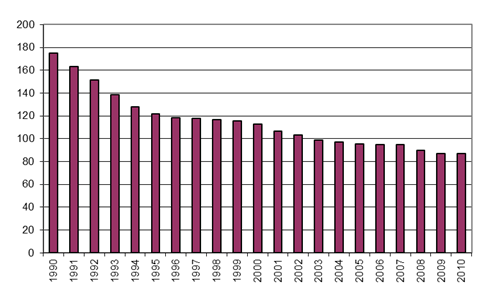
Fig. 5‑1 Trend of NMVOC emissions from Solvent and Other Product Use [Gg
NMVOC]
This
category includes particularly emissions of NMVOC (ozone precursor) from the
use of solvents, which are simultaneously considered to be a source of CO2
emissions (these solvents are mostly obtained from fossil fuels), as their
gradual oxidation in the atmosphere is also a factor. However, the use of
solvents is not an important source of CO2 emissions - in 2009, CO2
emissions were calculated at the level of 0.274 Mt CO2.
This category (Solvent and
Other Product Use) also includes N2O
emissions from the use of this substance in the
food industry (aerosol cans) and in health care (anaesthesia). These not very
significant emissions corresponding to 0.75 Gg N2O were derived from production in the Czech
Republic (0.6 Gg N2O)
and from import of N2O
(0.15 Gg N2O), see
(Markvart and Bernauer, 2010, 2011)
So far, in the Czech Republic, no relevant data have been available to
distinguish between N2O
used in anaesthesia and for aerosol cans. Therefore, the existing split
(50 % for anaesthesia) was based only on a rough estimate.
Now the authors of the study (Markvart and Bernauer, 2011) have managed
to perform studies leading to the qualified estimate that approx. 80% of the N2O is used in medicine
(anaesthesia). This estimate applies to the entire 1990 – 2010 time period.
The IPCC
methodology (Revised 1996 IPCC Guidelines, 1997) uses the CORINAIR methodology
(EMEP / CORINAIR Guidelines, 1999) for processing NMVOC emissions in
this category. This manual also gives the following conversions for the
relevant activities, which can be used in conversion of data from the CORINAIR
(i.e. SNAP) structure to the IPCC classification.
Tab. 5‑1 Conversion from SNAP into IPCC nomenclature
Inventory
of NMVOC emissions for 2010 for this sector is based on a study prepared by
SVÚOM Ltd. Prague (Geimplová, 2011). This study is elaborated annually for the
UNECE / CLRTAP inventory in NFR and is also adopted for the National
GHG inventory.
Solvent Use
chapter is based on the following sources of information:
· statistical information on producers
and imports from the Czech Statistical Office,
· REZZO data,
· annual reports of the Association of
Coatings Producers and Association of Industrial Distilleries,
· information from the Customs
Administration.
·
regular
monitoring of economic activities and economic developments in the CR,
knowledge and monitoring of important operations in the sphere of surface
treatments, especially in the area of application of coatings, degreasing and
cleaning;
·
regular
monitoring of investment activities is performed in the CR for technical
branches affecting the consumption of solvents and for overall developmental
technical trends of all branches of industry;
·
monitoring
of implementation of BAT in the individual technical branches;
·
technical
analysis of consumption of solvents in households; NMVOC emissions from
households are entirely fugitive and, according to qualified estimates,
contribute approximately 16.5 % to total NMVOC emissions.
The
activity data used in the individual categories and subcategories vary
considerably. Basic processing of data is performed in a more detailed
classification than that used in the CRF Reporter. A survey of the individual
groups of products and the formats of the activity data for basic processing of
emission data are apparent from the following survey.
It is
apparent from the Tab. 5‑2 that uniform expression of the
activity data cannot be employed, as this corresponds in the individual cases
to consumption of coatings, degreasing agents, solvents and, in some cases, the
weight of the final production, e.g. Dry Cleaning. Consequently, total NMVOC
emissions are employed as activity data in the CRF Reporter.
NMVOC
emissions oxidize relatively rapidly in the atmosphere, so that CO2
emissions generated as a consequence of this atmospheric oxidation are also
reported in CRF. The CO2 emissions are calculated using a conversion
factor that contains the ratio C/NMVOC = 0.855 and a recalculation ratio of C
to CO2 equal to 44/12. The overall conversion factor has a value of
3.14.
Tab. 5‑2 Structure for basic processing of emission data and the dimensions of
activity data
|
A Paint Application
|
EF - units
|
|
PAINT APPLICATION -
MANUFACTURE OF AUTOMOBILES
|
103 m2
|
|
PAINT APPLICATION - CAR
REPAIRING
|
t of paint
|
|
PAINT APPLICATION -
CONSTRUCTION AND BUILDINGS
|
t of paint
|
|
PAINT APPLICATION - DOMESTIC
USE
|
t of paint
|
|
PAINT APPLICATION - COIL
COATING
|
103 m2
|
|
PAINT APPLICATION - WOOD
|
t of paint
|
|
OTHER INDUSTRIAL PAINT
APPLICATION
|
t of paint
|
|
OTHER NON INDUSTRIAL PAINT
APPLICATION
|
t of paint
|
|
B Degreasing and Dry Cleaning
|
|
|
METAL DEGREASING
|
t
|
|
DRY CLEANING
|
t
|
|
ELECTRONIC COMPONENTS
MANUFACTURING
|
t
|
|
OTHER INDUSTRIAL CLEANING
|
t
|
|
C Chemical Products Manufacture / Processing
|
|
|
POLYESTER PROCESSING
|
t
|
|
POLYVINYLCHLORIDE PROCESSING
|
t
|
|
POLYSTYRENE FOAM PROCESSING
|
t
|
|
RUBBER PROCESSING
|
t
|
|
PHARMACEUTICAL PRODUCTS
MANUFACTURING
|
t
|
|
PAINTS MANUFACTURING
|
t
|
|
INKS MANUFACTURING
|
t
|
|
GLUES MANUFACTURING
|
t
|
|
ADHESIVE MANUFACTURING
|
t
|
|
ASPHALT BLOWING
|
t
|
|
TEXTILE FINISHING
|
103 m2
|
|
LEATHER TANNING
|
103 m2
|
|
D Other
|
-
|
The
uncertainty estimates have not yet been reported. Their implementation is
ongoing and is planned for inclusion in the following NIR.
Time series
consistency is ensured as the inventory approaches concerned are employed
identically across the whole reporting period from the base year 1990 to 2010.
The emission data in this section
were taken from the UNECE / CLRTAP inventories in NFR. Annual reports
are available on the method of calculation for the individual years from 1998.
Following transfer of the emission data to the new CRF Reporter, it was
apparent that trends in the emissions for all of Sector 3 – Solvent and Other
Product Use – did not exhibit any significant deviations.
A control was performed of the
company processing the data (SVÚOM Ltd. Prague) and the coordinator of
processing of UNECE / CLRTAP inventories in NFR. It was found that
more exact data were available to 2000, permitting assignment of consumption of
the individual types of solvents and other preparations containing NMVOC to
individual subcategories, from which the emissions are calculated in 4 main
subcategories of Sector 3 Solvent
and Other Product Use. As the total consumption of substances containing
NMVOC in all of CR is relatively well known, from 2000 the emissions that could
not be identified in the individual subcategory 3B Decreasing and Dry Cleaning were transferred to Category 3D Other Solvent Use,
because they were missing in the overall balance.
This
recalculation can be seen as the reallocation of N2O emissions for category 3D mentioned at the
beginning of this chapter.
The value of
the conversion factor (3.14) is slightly higher compared to other countries. It
is planned to try to obtain background information for a country-specific
value. Because of funding shortage it was not possible
to obtain data about carbon content in solvents used in CR.
Agricultural greenhouse gas emissions under Czech national conditions
consist mainly of emissions from enteric fermentation (CH4 emissions
only), manure management (CH4 and N2O
emissions) and agricultural soils (N2O
emissions only). The other IPCC subcategories – rice cultivation, prescribed
burning of savannas, field burning of agricultural residues and “other” – do
not occur in the Czech Republic.
Methane emissions are derived from animal
breeding. These are derived primarily from enteric fermentation (digestive
processes), which is manifested most for ungulate animals (in this country
mostly cattle). Other emissions are derived from fertilizer management, where
methane is formed under anaerobic conditions (with simultaneous formation of
ammonia which, however, is not monitored in the framework of greenhouse gas
inventories).
Nitrous oxide emissions are formed mainly by
nitrification-denitrification processes in soils. The anthropogenic
contribution that is determined in the national inventory of greenhouse gases
is caused by nitrogenous substances derived from inorganic nitrogen-containing
fertilizers, manure from animal breeding and nitrogen contained in parts of
agricultural crops that are returned to the soil (for example, in the form of
straw together with manure, or that are ploughed into the soil). In addition,
emissions are also included from stables and fertilizer management and indirect
emissions derived from atmospheric deposition and from nitrogenous substances
flushed into water courses and reservoirs.
For Agriculture,
five of six relevant categories of sources were evaluated by analysis decribed
in IPCC (2000 and 2003) as the key categories. An overview of sources, including their contribution
to aggregate emissions, is given in Tab. 6‑1.
Tab. 6‑1 Overview of significant categories
in this sector (2010)
|
Category
|
Character of category
|
Gas
|
% of total GHG*
|
|
4D1
|
Agricultural soils, direct
emissions
|
KC (LA, TA, LA*, TA*)
|
N2O
|
2.0
|
|
4A
|
Enteric fermentation
|
KC (LA, TA, LA*, TA*)
|
CH4
|
1.4
|
|
4D3
|
Agricultural soils, indirect
emissions
|
KC (LA, TA, LA*, TA*)
|
N2O
|
1.3
|
|
4B
|
Manure management
|
KC (LA, TA, LA*, TA*)
|
N2O
|
0.5
|
|
4B
|
Manure management
|
KC (TA, TA*)
|
CH4
|
0.3
|
|
4D2
|
Pasture, range and paddock manure
|
Non-KC
|
N2O
|
0.2
|
* assessed without considering LULUCF
KC: key category, LA, LA*: identified by level
assessment with and without considering LULUCF, respectively
TA, TA*: identified by trend assessment with
and without considering LULUCF, respectively
Agriculture is the third largest sector in the
Czech Republic with 5.8 % of total GHG emissions (incl. LULUCF) in 2010 with 7
777 Gg CO2 eq.; 60.4 % of emissions is coming from Agricultural
Soils, 25.7 % from Enteric Fermentation and 13.9 % from Manure
Management.
The CH4 emissions from
agriculture present 23 % of total national CH4 emissions and the N2O emissions from
agriculture present 72 % of total national N2O
emissions in 2010. During period 1990-2010 emissions from Agriculture decreased by almost 50 %.
The quantitative overview and emission trends in reported period are provided
in Fig.6.1 and Tab. 6.2.
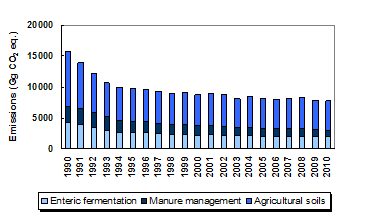
Fig. 6.1
The emission trend in agricultural sector during reporting period 1990–2010 (in
Gg CO2 eq.)
Tab. 6‑2 Emissions of Agriculture in period 1990-2010 (sorted by categories)
|
Year
|
Total
Emissions
|
Enteric Fermentation
(4A)
|
Manure Management
(4B)
|
Agricultural Soils
(4D)
|
|
[Gg CO2 eq.]
|
|
1990
|
15 733
|
4 219
|
2 710
|
8 804
|
|
1991
|
13 956
|
3 980
|
2 585
|
7 391
|
|
1992
|
12 191
|
3 568
|
2 344
|
6 279
|
|
1993
|
10 686
|
3 088
|
2 106
|
5 491
|
|
1994
|
9 898
|
2 705
|
1 862
|
5 331
|
|
1995
|
9 875
|
2 632
|
1 742
|
5 501
|
|
1996
|
9 540
|
2 608
|
1 802
|
5 130
|
|
1997
|
9 377
|
2 436
|
1 745
|
5 197
|
|
1998
|
8 976
|
2 284
|
1 654
|
5 038
|
|
1999
|
9 053
|
2 334
|
1 659
|
5 060
|
|
2000
|
8 786
|
2 241
|
1 544
|
5 001
|
|
2001
|
8 919
|
2 257
|
1 483
|
5 179
|
|
2002
|
8 706
|
2 209
|
1 414
|
5 083
|
|
2003
|
8 127
|
2 186
|
1 351
|
4 590
|
|
2004
|
8 502
|
2 139
|
1 299
|
5 065
|
|
2005
|
8 135
|
2 094
|
1 236
|
4 804
|
|
2006
|
8 013
|
2 064
|
1 218
|
4 731
|
|
2007
|
8 179
|
2 084
|
1 212
|
4 883
|
|
2008
|
8 374
|
2 103
|
1 179
|
5 091
|
|
2009
|
7 926
|
2 047
|
1 107
|
4 772
|
|
2010
|
7 777
|
1 999
|
1 079
|
4 699
|
The trend series are consistent both
for methane and for nitrous oxide. For methane, the decrease in emissions for
enteric fermentation since 1990 is connected with the decrease in the numbers
of animals (especially cattle) while the decrease in emissions derived from
manure (especially swine manure) is not as great, as there has been a smaller
decrease in the number of head of swine. It would seem that conditions have
partly stabilized somewhat in agriculture since 1994.
During the in-country review in
August/September 2011, the expert review team (ERT) identified the estimation
of N2O emissions from
Manure management of dairy cattle as a potential problem. The revision of
background information and Nex values for dairy cattle was requested. Already
during the review, the Czech Republic introduced revised country-specific data
for emission estimation using Tier 2 methods for Manure management of dairy
cattle. This recalculation was submitted to ERT as an resolved issue of the
“Saturday paper” regarding the 2011 NIR submission.
The assessment review report
(UNFCCC/ARR/2011/CZE) provided additional recommendations to improve the
inventory estimates for Agriculture. Other country-specific data for non-dairy
cattle was obtained. Based on these recommendations and additional
country-specific data, the following improvements were implemented in this 2012
submission:
- Reallocation of the
"Suckler cows" sub-category from Dairy cattle to Non-dairy
cattle
- More accurate animal population
data (not rounded off to thousands) reported (cattle, swine, sheep and
poultry).
- More accurate data for
individual cattle sub-categories (suckler and dairy cows, young heifers,
young bulls and calves) reported (not rounded off to thousands) for the
period since 2006 (since when the detailed data are available).
- Recalculation of N2O emissions from Manure
management using revised and complemented country-specific data: Nex
values for cattle, manure type distribution (AWMS), protein in milk and
protein in feed. Tier 2 methods implemented for the emission estimation of
Manure management of dairy and non-dairy cattle.
- Additionally, a new
country-specific parameter on digestibility (DE, in %) was determined and
implemented in the 2012 submission.
Given that the value of Nex for
cattle was revised based on the recommendation of ERT (2011), it led to changes
in N2O emissions from
Animal manure applied to soils, Pasture, range and paddocks (PRP), Atmospheric
deposition and N-lost through leaching and run-off. These changes apply to the
entire reporting period.
The recalculation requested based on
the document “Potential problems from ERT (Saturday paper)” led to increased
emissions by about 14 % relative to the older approach (submission 2011). The
use of updated country-specific data for cattle in calculation of emissions in
the 2012 submission resulted in a decrease in emissions by about 1.2 % in 1990
and increase by about 0.6 % in 2009 compared to the 2011 submission.
The following table presents the
differences between the emissions in the 2011 and 2012 submissions. Arrows
indicate a decrease (↓), or increase (↑) in the values in the 2012 submission
compared to the previous 2011 submission (April 2011) in the individual
categories between 1990 and 2009.
Tab. 6‑3 Comparison of changes according to previous
year
|
|
Total emissions
|
Enteric Fermentation
|
Manure Management
|
Agricultural Soils
|
|
1990
|
1.2 % ↓
|
13 % ↓
|
58 % ↑
|
5.9 % ↓
|
|
2009
|
0.6 % ↑
|
13 % ↓
|
49 % ↑
|
0.1 % ↓
|
|
|
Manure
Management (CH4)
|
Manure Management (N2O)
|
|
|
1990
|
0.8 % ↓
|
144 % ↑
|
|
2009
|
6.2 % ↓
|
126 % ↑
|
|
|
Manure applied
to soils
|
PRP
|
Atmospheric
deposition
|
Leaching
|
|
1990
|
11 % ↑
|
66 % ↓
|
4 % ↓
|
3 % ↓
|
|
2009
|
17 % ↑
|
43 % ↓
|
2 % ↑
|
2 % ↑
|
Note: The significance of the changes depends on the amount of emission values in the individual categories.
This
chapter describes estimation of the CH4 emissions from Enteric
Fermentation. In 2010, 84.4 % of agricultural CH4 emissions arose
from this source category (Table 6.2). This category includes emissions from
cattle (dairy and non-dairy), swine, sheep, horses and goats. Buffalo, camels
and llamas, and mules and asses do not occur in the Czech Republic. Enteric
fermentation emissions from poultry have not been estimated, the IPCC
Guidelines do not provide a default emission factor for this animal category.
Emissions from enteric fermentation
of domestic livestock have been calculated by using IPCC Tier 1 and Tier 2
methodologies presented in the Revised
IPCC Guidelines (IPCC, 1997) and IPCC Good
Practice Guidance (IPCC, 2000). Methane emissions for cattle, which are a
dominant source in this category, have been calculated using the Tier 2 method,
while for other livestock the Tier 1 method was used. The contribution of
emissions from livestock other than cattle to the total emissions from enteric
fermentation is not significant.
As the most important output of the
national study (Kolar, Havlikova and Fott, 2004), a system of calculation
spreadsheets have been developed and used for all the relevant calculations of CH4
emissions.
The emission factor for methane from
fermentation (EF) in kg/head p.a. according to the Revised Guidelines (IPCC, 1997) and Good Practice Guidance (IPCC, 2000) is proportional to the daily
food intake and the conversion factor. It thus holds that
EFi = 365 / 55.65 * daily food intake i
* Y
where the “daily food intake”
(MJ/day) is taken as the mean feed ration for the given type of cattle (there
are several subcategories of cattle) and Y is the conversion facto, which is
considered to be Y = 0.06 for cattle. Coefficient 55.65 has dimensions of
MJ/kg CH4.
In principle, this equation should
be solved for each cattle subcategory, denoted by index i. The Czech
Statistical Office, see Statistical
Yearbooks (CzSO, 1990–2010), provides following categorization of
cattle:
· Calves younger than 6 months of age (male and female)
· Young bulls and heifers (6-12 months
of age)
· Bulls and bullocks (1 – 2 years,
over 2 years)
· Heifers (1 – 2 years, over 2 years)
· Mature cows (dairy and suckler)
More disaggregated sub-categories
given above in parenthesis are given in the study by external agricultural
consultants of CHMI (Hons and Mudrik, 2003).
In the calculation, it is also very
important to distinguish between dairy and suckler cows, where the fraction of
suckler cows (suckler/all cows) gradually increased in the 1990-2010 time
period. Based on the ERT recommendation (2011) the sub-category "Suckler
cows" was reallocated from Dairy cattle to Non-dairy cattle.
According to the IPCC methodology,
Tier 2 (IPCC, 1997 and IPCC, 2000), the “daily food intake” for each
subcategory of cattle is not measured directly, but is calculated from national
zoo-technical inputs, mainly weight (including the final weight of mature animals),
weight gain (for growing animals), daily milk production including the
percentage of fat (for cows) and the feeding situation (stall, pasture). The
national zoo-technical inputs (noted above) were updated by expert from the
Czech University of Agriculture in Prague in 2006 and 2011. Examples of input
data used (Hons and Mudřík, 2003, Mudřík and Havránek, 2006, Kvapilík J. 2011)
are given below, Tab. 6‑4 and Tab. 6‑5.
Tab. 6‑4 Weights of individual categories of cattle,
1990–2010, in kg
|
Categories of cattle
|
1990 – 94
|
1995 – 98
|
1999 – 04
|
2005 – 09
|
2010 -
|
|
Mature cows (dairy
and suckler)
|
520
|
540
|
580
|
585
|
590
|
|
Heifers > 2 years
|
485
|
490
|
505
|
510
|
515
|
|
Bulls and bullocks
> 2 years
|
750
|
780
|
820
|
840
|
850
|
|
Heifers 1-2 years
|
380
|
385
|
395
|
395
|
390
|
|
Bulls 1-2 years
|
490
|
510
|
530
|
540
|
560
|
|
Heifers 6-12 months
|
275
|
280
|
285
|
285
|
290*
|
|
Bulls 6-12 months
|
325
|
330
|
335
|
340
|
540*
|
|
Calves to 6 months
|
128
|
132
|
133
|
135
|
135*
|
Note: * Since 2009 the age limit for “Calves”
shifted up to 8 months.
Tab. 6‑5 Feeding situation, 1990–2010, in % of pasture,
otherwise stall is considered
|
Categories of cattle
|
1990 – 94
|
1995 – 98
|
1999 – 04
|
2005 – 09
|
2010 -
|
|
Dairy cows
|
10
|
20
|
20
|
22
|
15
|
|
Suckler cows
|
10
|
20
|
20
|
22
|
95
|
|
Heifers > 2 years
|
30
|
30
|
30
|
35
|
50
|
|
Bulls > 2 years.
|
30
|
40
|
40
|
40
|
25
|
|
Heifers 1-2 years
|
30
|
40
|
40
|
40
|
50
|
|
Bulls 1-2 years
|
30
|
40
|
40
|
40
|
25
|
|
Heifers 6-12 months
|
30
|
40
|
40
|
40
|
50*
|
|
Bulls 6-12 months
|
30
|
40
|
40
|
40
|
50*
|
Note: * Since 2009 the age limit for “Calves”
shifted up to 8 months.
Percentages of pasture are related
only to the summer part of the year (180 days), while only the stall type is
used in the rest of year. The daily milk production statistics (Tab. 6.5), in
which only milk from dairy cows is considered, increased to 18.91 liters/day/head in 2010, with an
average fat content of 3.86 %. Milk from suckler cows is not included in the
table 6.5; a relevant daily milk production of 3.5 l /day head was used for the
calculation. The activity data of milk production comes from the official
statistics (CzSO) and these are verified in Yearbook of cattle in Czech
Republic (annual report).
As the official statistics,
specifically from CzSO, provide population values for cows and other cattle,
the resulting EFs in the CRF Tables are defined for the categories of “Dairy
cows” and “Non-dairy cattle”, as well as the relevant cells in the CRF. The
numbers of animal population are based on surveys of livestock (up to 1991 as
at 1.1., from 1992 to 2002 as at 1.3., since 2003 as at 1.4.).
The new country-specific parameter
DE (digestibility, in %) for cattle was estimated based on existing
publications. Based on the individual OMD (organic matter digestibility) values
for the most common feed (e.g. corn silage, hay and straw, green fodder –
alfalfa and clover, etc.) the average digestibility for cattle was estimated.
The estimated average digestibility corresponds to approximately 70 %
(Koukolová and Homolka 2008 and 2010, Tománková and Homolka 2010, Jančík et al.
2010, Petrikovič et al. 2000, Petrikovič and Sommer 2002, Sommer 1994, Zeman
1995 and Zeman et. al. 2006, Třináctý 2009, Čermák et al. 2008). Dr. Pozdíšek
(expert from the Research Institute for Cattle Breeding, Ltd., pers.
communication) determined the conservative average digestibility values for 3
basic cattle sub-categories. These digestibility values were employed for the
emission estimation:
· Dairy cattle DE = 67
%
· Suckler cows DE = 62 %
· Other cattle DE = 65 %
Details of the calculation are given
in the above-mentioned study (Kolar, Havlikova and Fott, 2004) and the results
are illustrated in Tab. 6‑7. It is obvious that EFs have
increased slightly since 1990 because of the increasing weight and milk
production for cows and because of the increasing weight and weight gain for
other cattle. On the other hand, CH4 emission from enteric
fermentation of cattle dropped during the 1990-2010 period to about one half of
the former values due to the rapid decreases in the numbers of animals kept.
Tab. 6‑6 Milk
production of dairy cows and fat content (1990–2010)
|
|
Dairy cows
|
Daily production
|
Fat content
|
|
[thousands]
|
[liters / day head]
|
[%]
|
|
1990
|
1206
|
10.67
|
4.03
|
|
1991
|
1165
|
9.63
|
4.09
|
|
1992
|
1006
|
10.13
|
4.07
|
|
1993
|
902
|
10.18
|
4.10
|
|
1994
|
796
|
10.79
|
4.04
|
|
1995
|
732
|
11.34
|
4.02
|
|
1996
|
713
|
11.69
|
4.08
|
|
1997
|
656
|
11.29
|
4.02
|
|
1998
|
598
|
12.44
|
4.05
|
|
1999
|
583
|
12.85
|
4.03
|
|
2000
|
548
|
13.55
|
4.00
|
|
2001
|
529
|
14.00
|
4.03
|
|
2002
|
496
|
15.08
|
3.98
|
|
2003
|
490
|
15.77
|
3.98
|
|
2004
|
476
|
16.41
|
3.98
|
|
2005
|
438
|
17.13
|
3.90
|
|
2006
|
424
|
17.45
|
3.90
|
|
2007
|
410
|
17.94
|
3.88
|
|
2008
|
406
|
18.51
|
3.86
|
|
2009
|
400
|
18.82
|
3.85
|
|
2010
|
384
|
18.91
|
3.86
|
Compared to cattle, the contribution of other farm animals to the whole CH4
emissions from enteric fermentation is much smaller, only about 5,5 %.
Therefore, CH4 emissions from enteric fermentation of other farm
animals (other than cattle) are estimated by the Tier 1 approach. Because
of some features of keeping livestock in the Czech Republic that are similar to
the neighbouring countries of Germany and Austria, default EFs for Tier 1
approaches recommended for Western Europe were employed. The obsolete national
approach used in the past, which was found not to be comparable with other
European countries (Dolejš, 1994 and Jelínek et.al., 1996), was definitively abandoned. The estimated values
are presented for the whole period since 1990.
Sheep, goats, swine and horses
The Czech Statistical Office (CzSO) publishes data on the number of
goats, sheep, swine, horses and poultry annually in the Statistical Yearbooks
(1990-2010).
Considering the rather small numbers in these animal categories, default
coefficients from the IPCC method have been used for estimating methane
emissions: 8 kg of methane annually per head for sheep, 5 kg of methane for
goats, 1.5 kg of methane for swine and 18 kg of methane for horses.
Poultry
IPCC guidelines do not define or require estimates of quantities of
methane from enteric fermentation.
Tab. 6‑7 Methane emissions from enteric fermentation, cattle (Tier 2, 1990–2010)
|
|
Dairy cows
|
Other cattle
|
EF. cows
|
EF. other
|
Em. cows
|
Em. other
|
Emissions
|
|
[thous.]
|
[thous.]
|
[kg CH4 / hd]
|
[kg CH4 / hd]
|
[Gg CH4]
|
[Gg CH4]
|
[Gg CH4]
|
|
1990
|
1206
|
2300
|
82.35
|
39.25
|
99.33
|
90.28
|
189.61
|
|
1991
|
1165
|
2195
|
79.01
|
39.41
|
92.08
|
86.50
|
178.58
|
|
1992
|
1006
|
1943
|
80.67
|
40.38
|
81.17
|
78.48
|
159.65
|
|
1993
|
902
|
1609
|
80.96
|
40.08
|
73.06
|
64.49
|
137.56
|
|
1994
|
796
|
1366
|
82.81
|
40.03
|
65.90
|
54.67
|
120.56
|
|
1995
|
732
|
1298
|
86.29
|
41.98
|
63.18
|
54.47
|
117.66
|
|
1996
|
713
|
1275
|
87.78
|
42.28
|
62.63
|
53.91
|
116.55
|
|
1997
|
656
|
1210
|
86.09
|
42.88
|
56.50
|
51.87
|
108.37
|
|
1998
|
598
|
1103
|
90.27
|
43.04
|
53.97
|
47.48
|
101.44
|
|
1999
|
583
|
1074
|
94.16
|
45.57
|
54.90
|
48.96
|
103.86
|
|
2000
|
548
|
1026
|
96.42
|
45.92
|
52.82
|
47.10
|
99.92
|
|
2001
|
529
|
1053
|
98.17
|
46.52
|
51.97
|
48.98
|
100.96
|
|
2002
|
496
|
1024
|
101.59
|
47.29
|
50.42
|
48.42
|
98.83
|
|
2003
|
490
|
984
|
103.98
|
47.60
|
50.99
|
46.81
|
97.80
|
|
2004
|
476
|
952
|
106.20
|
47.53
|
50.54
|
45.27
|
95.80
|
|
2005
|
438
|
960
|
108.46
|
48.31
|
47.49
|
46.36
|
93.84
|
|
2006
|
424
|
950
|
109.56
|
48.35
|
46.45
|
45.91
|
92.36
|
|
2007
|
410
|
981
|
111.07
|
48.45
|
45.58
|
47.53
|
93.11
|
|
2008
|
406
|
996
|
112.85
|
48.88
|
45.76
|
48.69
|
94.45
|
|
2009
|
400
|
964
|
113.82
|
48.77
|
45.47
|
47.00
|
92.47
|
|
2010
|
384
|
966
|
114.26
|
47.91
|
43.82
|
46.27
|
90.09
|
As mentioned above, methane emissions from the breeding of farm animals
are caused both by enteric fermentation and also by the decomposition of animal
excrements (manure). Determination of these emissions was prepared at the level
of both Tier 1 and Tier 2. As enteric fermentation is considered
according to Tab. 6.1 to constitute a key
source, preference should be given to determination in Tier 2.
For quite a long time, calculations were based
on historical studies (Dolejš, 1994) and (Jelínek et al, 1996). In principle, emissions from animal excrements
could be calculated according to Tier 1 (this is not a key source); however, because of
tradition and for consistency of the time series, the final values were also
calculated according to Tier 2 using the emission factors from
above-mentioned studies (Dolejš, 1994; Jelínek et al, 1996). An approach based
on historical studies was indicated to be obsolete in many reviews organized by
UNFCCC. Moreover, IEFs (implied emission factors) were mostly found as
outliers: especially EFs for enteric fermentation in cattle seemed to be
substantially underestimated. Details of the historical approach are given in
former NIRs (submitted before 2006).
The Czech team accepted critical remarks put
forth by the International Review Teams (ERT) and prepared a new concept for
calculation of CH4 emissions. This concept, in accordance with the
plan for implementing Good Practice, is based on the following options:
1) Emissions of methane from enteric
fermentation of livestock (a key
source) come predominantly from cattle. Therefore Tier 2, as
described in Good Practice (Good
Practice Guidance, 2000) is applied only to cattle.
2) CH4 emissions from
enteric fermentations of other farm animals are estimated by the Tier 1
approach. Because of some features of keeping livestock in the Czech Republic
that are similar to the neighbouring countries of Germany and Austria, default
EFs for Tier 1 approaches recommended for Western Europe were employed.
Increased attention was first paid to enteric
fermentation. It was stated that cooperation with specialized agricultural
experts is crucial to obtain new consistent and comparable data of suitable
quality. The relevant nationally specific data, milk production, weight, weight
gain for growing animals, type of stabling, etc. were collected by our external
experts (Hons and Mudrik, 2003). Moreover, statistical data for sufficiently
detailed classification of cattle, which are available in the Czech Republic,
were also collected at the same time. Calculation of enteric fermentation of
cattle using the Tier 2 approach was described in a study (Kolar,
Havlikova and Fott, 2004) for the whole time series since 1990 using the
above-mentioned country-specific data. The necessary QA/QC procedures were
performed in cooperation with experts from IFER. The nationally specific data like weight of individual categories of
cattle, weight gains of these categories and recent feeding situation
were revised in 2006. The new values were estimated
in a similar way by our external experts (Mudrik and Havranek, 2006) for the
next period.
The national zoo-technical inputs (mainly
weight, weight gain, daily milk production including the percentage of fat and
the feeding situation) were updated in this submission in conjunction with an
expert from the Research Institute of Animal Production.
Also in this submission, the
sub-category "Suckler cows" was reallocated from “Dairy cattle” to
“Non-dairy cattle”; more accurate cattle population data was used.
Additionally, the new digestibility values (DE) were employed for cattle
(detailed in Chapter 6.2.2.1), affecting the implied emission factors for
cattle categories. These changes in the activity data and input parameters
resulted in changes in emissions for the entire reporting period.
Uncertainty estimates based on expert
judgement.
The uncertainty in the activity data equals 5
%.
The uncertainty in the emission factor equals
20 %.
The combined uncertainty, calculated according
to IPCC GPG Tier 1 methodology, equals 20.6 %.
A detailed
description of source-specific QA/QC and inventory verification of agriculture
is presented in the Chapter 6.5.
Reallocation
of the sub-category Suckler cows from
Dairy cattle to Non-dairy cattle was performed in the 2012 submission.
Also more
accurate animal population data (not off to thousands) of cattle, swine, sheep,
poultry was used for the entire period and more precise data for cattle populations
(cattle sub-categories) are reported (not rounded off to thousands) since 2006 where data are available.
Last but
not least, the new digestibility values (DE) were employed for cattle (dairy
cows, suckler cows and other cattle).
These
changes in the activity data and input parameters resulted in changes in
emissions for the entire reporting period.
The analysis of uncertainties is currently in progress.
This
chapter describes the estimation of CH4 and N2O emissions from animal manure. In 2010, 16.6 %
of agricultural CH4 emissions (18.91 Gg CH4) and 12.7 %
of agricultural N2O
emissions (2.20 Gg N2O)
were caused by this source category. Total emissions from Manure Management are
1079.23 Gg CO2 eq. in 2010.
During
period 1990-2010 emissions from Manure Management decreased by 60 %. Emissions
from cattle and swine dominate the trend (see Tab. 6.7). The reduction in the
cow population is partly counterbalanced by an increase in cow efficiency
(increasing gross energy intake and milk production).
This
emission source covers manure management of domestic livestock. Both nitrous
oxide (N2O) and
methane (CH4) emissions from manure management of livestock (cattle,
swine, sheep, horses, goats and poultry) are reported. The animal waste
management systems (AWMS) are distinguished for N2O emission estimations: liquid system, daily
spread, solid storage & dry lot and other manure management systems.
Nitrous oxide is produced by the combined nitrification-denitrification
processes occurring in the manure nitrogen. Methane is produced in manure
during decomposition of organic material by anaerobic and facultative bacteria
under anaerobic conditions. The amount of emissions is dependent on the amount
of organic material in the manure and climatic conditions.
Tab. 6‑8 Emissions of Manure Management in reporting period 1990-2010.
|
Year
|
Emissions from Manure
Management
|
|
CH4
emissions
|
N2O emissions
|
|
[Gg CH4]
|
[Gg CO2
eq.]
|
[Gg N2O]
|
[Gg CO2
eq.]
|
|
1990
|
47.68
|
1001.19
|
5.51
|
1708.42
|
|
1991
|
45.91
|
964.07
|
5.23
|
1621.43
|
|
1992
|
42.07
|
883.54
|
4.71
|
1460.79
|
|
1993
|
38.37
|
805.72
|
4.19
|
1300.32
|
|
1994
|
33.56
|
704.82
|
3.73
|
1157.37
|
|
1995
|
31.78
|
667.38
|
3.47
|
1074.20
|
|
1996
|
31.92
|
670.34
|
3.65
|
1131.20
|
|
1997
|
30.89
|
648.67
|
3.54
|
1096.25
|
|
1998
|
29.34
|
616.19
|
3.35
|
1038.31
|
|
1999
|
29.02
|
609.42
|
3.39
|
1049.53
|
|
2000
|
27.34
|
574.18
|
3.13
|
970.10
|
|
2001
|
26.45
|
555.36
|
2.99
|
927.67
|
|
2002
|
25.80
|
541.78
|
2.81
|
872.14
|
|
2003
|
25.00
|
524.98
|
2.67
|
826.25
|
|
2004
|
23.80
|
499.73
|
2.58
|
799.00
|
|
2005
|
22.55
|
473.62
|
2.46
|
762.87
|
|
2006
|
22.22
|
466.71
|
2.42
|
751.01
|
|
2007
|
22.11
|
464.27
|
2.41
|
748.01
|
|
2008
|
21.16
|
444.32
|
2.37
|
735.10
|
|
2009
|
19.43
|
408.07
|
2.26
|
699.20
|
|
2010
|
18.91
|
397.13
|
2.20
|
682.20
|
CH4
emissions from manure management were identified as a key source only by trend assessment (TA); hence these emissions for
all farm animals are estimated by the Tier 1 approach. Default EFs for
Western Europe were employed for similar reasons as in the previous paragraph (Tab. 6‑9). Similarly as for enteric
fermentation, the obsolete national approach used in the past was abandoned
because of lack of comparability with other countries. Relation to the
decreasing trend in animal population (especially cattle and swine, Fig. 6.2), the emissions from Manure Management rapidly declined
during 1990-2010.
Tab. 6‑9 Table 6.8 IPCC default emission factors used to estimate CH4
emissions from Manure Management
|
Livestock type
|
EF (kg/head/yr)
|
|
Dairy Cattle
|
14
|
|
Non-Dairy
Cattle
|
6
|
|
Sheep
|
0.19
|
|
Goats
|
0.12
|
|
Horses
|
1.39
|
|
Swine
|
3
|
|
Poultry
|
0.078
|
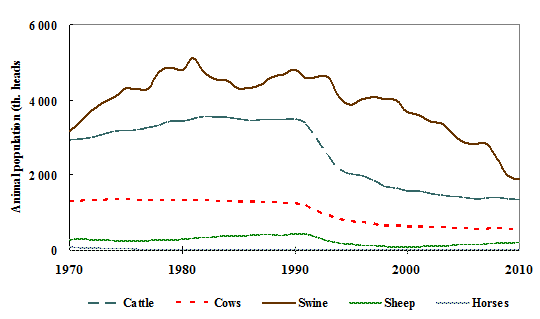
Fig. 6.2
Trend of individual animal population in period 1970–2010
N2O
emissions from manure management were identified as a key source; Tier
2 methodology is used for emission estimation for the cattle category
(Tier 2 for other animals). Emissions are calculated on the basis of N
excretion per animal and animal waste management system. Following the
guidelines, all emissions of N2O
taking place before the manure is applied to soils are reported under Manure
Management. The IPCC Guidelines method for estimating N2O emissions from manure management entails
multiplying the total amount of N excretion (from all animal
species/categories) in each type of manure management system by an emission
factor for that type of manure management system.
In response to the list of potential problems
and further questions raised by the ERT, the Czech Republic revised the Nex
values for dairy and non-dairy cattle (see Tab. 6‑10)
and changed the distribution ratio of manure per AWMS (see Tab. 6‑11)
according to the national conditions based on expert judgment (Hons and Mudřík
2004 and Kvapilík J. 2011).
The IPCC
default nitrogen excretion (Nex) values and distribution of AWMS systems for
other animal categories (excl. cattle) are presented in Tab. 6‑12. According to GPG (IPCC, 2000), the
IPCC default values for swine were taken from Tables B-3 through B-6 and the
IPCC default values for all the other animal species were taken from Table
4-21. The emissions are then summed over all the manure management systems.
Tab. 6‑10 Czech national Nex (nitrogen excretion) values used to estimate N2O
emissions from Manure Management
|
Year
|
Nitrogen excretion
(Nex)
|
|
Dairy cows
|
Non-dairy cattle
(AVG value)
|
|
[kg/head/year]
|
|
|
1990
|
101.94
|
58.51
|
|
|
1991
|
99.06
|
58.66
|
|
|
1992
|
100.51
|
59.66
|
|
|
1993
|
100.85
|
59.17
|
|
|
1994
|
102.38
|
59.09
|
|
|
1995
|
105.93
|
61.27
|
|
|
1996
|
107.45
|
61.61
|
|
|
1997
|
105.75
|
62.28
|
|
|
1998
|
109.63
|
62.52
|
|
|
1999
|
114.61
|
65.43
|
|
|
2000
|
116.57
|
65.87
|
|
|
2001
|
118.26
|
66.58
|
|
|
2002
|
121.16
|
67.47
|
|
|
2003
|
123.33
|
67.90
|
|
|
2004
|
125.32
|
67.78
|
|
|
2005
|
127.15
|
69.00
|
|
|
2006
|
128.13
|
69.00
|
|
|
2007
|
129.39
|
69.00
|
|
|
2008
|
130.89
|
69.51
|
|
|
2009
|
131.71
|
69.49
|
|
|
2010
|
132.59
|
68.76
|
|
Tab. 6‑11 Czech national distribution of AWMS systems for cattle categories only
|
Dairy cows
|
Fraction of Manure Nitrogen per AWMS (in %)
|
|
Liquid
|
Daily spread
|
Solid
|
PRP
|
|
1990
|
25
|
2
|
68
|
5
|
|
1995
|
23
|
1
|
66
|
10
|
|
2000
|
15
|
1
|
74
|
10
|
|
2005
|
26
|
1
|
62
|
11
|
|
2010
|
27
|
1
|
65
|
7
|
|
Non-dairy cattle (AVG)
|
Liquid
|
Daily spread
|
Solid
|
PRP
|
|
1990
|
51
|
1
|
33
|
15
|
|
1995
|
48
|
1
|
31
|
20
|
|
2000
|
49
|
1
|
33
|
17
|
|
2005
|
52
|
1
|
27
|
20
|
|
2010
|
52
|
1
|
27
|
20
|
Tab. 6‑12 IPCC default nitrogen excretion (Nex) and distribution of AWMS systems
for other animal categories (excl. cattle)
|
Livestock type
|
Nex
(kg/head/yr)
|
Type of AWMS
|
|
Liquid
|
Daily spread
|
Solid
|
PRP
|
Other
|
|
Fraction of Manure
Nitrogen per AWMS (in %)
|
|
Sheep
|
20
|
0
|
0
|
2
|
87
|
11
|
|
Swine
|
20
|
76
|
0
|
23
|
0
|
1
|
|
Poultry
|
0.6
|
13
|
0
|
1
|
2
|
84
|
|
Horses
|
25
|
0
|
0
|
0
|
96
|
4
|
|
Goats
|
25
|
0
|
0
|
0
|
96
|
4
|
6.3.2.3 Emission factors
To estimate
N2O emissions from
manure management, the default emission factors for the different animal waste
management systems were taken from the Good Practice Guidance, Table 4-22
(IPCC, 2000), see Tab. 6‑13.
Tab. 6‑13 IPCC default emission factors of animal waste per different AWMS
|
AWMS
|
Emission Factor
(EF3)
(kg N2O-N per kg N excreted)
|
|
Liquid
|
0.001
|
|
Solid Storage
|
0.02
|
|
Pasture/Range/Paddock
|
0.02
|
|
Other Systems
|
0.005
|
As
mentioned above, methane emissions from the breeding of farm animals are caused
both by enteric fermentation and also by the decomposition of animal excrements
(manure). Determination of the second of them was prepared at the level
Tier 1, besides the cattle where the emissions are calculated by Tier 2
since submission 2012.
The Czech
team accepted critical remarks put forth by the International Review Teams
(ERT). A concept, in accordance with the plan for implementing Good Practice,
is based on option, that CH4 emissions from manure management for
all farm animals are estimated by the Tier 1 approach. For similar reasons
as in the previous paragraphs, the default emission factors for Western Europe
were employed.
On the basis of the recommendations of the ERT 2009, the estimation of manure management N2O emissions from horses
and goats is reported as two individual groups of animals (category Other livestock was regrouped to two categories),
applying the IPCC Tier 1 method and the 1996 IPCC default values. The total
emissions from the category “N2O
emissions from Manure Management” were not affected.
According to the recommendations of ERT 2011 (ARR), the recalculation of emissions from
Manure Management was performed using new national parameters: feed consumption, nitrogen feed
intake and protein content of milk and feed (revised Nex value). In addition, the values of digestible energy expressed as a percentage
of gross energy (DE) for cattle were revised (the default values were
substituted by national values). In addition, national data on the distribution
of manure management practices across AWMS were collected and updated (Kvapilík
J. 2011).
Uncertainty
estimates based on expert judgement.
The
uncertainty in the activity data equals 5 %.
The
uncertainty in the emission factor for estimation of CH4 emissions
equals 30 %; for estimation of N2O
emissions, this value equals 100 %.
The
combined uncertainty for CH4 emissions equals 30.4 % and that for N2O emissions equals 100.12
%.
A detailed description of source-specific QA/QC and inventory
verification of agriculture is presented in the Chapter 6.5.
Based on new zoo-technical data and updated country-specific
parameters and activity data the emissions from Manure management of for dairy
and non-dairy cattle categories were calculated by Tier 2 method over the
entire 1990-2010 reporting period.
The estimation of N2O emissions from Manure management was performed
using the revised Nex values for dairy and non-dairy cattle with the updated
parameters (feed consumption, nitrogen feed intake and protein content of milk,
to estimate the amount of N retained in milk). Equations 10.32 and 10.33 (2006 IPCC)
were used to revise Nex and to calculate the variables for nitrogen intake and
nitrogen retained (milk production and growth). The results served as an input
for Eq. 10.31.
The parameters for estimation of the revised
Nex for cattle were collected from literature and from personal communications
with agricultural experts. The protein content in milk was determined based on
3.3 % (Poustka 2007, Ingr 2003 and Turek 2000) and protein content in feed (in
dry matter) of 18 % (Zeman - Czech feed standards 12-21 %, Central Institute
for Supervising and Testing in Agriculture 18 %, Karabcová pers. commun. 16-18
%).
Country-specific redistribution of manure
management practices across AWMS for cattle (Tab. 6‑11) was taken from Hons and Mudrik (2004) for the 1990-1999 period and
updated data from Kvapilík J. (2011) was used for the 2000-2010 period. Dr.
Kvapilik (author of the Annual report of Czech cattle breeding of the Institute
of Animal Science in Prague) also provided national data on grazing animals
(feed situation of cattle categories, see Tab. 6‑5).
Using the above changes, the N2O emissions from Manure
management were calculated by the Tier 2 method for dairy and non-dairy cattle
categories for the entire reporting period.
The analysis of uncertainties is in progress.
In the next submission the attention will be
paid to the using a higher –tier method to estimate CH4 emissions
from Manure Management as recommended by ERT.
This source
category includes direct and indirect nitrous oxide emissions from agricultural
soils. Both these categories (direct and indirect) of N2O soil emissions are the key sources (Tab. 6‑1). Nitrous oxide is produced in
agricultural soil as a result of microbial nitrification-denitrification
processes. The processes are influenced by chemical and physical
characteristics (availability of mineral N substrates and carbon, soil moisture,
temperature and pH). Thus, addition of mineral nitrogen in the form of
synthetic fertilizers, animal manure applied to soils, crop residue, N-fixing
crops enhance the formation of nitrous oxide emissions.
Nitrous
oxide emissions from agriculture include these subcategories:
- direct emissions (emissions
from synthetic fertilizers, animal manure applied to soils, crop residue
and N-fixing crops)
- emissions from pasture manure
(PRP)
- indirect emissions (emissions
from atmospheric deposition and nitrogenous substances flushed into water
courses and reservoirs - leaching)
Tab. 6‑14 N2O emissions come from Agricultural Soils (4D category) in
period 1990-2010 in Gg N2O.
|
Year
|
Total emissions
|
Direct emissions
|
Pasture Manure
|
Indirect emissions
|
|
a
|
b
|
c
|
d
|
Atmosph. deposition
|
Leaching
|
|
1990
|
28.40
|
7.39
|
5.50
|
0.18
|
3.00
|
1.02
|
1.86
|
9.44
|
|
1991
|
23.84
|
5.26
|
5.25
|
0.24
|
2.67
|
0.99
|
1.62
|
7.82
|
|
1992
|
20.26
|
4.00
|
4.85
|
0.24
|
2.26
|
0.87
|
1.41
|
6.63
|
|
1993
|
17.71
|
3.19
|
4.38
|
0.27
|
2.24
|
0.72
|
1.23
|
5.68
|
|
1994
|
17.20
|
3.59
|
3.84
|
0.19
|
2.30
|
0.61
|
1.15
|
5.51
|
|
1995
|
17.75
|
4.05
|
3.61
|
0.17
|
2.23
|
0.80
|
1.16
|
5.71
|
|
1996
|
16.55
|
3.36
|
3.64
|
0.16
|
2.24
|
0.78
|
1.10
|
5.26
|
|
1997
|
16.76
|
3.64
|
3.51
|
0.12
|
2.33
|
0.73
|
1.10
|
5.33
|
|
1998
|
16.25
|
3.59
|
3.37
|
0.16
|
2.25
|
0.67
|
1.06
|
5.17
|
|
1999
|
16.32
|
3.54
|
3.41
|
0.14
|
2.32
|
0.67
|
1.06
|
5.17
|
|
2000
|
16.13
|
3.77
|
3.24
|
0.10
|
2.15
|
0.65
|
1.05
|
5.18
|
|
2001
|
16.71
|
3.99
|
3.17
|
0.11
|
2.44
|
0.65
|
1.05
|
5.28
|
|
2002
|
16.40
|
4.02
|
3.12
|
0.08
|
2.24
|
0.63
|
1.04
|
5.26
|
|
2003
|
14.81
|
3.39
|
3.05
|
0.09
|
1.92
|
0.62
|
0.97
|
4.78
|
|
2004
|
16.34
|
3.83
|
2.92
|
0.12
|
2.91
|
0.61
|
0.98
|
4.97
|
|
2005
|
15.50
|
3.65
|
2.80
|
0.14
|
2.56
|
0.64
|
0.95
|
4.77
|
|
2006
|
15.26
|
3.80
|
2.76
|
0.12
|
2.14
|
0.63
|
0.95
|
4.85
|
|
2007
|
15.75
|
3.95
|
2.76
|
0.09
|
2.37
|
0.65
|
0.97
|
4.95
|
|
2008
|
16.42
|
4.21
|
2.68
|
0.07
|
2.75
|
0.67
|
0.98
|
5.07
|
|
2009
|
15.39
|
3.92
|
2.49
|
0.09
|
2.59
|
0.66
|
0.91
|
4.73
|
|
2010
|
15.16
|
4.00
|
2.36
|
0.09
|
2.28
|
0.80
|
0.91
|
4.73
|
Note: a, b, c,
d = individual sources of direct emissions; (a) Synthetic fertilizers, (b)
Animal manure applied to soils, (c) N-fixing crops and (d) Crop residue
In 2010,
87.3 % of total N2O
emissions from Agriculture originated from Agricultural Soils, while the rest
originated from Manure Management (12.7 %). The trend in N2O emissions from this
category is decreasing: in 2010 emissions (4699.23 Gg CO2 eq.) were
ca. 47 % below the base year level. Tab. 6‑14 and Figure 6.3 present the N2O emissions of
Agricultural soils by individual sub-category.
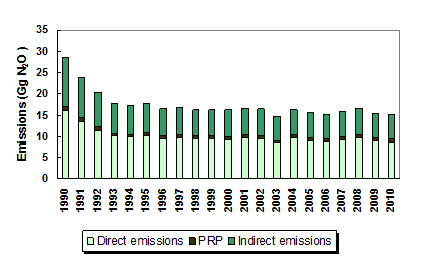
Fig. 6.3
Nitrous oxide emissions from Agricultural soils (sub-categories)
Although nitrous oxide emissions from agriculture are key sources,
emissions are estimated and analyzed by the Tier 1 approach of the IPCC
methodology (IPCC, 1997). A set
of interconnected spreadsheets in MS Excel has been used for the relevant
calculations for several years. The emissions from nitrogen excreted to pasture
range and paddocks by animals are reported under animal production in CRF table
4D2. The nitrogen from manure that is spread daily is consistently included in
the manure nitrogen applied to soils.
The standard calculation of Tier 1
required the following input information based on CzSO data:
· number of heads of farm animals
(dairy cows, other cattle, pigs, sheep, poultry, horses and goats),
· annual amount of nitrogen applied in
the form of industrial nitrogen fertilizers
- the application of agricultural fertilizers was previously intensive
in this country, but decreased radically during the 1990s. The amount of
nitrogen fertilizers applied in 1990 equaled over 418 kt decreased to 226 kt in
2010. This corresponds to the trend reported for use of fertilizers, which
decreased a lot in early 1990s (Sálusová et al., 2006).
· annual harvests of crops, pulses and
soya beans (see Tab. 6‑15).
All these data were taken from the Statistical
Yearbooks of the Czech Republic (Statistical
Yearbooks, 1990-2010).
Other input data consists in the mass fraction
Xi,j of animal excrement in animal category i (i = dairy cows, other
cattle, pigs, …) for various types of excrement management (AWMS - Animal Waste
Management System) j (j = anaerobic lagoons, liquid manure, solid manure,
pasturage, daily spreading in fields, other). Here, it holds that Xi,1 + Xi,2 + ... + Xi,6
= 1. For Tier 1, (Revised
1996 IPCC Guidelines, 1997) gives only the values of matrix X for
typical means of management of animal excrement in Eastern and Western Europe.
As we are aware that agricultural farming in the Czech Republic has not yet
been classified according to this system, we performed the calculation for AWMS
parameters presented in the IPCC methodology (Revised 1996 IPCC Guidelines, 1997) for the case of Western
Europe. Nevertheless, collection of the relevant country specific AWMS
parameters is under way and perhaps it will be possible to employ such an
approach sometime in the future.
Tab. 6‑15 Annual harvests of agricultural
products (incl. crops, pulses and soybeans) in period 1990-2010
|
Year
|
Crop
production
|
Pulses
(excl. soya)
|
Soya
beans
|
|
[in
thousands tons]
|
|
1990
|
8 947
|
152
|
2.2
|
|
1991
|
7 845
|
195
|
6.4
|
|
1992
|
6 565
|
203
|
3.7
|
|
1993
|
6 468
|
227
|
0.7
|
|
1994
|
6 777
|
163
|
0.7
|
|
1995
|
6 602
|
144
|
0.6
|
|
1996
|
6 644
|
136
|
0.5
|
|
1997
|
6 983
|
104
|
0.3
|
|
1998
|
6 669
|
133
|
0.3
|
|
1999
|
6 928
|
119
|
0.6
|
|
2000
|
6 454
|
85
|
2.3
|
|
2001
|
7 338
|
91
|
4.3
|
|
2002
|
6 771
|
65
|
6.4
|
|
2003
|
5 762
|
62
|
11.9
|
|
2004
|
8 784
|
88
|
12.9
|
|
2005
|
7 660
|
96
|
18.9
|
|
2006
|
6 386
|
88
|
17.8
|
|
2007
|
7 153
|
65
|
13.2
|
|
2008
|
8 370
|
48
|
9.4
|
|
2009
|
7 832
|
62
|
13.6
|
|
2010
|
6 878
|
58
|
16.1
|
IPCC
default emission factors have been used for calculating N2O emissions from agricultural soils. The
emission factors for calculation of direct N2O
emissions from the agriculture soil category, direct emissions from atmospheric
deposition and leaching were used according to Tab. 6‑16.
The default
fraction values were used to estimate emissions (Tab. 6‑17). The fraction of livestock N
excreted and deposited onto soil during grazing (FracGRAZ) varied
from 0.085 in 1990 to 0.145 in 2010.
Tab. 6‑16 IPCC default parameters/fractions used for emission estimation
|
Parameters/Fractions
|
Default values
|
|
FracGASM
|
0.20
|
|
FracNCR0
|
0.015
|
|
FracNCRBF
|
0.03
|
|
FracR
|
0.45
|
|
FracBURN
|
0.00
|
Tab. 6‑17 Emission factors (EFs) for the calculation of Agricultural Soils
|
|
Emissions (sources)
|
Emission Factors
|
|
Direct emissions
|
Synthetic fertilizer
|
EF1=0.0125 kg N2O-N/kg
N
|
|
Animal Waste
|
|
N-fixing crops
|
|
Crop residue
|
|
Pasture, range &
paddock manure
|
Grazing animals
|
EF3=0.02 kg N2O-N/kg N
|
|
Indirect emissions
|
Atmospheric Deposition
|
EF4=0.01 kg N2O-per kg emitted NH3
and NOx
|
|
Nitrogen Leaching
|
EF5=0.025 kg N2O - per kg of leaching N
|
In relation
to the consistency of the emission series for N2O
(agricultural soils), it should be mentioned that emission estimates have been
calculated in a consistent manner since 1996 according to the default
methodology of Revised 1996 IPCC
Guidelines (IPCC, 1997). Emission estimates for 1990, 1992, 1994 and
1995 were obtained and reported in several recent years; the data for 1991 and
1993 are reported (together with year 2004) this year as part of the 2006
submission.
The
quantitative overview and emission trends during period 1990-2010 are shown in
Tab. 6.2. The trend in N2O
emissions from agricultural soils is summarized in Tab. 6.15. During 1990-2010
the total emissions from agricultural soils decreased by 47 % (rapidly during
period 1990-1995, about 40 %), direct emissions decreased by 40 % and indirect
emissions by 50 %. More than 60 % reduction was reached in the animal
production.
Following the ERT, the Czech emission inventory
team verified the activity data required for this category and found that the
previously reported data based on expert judgment of areas could not be
confirmed and verified from the official statistics. According to the expert
common consensus (I. Skorepova, P. Fott, E. Cienciala and Z. Exnerova), there
are no cultivated histosols on agricultural land in this country and hence also
no data for this category. Organic soils mostly occur on forest land and they
are reported in the LULUCF sector. During in-country review 2009 was confirmed
that there are no cultivated histosols on agricultural land in the Czech
Republic.
On the
basis of the recommendations of ERT (in-country review 2009) and the ARR
(2009), several recalculations were performed (N2O emissions from Animal manure applied to soils,
Crop residues, N-fixing crops) and technical errors were corrected in the emission
inventory of agricultural soils in the last 2010 submission.
Given that
the value of Nex for cattle was revised based on the recommendation of ERT
(2011), it led to changes in N2O
emissions from i) animal manure applied to soils (4D1b), ii) PRP (4D2), iii)
atmospheric deposition (4D3.1) and iv) N lost through leaching and run-off
(4D3.2). These changes apply to the entire reporting period.
Uncertainty
estimates based on expert judgement.
The
uncertainty in the activity data for estimation of direct and indirect
emissions from agricultural soils equals 20 %; for Pasture, Range and Paddock
Manure (PRP) this value equals 10 %.
The
uncertainty in the emission factor for estimation of direct and indirect
emissions from agricultural soils equals 50 %; for estimation of emissions from
PRP Manure this value equals 100 %.
The
combined uncertainty for the direct and indirect emissions from agricultural
soils equals 53.85 %; for N2O
emissions from PRP Manure this value equals 100.5 %.
A detailed description of source-specific QA/QC
and inventory verification of agriculture is presented in the Chapter 6.5.
On the basis of the recommendations of
ERT (in-country review in August-Sept 2011 in Prague) and the following ARR document, N2O emissions from
agricultural soils were recalculated in the 2012 submission. Given that the value of Nex for cattle was revised in the
Manure Management category, it led to changes in N2O emissions from:
1. animal manure applied to soils
(4D1b)
2. pasture, range and paddocks (4D2)
3. atmospheric deposition (4D3.1)
4. nitrogen lost through leaching and
run-off (4D3.2)
These changes apply to the entire
reporting period.
The
analysis of uncertainties is in progress.
Following
the recommendation of the latest in-country review, a sector-specific QA/QC
plan was formulated, tightly linked to the corresponding QA/QC plan of the
National Inventory System, chapter 1.5. The plan describes the key procedures
of inventory compilation, provides a table of personal responsibilities and a
timetable of sector-specific QA/QC procedures. This plan consolidates the
quality assurance procedures and facilitates effective quality control of the
Agriculture inventory.
The
Institute of Forest Ecosystem Research (IFER) is the sector-solving institution
for this category.
The
agricultural greenhouse gas inventory is compiled by an experienced expert from
the IFER, including performance of self-control. Czech University of Life
Sciences, Institute of Animal Science Prague, Research Institute for Cattle
Breeding and the AGROBIO are other institutes contributing information used in
the sector of Agriculture. Slovak agricultural experts (SHMI) also participate
in debates on inventory improvements.
Potential
errors and inconsistencies are documented and corrections are made if
necessary. In addition to the official review process, emission inventory
methods and results are internally reviewed by the technical experts involved
in the emission inventory of the Agriculture and LULUCF sectors.
To comply
with QA/QC, is necessary to check
·
The
inclusion of all activity data for animal categories, selected harvests (crops,
pulses, soya beans), amount of synthetic fertilizers (agricultural statistics)
·
The
consistency of time-series activity data and emission factors (agricultural
statistics)
·
The
annual update of national zoo-technical data
·
All
the emission factors and used parameters/fractions
QA/QC includes
checking of activity data, emission factors and methods employed. All the
differences are discussed and, if necessary, also corrected. The procedure of
inventory compiling is initiated by IFER, where all the necessary data,
obtained from the Czech Statistical Office (CzSO), are inserted into the excel
spreadsheets. The excel files are verified by other IFER experts. Some more
specific parameters, not available from CzSO, are required to estimate the
country-specific emission factors for cattle (Tier 2). The zoo-technical
national data (specifically concerned with cattle breeding) are supplied by
experts from agricultural institute (see above). The appropriate values in the
calculation spreadsheets are updated at IFER, replacing the older values. The verified
data are transferred to the CRF Reporter, where the data are again technically
verified. The CRF tables are sent to the NIS coordinator for final time-series
checking and approval.
All the
information used for the inventory report is archived by the author and by the
NIS coordinator. Hence, all the background data and calculations are
verifiable.
The
emission inventory of the 5 Land
Use, Land Use Change and Forestry (LULUCF) sector includes emissions and
removals of greenhouse gases (GHG) resulting from land use, land-use change and
forestry. The inventory is based on application of the IPCC Good Practice
Guidance for Land Use, Land-Use Change and Forestry (IPCC 2003, further also abbreviated
as GPG for LULUCF) and the reporting format adopted by the 9th
Conference of Parties to UNFCCC. The application of GPG for LULUCF in the
national emission inventory entails manifold specific requirements on the
inventory of the sector, which have been implemented gradually. The current
inventory of the LULUCF sector represents an advanced phase of this
implementation. It employs a refined system of land use identification at the
level of the individual cadastral units, which was also utilized for determination
of land-use changes. This inventory submission contains additional
methodological improvements and to some degree reflects the suggestions
following from the latest reviews of the LULUCF emission inventory. Where
feasible, the methodological elements from IPCC 2006 Guidelines for National
Greenhouse Gas Inventories (IPCC 2006) for the Agriculture, Forestry and Other
Land Use (AFOLU) were also used. Although the Czech LULUCF inventory is still
expected to undergo further development and consolidation, it already
represents a solid system for providing information on GHG emissions and
removals in the LULUCF sector, as well as for providing the additional
information on the LULUCF activities required under the Kyoto protocol.
The current
inventory includes CO2 emissions and removals, and emissions of non-CO2
gases (CH4, N2O,
NOx and CO) from
biomass burned in forestry and disturbances associated with land-use
conversion. The inventory covers all six major LULUCF land-use categories,
namely 5A Forest Land, 5B Cropland,
5C Grassland, 5D Wetlands, 5E Settlements and 5F Other Land, which
were linked to the Czech cadastral classification of lands. The emissions
and/or removals of greenhouse-gases are reported for all mandatory categories.
The current submission covers the whole reporting period from the base year of
1990 to 2010 (Fig. 7‑1).
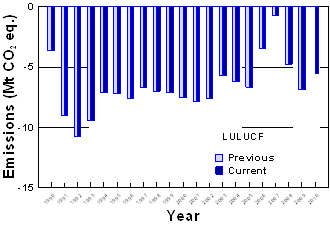
Fig. 7‑1 Current and previously reported assessment of emissions for the LULUCF
sector. The values are negative, hence representing net removals of green-house
gases.
Tab. 7.1
provides a summary of the LULUCF GHG estimates for the base year 1990 and the
most recently reported year 2010. In 2010, the net GHG flux for the LULUCF
sector, estimated as the sum of emissions and removals, equaled -5.519 Mt CO2
eq., thus representing a net removal of GHG gases. In relation to the estimated
emissions in other sectors in the country for the inventory year 2010, the removals
realized within the LULUCF sector decrease the GHG emissions generated in other
sectors by 3.97 %. Correspondingly, for the base year of 1990, the total
emissions and removals in the LULUCF sector equaled -3.618 Mt CO2.eq.
In relation to the emissions generated in all other sectors, the inclusion of
the LULUCF estimate reduces the total emissions by 1.85 % for the base year of
1990. It is important to note that the emissions within the LULUCF sector
exhibit high inter-annual variability (Fig. 7.1) and the values shown in Tab.
7.1 should not be interpreted as trends. The entire data series can be found in
the corresponding CRF Tables.
Tab. 7.1 GHG estimates in Sector 5 (LULUCF) and its categories in 1990 (base
year) and 2010.
|
Sector/category
|
Emissions 1990
Gg CO2 eq.
|
Emissions 2010
Gg CO2 eq.
|
|
5 Total LULUCF
|
-3 618
|
-5 519
|
|
5A Forest Land
|
-4 947
|
-5 400
|
|
5A1 Forest Land remaining Forest Land
|
-4 667
|
-5 132
|
|
5A2 Land converted to Forest Land
|
-280
|
-308
|
|
5B Cropland
|
1 337
|
139
|
|
5B1 Cropland remaining Cropland
|
1089
|
38
|
|
5B2 Land converted to Cropland
|
247
|
101
|
|
5C Grassland
|
-128
|
-371
|
|
5C1 Grassland remaining Grassland
|
59
|
2
|
|
5C2 Land converted to Grassland
|
-187
|
-373
|
|
5D Wetlands
|
23
|
34
|
|
5D1 Wetlands remaining Wetlands
|
(0)
|
(0)
|
|
5D2 Land converted to Wetlands
|
23
|
34
|
|
5E Settlements
|
86
|
118
|
|
5E1 Settlements remaining Settlements
|
(0)
|
(0)
|
|
5E2 Land converted to Settlements
|
86
|
103
|
|
5F Other Land
|
(0)
|
(0)
|
Note: Emissions of non-CO2 gases (CH4 and N2O) are also included.
Tab. 7.2 Key categories of the LULUCF sector (2010)
|
Category
|
Character of
category
|
Gas
|
% of total GHG
|
|
5A1 Forest Land
remaining Forest Land
|
KC (LA, TA)
|
CO2
|
-3.96
|
|
5B1 Cropland
remaining Cropland
|
KC (TA)
|
CO2
|
0.03
|
KC: key category, LA - identified by level
assessment, TA - identified by trend assessment
% of total GHG: relative contribution of
category to net GHG (including LULUCF)
Of the main categories listed in Tab. 7.1, two of them were identified as key categories according to the IPCC Good Practice (Good Practice
Guidance, IPCC 2000, Good Practice
Guidance for LULUCF, IPCC 2003). Of these LULUCF categories, the largest
effect on the overall emission inventory in the country is attributed to 5A1 Forest Land remaining Forest Land.
With a contribution of -4.0 %, it is the only LULUCF category identified
by the level assessment for the year 2010 (Tab. 7.2). It was also identified as a key
category by the trend assessment. The emissions of this category are determined
by the changes in biomass carbon stock. Additionally, one LULUCF category was
identified by the trend assessment, namely 5B1
Cropland remaining Cropland (Tab. 7.2). In 5B1, the trend analysis reflected the effect of liming on emissions
from agricultural soils, which decreased rapidly in early 1990s compared to the
following years.
The
reporting format requires the estimation of GHG emissions into the atmosphere
by sources and sinks for six land-use categories, namely Forest Land, Cropland,
Grassland, Wetlands, Settlements and Other Land. Each of these categories is
divided into lands remaining in the given category during the inventory year,
and lands that are newly converted into the category from a different one.
Accordingly, GPG for LULUCF outlines the appropriate methodologies for
estimation of emissions.
Consistent
representation of land areas and identification of land-use changes constitute
the key steps in the inventory of the sector in accordance with GPG for LULUCF.
The adopted land-use representation and land-use change identification system
was build gradually since the 2007 NIR submission. It was radically improved in
the 2008 NIR submission and further refined in 2009 inventory submission.
Initially,
the identification of land-use categories was based on two key data sources.
Information on areas of the individual land-use categories was obtained from
the Czech Office for Surveying, Mapping and Cadastre (COSMC; www.cuzk.cz). It
provided annually updated cadastral information, published as aggregated data
in the statistical yearbooks. The second data source utilized previously was
the Land Cover Database of the Pan-European CORINE project (reference years
1990 and 2000), administered by the Czech Ministry of the Environment. The
combination of COSMC cadastral data and CORINE land-use change trends permitted
estimation of land-use changes. Although this method was endorsed by the 2007
in-country review, the aggregated land-use information did not provide
sufficient spatial details and the CORINE-derived trends remained uncertain for
several reasons.
Since the
2008 NIR submission, land-use representation and the land-use change
identification system have been based exclusively on the annually updated COSMC
data, elaborated at the level of about 13 thousands individual cadastral units.
This system was built in several steps, including 1) source data assembly 2)
linking land-use definitions 3) identification of land-use change 4)
complementing time series. These steps are described below. The result is a
system of consistent representation of land areas having the attributes of both
Approach 2 and Approach 3 (GPG for LULUCF), permitting accounting for all
land-use transitions in the annual time step.
The
methodology requirements and principles associated with the approaches
recommended by the GPG for LULUCF (IPCC 2003) imply that, for the reported
period of 1990 to 2010, the required land use should be available for the
period starting from 1969. Information on land use was obtained from the Czech
Office for Surveying, Mapping and Cadastre (COSMC), which administers the
database of “Aggregate areas of cadastral land categories” (AACLC). The AACLC
data were compiled at the level of the individual cadastral units (1992-2010)
and individual districts (1969-2010). There are over 13 000 cadastral
units, the number of which varied due to separation or division for various
administrative reasons. In the period of 1992 to 2010, the total number of
cadastral units varied between 13 027 and 13 079.
To identify
the administrative separation and division of cadastral units, these were
crosschecked by comparing the areas in subsequent years using a threshold of
one hectare difference. Neighboring cadastral units mutually changing their
areas in subsequent years were integrated. Until the reported year of 2006,
this concerned a total of 706 former and/or current units that were integrated
into 235 newly labeled units. This resulted in a total of 12 624 cadastral
units, for which the annual land-use change was specifically estimated (see below).
The land use system was further refined for reporting years since 2007.
Thereon, the eventual integration of cadastral units is performed on an annual
basis and hence concerns only those cadastral units where some land was
exchanged between two subsequent years. For 2010, there were 45 integrated
cadastral units, which affected a total of 114 individual cadastral units. This
further increased the spatial resolution of the system, as the land use change
identification could be analyzed for 12 958 individual units in 2010 as
compared to 12 624 units for the years until 2006 (Fig. 7.2).
To obtain
information on land-use and land-use change prior 1993, a complementary data
set from COSMC at the level of 76 district units was prepared. It actually
covered the period since 1969. It was required for application of the IPCC
default transition time period of 20 years for carbon stock change in soils.
The overlapping time period of 1993 to 2006 was utilized to correct the
land-use change assessment based on the coarser, i.e., district data (see below
for details). The spatial coverage of cadastral and district units is also
shown in Fig. 7.2.
The
analysis of land use and land-use change is based on the data from the
“Aggregate areas of cadastral land categories” (AACLC), centrally collected and
administered by COSMC and regulated by Act No. 265/1992 Coll., on Registration
of proprietary and other material rights to real estate, and Act No. 344/1992
Coll., on the real estate cadastre of the Czech Republic (the Cadastral Act),
both as amended by later regulations. AACLC distinguishes ten land categories,
six of them belonging to land utilized by agriculture (arable land, hop-fields,
vineyards, gardens, orchards, grassland) and four under other use (forest land,
water surfaces, built-up areas and courtyards, and other land). Additionally,
the land register included information on land use for every land parcel.
Different AACLC land categories may have identical use. Both land categories and
land use in the COSMC database were linked so as to most closely match the
default definitions of the six major land-use categories (Forest Land,
Cropland, Grassland, Wetlands, Settlements and Other Land ) as given by GPG for
LULUCF (IPCC 2003). The specific definition content can be found in the
respective Chapters 7.3 to 7.8 devoted to each of the major land-use
categories.
Fig. 7.2 Cadastral units (grey lines),
integrated cadastral units (shading) and district borders (black lines) as used
until year 2006 (top) and the currently refined situation for year 2010
(bottom).
The
critical issue of any LULUCF emission inventory is the determination of
land-use change. This inventory identifies and quantifies land-use change by
balancing the six major land-use areas for each of the individual or integrated
cadastral units (12 958 units in year 2010) on an annual basis using the
subsequent years of the available period. The approach is exemplified in Fig.
7.3. In the example of the cadastral unit of Jablunkov (ID 656305), it can be
observed that, during 2006, three land-use categories lost their land, while
one exhibited an increase. This identifies three types of land-use conversion
with specific areas corresponding to the proportion of the loss of all the
contributing categories. Similarly, if the converted land were to be attributed
to two or more land-use categories, it would be accordingly distributed in
proportion to the increase in their specific areas. Since this task is
computation-intensive, involving tens of thousands of matrix manipulations, it
is handled by a specific software application developed for this purpose using
the MS-Access file format. All identified land-use transfers are summarized by
each type of land-use change on an annual basis to be further used for
calculation of the associated emissions.
Fig. 7.3
Example of land-used change identification for year 2006 and cadastral unit
656306 (Jablunkov); all spatial units are in m2.
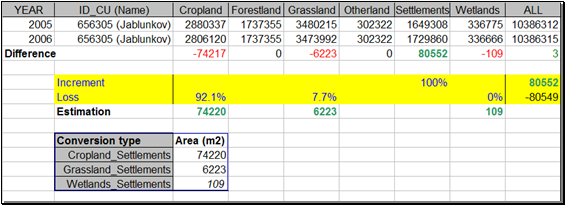
The above
described calculation of land-use change could only be performed for the years
1993 to 2010, because the data on land-use for the individual cadastral units
has only been available since 1992. For the years preceding 1993, i.e., for
land-use change attributed to the years 1970 to 1992, an identical approach as
described above was used, but with aggregated cadastral input data at the level
on the individual districts. The effect of an increased scale and data
aggregation always results in a lower area of identified land-use change. This
is probably due to within-domain compensation of area losses and increments. To
compensate this effect for the 1970 to 1992 data series, a correction was
applied to the estimates, based on district data input. The correction was
based on a linear regression function between R (the ratio of identified land conversions at the level of the
districts and individual cadastral units) and the logarithmically transformed
areas from the data at the district level. The corrections were derived at the
level of the major land-use categories, using the annual data from the period
of 1993 to 2006, for which the land-use conversions could be estimated
independently at both spatial levels, i.e., districts and individual cadastral
units. More details, including the statistics and estimated parameters of the
regression equation, are given in Cienciala and Apltauer (2007). The correction
procedure was the final step in land-use database operations required to
provide a consistent data-series on annual land-use conversions for the 1970 to
2010 period.
The overall
trends in the areas of the major land-use categories in the Czech Republic for
the 1970 to 2010 period are shown in Fig 7.4. The largest quantitative change
is associated with the Cropland and Grassland land-use categories.
Fig. 7.4 Trends
in areas of the six major land-use categories in the Czech Republic between
1970 and 2010 (based on information from the Czech Office for Surveying,
Mapping and Cadastre).
An insight
into the net trends shown in Fig. 7.4 is provided by analysis of
land-use changes as described in Section 7.1.2. Tab. 7.3 shows a product of
that analysis, namely the areas of land-use change among the major land-use
categories over the 1990 to 2010 period in the form of land-use change matrices
for the individual years. It is important to note that the annual totals for
the individual years in the matrices do not necessarily correspond to the areas
that appear in the CRF Tables, which accounts for the progressing 20-year
transition period that began in 1970. This is a Tier 1 assumption of GPG for LULUCF
for estimation of changes in soil carbon stock. This also implies that the
areas relevant to the biomass pool are not the same as those for the soil
pools; this is important for interpretation of the emission factors estimated
from the land-use change areas accumulated over 20-year periods. Secondly, for
Forest Land, the available input information at a detailed (cadastral,
district) level did not permit separation of the fraction of permanently
unstocked Forest Land devoted to use other than growing forests. This small
fraction of Forest Land was separated ex-post after estimating land-use changes
and summing over the whole country, when it was assigned to Grassland.
Tab. 7.3 Land-use matrices describing initial and final areas of particular
land-use categories and the identified annual land-use conversions among these
categories for years 1990 to 2010.
|
Year 1990
|
Initial
(1989)
|
Area
(kha)
|
|
|
Category
|
Forest Land
|
Grassland
|
Cropland
|
Wetlands
|
Settlements
|
Other Land
|
|
Final
(1990)
|
Forest Land
|
2 628.2
|
0.5
|
0.7
|
0.0
|
0.0
|
0.0
|
2 629.5
|
|
Grassland
|
0.1
|
867.3
|
10.8
|
0.0
|
0.0
|
0.0
|
878.2
|
|
Cropland
|
0.1
|
1.2
|
3 453.4
|
0.1
|
0.2
|
0.0
|
3 455.0
|
|
Wetland
|
0.0
|
0.4
|
0.4
|
155.9
|
0.8
|
0.0
|
157.5
|
|
Settlements
|
0.3
|
3.7
|
3.7
|
0.1
|
651.2
|
0.0
|
658.9
|
|
Other Land
|
0.0
|
0.0
|
0.0
|
0.0
|
0.0
|
107.2
|
107.2
|
|
|
Area (kha)
|
2 628.7
|
873.1
|
3 469.0
|
156.1
|
652.2
|
107.2
|
7 886.4
|
|
Year 1991
|
Initial
(1990)
|
Area
(kha)
|
|
|
Category
|
Forest Land
|
Grassland
|
Cropland
|
Wetlands
|
Settlements
|
Other Land
|
|
Final
(1991)
|
Forest Land
|
2 628.8
|
0.1
|
0.4
|
0.0
|
0.0
|
0.0
|
2 629.3
|
|
Grassland
|
0.4
|
876.4
|
32.6
|
0.0
|
0.3
|
0.0
|
909.8
|
|
Cropland
|
0.3
|
0.5
|
3 419.4
|
0.0
|
0.2
|
0.0
|
3 420.4
|
|
Wetland
|
0.1
|
0.1
|
0.6
|
157.4
|
0.0
|
0.0
|
158.1
|
|
Settlements
|
0.2
|
0.3
|
3.4
|
0.0
|
657.7
|
0.0
|
661.6
|
|
Other Land
|
0.0
|
0.0
|
0.0
|
0.0
|
0.0
|
107.2
|
107.2
|
|
|
Area (kha)
|
2 629.6
|
877.4
|
3 456.4
|
157.4
|
658.2
|
107.2
|
7 886.4
|
|
Year 1992
|
Initial
(1991)
|
Area
(kha)
|
|
|
Category
|
Forest Land
|
Grassland
|
Cropland
|
Wetlands
|
Settlements
|
Other Land
|
|
Final
(1992)
|
Forest Land
|
2 628.7
|
0.1
|
0.2
|
0.0
|
0.0
|
0.0
|
2 629.1
|
|
Grassland
|
0.2
|
907.3
|
10.2
|
0.1
|
0.0
|
0.0
|
917.9
|
|
Cropland
|
0.1
|
0.7
|
3 409.9
|
0.0
|
0.2
|
0.0
|
3 410.9
|
|
Wetland
|
0.0
|
0.1
|
0.2
|
157.8
|
0.0
|
0.0
|
158.1
|
|
Settlements
|
0.3
|
0.4
|
2.0
|
0.1
|
660.5
|
0.0
|
663.3
|
|
Other Land
|
0.0
|
0.0
|
0.0
|
0.0
|
0.0
|
107.2
|
107.2
|
|
|
Area (kha)
|
2 629.5
|
908.6
|
3 422.4
|
158.0
|
660.7
|
107.2
|
7 886.4
|
|
Year 1993
|
Initial
(1992)
|
Area
(kha)
|
|
|
Category
|
Forest Land
|
Grassland
|
Cropland
|
Wetlands
|
Settlements
|
Other Land
|
|
Final
(1993)
|
Forest Land
|
2 628.2
|
0.1
|
0.1
|
0.0
|
0.2
|
0.0
|
2 628.6
|
|
Grassland
|
0.1
|
916.6
|
1.6
|
0.0
|
0.3
|
0.0
|
918.6
|
|
Cropland
|
0.2
|
0.6
|
3 407.9
|
0.0
|
0.4
|
0.0
|
3 409.1
|
|
Wetland
|
0.0
|
0.1
|
0.0
|
157.9
|
0.3
|
0.0
|
158.3
|
|
Settlements
|
0.5
|
0.4
|
1.2
|
0.1
|
662.3
|
0.0
|
664.6
|
|
Other Land
|
0.0
|
0.0
|
0.0
|
0.0
|
0.0
|
107.2
|
107.2
|
|
|
Area (kha)
|
2 629.1
|
917.8
|
3 410.9
|
158.1
|
663.4
|
107.2
|
7 886.4
|
|
Year 1994
|
Initial
(1993)
|
Area
(kha)
|
|
|
Category
|
Forest Land
|
Grassland
|
Cropland
|
Wetlands
|
Settlements
|
Other Land
|
|
Final
(1994)
|
Forest Land
|
2 628.1
|
0.2
|
0.2
|
0.1
|
0.9
|
0.0
|
2 629.5
|
|
Grassland
|
0.1
|
917.2
|
14.8
|
0.0
|
0.4
|
0.0
|
932.5
|
|
Cropland
|
0.1
|
0.7
|
3 392.7
|
0.0
|
0.4
|
0.0
|
3 394.0
|
|
Wetland
|
0.0
|
0.1
|
0.0
|
158.1
|
0.4
|
0.0
|
158.6
|
|
Settlements
|
0.4
|
0.4
|
1.3
|
0.1
|
662.6
|
0.0
|
664.8
|
|
Other Land
|
0.0
|
0.0
|
0.0
|
0.0
|
0.0
|
107.2
|
107.2
|
|
|
Area (kha)
|
2 628.7
|
918.6
|
3 409.1
|
158.4
|
664.7
|
107.2
|
7 886.7
|
|
Year 1995
|
Initial
(1994)
|
Area
(kha)
|
|
|
Category
|
Forest Land
|
Grassland
|
Cropland
|
Wetlands
|
Settlements
|
Other Land
|
|
Final
(1995)
|
Forest Land
|
2 629.0
|
0.4
|
0.3
|
0.0
|
0.5
|
0.0
|
2 630.1
|
|
Grassland
|
0.1
|
930.9
|
15.4
|
0.0
|
0.5
|
0.0
|
946.9
|
|
Cropland
|
0.2
|
0.8
|
3 376.9
|
0.1
|
0.6
|
0.0
|
3 378.5
|
|
Wetland
|
0.0
|
0.1
|
0.1
|
158.4
|
0.4
|
0.0
|
159.1
|
|
Settlements
|
0.3
|
0.4
|
1.2
|
0.1
|
662.8
|
0.0
|
664.8
|
|
Other Land
|
0.0
|
0.0
|
0.0
|
0.0
|
0.0
|
107.2
|
107.2
|
|
|
Area (kha)
|
2 629.5
|
932.5
|
3 393.9
|
158.6
|
664.8
|
107.2
|
7 886.6
|
|
Year 1996
|
Initial
(1995)
|
Area
(kha)
|
|
|
Category
|
Forest Land
|
Grassland
|
Cropland
|
Wetlands
|
Settlements
|
Other Land
|
|
Final
(1996)
|
Forest Land
|
2 629.2
|
0.4
|
0.9
|
0.0
|
0.5
|
0.0
|
2 631.0
|
|
Grassland
|
0.3
|
943.7
|
45.4
|
0.1
|
1.3
|
0.0
|
990.9
|
|
Cropland
|
0.2
|
2.2
|
3 330.8
|
0.1
|
0.8
|
0.0
|
3 334.0
|
|
Wetland
|
0.0
|
0.1
|
0.1
|
158.8
|
0.3
|
0.0
|
159.3
|
|
Settlements
|
0.4
|
0.5
|
1.4
|
0.1
|
661.8
|
0.0
|
664.2
|
|
Other Land
|
0.0
|
0.0
|
0.0
|
0.0
|
0.0
|
107.2
|
107.2
|
|
|
Area (kha)
|
2 630.1
|
946.9
|
3 378.6
|
159.1
|
664.7
|
107.2
|
7 886.7
|
|
Year 1997
|
Initial
(1996)
|
Area
(kha)
|
|
|
Category
|
Forest Land
|
Grassland
|
Cropland
|
Wetlands
|
Settlements
|
Other Land
|
|
Final
(1997)
|
Forest Land
|
2 630.1
|
0.4
|
0.3
|
0.0
|
0.9
|
0.0
|
2 631.8
|
|
Grassland
|
0.2
|
987.2
|
10.2
|
0.1
|
1.1
|
0.0
|
998.8
|
|
Cropland
|
0.2
|
2.6
|
3 322.2
|
0.1
|
1.3
|
0.0
|
3 326.4
|
|
Wetland
|
0.0
|
0.1
|
0.1
|
159.0
|
0.2
|
0.0
|
159.4
|
|
Settlements
|
0.4
|
0.6
|
1.1
|
0.1
|
660.8
|
0.0
|
662.9
|
|
Other Land
|
0.0
|
0.0
|
0.0
|
0.0
|
0.0
|
107.2
|
107.2
|
|
|
Area (kha)
|
2 630.9
|
990.9
|
3 334.0
|
159.3
|
664.3
|
107.2
|
7 886.6
|
|
Year 1998
|
Initial
(1997)
|
Area
(kha)
|
|
|
Category
|
Forest Land
|
Grassland
|
Cropland
|
Wetlands
|
Settlements
|
Other Land
|
|
Final
(1998)
|
Forest Land
|
2 630.3
|
0.7
|
0.5
|
0.1
|
2.3
|
0.0
|
2 633.8
|
|
Grassland
|
0.4
|
983.6
|
5.8
|
0.3
|
2.8
|
0.0
|
992.9
|
|
Cropland
|
0.4
|
13.4
|
3 318.3
|
0.4
|
4.5
|
0.0
|
3 337.0
|
|
Wetland
|
0.1
|
0.2
|
0.1
|
158.2
|
0.4
|
0.0
|
159.0
|
|
Settlements
|
0.5
|
0.9
|
1.5
|
0.3
|
652.9
|
0.0
|
656.1
|
|
Other Land
|
0.0
|
0.0
|
0.0
|
0.0
|
0.0
|
107.2
|
107.2
|
|
|
Area (kha)
|
2 631.7
|
998.8
|
3 326.2
|
159.3
|
662.8
|
107.2
|
7 886.0
|
|
Year 1999
|
Initial
(1998)
|
Area
(kha)
|
|
|
Category
|
Forest Land
|
Grassland
|
Cropland
|
Wetlands
|
Settlements
|
Other Land
|
|
Final
(1999)
|
Forest Land
|
2 632.9
|
0.5
|
0.3
|
0.0
|
0.7
|
0.0
|
2 634.5
|
|
Grassland
|
0.1
|
991.1
|
4.1
|
0.0
|
0.4
|
0.0
|
995.7
|
|
Cropland
|
0.1
|
0.9
|
3 330.6
|
0.0
|
0.6
|
0.0
|
3 332.2
|
|
Wetland
|
0.1
|
0.1
|
0.2
|
158.7
|
0.1
|
0.0
|
159.2
|
|
Settlements
|
0.6
|
0.6
|
1.9
|
0.1
|
654.4
|
0.0
|
657.5
|
|
Other Land
|
0.0
|
0.0
|
0.0
|
0.0
|
0.0
|
107.2
|
107.2
|
|
|
Area (kha)
|
2 633.8
|
993.1
|
3 337.1
|
159.0
|
656.2
|
107.2
|
7 886.4
|
|
Year 2000
|
Initial
(1999)
|
Area
(kha)
|
|
|
Category
|
Forest Land
|
Grassland
|
Cropland
|
Wetlands
|
Settlements
|
Other Land
|
|
Final
(2000)
|
Forest Land
|
2 633.8
|
0.5
|
0.5
|
0.1
|
2.4
|
0.0
|
2 637.3
|
|
Grassland
|
0.1
|
992.9
|
13.1
|
0.1
|
0.4
|
0.0
|
1 006.6
|
|
Cropland
|
0.1
|
1.7
|
3 316.6
|
0.1
|
0.3
|
0.0
|
3 318.8
|
|
Wetland
|
0.1
|
0.1
|
0.2
|
158.9
|
0.1
|
0.0
|
159.3
|
|
Settlements
|
0.4
|
0.5
|
1.9
|
0.1
|
654.3
|
0.0
|
657.2
|
|
Other Land
|
0.0
|
0.0
|
0.0
|
0.0
|
0.0
|
107.2
|
107.2
|
|
|
Area (kha)
|
2 634.5
|
995.8
|
3 332.2
|
159.3
|
657.5
|
107.2
|
7 886.5
|
|
Year 2001
|
Initial
(2000)
|
Area
(kha)
|
|
|
Category
|
Forest Land
|
Grassland
|
Cropland
|
Wetlands
|
Settlements
|
Other Land
|
|
Final
(2001)
|
Forest Land
|
2 636.8
|
0.5
|
0.4
|
0.0
|
1.1
|
0.0
|
2 638.9
|
|
Grassland
|
0.1
|
1 004.8
|
6.0
|
0.0
|
0.5
|
0.0
|
1 011.4
|
|
Cropland
|
0.1
|
0.8
|
3 310.3
|
0.0
|
0.3
|
0.0
|
3 311.6
|
|
Wetland
|
0.0
|
0.1
|
0.1
|
159.2
|
0.1
|
0.0
|
159.6
|
|
Settlements
|
0.3
|
0.4
|
1.9
|
0.1
|
655.1
|
0.0
|
657.8
|
|
Other Land
|
0.0
|
0.0
|
0.0
|
0.0
|
0.0
|
107.2
|
107.2
|
|
|
Area (kha)
|
2 637.3
|
1 006.6
|
3 318.7
|
159.4
|
657.2
|
107.2
|
7 886.5
|
|
Year 2002
|
Initial
(2001)
|
Area
(kha)
|
|
|
Category
|
Forest Land
|
Grassland
|
Cropland
|
Wetlands
|
Settlements
|
Other Land
|
|
Final
(2002)
|
Forest Land
|
2 638.4
|
0.9
|
1.1
|
0.0
|
2.5
|
0.0
|
2 643.1
|
|
Grassland
|
0.1
|
1 009.3
|
3.7
|
0.0
|
0.9
|
0.0
|
1 014.0
|
|
Cropland
|
0.0
|
0.3
|
3 303.9
|
0.1
|
0.1
|
0.0
|
3 304.5
|
|
Wetland
|
0.1
|
0.1
|
0.2
|
159.4
|
0.2
|
0.0
|
159.9
|
|
Settlements
|
0.3
|
0.8
|
2.6
|
0.1
|
654.3
|
0.0
|
658.1
|
|
Other Land
|
0.0
|
0.0
|
0.0
|
0.0
|
0.0
|
107.2
|
107.2
|
|
|
Area (kha)
|
2 638.9
|
1 011.4
|
3 311.6
|
159.6
|
658.0
|
107.2
|
7 886.8
|
|
Year 2003
|
Initial
(2002)
|
Area
(kha)
|
|
|
Category
|
Forest Land
|
Grassland
|
Cropland
|
Wetlands
|
Settlements
|
Other Land
|
|
Final
(2003)
|
Forest Land
|
2 642.1
|
0.6
|
0.7
|
0.0
|
0.7
|
0.0
|
2 644.2
|
|
Grassland
|
0.1
|
1 011.2
|
4.6
|
0.0
|
0.3
|
0.0
|
1 016.3
|
|
Cropland
|
0.1
|
1.5
|
3 296.9
|
0.0
|
0.1
|
0.0
|
3 298.6
|
|
Wetland
|
0.0
|
0.1
|
0.2
|
159.7
|
0.1
|
0.0
|
160.1
|
|
Settlements
|
0.5
|
0.6
|
2.1
|
0.1
|
656.9
|
0.0
|
660.2
|
|
Other Land
|
0.0
|
0.0
|
0.0
|
0.0
|
0.0
|
107.2
|
107.2
|
|
|
Area (kha)
|
2 642.9
|
1 014.0
|
3 304.5
|
159.9
|
658.1
|
107.2
|
7 886.7
|
|
Year 2004
|
Initial
(2003)
|
Area
(kha)
|
|
|
Category
|
Forest Land
|
Grassland
|
Cropland
|
Wetlands
|
Settlements
|
Other Land
|
|
Final
(2004)
|
Forest Land
|
2 643.5
|
0.8
|
0.8
|
0.0
|
0.6
|
0.0
|
2 645.7
|
|
Grassland
|
0.1
|
1 013.8
|
3.1
|
0.0
|
0.4
|
0.0
|
1 017.4
|
|
Cropland
|
0.1
|
0.7
|
3 291.9
|
0.0
|
0.2
|
0.0
|
3 292.8
|
|
Wetland
|
0.0
|
0.2
|
0.2
|
159.9
|
0.1
|
0.0
|
160.5
|
|
Settlements
|
0.5
|
0.9
|
2.7
|
0.1
|
658.9
|
0.0
|
663.1
|
|
Other Land
|
0.0
|
0.0
|
0.0
|
0.0
|
0.0
|
107.2
|
107.2
|
|
|
Area (kha)
|
2 644.2
|
1 016.4
|
3 298.7
|
160.1
|
660.2
|
107.2
|
7 886.8
|
|
Year 2005
|
Initial
(2004)
|
Area
(kha)
|
|
|
Category
|
Forest Land
|
Grassland
|
Cropland
|
Wetlands
|
Settlements
|
Other Land
|
|
Final
(2005)
|
Forest Land
|
2 645.1
|
0.9
|
0.9
|
0.0
|
0.6
|
0.0
|
2 647.4
|
|
Grassland
|
0.1
|
1 015.1
|
4.0
|
0.0
|
0.3
|
0.0
|
1 019.5
|
|
Cropland
|
0.1
|
0.4
|
3 284.9
|
0.0
|
0.2
|
0.0
|
3 285.7
|
|
Wetland
|
0.0
|
0.2
|
0.2
|
160.4
|
0.1
|
0.0
|
160.9
|
|
Settlements
|
0.4
|
0.8
|
2.7
|
0.1
|
661.9
|
0.0
|
666.0
|
|
Other Land
|
0.0
|
0.0
|
0.0
|
0.0
|
0.0
|
107.2
|
107.2
|
|
|
Area (kha)
|
2 645.7
|
1 017.4
|
3 292.8
|
160.5
|
663.1
|
107.2
|
7 886.7
|
|
Year 2006
|
Initial
(2005)
|
Area
(kha)
|
|
|
Category
|
Forest Land
|
Grassland
|
Cropland
|
Wetlands
|
Settlements
|
Other Land
|
|
Final
(2006)
|
Forest Land
|
2 647.0
|
0.7
|
1.0
|
0.0
|
0.4
|
0.0
|
2 649.1
|
|
Grassland
|
0.1
|
1 017.6
|
4.0
|
0.0
|
0.2
|
0.0
|
1 021.9
|
|
Cropland
|
0.1
|
0.4
|
3 277.5
|
0.0
|
0.2
|
0.0
|
3 278.2
|
|
Wetland
|
0.0
|
0.2
|
0.3
|
160.7
|
0.2
|
0.0
|
161.4
|
|
Settlements
|
0.3
|
0.7
|
2.8
|
0.1
|
664.9
|
0.0
|
668.8
|
|
Other Land
|
0.0
|
0.0
|
0.0
|
0.0
|
0.0
|
107.2
|
107.2
|
|
|
Area (kha)
|
2 647.4
|
1 019.5
|
3 285.6
|
160.9
|
665.9
|
107.2
|
7 886.7
|
|
Year 2007
|
Initial
(2006)
|
Area
(kha)
|
|
|
Category
|
Forest Land
|
Grassland
|
Cropland
|
Wetlands
|
Settlements
|
Other Land
|
|
Final
(2007)
|
Forest Land
|
2 648.8
|
0.6
|
0.9
|
0.0
|
0.9
|
0.0
|
2 651.2
|
|
Grassland
|
0.1
|
1 019.9
|
3.5
|
0.0
|
0.2
|
0.0
|
1 023.7
|
|
Cropland
|
0.0
|
0.5
|
3 270.4
|
0.0
|
0.2
|
0.0
|
3 271.2
|
|
Wetland
|
0.0
|
0.2
|
0.3
|
161.2
|
0.4
|
0.0
|
162.1
|
|
Settlements
|
0.3
|
0.7
|
3.0
|
0.1
|
667.1
|
0.0
|
671.2
|
|
Other Land
|
0.0
|
0.0
|
0.0
|
0.0
|
0.0
|
107.2
|
107.2
|
|
|
Area (kha)
|
2 649.1
|
1 021.9
|
3 278.1
|
161.4
|
668.8
|
107.2
|
7 886.7
|
|
Year 2008
|
Initial
(2007)
|
Area
(kha)
|
|
|
Category
|
Forest Land
|
Grassland
|
Cropland
|
Wetlands
|
Settlements
|
Other Land
|
|
Final
(2008)
|
Forest Land
|
2 650.8
|
0.5
|
0.8
|
0.1
|
0.9
|
0.0
|
2 653.0
|
|
Grassland
|
0.0
|
1 021.8
|
3.3
|
0.0
|
0.1
|
0.0
|
1 025.4
|
|
Cropland
|
0.1
|
0.4
|
3 263.6
|
0.0
|
0.2
|
0.0
|
3 264.4
|
|
Wetland
|
0.0
|
0.2
|
0.3
|
161.9
|
0.1
|
0.0
|
162.5
|
|
Settlements
|
0.3
|
0.7
|
3.1
|
0.1
|
669.8
|
0.0
|
674.0
|
|
Other Land
|
0.0
|
0.0
|
0.0
|
0.0
|
0.0
|
107.2
|
107.2
|
|
|
Area (kha)
|
2 651.2
|
1 023.6
|
3 271.1
|
162.1
|
671.2
|
107.2
|
7 886.5
|
|
Year 2009
|
Initial
(2008)
|
Area
(kha)
|
|
|
Category
|
Forest Land
|
Grassland
|
Cropland
|
Wetlands
|
Settlements
|
Other Land
|
|
Final
(2009)
|
Forest Land
|
2 652.6
|
0.7
|
0.8
|
0.1
|
1.1
|
0.0
|
2 655.2
|
|
Grassland
|
0.1
|
1 023.3
|
4.7
|
0.0
|
0.3
|
0.0
|
1 028.4
|
|
Cropland
|
0.0
|
0.5
|
3 255.4
|
0.0
|
0.2
|
0.0
|
3 256.2
|
|
Wetland
|
0.0
|
0.2
|
0.3
|
162.9
|
0.1
|
0.0
|
162.8
|
|
Settlements
|
0.3
|
0.8
|
3.2
|
0.2
|
672.2
|
0.0
|
676.6
|
|
Other Land
|
0.0
|
0.0
|
0.0
|
0.0
|
0.0
|
107.2
|
107.2
|
|
|
Area (kha)
|
2 653.0
|
1 025.4
|
3 264.3
|
162.5
|
674.0
|
107.2
|
7 886.5
|
|
Year 2010
|
Initial
(2009)
|
Area
(kha)
|
|
|
Category
|
Forest Land
|
Grassland
|
Cropland
|
Wetlands
|
Settlements
|
Other Land
|
|
Final
(2010)
|
Forest Land
|
2 654.6
|
0.6
|
1.1
|
0.1
|
0.9
|
0.0
|
2 657.4
|
|
Grassland
|
0.1
|
1 026.1
|
4.8
|
0.0
|
0.5
|
0.0
|
1 031.5
|
|
Cropland
|
0.1
|
0.6
|
3 246.7
|
0.0
|
0.2
|
0.0
|
3 247.6
|
|
Wetland
|
0.1
|
0.2
|
0.4
|
162.3
|
0.2
|
0.0
|
163.1
|
|
Settlements
|
0.3
|
1.0
|
3.2
|
0.3
|
674.7
|
0.0
|
679.6
|
|
Other Land
|
0.0
|
0.0
|
0.0
|
0.0
|
0.0
|
107.2
|
107.2
|
|
|
Area (kha)
|
2 655.2
|
1 028.5
|
3 256.2
|
162.8
|
676.6
|
107.2
|
7 886.5
|
The
estimation of emissions and removals of CO2 and non-CO2 gases
for the sector was performed according to Chapter 3 of GPG for LULUCF (IPCC
2003). Additionally, the 2006 Guidelines for National Greenhouse Gas
Inventories – Agriculture, Forestry and Other Land Use (IPCC 2006) were
consulted whenever appropriate. The following text describes the inventory for
the individual land-use categories, noting vital information on the category
within the conditions of the Czech Republic, the methodology employed,
uncertainty and time consistency, QA/QC and verification, recalculations and
source-specific planned improvements.
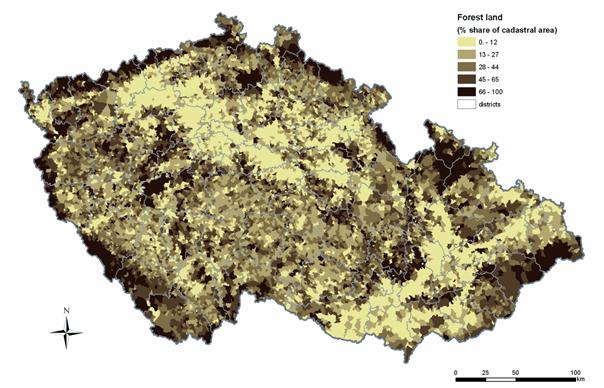
Fig. 7.5 Forest Land in the Czech Republic
–distribution calculated as a spatial share of the category within individual
cadastral units (as of 2010).
The Czech
Republic is a country with a long forestry tradition. Practically all the
forests can be considered to be temperate-zone managed forests under the IPCC
definition of forest management (GPG Chapter 3, IPCC 2003). With respect to the
definition thresholds of the Marrakesh Accords, Forest Land is defined as land
with woody vegetation and with tree crown cover of at least 30 %, over an
area exceeding 0.05 ha containing trees able to reach a minimum height of 2 m
at maturity.
This definition of forests excludes the areas of permanently unstocked
cadastral forest land, such as forest roads, forest nurseries and land under
power transmission lines. The permanently unstocked area of cadastral forest
land has predominantly the attributes of Grassland, and therefore it was
ascribed to that category. Hence, Forest Land in this emission inventory
corresponds to the national definition of timberland (Czech Forestry Act
84/1996). In 2010, the stocked forest area (timberland) qualifying under the
category of Forest Land in this emission inventory equaled 2 604 thousand
ha, representing 98 % of the cadastral forest land in the Czech Republic.
The permanently unstocked area represents 2 % of the forest land according
to cadastral data and it was linked by this proportion to the area of Forest
Land for the whole time series since 1969.
Forests
(cadastral forest land) currently occupy 33.7 % of the area of the country
(MA 2011). The tree species composition is dominated by conifers, which
represent 73.9 % of the timberland area. The four most important tree
species in this country are spruce, pine, beech and oak, which account for
51.9, 16.8, 7.3 and 6.9 % of the timberland area, respectively (MA 2011).
Broadleaved tree species have been favored in new afforestation since 1990. The
proportion of broadleaved tree species increased from 21 % in 1990 to
about 25 % in 2010. The total growing stock (merchantable wood volume) in
forests in the country has increased during the reported period from 564 mil. m3
in 1990 to 681 mil. m3 (under bark) in 2010 (MA 2011).
Several
sources of information on forests are available in the Czech Republic. The
primary source of activity data on forests used for this emission inventory is
the forest taxation data in Forest Management Plans (further denoted as FMP),
which are administered centrally by the Forest Management Institute (FMI),
Brandýs n. L. With a forest management plan cycle of 10 years, the annual
update of the FMP database is related to 1/10 of the total forest area
scattered throughout the country. The information in FMP represents an ongoing
national stand-wise type of forest inventory. The second source of information
consists in the data from the first cycle of the statistical (sample based,
tree level) forest inventory performed during 2001-2004 by FMI. The results of
this forest inventory were published in 2007 (FMI, 2007). The most recent statistical
information on forests at a county level gives the Czech landscape inventory
(CzechTerra; www.czechterra.cz), a
project funded by the Ministry of Environment (Černý 2009, SP/2d1/93/07).
This emission inventory is dominantly based on the FMP data, which have also
been used for all the international reporting on forests of the Czech Republic
to date. Whenever feasible, the information from other inventory programs
mentioned above and/or other sources was also utilized.
FMP data
were aggregated in line with the country-specific approaches at the level of
the four major tree species (i-beech: all broadleaved species except oaks,
ii-oak: all oak species, iii-pine: pines and larch, iv-spruce: all conifers
except pines and larch) and age-classes (10-year intervals). For these
categories, growing stock (merchantable volume, defined as tree stem and branch
volume under bark with a minimum diameter threshold of 7 cm), the corresponding
areas and other auxiliary information were available for each inventory year.
It can be observed in Fig. 7.6 that the average growing stock has
increased steadily for all tree species groups since 1990 in this country. In
addition to the four major categories by predominant tree species, clear-cut
areas are also distinguished, forming another, specific sub-category of Forest
Land as reported in this submission. A clear-cut area is defined as a
temporarily unstocked area following final or salvage harvest of forest stands.
It ceases to exist once it is reforested, which must occur within two years
according to the Czech Forestry Act. There is no detectable carbon stock change
for this category and it is introduced solely for the purpose of consolidated,
transparent and consistent reporting of forest land. In 2010, clear-cut areas
represented 1.1 % of Forest Land.
Fig. 7.6
Activity data – mean growing stock
volume against stand age for the four major groups of species during 1990 to
2010; each line corresponds to an individual inventory year. The symbols
identify only the situation in 1990 and 2010.
The annual
harvest volume constitutes the other key information related to forestry. This
value is available from the Czech Statistical Office (CzSO). CzSO collects this
information on the basis of about 600 country respondents (relevant forest
companies and forest owners) and encompasses commercial harvest and fuel wood,
and included compensation for the forest areas not covered by the respondents.
The total drain of merchantable wood from forests increased from 13.3 mil. m3
in 1990 to 16.7 mil. m3 in 2010, down from the all-time high 18.5
mil. m3 harvested in 2007 (all data refer to underbark volumes, MA
2011). Additionally in the emission inventory, harvest loss of 5 and 15 %
is applied to final and salvage logging volumes, respectively (see Section
7.3.2 below). The salvage logging operations concern primarily stands of
coniferous species, which are commonly hit by windstorms, snow and bark-beetle
calamities in this country.
Category 5A Forest Land includes emissions and
sinks of CO2 associated with forests and non-CO2 gases
generated by burning in forests. This category is composed of 5A1 Forest Land remaining Forest Land,
and 5A2 Land converted to Forest Land.
The following text describes the major methodological aspects related to
emission inventories of both forest sub-categories.
The methods
of area identification described in Section 7.1.2 distinguish the areas of
forest with no land-use change over the 20 years prior the reporting year.
These lands are included in subcategory 5A1
Forest Land remaining Forest Land. The other part represents subcategory 5A2 Land converted to Forest Land, i.e.,
the forest areas “in transition” that were converted from other land-use
categories over the 20 years prior to the reporting year. The areas of forest
subcategories, i.e., 5A1 and 5A2 accumulated over a 20-year rolling
period can be found in the corresponding CRF Tables. The annual matrices of
identified land-use and land-use changes are given in Tab. 7.3 above.
Carbon
stock change in category 5A1 Forest Land remaining
Forest Land is given by the sum of changes in living biomass, dead organic
matter and soils. The carbon stock change in living biomass was estimated using
the default method
according to Eq. 3.3.2 of GPG for LULUCF. This method is based on separate
estimation of increments and removals, and their difference.
The
reported growing stock of merchantable volume from the database of FMP formed
the basis for assessment of the carbon increment (Eqs. 3.2.4 and 3.2.5 of GPG
for LULUCF). The key input to calculate the carbon increment is the volume
increment (Iv) data. In the Czech Republic, these values have
been traditionally calculated by FMI (FMP database administrator; see also
Acknowledgment) and reported to the national and international statistics. The
calculation is performed at the level of the individual stands and species
using the available growth and yield data and models. The increment data were
partly revised in the earlier NIR (2008) to unify two different base
information sources (Schwappach 1923; Černý et al. 1996) for increment
estimates and to apply only the latest source across the entire reporting
period. This was to comply with the GPG for LULUCF requirements of consistent
time series. No change, apart from entering the increment of latest reported
year, was made to the increment in the inventory submissions thereafter (Fig. 7.7).
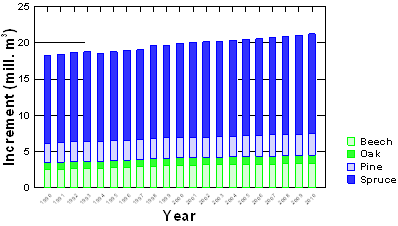
Fig. 7.7
Current annual increment (IV;
m3
underbark) by the individual tree species groups as used in the reporting
period 1990 to 2010.
The
merchantable volume increment (Iv) is converted to the
biomass increment (GTotal), biomass conversion and expansion
factors applicable for increment (BCEFi) using Eqs. 2.9 and
2.10 (AFOLU 2006) as follows:
|
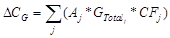
|
(1)
|
where Aj and CFj represent the actual stand area (ha) and carbon
fraction of dry matter (t C per t dry matter), respectively, for each major
tree species type j (beech, oak,
pine, spruce), while  is calculated
for each j as follows:
is calculated
for each j as follows:
|

|
(2)
|
where R
is a root/shoot ratio to include the below-ground component. The total biomass
increment is multiplied by the carbon fraction and the applicable forest land
area. Tab. 7.4 lists the factors used in the
calculation of the biomass carbon stock increment.
Tab. 7.4 Input data and factors used in carbon stock increment calculation (1990
and 2010 shown) for beech, oak, pine and spruce species groups, respectively.
|
Variable or
conversion factor
|
Unit
|
Year 1990
|
Year 2010
|
|
Area of forest land
remaining forest land (A)
|
kha
|
372; 152; 455; 1504
|
466; 176; 431; 1462
|
|
Biomass conv. &
exp. factor, incr. (BCEFi)
|
Mg m-3
|
0.74; 0.86; 0.52; 0.60
|
0.74; 0.85; 0.53; 0.60
|
|
Carbon fraction in
biomass (CF)
|
t C/t biomass
|
0.50
|
0.50
|
|
Root/shoot ratio (R)
|
-
|
0.20
|
0.20
|
|
Volume increment (Iv)
|
m3
|
6.55; 5.96; 5.84; 7.89
|
7.14; 6.23; 6.81; 9.31
|
In Tab. 7.4, A represents only the areas
of 5A1 Forest Land remaining Forest Land,
updated annually. The applied biomass conversion and expansion factors
applicable for the increment (BCEFi) and growing stock
volumes (BCEFh) are based
on national allometric studies (Cienciala et
al. 2006a, 2006b, 2008a) or biomass compilations that include data from the
Czech Republic (Wirth et al. 2004,
Wutzler et al. 2008). Since the
biomass conversion and expansion factors are age-dependent (Lehtonen et al. 2004, 2007), they respect the
actual age-class distribution of the dominant tree species. Hence, the BCEFi
values shown in Table 7.4 are weighted means considering the actual volumes of
the individual age classes for each of the major tree species. Besides the
allometric equations noted above, the source dendrometrical material used for
derivation of the country-specific BCEFi values were the data
of the landscape inventory program CzechTerra (Černý 2009). Its first cycle was
completed in 2009 and these dendrometrical data hence represent the most
current information on the Czech Forests available in the country. The tree
level data together with the information of age was used to assess the median BCEFi
values for each age class and major tree species. CF of 0.50 is a
generally accepted default constant, which is also recommended by IPCC (2003). R
was selected as a conservative value from the range recommended for
temperate-zone forests by IPCC (2003). It corresponds well to the available
relevant experimental evidence (Černý 1990, Green et al. 2006), as well
as to the evidence apparent from the parameterized allometric equations for the
major tree species (Wirth et al.
2004, Wutzler et al. 2008). Iv is the annually updated volume
increment estimated per hectare and species group as described above.
The
estimation of carbon drain (L; Eq. 2) in the category 5A1 Forest Land remaining Forest Land
basically follows Eqs. 3.2.6, 3.2.7 and 3.2.8 (IPCC 2003). It uses the annual
amount of total harvest removals (H) reported by the CzSO for individual
tree species in the country. H covers thinning and final cut, as well as
the amount of fuel wood, which is reported as an assortment under the
conditions of Czech Forestry. To include a potentially unaccounted-for loss
associated with H, the factor FHL was applied to H;
it was calculated from annual harvest data and the share of salvage logging,
assuming 5 % loss under planned forest harvest operations and 15 %
for accidental/salvage harvest applicable for coniferous species.
Hence, the harvest volumes entering the actual emission calculation (H in eq. 3 below) include the correction
by the above described factor, FHL. The calculation of the
carbon drain (L; loss of carbon) otherwise also follows Eq. 2.12 (AFOLU
2006) as
|

|
(3)
|
where
BCEFh represents a
biomass expansion and conversion factor applicable to harvested volumes,
derived from national studies or regional compilations that include the data
from the Czech Republic as noted and mentioned above. The application of BCEFh considers the share of the
planned harvested volume and the actual salvage logging that was not planned.
In the case of planned harvest volumes, the age-dependent BCEFh values also consider the
mean felling age, which is taken from the national reports of the Ministry of
Agriculture. For salvage logging, BCEFh represents the volume-weighted mean of all age classes
for the individual dominant tree species, as the actual stand age of those
harvested volumes is unknown. The other factors (CF, R) are identical to
those described under Tab. 7.4. The specific values of input
variables and conversion factors used to calculate L are listed in Table
7.5.
Tab. 7.5 Specific input data and factors
used in calculation of carbon drain (1990 and 2010 shown) for beech, oak, pine
and spruce species groups, respectively.
|
Variable or conversion factor
|
Unit
|
Year 1990
|
Year 2010
|
|
Harvest volume (H)
|
mill. m3
|
0.84; 0.31;
1.33; 10.8
|
1.28; 0.39;
2.08; 13.0
|
|
Biomass expansion factor (BCEFh)
|
Mg m-3
|
0.69; 0.81;
0.52; 0.59
|
0.69; 0.81;
0.52; 0.58
|
The impact
of disturbances (Eq. 2.14, AFOLU 2006) has not been explicitly estimated. To
the present time, the disturbance in Czech forests since 1990 has not reached
proportions above the buffering capacity of Czech forestry management
practices. Consequently, any salvage felling is flexibly allocated to the
desired amount of planned wood removals, and is thereby accounted for in the
reported harvest volumes.
The
assessment of the net carbon stock change in organic matter (deadwood and
litter) followed the Tier 1 (default) GPG for LULUCF assumption of zero
change in these carbon pools. This is a safe assumption, as the country did not
experience significant changes in forest types, disturbance or management
regimes within the reporting period.
The above
assumption also applies to the soil carbon pool, in which the net carbon stock
change was considered to equal zero (Tier 1, IPCC 2003). This concerns
both mineral and organic soils. The organic soils occur only in the areas of
the Spruce sub-category on 5A1 Forest
Land remaining Forest Land. They represent protected peat areas in
mountainous regions dominated by spruce stands, with no or specific management
practices. No such areas occur under other the sub-categories by the predominant
species of Beech, Oak and Pine.
Emissions
in category 5A1 Forest Land remaining
Forest Land include, in addition to CO2, also other greenhouse
gases (CH4, CO, N2O
and NOx) resulting
from burning. This encompasses both prescribed fires associated with burning of
biomass residues and also emissions due to wildfires. The emissions from
burning of biomass residues were estimated according to Eq. 3.2.19 and the
emission ratios in Table 3A.1.15 (Tier 1, IPCC 2003). Under the conditions
in this country, part of the biomass residues is burned in connection with
final cut. The expert judgment employed in this inventory revision considers
that 30 % of the biomass residues including bark is burned. This biomass
fraction was quantified on the basis of the annually reported amount of final
felling volume of broadleaved and coniferous species, BCEFh
and CF as applied to harvest removals (above). The amount of biomass
burned (dry matter) was estimated as 585 Gg in 1990 and 748 Gg in 2010.
The
emissions of greenhouse gases due to wildfires were estimated on the basis of
known areas burnt annually by forest fires and the average biomass stock in
forests according to Eq. 3.2.9 (IPCC 2003). This equation used a default factor
of biomass left to decay after burning (0.45; Table 3A.1.12). The associated
amounts of non-CO2 gases (CH4, CO, N2O and NOx) were estimated
according to Eq. 3.2.19. The amount of biomass (dry matter) burned in
wildfires was estimated as 10.2 Gg in 1990 and 15.1 Gg in 2010. The most
extreme year of the reporting period was 1997, when about 228 Gg of biomass was
burned due to wildfires. The full time series and the associated emissions of
non-CO2 gases can be found in the corresponding CRF tables.
There are
no direct N2O
emissions from N fertilization on Forest Land, as there is no practice of
nitrogen fertilization of forest stands in the Czech Republic. Similarly, non-CO2
emissions related to drainage of wet forest soils are not reported, as this
activity no longer occurs in practice.
The methods
employed to estimate emissions in the 5A2
Land converted to Forest Land category are similar to those for the
category of Forest Land remaining Forest Land, but they differ in some
assumptions, which follow the recommendations of GPG for LULUCF.
For
estimation of the net carbon stock change in living biomass on Land converted
to Forest Land by the Tier 1 method (IPCC 2003), the carbon increment is
proportional to the extent of afforested areas and the growth of biomass. The
revised methodology of land-use change identification (Section 7.1.2) provides
areas of all conversion types updated annually. Land areas are considered to be
under conversion for a period of 20 years, according the Tier 1 assumption of
GPG for LULUCF. Under the conditions in this country, all newly afforested
lands are considered as intensively managed lands under the prescribed forest
management rules as specified by the Czech Forestry Act.
Until 2006,
the increment applicable to age classes I and II (stand age up to 20 years) was
estimated from the actual wood volumes and areas that were available per major
species groups. Using the available activity stand level data categorized by
species and age classes and the national growth and yield model SILVISIM (Černý
2005), the wood increment was derived for all the age classes above 20 years.
For age class one (1-10 years), the increment was simply calculated from the
reported areas and volumes, assuming a mean age of five years. The increment of
age class two (11 to 20 years) was estimated from linear interpolation between
the increment of age classes I and III. For the year 2007 and forward,
increment is derived for individual tree species using the ratio of increment
for individual tree species to the total stand increment estimated from the
period 2000 to 2006.
Since the
specific species composition of the newly converted land is unknown, the
increment estimated for the major tree species was averaged using the weight of
actual areas for the individual tree species known from the unchanged
(remaining) forest land. Expressed in terms of aboveground biomass, the
estimated aggregated mean increment for 2010 was 3.15 t/ha, a value matching
that for temperate coniferous (3 t/ha) and somewhat lower than that for
broadleaved (4 t/ha) forests given as defaults in GPG for LULUCF. The
estimation of increment in terms of aboveground biomass is facilitated by the
age and species dependent BCEFi values as described in Section
7.3.2.1 above. The estimated species-specific values of BCEFi
applicable for young trees until 20 years were 0.99, 1.25, 0.65 and 0.93 for
beech, oak, pine and spruce, respectively.
The carbon
loss associated with biomass in the category of Land converted to Forest Land
was assumed to be insignificant (zero). This is because the first significant
thinning occurs in older age classes, which is implicitly accounted for within
the category Forest Land remaining Forest Land.
The net
changes of carbon stock in dead organic matter were assumed to be insignificant
(zero), in accordance with the assumptions of the Tier 1 method (IPCC
2003).
The net
change of carbon stock in mineral soils was estimated using the
country-specific Tier 2/Tier 3 method. It was based on the vector map
of topsoil organic carbon content (Macků et
al. 2007, Šefrna and Janderková 2007; Fig. 7.8). The map constructed for forest
soils utilized over six thousand soil samples, linking the forest ecosystem
units - stand site types and ecological series available in maps 1:5 000
and 1:10 000, as used in the Czech system of forest typology (Macků et al. 2007). This represents the soil
organic carbon content to a reference depth of 30 cm, including the upper
organic horizon. The carbon content on agricultural soils was prepared so as to
match the forest soil map in terms of reference depth and categories of carbon
content, although based on interpretation of coarser 1:50 000 and
1:500 000 soil maps (Šefrna and Janderková 2007). The polygonal source
maps were used to obtain the mean carbon content per individual cadastral unit
(n=12 959 in 2010), serving as reference levels of soil carbon stock applicable
to forest and agricultural soils. Since agricultural soils include both
Cropland and Grassland land-use categories, the bulk soil carbon content
obtained from the map was adjusted for the two categories. This was performed
by applying a ratio of 0.85 relating the soil carbon content between Cropland
and Grassland (J. Šefrna, personal communication 2007) and considering the
actual areas of Cropland and Grassland in the individual cadastral units. This
system permitted estimation of the soil carbon stock change among categories 5A Forest Land, 5B Cropland and 5C Grassland. The estimated
quantities of carbon stock change at the level of the individual spatial units
entered 20-year accumulation matrices distributing carbon into fractions over
20 years (Tier 1, IPCC 2003). These quantities, together with the
accumulated areas under the specific conversion categories, were used for
estimation of emissions and removals of CO2.
The net
changes of carbon stock in organic soils, occurring only in the sub-category of
stands dominated by spruce, were assumed to be insignificant (zero). This is in
accordance with the general assumption of the Tier 1 method applicable for
forest soils, as no other specific methodology is available for organic soils
besides the drained ones (IPCC 2003).
Non-CO2
emissions from burning are not estimated for category 5A2 Land converted to Forest Land, as there is no such practice in
this country. The same applies to the N2O
emissions from nitrogen fertilization, which is not employed in this country.
Fig. 7.8
Top - topsoil (30
cm) organic carbon content map adapted from Macků et al. (2007), Šefrna and Janderková (2007); bottom –topsoil carbon
content for agricultural (left) and forest (right) soils estimated as cadastral
unit means from the source maps. The unit (t/ha) and unit categories are
identical for all maps.
The methods
used in this inventory were consistently employed across the whole reporting
period from the base year of 1990 to 2010.
The
uncertainty estimation was guided by the Tier 1 methods outlined in GPG for
LULUCF (IPCC 2003), employing the following equations:
|

|
(4)
|
where Utotal is the percentage
uncertainty in the product of the quantities and Ui denotes the percentage uncertainties with each of the
quantities (Eq. 5.2.1, IPCC 2003).
For the
quantities that are combined by addition or subtraction, we used the following
equation to estimate the uncertainty:
|

|
(5)
|
where UE is the percentage
uncertainty of the sum, Ui
is the percentage uncertainty associated with source/sink i, and Ei is
the emission/removal estimate for source/sink i (Eq. 5.2.2, IPCC 2003).
It should
be noted, however, that Eq. 5 as exemplified in GPG for LULUCF, is not well
applicable for the LULUCF sector. Summing negative (removals) and positive
(emission) members (Ei) in
denominator of Eq. 5 may easily produce unrealistically high uncertainties and
theoretically lead to a division by zero, which is not possible. In this
respect, this approach is not correct. In previous inventory reports, we
stressed this issue and recommended focusing to individual uncertainty
components prior the resulting product of Eq. 5.
In this
inventory report, we followed the recommendations of the recent reviews and
revised the uncertainty values and calculation. The currently adopted
uncertainty values are listed below and/or under the corresponding subchapters
of other land use categories. Apart the IPCC (2006), the source information for
adjusted uncertainty values was the recently conducted statistical landscape
inventory of the Czech Republic CzechTerra (Černý et al. 2009). Otherwise, the
uncertainty estimation utilized primarily the default uncertainty values as
recommended by UNFCCC (2005) and IPCC (2003, 2006) that concern areas of land
use (3 %), biomass increment (6 %), amount of harvest (20 %),
carbon fraction in dry wood mass (7 %), root/shoot factor (30 %), and
factor (1-fBL; 75 %), used in calculation of emissions from
forest fires. The uncertainty applicable to BCEF
was 22 %, which was derived from the work of Lehtonen et al. (2007). The uncertainty associated with fractions of
unregistered loss of biomass under felling operations was set by expert
judgment at 30 %.
Secondly,
we revised the approach of uncertainty combination for individual
sub-categories of tree species differently in this submission. Specifically, we
calculate mean error estimate from the components of carbon stock increase and
carbon stock loss, which are both given in identical mass units of carbon per
year. At the same time, we preserve the recommended logics of combining uncertainties
on the level of entire land use category or on the level of entire LULUCF
sector according Eq. 5. This is calculated on the basis of CO2 or CO2
eq. units and the corresponding uncertainty estimates respect the actual
direction of source and sink categories to be combined. This approach together
with the revised emission estimates significantly reduced the overall
uncertainty estimates on the level of major land use categories and entire
LULUCF sector as compared to previously reported values.
For 2010,
the uncertainty estimates for the categories 5A1 Forest Land remaining Forest Land and 5A2 Land converted to Forest Land using the above revised approach reached 25.4 and 38.5 %,
respectively. Correspondingly, the uncertainty for the entire category 5A Forest Land reached 25.1 %.
Following
the recommendation of the previous in-country review, a sector-specific QA/QC
plan was formulated, tightly linked to the corresponding QA/QC plan of the
National Inventory System. The plan describes the key procedures of inventory
compilation, provides a table of personal responsibilities a timetable of
sector-specific QA/QC procedures. This plan consolidates the quality assurance
procedures and facilitates an effective quality control of the LULUCF
inventory.
Basically
all the calculations are based on the activity data taken from the official
national sources, such as the Forest Management Institute (Ministry of
Agriculture), the Czech Statistical Office, the Czech Office for Surveying, Mapping
and Cadastre (COSMC) and the Ministry of the Environment. Data sources are
verifiable and updated annually. The gradual development of survey methods and
implementation of information technology, checking procedures and increasing
demand on quality result in increasing accuracy of the emission estimates. The
QA/QC procedures generally cover the elements listed in Table 5.5.1 of GPG for
LULUCF (IPCC 2003).
The input
information and calculations are archived by the expert team and the
coordinator of NIR. Hence, all the background data and calculations are
verifiable.
Apart from
official review process, emission inventory methods and results are internally
reviewed among the technical experts involved in the emission inventory of the
Agriculture and LULUCF sectors. Whenever feasible, the methods are subject to
peer-review in case of the cited scientific publications, and expert team
reviews within the relevant national research projects.
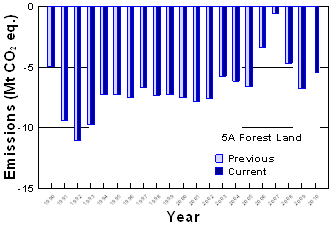
Fig. 7.9
Current and previously reported assessment of emissions for category 5A Forest
Land. The values are negative, hence representing net removals of green-house
gases.
Since the
last submission, no emission recalculation has been performed in the category
of Forest Land. Therefore, the current and previous estimates are identical for
the jointly reported years (Fig. 7.9).
The current
revision applicable for Forest Land and associated land-use change introduced
improvements regarding uncertainty estimation following the suggestions of the
recent inventory reviews. Other recommendations such as reporting
emissions/removals by sub-categories of major tree species groups, revised
categorization of land-use and an improved land-use determination system were
already implemented before. Nonetheless, the category will require additional
efforts to further consolidate the estimates. This includes a further
improvement of the uncertainty assessment (exploring the Monte-Carlo
approaches) and further formalization and enhancement of QA/QC procedures. Over
a longer term, utilization of the stock change method in as explored in
Cienciala et al. (2006a) will be considered. This involves an assessment
of how the data from the recently conducted statistical landscape inventory
(CzechTerra, Černý 2009) could be utilized.
Additionally
in this inventory, emissions from lime application on forest land is newly
included in this submission. These emissions are, however, reported under the
category 5G Other due to the current
technical limitations of the CRF Reporting software. The addition of emissions
from lime application on forest land makes the reporting under Convention
compatible with that of KP LULUCF activities where emissions from lime
applications are also reported for the activities related to forest land.
In the
Czech Republic, Cropland is predominantly represented by arable land (93 %
of the category), while the remaining area includes hop-fields, vineyards, gardens
and orchards. These categories correspond to five of the six real estate
categories on agricultural land from the database of “Aggregate areas of
cadastral land categories” (AACLC), collected and administered by COSMC.
Cropland is
spatially the largest land-use category in the country. Simultaneously, the
area of Cropland has constantly decreased since the 1970s, with a particularly
strong decreasing trend since 1990 (Fig. 7.4). While, in 1990, Cropland
represented approx. 44 % of the total area of the country, this share
decreased to nearly 41 % in 2010. It can be expected that this trend will
continue. The conversion of arable land to grassland is also actively promoted
by state subsidies. In addition, there is a growing demand for land for
infrastructure and settlements. The current estimate of probable excess lands
qualifying for conversion to other land-use in the near future is about
600 000 ha. Conversion to grassland concerns mainly the lands of less
productive regions of alpine and sub-alpine regions.
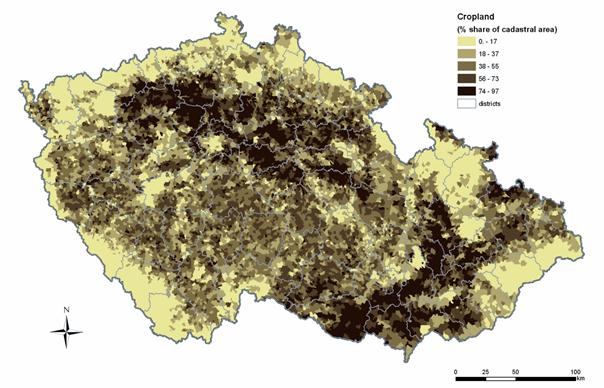
Fig. 7.10 Cropland in the Czech Republic –
distribution calculated as a spatial share of the category within individual
cadastral units (as of 2010).
The
emission inventory of Cropland concerns sub-categories 5B1 Cropland remaining Cropland and 5B2 Land converted to Cropland. The emission inventory of Cropland
considers changes in living biomass and soil. In addition, CO2
emissions resulting from application of agricultural limestone and N2O emissions associated
with soil disturbance during land-use conversion to cropland are quantified for
this category.
For
category 5B1 Cropland remaining Cropland,
the changes in biomass can be estimated only for perennial woody crops. Under
the conditions in this country, this might be applicable to the categories of
vineyards, gardens and orchards. Hence, to estimate emissions associated with
biomass on Cropland, we applied a default factor for the biomass accumulation
rate (2.1 t C/ha/year, Table 3.3.2, IPCC 2003) and estimated changes in the
areas concerned.
The carbon
stock changes in soil in the category Cropland remaining Cropland are given by
changes in mineral and organic soils. Organic soils basically do not occur on
Cropland; they occur as peatland in mountainous regions on Forest Land. While
organic soils practically do not occur on Cropland, emissions were estimated
for mineral soils. Based on the average carbon content on Cropland estimated from
the detailed soil carbon maps (Fig. 7.8), we applied the default relative stock
change factors for land use (FLU;
1.0), management (FMG;
1.08) and input of organic matter (FI;
1.0), respectively (Table 5.5; IPCC 2006). These differentiate management activities
on individual Cropland subcategories, in our case arable land, hop fields and
the sub-categories containing perennial woody crops. The average soil carbon on
typical arable cropland, estimated as the area-weighted average from individual
cadastral units, was 59 t/ha, while it was estimated as 63.7 t/ha for soils
with woody vegetation, such as in orchards. The changes in soil carbon stock,
associated with the annually changing proportion of land areas of cropland
sub-categories, result in emissions/removals. These are calculated after
redistribution of the estimated carbon stock change over a 20-year rolling
period.
The
Cropland category also includes emissions due to liming, which were estimated
from the reported limestone use and application area. Liming by either
limestone (CaCO3) or dolomite (CaMg(CO3)2) is
used to improve soil for crop growth by increasing the availability of
nutrients and decreasing acidity. However, the reactions associated with
limestone application also lead to evolution of CO2, which must be
quantified. Of the reported total limestone use in agriculture, 95 % was
ascribed to Cropland (the reminder to Grassland), based on expert judgment (V.
Klement, Central Institute for Supervising and Testing in Agriculture –
personal communication, 2005). The quantification followed the Tier 1
method of GPG for LULUCF (Eq. 3.3.6 IPCC 2003), with an emission factor of 0.12
t C/t CaCO3. Separate data are not available for limestone and
dolomite, hence the aggregate estimates for total lime applications are
reported.
The
application of agricultural limestone was previously intensive in this country,
but decreased radically during the 1990s. Hence, the amount of limestone
applied in 1990 equaled over 2.5 mil. t, but decreased to less than 200 000
t annually during the most recent years (see the corresponding CRF Tables).
This dramatic decrease makes the entire category of 5B1 Cropland remaining Cropland a key category identified by trend,
although its quantitative contribution to national emissions in recent years is
marginal and reached less than 0.03 % in 2010. The activity data on liming were
repeatedly verified. They correspond to the trend reported for use of
fertilizers, which decreased a lot in early 1990s (Salusová et. al. 2006).
Non-CO2
greenhouse gas emissions from burning do not occur in category 5A2 Land converted to Forest Land, as
there is no such practice in this country.
Category 5B2 Land converted to Cropland includes
land conversions from other land-use categories. Cropland has generally
decreased in area since 1990, by far most commonly converted to Grassland.
However, the adopted land-use identification system was also able to detect
some land conversion in the opposite direction, i.e., to Cropland.
The
estimation of carbon stock changes in biomass in the category 5B2 Land converted to Cropland was based
on quantifying the difference between the carbon stock before and after the
conversion, including the estimate of one year of cropland growth (5 t C/ha;
Table. 3.3.8, IPCC 2003), which follows Tier 1 assumptions of GPG for
LULUCF and the recommended default values for the temperate zone. For biomass
carbon stock on Forest Land prior conversion, the annually updated average
growing stock volumes, species-specific volume-weighted biomass conversion and
expansion factors ((BCEF), and other factors such as the below-ground
biomass ratio were used as described the 5A Forest
Land category in Section 7.2.2.1 above. For biomass carbon stock on
Grassland prior the conversion, the default factors of 6.8 t/ha for
above-ground and below-ground biomass were used (Table 6.4, IPCC 2006). A
biomass content of 0 t/ha was assumed after land conversion to 5B Cropland.
The
estimation of net carbon stock change in dead organic matter concerns the land
use conversion from Forest Land. In this case, the input information on
standing and lying deadwood was obtained from the recently (2008 to 2009)
conducted field campaign of the Czech landscape inventory CzechTerra (Černý 2009;
www.czechterra.cz). It provides data on
the mean standing deadwood biomass (2.17 t/ha) and volume of lying deadwood
(7.5 m3/ha) classified in four categories according to decomposition
degree. These categories are defined as follows: i) basically solid wood;
ii) peripheral layers soft, central hard; iii) peripheral layers
hard, central soft; iv) totally rotten wood. The amount of carbon held in
lying deadwood was estimated as the product of the wood volume, density
weighted by mean growing stock volume of major tree species (0.433 t/m3),
reduction coefficients of 0.8, 0.5, 0.5, 0.2 (Cerny et al. 2002; Carmona et al.
2002) applicable to the above described decomposition categories, respectively,
and the carbon fraction in the wood (0.5 t C/t biomass). A default,
conservative assumption that no deadwood is present following the land use
change was adopted in this calculation.
The
estimation of the carbon stock change in soils for the category 5B2 Land converted to Cropland in the
Czech Republic concerns mineral soils. The soil carbon stock changes following
the conversion from Forest Land and Grassland were quantified by the
country-specific Tier 2/Tier 3 approach is described in detail in
Section 7.2.2.2 above.
The Land
converted to Cropland category represents a source of non-CO2 gases,
namely emissions of N2O
due to mineralization. The estimation followed the Tier 1 approach of Eqs.
3.3.14 and 3.3.15 (IPCC 2003). Accordingly, N2O
was quantified on the basis of the detected changes in mineral soils employing
a default emission factor of 0.0125 kg N2O-N/kg
N, and C:N ratio of 15.
Other non-CO2
emissions may be related to those from burning. However, this is not common
practice in this country and no other non-CO2 emissions besides the
above described are reported in the LULUCF sector.
The methods
used in this inventory were consistently employed across the whole reporting
period from the base year of 1990 to 2007, which applies also for the land use
category of Cropland. The uncertainty estimation was guided by the Tier 1
methods outlined in GPG for LULUCF (IPCC 2003) and described in Section 7.3.3.
The uncertainty estimation utilized primarily the default uncertainty values as
recommended by UNFCCC (2005) and IPCC (2003, 2006). These were partly revised
for this submission as reported above in section 7.3.3. The following
uncertainty values were used: land use areas 3 %, biomass accumulation
rate 75 %, average above-ground to below-ground biomass ratio R (root-shoot-ratio) 68 %, average
growing stock volume in forests 8 %, stock change factor for land use 50
%, stock change factor for management regime 5 %, amount of lime 10 %,
emission factor for liming 5 %, reference biomass carbon stock prior and
after land-use conversion 75 %, average amount of standing deadwood 27 %,
average amount of lying deadwood 20 %, carbon fraction of dry woody matter
7 %. The uncertainty applicable to BCEF
was 22 %, which was derived from the work of Lehtonen et al. (2007).
For 2010,
using the revised uncertainty values, the total estimated uncertainty for
category 5B1 Cropland remaining Cropland
was 14.4 %. The corresponding uncertainty for category 5B2 Land converted to Cropland was 45 %.
The overall uncertainty for category 5B
Cropland was estimated to be 32.3 %.
The
emission estimates are based on the activity data taken from the official
national sources and follow the recommendations of GPG for LULUCF. The data
sources are verifiable and updated annually. All the input information and
calculations are archived by the expert team and the coordinator of NIR. Hence,
all the background data and calculations are verifiable. Other QA/QC elements
were adopted in the same manner as described in Section 7.3.4 above, following
the application of the QA/QC plan applicable for the LULUCF sector.
No
recalculation has been performed in the category of Cropland since the last
submission. Therefore, the current and previous estimates are identical for the
jointly reported years (Fig. 7.11).
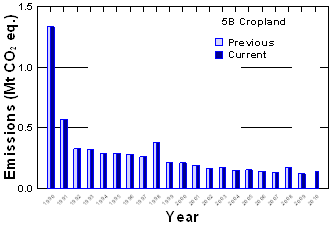
Fig. 7.11
Current and previously reported assessment of emissions for category 5B
Cropland.
Similarly
as for other categories, additional efforts will be exerted to further
consolidate the current estimates for Cropland. Specific attention will be paid
to a likely overall formalization and enhancement of the QA/QC procedures.
Also, a more detailed stratification of Cropland area to allow a more specific
application of appropriate factors used in emission estimation will be explored
as also suggested by the latest in-country review.
Through its
spatial share of close to 14 % in 2010, the category of Grassland ranks
third among land-use categories in the Czech Republic. Its area has been
growing since 1990, specifically in early 1990s (Fig. 7.4). Grassland as defined in this
inventory corresponds to the grassland real estate category, one of the six
such categories of agricultural land in the database of “Aggregate areas of
cadastral land categories” (AACLC), collected and administered by COSMC. This
land is mostly used as pastures for cattle and meadows for growing feed.
Additionally, the fraction of permanently unstocked cadastral Forest Land is
also included under Grassland. This is because it predominantly has the
attributes of Grassland (such as land under power transmission lines).
The importance
of Grassland will probably increase in this country, both for its production
role and for preserving biodiversity in the landscape. According to the
national agricultural programs, the representation of Grassland should further
increase to about 18 % of the area of the country. The dominant share
should be converted from Cropland, the share of which is still considered
excessive. After implementation of subsidies in the 1990s, the area of
Grassland has increased by about 17 % (in 2010) since 1990.

Fig. 7.12 Grassland in the Czech Republic
– distribution calculated as a spatial share of the category within individual
cadastral units (as of 2010).
The
emission inventory of 5C Grassland
concerns sub-categories 5C1 Grassland
remaining Grassland and 5C2 Land
converted to Grassland. Similarly to 5B Cropland,
the emission inventory of 5C Grassland
considers changes in living biomass and soil. In addition, the effect of
application of agricultural limestone is quantified for this category.
For
category 5C1 Grassland remaining
Grassland, the assumption of no change in carbon stock held in living
biomass was employed, in accordance with the Tier 1 approach of IPCC
(2003). This is a safe assumption for the conditions in this country and any
application of higher tier approaches would not be justified with respect to
data requirements and the expected insignificant carbon stock changes.
The
emissions estimates from changes in soil carbon stock were estimated for
category 5C1. These changes are due
to an effect of different management regimes and the changing proportion of the
concerned subcategories of 5C1. The
changes also concern permanently unstocked cadastral Forest Land, which has the
attributes of Grassland and is treated accordingly in the emission estimates
(see Section 7.3.1). Other land belonging to the category of Grassland is
considered as typically managed grassland. The reference soil carbon stock for
this category is estimated as area-weighted mean for all the individual
cadastral units. The analogous mean carbon content for the category of
unmanaged grassland is determined using the corresponding factors (Table 5.5;
IPCC 2006). These included the stock change factor for land use (FLU; 1.0), stock change
factor for the management regime (FMG;
0.95) and stock change factor for input of organic matter (FI; 1.0). The estimated area-weighted average soil
carbon stock for classically managed grassland was equal to 69 t C/ha,
while that for unmanaged grassland was 65.5 t/ha. This is estimated for the
whole reporting period and the soil carbon stock change was derived from the
difference between the consecutive years. The changes in soil carbon stock
associated with the annually changing proportion of land areas of cropland
sub-categories result in emissions/removals. These are calculated after
redistribution of the estimated carbon stock change over a 20-year rolling
period.
Other
explicitly quantified effect on soil carbon that results in CO2
emissions is that of limestone application. This was quantified as described in
Section 7.3.2.1 for 5B Cropland.
The applicable amount of limestone was set at 5 % of the reported
limestone use on agricultural lands, based on expert judgment (V. Klement,
Central Institute for Supervising and Testing in Agriculture – personal
communication, 2005).
Non-CO2
gases on category 5C1 Grassland remaining
Grassland do not concern the LULUCF sector in the Czech Republic.
For category
5C2 Land converted to Grassland, the
estimation concerns carbon stock changes in living biomass and soils.
For living
biomass, the calculation used Eq. 3.4.13 (IPCC 2003) with the assumed carbon
content before the conversion of 5B Cropland
set at 5 t C/ha (Table 3.4.8; IPCC 2003) and that of Forest Land calculated
from the mean growing stock volumes as described in Section 7.3.2.2 above. The
biomass carbon content immediately after the conversion was assumed to equal
zero and carbon stock from one-year growth of grassland vegetation following
the conversion was assumed to be 6.8 t C/ha (Table 3.4.9; IPCC 2003).
For dead
organic matter, emissions are reported due to changes in deadwood that concern
the category 5C21 Forest Land converted
to Grassland. Apart from the actual areas concerned, the emission
estimation is identical as described in Section 7.4.2.2 above.
The
estimation of carbon stock change in soils for category 5C2 Land converted to Grassland in the Czech Republic concerns the
changes in mineral soils. The soil carbon stock changes following the
conversion from 5A Forest Land
and 5B Cropland were quantified
by the country-specific Tier 2/Tier 3 approach described in detail in
Section 7.2.2.2 above.
Similarly
as for other land-use categories, the methods used in this inventory for
Grassland were consistently employed across the whole reporting period from the
base year of 1990 to 2010. The uncertainty estimation was guided by the Tier 1
methods outlined in GPG for LULUCF (IPCC 2003) and described in Section 7.3.3.
The uncertainty estimation utilized primarily the default uncertainty values as
recommended by IPCC (2003, 2006). As reported above in chapter 7.3.3,
uncertainty estimation was revised for this submission, which applies also to
this land use category. The following uncertainty values were used: converted
land use areas 3 %, average growing stock volume in forests prior
conversion 8 %, average biomass stock in cropland and grassland prior
conversion 75 %, biomass carbon stock after land-use conversion 75 %,
average amount of standing deadwood 27 %, average amount of lying deadwood 20
%, average above-ground to below-ground biomass ratio R (root-shoot-ratio) 68 %, stock change factor for land use 50 %,
stock change factor for management regime 5 %, amount of lime 10 %,
emission factor for liming 5 % and reference biomass carbon stock prior to
and after land-use conversion 75 %. The uncertainty applicable to BCEF was 22 %, which was derived from
the work of Lehtonen et al. (2007).
For 2010,
the total estimated uncertainty for category 5C1 Grassland remaining Grassland reached 9.5 %. The
corresponding uncertainty for category 5C2
Land converted to Grassland reached 18.0 %. The overall combined uncertainty
for category 5C Grassland also reached 18.1 %.
The
emission estimates are based on the activity data taken from the official
national sources and follow the recommendations of GPG for LULUCF. Data sources
are verifiable and updated annually. All the input information and calculations
are archived by the expert team and the coordinator of NIR. Hence, all the
background data and calculations are verifiable. Other QA/QC elements were
adopted in the same manner as described in Section 7.3.4 above, following the
application of the QA/QC plan applicable for the LULUCF sector.
No
recalculation has been performed in the category of Grassland since the last
submission. Therefore, the current and previous estimates are identical for the
jointly reported years (Fig. 7.13).
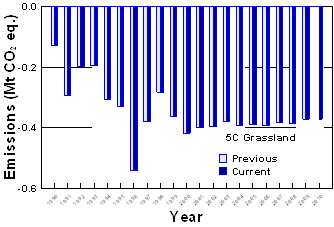
Fig. 7.13 Current and previously reported assessment
of emissions for category 5C Grassland. The values are negative, hence
representing net removals of green-house gases.
Further
efforts to consolidate the emission estimates are expected for the category of
Grassland. Specific attention will be paid to a likely overall formalization
and enhancement of the QA/QC procedures. Also, a more detailed stratification
of Grassland area to allow a more specific application of factors used in
emission estimation will be explored.
Category 5D Wetlands as classified in this
emission inventory includes riverbeds, and water reservoirs such as lakes and
ponds, wetlands and swamps. These areas correspond to the real estate category
of water area of the “Aggregate areas of cadastral land categories” (AACLC),
collected and administered by COSMC. It should be noted that there are about 11
wetlands identified as Ramsar sites in this country. However,
these areas are commonly located in several IPCC land-use categories and are
not directly comparable with the actual content of the 5D emission category.
The area of
5D Wetlands currently covers
2.1 % of the total territory. It has been growing steadily since 1990 (Fig. 7.4) with even a stronger trend since
1970. It can be expected that this trend would continue and that the area of Wetlands
would increase further. This is mainly due to programs aimed at increasing the
water retention capacity of the landscape.
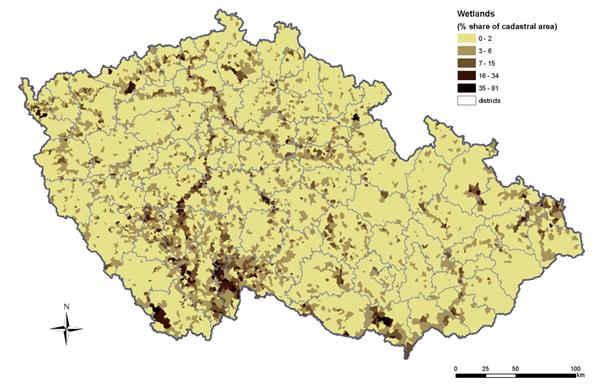
Fig. 7.14 Wetlands – distribution
calculated as a spatial share of the category within individual cadastral units
(as of 2010).
The
emission inventory of sub-category 5D1
Wetlands remaining Wetlands can address the areas in which the water table
is artificially changed, which correspond to peat-land draining or lands
affected by water bodies regulated through human activities (flooded land).
Both categories are insignificant under the conditions in this country. Hence,
the emissions for 5D1 Wetlands remaining
Wetlands were not explicitly estimated and they can safely be considered
negligible.
Sub-category
5D2 Land converted to Wetlands
encompass conversion from 5A Forest
Land, 5B Cropland and 5C Grassland. This is a very minor
land-use change identified in this country, which corresponds to the category
of land converted to flooded land. The emissions associated with this type of
land-use change are derived from the carbon stock changes in living biomass and
in the case of conversion from Forest land, also deadwood. The emissions were
generally estimated using the Tier 1 approach and Eq. 3.5.6 of GPG for
LULUCF, which simply relates the biomass stock before and after the conversion.
The corresponding default values were employed: the biomass stock after
conversion equaled zero, while the mean biomass stock prior to the conversion
in the 5A Forest Land, 5B Cropland and 5C Grassland categories was estimated and/or assumed
identically as described above in Sections 7.3.2.2 and 7.4.2.2. The latter
section also describes the estimation of emissions related to deadwood
component, which was applied identically in this land use category.
The methods
used in this inventory for Wetlands were consistently employed across the whole
reporting period from the base year of 1990 to 2010. Similarly as for the other
land-use categories, the uncertainty estimation was guided by the Tier 1
methods outlined in GPG for LULUCF (IPCC 2003) and described in Section 7.3.3.
It utilized primarily the default uncertainty values as recommended by IPCC
(2003, 2006). As reported above in chapter 7.3.3, uncertainty estimation was
revised for this submission, which applies also to this land use category. The
following uncertainty values were used: converted land use areas 3 %,
average growing stock volume in forests prior conversion 8 %, average biomass
stock in cropland and grassland prior conversion 75 %, biomass carbon stock
after land-use conversion 75 %, average amount of standing deadwood 27 %,
average amount of lying deadwood 20 %, carbon fraction of dry woody matter 7 %,
and average above-ground to below-ground biomass ratio R (root-shoot-ratio) 68 %. The uncertainty applicable to BCEF was 22 %, which was derived from
the work of Lehtonen et al. (2007).
Since the
emission estimate concerns only category 5D2
Land converted to Wetlands, the uncertainty is estimated for this category.
For 2010, the estimated uncertainty for category 5D2 was 71 %.
The
emission estimates are based on the activity data taken from the official
national sources and follow the recommendations of GPG for LULUCF. Data sources
are verifiable and updated annually. All the input information and calculations
are archived by the expert team and the coordinator of NIR. Hence, all the
background data and calculations are verifiable. Other QA/QC elements were
adopted in the same manner as described in Section 7.3.4 above, following the
application of the QA/QC plan applicable for the LULUCF sector.
No
recalculation has been performed in the category of Wetlands since the last
submission. Therefore, the current and previous estimates are identical for the
jointly reported years (Fig. 7.15).
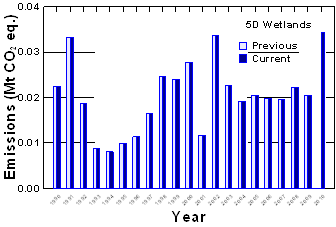
Fig. 7.15 Current and previously reported
assessment of emissions for the category 5D Wetlands.
For the
category of 5D Wetlands,
attention will be paid to a further consolidation of the uncertainty assessment
and to overall formalization and enhancement of the QA/QC procedures.

Fig. 7.16 Settlements – distribution
calculated as a spatial share of the category within individual cadastral units
(as of 2010).
Category 5E Settlements is defined by IPCC (2003)
as all developed land, including transportation infrastructure and human
settlements. For this emission inventory, the area definition under category 5E Settlements was revised to better
match the IPCC (2003) default definition. The category currently includes two
categories of the database “Aggregate areas of cadastral land categories”
(AACLC), collected and administered by COSMC, namely “Built-up areas and
courtyards” and “Other lands”. Of the latter AACLC category, all types of
land-use were included with the exception of “unproductive land”, which
corresponds to category 5F Other Land.
Hence, the Settlements category also includes all land used for infrastructure,
as well as that of industrial zones and city parks, previously included in
category 5F Other Land.
The
category of Settlements as defined above currently represents about 8.6 %
of the area of the country. The area of this category has increased since 1990
and especially during the most recent years (Fig. 7.4).
The
emission inventory for this category concerns primarily 5E2 Land converted to Settlements. As for category 5E1 Settlements remaining Settlements, emissions of CO2
were considered insignificant as no change in biomass, dead organic matter and
soil carbon pools is assumed (Tier 1, IPCC 2006). Emissions quantified in this
inventory concern the category 5E2 Forest
Land converted to Settlements. The emissions result mainly from the biomass
carbon stock change, which was quantified using Eq. 3.6.1 (IPCC 2003). The
carbon stock prior conversion was estimated as described in Section 7.3.2.2.
All biomass is assumed to be lost during the conversion, according to the Tier
1 assumption of GPG for LULUCF. Additional contribution to emissions is from
deadwood component. It was estimated identically as described in Section
7.4.2.2 above, using the actual areas of the land use change concerned.
The methods
used in this inventory for 5E Settlements
were consistently employed across the whole reporting period from the base year
of 1990 to 2010. The uncertainty estimation was guided by the Tier 1 methods
outlined in GPG for LULUCF (IPCC 2003) and described in Section 7.3.3. It
utilized primarily the default uncertainty values as recommended by IPCC (2003,
2006). As reported above, uncertainty estimation was revised for this
submission, which applies also to this land use category. The following
uncertainty values were used: carbon fraction in dry matter 7 %, land use areas
3 %, reference biomass carbon stock prior and after land-use conversion
75 %, average growing stock volume in forests 8 %, average amount of
standing deadwood 27 %, average amount of lying deadwood 20 %, and average
above-ground to below-ground biomass ratio R
(root-shoot-ratio) 68 %. The uncertainty applicable to BCEF was 22 %, which was derived from the work of Lehtonen et al. (2007).
The
emission estimate concerns only category 5E2
Land converted to Settlements; therefore, the uncertainty is estimated only
for this category. For 2010, the estimated uncertainty for the category 5E2 was 102 %.
The emission estimates are based on the activity data taken from the
official national sources and follow the recommendations of GPG for LULUCF. The
data sources are verifiable and updated annually. All the input information and
calculations are archived by the expert team and the coordinator of NIR. Hence,
all the background data and calculations are verifiable. Other QA/QC elements
were adopted in the same manner as described in Section 7.3.4 above, following
the application of the QA/QC plan applicable for the LULUCF sector.
Similarly
as for the other categories, no recalculation has been performed in the
category of Settlements since the last submission. Therefore, the current and
previous estimates are identical for the jointly reported years (Fig. 7.17).
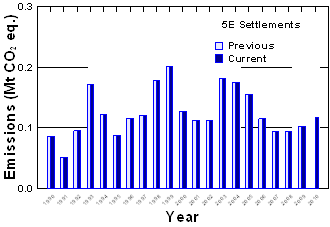
Fig. 7.17 Current and previously reported
assessment of emissions for the category 5E Settlements.
Further
efforts to consolidate the emission estimates are expected for the category of
Settlements. This will include an assessment of how the data from the recently
conducted statistical landscape inventory CzechTerra (Černý 2009) could be
utilized. Attention will also be paid to further improvement of the uncertainty
assessment and overall formalization and enhancement of the QA/QC procedures.
Since NIR
2008 submission, the category 5F Other
Land represents unmanaged (unmanageable) land areas, matching the IPCC
(2003) default definition. These areas were assessed from the database of
“Aggregate areas of cadastral land categories” (AACLC), collected and
administered by COSMC. It is a part the AACLC category “other lands” with the
specific land use category “unproductive land”, assessed from the 2006 land
census of COSMC. This category represents 1.0 % of the territory of the country
and it is considered to be constant, not involving any land-use conversions.
Change in
carbon stocks and non-CO2 emissions are not considered for 5F1 Other Land remaining Other Land
(IPCC 2003). Since no land-use conversion involving “other land” is assumed by
this inventory, no emissions were considered in the entire category 5F Other Land.
The
uncertainty estimates are not reported here. Time series consistency is ensured
as the inventory approaches and/or assumptions are applied identically across
the whole reporting period from the base year 1990 to 2010.
The
activity data are based on land-use information from the national sources and
the estimation approaches follow the recommendations of GPG for LULUCF.
The QA/QC
elements were adopted in the same manner as described in Section 7.3.4 above,
limited to those relevant for this specific land-use category.
No
recalculations concern category 5F Other
Land.
There are
no short-term plans concerning this category.
Since this
submission, the category 5G Other is
reported . Unlike other land use categories, 5G Other has no area representation and therefore it is not
reported in land use matrices (Tab. 7.3). It was introduced to facilitate
reporting of emissions from lime application on Forest land. This is due to the
current technical restrictions of the CRF Reporter software, which does not
permit adding emissions from lime application under the category of 5A Forest Land where these emissions
should actually be attributed to.
For the
emissions from lime application, the methodology described in Section 3.3.1.2.1
of GPG for LULUCF (IPCC 2003) was used. The activity data in terms of forest
area and amount of limestone applied were taken from the national reports on
Czech forestry (Green report, MA 2011). In 2010, the amount of lime applied to
forest soils equaled 5.12 kt and concerned an area of 1 721 ha.
The
uncertainty estimates are not specifically reported here. Time series
consistency is ensured as the inventory approaches and/or assumptions are
applied identically across the whole reporting period from the base year 1990
to 2010.
The
activity data are based on land-use information from the national sources and
the estimation approaches follow the recommendations of GPG for LULUCF.
The QA/QC
elements were adopted in the same manner as described in Section 7.3.4 above,
limited to those relevant for this specific emission category.
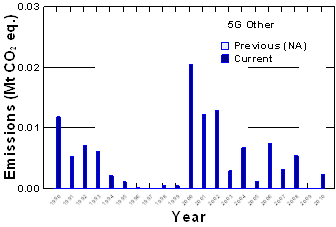
Fig. 7.18 Currently reported assessment of
emissions for the category 5G Other, represented solely by emissions from lime
application on Forest land. Not applicable (NA) for the previous submission.
Since the
category 5G Other is used and
reported for the first time, no recalculations are applicable for this category
(Fig. 7.18).
The UNFCCC
Secretariat will be further consulted to allow reporting of the emissions from
lime application on forest land under the category 5A Forest Land, where it logically belongs. Once this will be made
possible in the CRF Reporter, the category 5G
Other will not be used for this purposes.
The authors
would like to thank Vladimír Henžlík, formerly at the Forest Management
Institute in Brandýs n. Labem, for some of the activity data and his expert
advice. Thanks are also due to Jan Hána, Patrik Pacourek and Miroslav Zeman,
Forest Management Institute in Brandýs n. Labem, for compiling the required
increment data concerning forests. Some of the analyses required for this
inventory were performed within the project CzechCarbo (VaV/640/18/03), while
some of the critical data were obtained from the project CzechTerra
(SP/2d1/93/07), both funded by the Czech Ministry of the Environment.
The waste sector consists of several categories. The main source
category of this sector is 6A Methane emissions from solid waste disposal
sites. In 2010, this category emitted 124
Gg of methane (2612 Gg of CO2 ekv). The second source category is 6B emissions from
waste-water, which is calculated as the sum of four subcategories – emissions
of methane from industrial waste-water treatment, domestic waste-water
treatment, on-site treatment and emissions of nitrous oxide from waste-water.
These subcategories summed up in 2009 emitted
24.2 Gg of methane and 0.66 Gg of N2O.
The last source category in this sector is
incineration of wastes, which was recalculated this year and split between two
sectors. Waste used as a fuel for energy purposes was calculated and reported
in category 1AA1A other fuels. Industrial and hazardous waste remained in
category 6 C and produced a total of 183
Gg of fossil CO2ekv.This inventory year sector 6 produced 3515 Gg of
CO2ekv in total.
Tab. 8‑1 Overview of significant categories
in this sector (2010)
|
Category
|
Character of category
|
Gas
|
% of total GHG*
|
|
6A Solid Waste
Disposal on Land
|
KC (LA, TA, LA*, TA*)
|
CH4
|
2.0
|
|
6B Waste Water
Handling
|
non-KC
|
CH4
|
0.4
|
|
6C Waste
Incineration (without MSW)
|
non-KC
|
CO2
|
0.1
|
|
6B Waste Water
Handling
|
non-KC
|
N2O
|
0.1
|
* assessed
without considering LULUCF
KC: key
category,LA, LA*: identified by level assessment with and without considering
LULUCF, respectively
TA, TA*:
identified by trend assessment with and without considering LULUCF,
respectively
Right from the start, CHMI co-operated in compilation of the emission
inventory for this sector with professional workplaces, in particular with the
Institute for Environmental Science of the Faculty of Sciences at Charles
University in Prague (PřFUK) (Havránek, 2001), the University of Chemical
Technology (VŠCHT) (Zábranská, 2004) and the Institute for Research and Use of
Fuels in Prague Běchovice (ÚVVP) (Straka, 2001). In the
framework of this cooperation, all the emission inventories in this category
were recalculated for the entire time series from the reference year of 1990 to
the present. At the present time, this
sector is managed by the Charles University Environmental Center (CUEC).
Treatment and disposal of municipal, industrial and other solid waste
produces significant amounts of methane (CH4). Decomposition
of organic material derived from biomass sources (e.g., crops, wood) is the
primary source of CO2 released from waste. These CO2 emissions are not included in the
national totals, because the carbon is of biogenic origin and net emissions are
accounted for under land use change and forestry.
This category produces emissions of other micropollutants, such as
non-methane volatile organic compounds (NMVOCs), as well as smaller amounts of
nitrous oxide (N2O),
nitrogen oxides (NOx)
and carbon monoxide (CO).
Only CH4 is addressed in this report.
Category was recalculated for this year. Based on suggestions in the
in-country review, we gathered country-specific waste composition data. Using the default carbon content
suggested in the IPCC guidelines, we
derived the country-specific DOC for
particular waste streams.
Waste disposal to SWDS
Key activity data for methane quantification from 6.A consists in the
amount of waste disposed in landfills. Annual disposal is shown Tab. 8‑2 MSW disposal in SWDS in the Czech Republic [Gg], 1990-2010. Data for annual
disposal are from mixed sources because correct application of the FOD
model requires data from 1950 to the present
day. These data are not available in the country and therefore assumptions
about the past must have been used. These assumptions are described in the
working paper published in this issue (Havránek, 2007) but the method can be
simply described as intrapolation and extrapolation between points in time; we
correlated waste production with social product (predecesor of current GDP) as
a test method. The higher of the two estimates was used in the quantification.
Tab. 8‑2 MSW disposal in SWDS in the Czech
Republic [Gg], 1990-2010
|
Year
|
MSW in SWDS
|
|
Year
|
MSW in SWDS
|
|
Year
|
MSW in SWDS
|
|
1990
|
2371
|
|
1997
|
2739
|
|
2004
|
3000
|
|
1991
|
2388
|
|
1998
|
2804
|
|
2005
|
3070
|
|
1992
|
2484
|
|
1999
|
2632
|
|
2006
|
3221
|
|
1993
|
2543
|
|
2000
|
2803
|
|
2007
|
3314
|
|
1994
|
2561
|
|
2001
|
2826
|
|
2008
|
3424
|
|
1995
|
2621
|
|
2002
|
2920
|
|
2009
|
3406
|
|
1996
|
2683
|
|
2003
|
2952
|
|
2010
|
3185
|
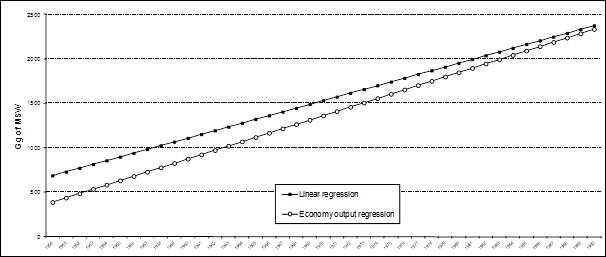
Fig. 8‑1MSW disposal in SWDS in the Czech Republic, 1950-1990
The method used for estimation of methane emissions from this source
category is the Tier 2 FOD approach
(first-order decay model). The first-order decay (FOD) model
assumes gradual decomposition of waste disposed in landfills. We calculated GHG emissions from the IPCC Spreadsheet
for Estimating Methane Emissions from Solid Waste Disposal Sites, which is part
of the new methodology guidelines (IPCC, 2007) referred further to as (IPCC
model, 2006).
Waste composition, k-rate and DOC
Waste composition is
crucial for emission estimations. We made several attempts to obtain
country-specific data about waste composition. Light-greyed data
(1990-1995) are based on the IPCC default values for Eastern Europe, Dark-greyed
data (1996-2000 and 2002-2004) are based on intrapolation between data points.
Data in the white rows (2001 and 2005-2010)
are based on waste surveys performed in R&D projects dealing with waste
composition.
The table also
contains the methane generation rate (k-rate) employed. This rate is closely
related to the compostion of a particular substance and the available moisture.
We used IPCC default k-rates for a wet temperate climate (as the average temperature of the Czech Republic is about 7 °C
and the annual precipitation is higher than the potential evapotranspiration). The average DOC for
particular waste streams is also based on the IPCC default values for particular categories of waste. The
average DOC for a particular year is in the last column of the table.
Tab. 8‑3 MSW composition for the Czech Republic used in
the quantification (fractions of total, 1990-2010)
|
|
Paper
|
Food
|
Textil
|
Wood and straw
|
DOC
|
|
k-rate
|
0.06
|
0.185
|
0.06
|
0.03
|
|
|
DOC
|
0.4
|
0.15
|
0.24
|
0.43
|
|
|
|
Share of particular waste streams
|
|
1990
|
0.22
|
0.30
|
0.05
|
0.08
|
0.176
|
|
1991
|
0.22
|
0.30
|
0.05
|
0.08
|
0.176
|
|
1992
|
0.22
|
0.30
|
0.05
|
0.08
|
0.176
|
|
1993
|
0.22
|
0.30
|
0.05
|
0.08
|
0.176
|
|
1994
|
0.22
|
0.30
|
0.05
|
0.08
|
0.176
|
|
1995
|
0.22
|
0.30
|
0.05
|
0.08
|
0.176
|
|
1996
|
0.22
|
0.29
|
0.05
|
0.08
|
0.179
|
|
1997
|
0.23
|
0.28
|
0.06
|
0.08
|
0.181
|
|
1998
|
0.24
|
0.27
|
0.06
|
0.08
|
0.184
|
|
1999
|
0.25
|
0.26
|
0.07
|
0.08
|
0.187
|
|
2000
|
0.26
|
0.25
|
0.07
|
0.08
|
0.191
|
|
2001
|
0.27
|
0.23
|
0.08
|
0.08
|
0.195
|
|
2002
|
0.24
|
0.25
|
0.08
|
0.09
|
0.194
|
|
2003
|
0.22
|
0.27
|
0.07
|
0.11
|
0.193
|
|
2004
|
0.19
|
0.30
|
0.07
|
0.13
|
0.192
|
|
2005
|
0.16
|
0.32
|
0.07
|
0.14
|
0.191
|
|
2006
|
0.16
|
0.32
|
0.07
|
0.14
|
0.187
|
|
2007
|
0.17
|
0.32
|
0.08
|
0.13
|
0.193
|
|
2008
|
0.16
|
0.32
|
0.07
|
0.14
|
0.188
|
|
2009
|
0.16
|
0.35
|
0.08
|
0.13
|
0.193
|
|
2010
|
0.16
|
0.35
|
0.08
|
0.13
|
0.193
|
Methane correction factor
The methane correction factor (MCF) is a value expressing overall
management of the landfills in the country. Better-managed
and deeper landfills have larger MCF values. Shallow SWDS ensure that far more oxygen penetrates into the body of the
landfill to aerobically decompose DOC. The
suggested IPCC values are given in Tab. 8‑4 Methane correction values (IPCC, 1996)
Tab. 8‑4 Methane correction values (IPCC, 1996)
|
|
MCF
|
|
Unmanaged, shallow
|
0.4
|
|
Unmanaged, deep
|
0.8
|
|
Managed
|
1.0
|
|
Managed, semi-aerobic
|
0.5
|
|
Uncategorised
|
0.6
|
Tab. 8‑5 MCF values employed, 1950-2010
|
|
MCF
|
|
1950 – 1959
|
0.6
|
|
1960 – 1969
|
0.6
|
|
1970 – 1979
|
0.8
|
|
1980 – 1989
|
0.9
|
|
1990 – 2010
|
1.0
|
Oxidation factor
As methane moves
from the anaerobic zone to the aerobic and semi-aerobic zones close to the
landfill surface, part of it becomes oxidized to CO2. There is no conclusive agreement in the
scientific community on how intensive the oxidation of methane is. Oxidation is indeed site-specific due to the effects
of local conditions (including fissures and cracks, compacting, landfill cover
etc.). No representative measurement or
estimations of the oxidation factor are
available for the Czech Republic. Some studies are quoted in Straka, 2001, which mentions a non-zero
oxidation factor, but these figures seem to be site-specific (and really high)
and therefore cannot be used as representative for the whole country. However, the methodology (IPCC, 2000) suggests that an
oxidation factor higher than 0.1 should not be used if no site measurements are
available (a larger value adds uncertainty). The author used the recommended oxidation factor of 0.1 in the report.
Delay time
When waste is
disposed in SWDS, decomposition (and methanogenesion) do not start immediately. The assumption employed in the IPCC
model is that the reaction starts on the first of January in the year after
deposition, which is equivalent to an average delay time of six months before
decay to methane commences. It is good
practice to assume an average delay of two to six months. If a value greater than six months is chosen, evidence
to support this must be provided. The
Czech Republic has no representative country-specific value for delay time, so
the author used a default value of 6 months.
Fraction of methane
This parameter
indicates the share (mass) of methane in the total amount of Landfill Gas (LFG). In previous calculations of methane
emissions from SWDS (NIR, 2004), a value 0.61 was used. This figure was based on measurement of a limited number
of sites (Straka, 2001). This value is
higher than the range of 0.5-0.6 suggested by IPCC. In this work, we revised these values based on new
evidence (MIT, 2005). MIT receives annual
reports from landfills capturing their LFG; SWDS report the net calorific value
of their captured LFG. We used this value
for comparison with the gross calorific value of pure methane, yielding a value
of approx. 0.55, which was used in the quantification.
Recovered methane
On SWDS in the country, methane is sometimes collected by an
LFG collection system and incinerated for energy purposes. Based on IPCC
guidelines, this methane is converted to CO2 and, having biogenic
origin, it is not considered to constitute an emission of GHG. Recovered methane (R) is substituted in
the equation in Appendix 1. There is no default value for R, so we used country
estimates based on various sources. The Ministry of Industry and Trade
conducts an annual survey of all SWDS. All the energy data about LFG is
collected. An attempt is made to update old estimates as much as possible.
Since the start of the survey in 2005, it has been possible to provide
estimates for time series from 2003 to 2010. The estimates in Straka, 2001 were used for the 1990-1996 period. Linear intrapolation of recovered methane was used
for the period between 2003 and 1996.
CH4 recovery column. Because of changes in the
activity data on methane recovery provided by MIT, the time series since 1996
has been recalculated.
Total emissions of
methane are based on the equation from the IPCC CH4 model. Detailed time series from 1950 with
breakdown into individual waste components are given in the paper by Havranek
2007, together with the other model outputs gives the trends in emissions of
methane from SWDS following recalculation.
Tab. 8‑6 Emissions of methane from SWDS
[Gg], Czech Republic, 1990-2010
|
|
CH4
generation
|
CH4
recovery
|
CH4
oxidized
|
CH4
emission
|
|
1990
|
91
|
3.3
|
9.1
|
79.2
|
|
1991
|
95
|
3.3
|
9.5
|
82.8
|
|
1992
|
99
|
3.5
|
9.9
|
86.0
|
|
1993
|
103
|
3.5
|
10.3
|
89.5
|
|
1994
|
107
|
3.5
|
10.7
|
93.0
|
|
1995
|
110
|
3.5
|
11.0
|
96.2
|
|
1996
|
114
|
6.0
|
11.4
|
97.1
|
|
1997
|
118
|
6.6
|
11.8
|
99.9
|
|
1998
|
121
|
7.1
|
12.1
|
102.6
|
|
1999
|
125
|
7.7
|
12.5
|
105.5
|
|
2000
|
127
|
8.2
|
12.7
|
107.3
|
|
2001
|
131
|
8.8
|
13.1
|
109.8
|
|
2002
|
134
|
9.3
|
13.4
|
112.3
|
|
2003
|
138
|
9.9
|
13.8
|
115.1
|
|
2004
|
142
|
15.6
|
14.2
|
113.4
|
|
2005
|
145
|
18.0
|
14.5
|
114.7
|
|
2006
|
149
|
20.6
|
14.9
|
116.0
|
|
2007
|
154
|
25.9
|
15.4
|
114.8
|
|
2008
|
158
|
24.6
|
15.8
|
120.4
|
|
2009
|
163
|
24.5
|
16.3
|
124.5
|
|
2010
|
168
|
24.7
|
16.8
|
129.0
|
This sector was
extensively recalculated this year. We changed waste composition to be
consistent with the country estimates and we have changed recovered methane
estimates to be consistent with the latest data collection work on LFG.
Havranek, 2007 contains a sensitivity analysis for several key factors and
assumption used in the previous recalculation when we moved from Tier 1 to Tier
2. Overall quantification of the uncertainity for this category is still incomplete. This is considered a
high priority and will be conducted in the following years as soon as budget
constraints permit. This category entails the difficulty that the
uncertainty does not permeate through the whole waste management period of
1950-2010 and cannot be quantified by simple analysis.
Activity data from
national agencies and ministries are the subjects of internal QA/QC mechanisms. The recalculation that is fully described in Havranek, 2007 was approved by the
Expert Review Team in 2007.
Several
changes in this sector qualify as recalculation. The first small change is in the amount of
MSW that is disposed in SWDS. This change is due to improved data available for
this activity and it is a minor change (less than 1%). The second major change
is the use of country-specific values for waste composition. Due to the higher-than-default
values mainly in the food category, this led to changes in the total DOC in
landfilled waste and increased methane emissions significantly. The third
change was in the estimate of recovered methane . Here, we used
actualized data from the statistical survey
We have improved
this sub-category this year by using country specific values for the waste. In near future we do not plan any
significant methodological improvement. We
plan to conduct uncertainity analysis of the newly recalculated results in 2013
submission. We of course will include
improved data in this category should they be available but not as a planned
improvement but rather as regular maintenance of the quality of the chapter.
This category has
CRF code 6B and consists of four separately calculated sub-categories –
emissions of methane from 6B1 Industrial
Waste-water, 6B2 Domestic and
Commercial Waste-water and 6B3 Other
(Treatment on site) and emissions of nitrous oxide from 6B2 Domestic and Commercial Waste-water.
The basic factor for
determining methane emissions from waste-water handling is the content of
organic pollution in the water. The content of organic pollution in municipal waste-water and sludge is
given as BOD5 (the biochemical oxygen demand). BOD is a group method of determination of organic
substances and expresses the amount of oxygen consumed in the biochemical
oxidation, and is thus a measure of biologically degradable substances. In contrast, COD (chemical oxygen demand) is the
amount of oxygen required for chemical oxidation and includes both biologically
degradable and biologically non-degradable substances. COD is used according to the Revised 1996 IPCC Guidelines, 1997 for calculation of methane
emissions from industrial waste-water and is always larger than BOD.
The current IPCC
methodology employs BOD for evaluation of municipal waste-waters and sludge and
COD for industrial waste-waters. The new method is also extended to include determination of emissions from
sludge that are primarily the products of various methods of treatment of
waste-waters and, under anaerobic conditions, may contribute to methane
production and methane emissions. The
amount of nitrous oxide emitted from waste-waters is a function of protein
consumption in the population rather than BOD or COD.
8.3.2.1
Industrial
waste-water (6B1)
The main activity
data for estimation of methane emissions from this subcategory is determination
of the amount of degradable pollution in industrial waste-water. In this inventory we use specific
production of pollution - the amount of pollution per production unit - kg COD
/ kg product and then we multiply it by the production, or the value obtained
from the overall amounts of industrial waste-water and from a qualified
estimate of their concentrations (in kg COD/m3). We use the procedure from the IPCC methodology (Revised 1996 IPCC Guidelines, 1997; Good Practice Guidance, 2000). The necessary activity data were taken from the
material of CZSO (Czech Statistical
Office - Statistical Yearbook)
and the other parameters required for the calculation were taken from the IPCC Good Practice (Good Practice Guidance, 2000).
On the basis of information on the total amount
of industrial waste-water equal to 159 mil.m3 (actually only 157
mil.m3 were treated) (Source CENIA, Environmental Statistical Yearbook)
we are able to correct our overestimation of possible waste-water generation of
industry (40 mil.m3), which was assigned an average concentration of
3 kg COD/m3. In previous years
this factor was positive; in 2008, for the first time, this correction factor
started to be negative. In addition, in
accordance with (Revised 1996 IPCC
Guidelines, 1997), it was estimated that the amount of sludge equals 10% of
the total pollution in industrial water (25% was assumed in the Meat & Poultry, Paper and Pulp and in Vegetables,
Fruits & Juices category). These estimates are based on Dohanyos and
Zábranská, 2000; Zábranská, 2004, see Tab. 8‑7 Estimation of COD generated by individual sub-categories 2010.
Tab. 8‑7 Estimation of COD generated by
individual sub-categories 2010
|
|
Production
[kt/year]
|
COD/m3
[kg /m3]
|
Waste-water/t [m3/t]
|
Share of sludge [%]
|
COD of sludge [t]
|
COD of waste-water [t]
|
|
Alcohol Refining
|
16
|
11.0
|
24.00
|
0.10
|
423
|
3 804
|
|
Dairy Products
|
1 118
|
2.7
|
7.00
|
0.10
|
2 113
|
19 017
|
|
Malt & Beer
|
3 281
|
2.9
|
6.30
|
0.10
|
5 994
|
53 950
|
|
Meat & Poultry
|
504
|
4.1
|
13.00
|
0.25
|
6 716
|
20 147
|
|
Organic Chemicals
|
183
|
3.0
|
67.00
|
0.10
|
3 690
|
33 213
|
|
Pet. ref./Petrochemicals[22]
|
0
|
1.0
|
0.60
|
0.10
|
0
|
0
|
|
Plastics and Resins
|
600
|
3.7
|
0.60
|
0.10
|
133
|
1 199
|
|
Pulp & Paper
|
830
|
9.0
|
162.00
|
0.25
|
302 717
|
908 152
|
|
Soap and Detergents
|
29
|
0.9
|
3.00
|
0.10
|
7
|
67
|
|
Starch production
|
83
|
10.0
|
9.00
|
0.10
|
748
|
6 733
|
|
Sugar Refining
|
421
|
3.2
|
9.00
|
0.10
|
1 213
|
10 920
|
|
Textiles(natural)
|
36
|
0.9
|
172.00
|
0.10
|
556
|
5 002
|
|
Vegetable Oils
|
122
|
0.9
|
3.10
|
0.10
|
32
|
289
|
|
Vegetables, Fruits & Juices
|
120
|
5.0
|
20.00
|
0.25
|
2 985
|
8 954
|
|
Wine & Vinegar
|
59
|
1.5
|
23.00
|
0.10
|
204
|
1 839
|
|
Unidentified
waste-water
|
- 38 865
|
3.0
|
1.00
|
0.10
|
-11 659
|
-104 935
|
|
Total
|
|
|
|
|
315 873
|
968 352
|
Tab. 8‑8 Parameters for CH4 emissions
calculation from industrial waste-water 1990-2010
|
|
MCF
|
1990
|
1993
|
1996
|
1999
|
2002
|
2005
|
2008
|
2009
|
2010
|
|
Non-treated
|
0.05
|
29 %
|
18 %
|
13 %
|
5 %
|
7 %
|
3 %
|
1 %
|
2%
|
1%
|
|
Aerobic treatment of water
|
0.06
|
67 %
|
73 %
|
70 %
|
70 %
|
65 %
|
68 %
|
69 %
|
69%
|
70%
|
|
Anaerobic treatment of water
|
0.70
|
4 %
|
8 %
|
17 %
|
25 %
|
28 %
|
29 %
|
30 %
|
30%
|
29%
|
|
Aerobic treatment of sludge
|
0.10
|
40 %
|
40 %
|
40 %
|
40 %
|
30 %
|
27 %
|
27 %
|
27%
|
27%
|
|
Anaerobic treatment of sludge
|
0.30
|
60 %
|
60 %
|
60 %
|
60 %
|
70 %
|
73 %
|
73 %
|
73%
|
73%
|
In accord with (Good
Practice Guidance, 2000), the maximum theoretical methane production B0
was considered to equal 0.25 kg CH4/kg COD. This value is in accordance with the national factors presented in Dohanyos and Zábranská,
2000.
The calculation of the emission factor for waste-water is
based on a qualified estimate of the ratio of the use of individual
technologies during the entire recalculated time series. In the future, this ratio will shift
towards anaerobic treatment of waste-water and sludge because of the energy
advantages of this means of treating waste-water. Tab. 8‑7 Estimation of COD generated by individual sub-categories 2010 describes this trend. The conversion factor for
anaerobic treatment is 0.06 and, for aerobic treatment, 0.7.
In contrast to a quite stable ratio for waste-water treatment
technologies (6.B.2), ratio used for sludge keeps shifting in favor of
anaerobic treatment. This
is mostly due its economic efficiency. The
calculation of the emission factor for sludge was based on the assumption that
27% is treated anaerobically with a conversion factor of 0.3 and the remaining
73 % by other, especially aerobic methods with a conversion factor of 0.1.
Similarly as in 6.B.2, it is assumed that all
the methane from anaerobic processes is burned (mostly usefully in cogeneration
units, as flaring is being phased out and cogeneration technology seems to be
economically effective); however, in contrast to municipal water, methane from
anaerobic sludge and waste-water is included. This assumption is based on national standards and regulations presented
in the subchapter below (Zábranská,
2004). For calculation of methane
emissions, it is sufficient to consider only aerobic processes (where the
methane is not oxidized to biological CO2). Experts at the University
of Chemical Technology recommended the conversion factors and other
parameters given in this part, see (Dohanyos and Zábranská, 2000; Zábranská,
2004).
Tab. 8‑9 Emissions of CH4 (Gg) from 6B1,
1990-2010, Czech Republic
|
|
1990
|
2000
|
2001
|
2002
|
2003
|
2004
|
2005
|
2006
|
2007
|
2008
|
2009
|
2010
|
|
CH4 production
|
49.8
|
63.5
|
66.4
|
77.4
|
75.4
|
77.4
|
76.9
|
80.6
|
80.9
|
78.0
|
76.0
|
79.8
|
|
Oxidized CH4
|
25.3
|
50.3
|
55.5
|
64.5
|
63.0
|
65.0
|
64.7
|
67.9
|
68.1
|
65.9
|
64.2
|
67.5
|
|
Total CH4 emissions
|
24.5
|
13.3
|
10.9
|
12.9
|
12.3
|
12.2
|
12.1
|
12.7
|
12.3
|
12.1
|
11.8
|
12.3
|
8.3.2.2
Municipal
and commercial waste-water treatment (6B2) and treatment on site (6B3)
The basic activity
data (and their sources) for determining emissions from these subcategories are
as follows:
- the number
of inhabitants (source Czech Statistical Office);
- the
organic pollution produced per inhabitant (source IPCC default value);
- the
conditions under which the waste-water is treated.
(source Czech Statistical Office, with some
specific national factors);
- the
amount of proteins in the diet of the population (source FAO).
Calculations for
conditions in this country are based on pollution production per inhabitant of
18.25 kg BOD p.a. (Revised 1996 IPCC Guidelines, 1997), of which approx. 33% is present in the form of insoluble
substances, i.e. is separated as sludge. This
factor was slightly changed in 2003 mainly due to increasing water savings in
water use (aprox. 10-20%). The total
amount of organic pollution is constant, but the density is higher than for the period
before 2003. From 2003 onwards, we assume that 40% of the BOD is separated as sludge. (Zábranská, 2004).
Other data entering
the calculation also include the number of inhabitants connected to the sewers
and the percent of treated waste-water collected in the sewers. gives the
amounts for the time series. According to IPCC Good Practice (Good Practice
Guidance, 2000), the maximum theoretical methane production B0 equals 0.25 kg CH4/kg
COD, corresponding to 0.6 kg CH4/kg BOD. This data is
used to determine the emission factors for municipal waste-water and sludge.
In determining the emission factor for sludge,
it is necessary to evaluate the technology used to treat the particular sludge
and to assign a conversion factor to it - MCF - Methane Conversion Factor -
giving the part of the organic material that will be transformed as methane
(the remainder to CO2). The
literature (Dohanyos and Zábranská, 2000;
Zábranská, 2004) contains a survey of the nationally specific factors for the
ratio of aerobic and anaerobic technologies for 1990-2004. There is also a certain fraction of waste-water that
does not enter the sewer system and is treated on site. For this situation, the IPCC methodology (Revised 1996
IPCC Guidelines, 1997; Good Practice Guidance, 2000) recommends that separation
into waste-water and sludge not be carried out (this corresponds to latrines,
septic tanks, cesspools, etc.). The
residual waste-water in the Czech Republic which does not enter the sewer
system is considered to be treated on site. All methane generated in anaerobic processes for sludge is considered to
be removed (recovered for energy purposes or flared). The remaining methane is considered to be emitted. This assumption is based on Czech national standards
(to certain degree similar to ISO standards) CSN 385502, CSN 105190 and CSN
756415. On the basis of these standards, every waste-water treatment facility
is obliged to maintain safety and abate gas emission. Leakage might occur only during accidents, but the
amount of methane emitted is assumed to be insignificant (the estimate based on
expert judgment is less than 1% of the total amount) (Zábranská, 2004).
In the estimation of methane emissions from waste-water and sludge, it is
necessary to determine the total amount of organic substances contained in them
and to determine (estimate) the emission factors for the individual means of
waste-water treatment. For this purpose, professional cooperation was
undertaken with the University of
Chemical Technology and a study was carried out (Havránek, 2001),
supplementing an earlier study (Dohányos and Zábranská, 2002) and related to a
new study (Zábranská, 2004).
Tab. 8‑10 Population connection to sewers and share of treated water, 1990-2010,
Czech Republic
|
|
Total
population
(thous. pers.)
|
Sewer
connection
(%)
|
Water
treated
(%)
|
|
Total
population
(thous. pers.)
|
Sewer
connection (%)
|
Water
treated
(%)
|
|
1990
|
10 362
|
72.6
|
73.0
|
2000
|
10 272
|
74.8
|
94.8
|
|
1991
|
10 308
|
72.3
|
69.6
|
2001
|
10 224
|
74.9
|
95.5
|
|
1992
|
10 317
|
72.7
|
78.7
|
2002
|
10 201
|
77.4
|
92.6
|
|
1993
|
10 330
|
72.8
|
78.9
|
2003
|
10 202
|
77.7
|
94.5
|
|
1994
|
10 336
|
73.0
|
82.2
|
2004
|
10 207
|
77.9
|
94.9
|
|
1995
|
10 330
|
73.2
|
89.5
|
2005
|
10 234
|
79.1
|
94.6
|
|
1996
|
10 315
|
73.3
|
90.3
|
2006
|
10 267
|
80.0
|
94.2
|
|
1997
|
10 303
|
73.5
|
90.9
|
2007
|
10 323
|
80.8
|
95.8
|
|
1998
|
10 294
|
74.4
|
91.3
|
2008
|
10 486
|
81.1
|
95.3
|
|
1999
|
10 282
|
74.6
|
95.0
|
2009
|
10 492
|
81.3
|
95.2
|
|
|
|
|
|
2010
|
10 517
|
81.9
|
96.2
|
(Source: CSO)
Tab. 8‑11 Methane conversion factors (MCF) and share of
individual technology types [%], 1990-2010
|
|
MCF
|
1990
|
1993
|
1996
|
1999
|
2002
|
2005
|
2008
|
2010
|
|
On-site treatment
|
0.15
|
100
|
100
|
100
|
100
|
100
|
100
|
100
|
100
|
|
Discharged into rivers
|
0.05
|
27
|
21
|
10
|
5
|
7
|
5
|
5
|
4
|
|
Aerobic water
|
0.05
|
48
|
54
|
65
|
70
|
68
|
72
|
73
|
73
|
|
Anaerobic water
|
0.50
|
25
|
25
|
25
|
25
|
25
|
23
|
23
|
23
|
|
Aerobic sludge
|
0.10
|
45
|
40
|
35
|
30
|
20
|
15
|
15
|
15
|
|
Anaerobic sludge
|
0.50
|
55
|
60
|
65
|
70
|
80
|
85
|
85
|
85
|
The method of
quantification is described in the IPCC guidelines as a Tier 1 approach and we
follow it in this subcategory without any modification. The amount of methane emitted from 6B2 is given by the
equation:
Total Gg CH4 p.a. = Gg CH4
(tos) + Gg CH4 (wwt) + Gg CH4 (sld)
– R
Where tos is the part of the waste-water treated on
site, wwt is the part treated as waste-water and sld is the part treated as
sludge. R is the recovered methane (flared or used as gas fuel). Each part
(tos, wwt, sld) is calculated as the share of this part in the organic
pollution (according to Tab. 8‑1
Overview of significant categories in this sector (2010) and share of individual technology types [%], 1990-2010),
multiplied by an emission factor.
Particular MCFs are calculated
as a weighted average – thus, the wwt emission factor is, in fact, the maximum
methane capacity multiplied by the weighted average of MCF for aerobic,
anaerobic and river discharge treatment options.
Tab. 8‑12 Emissions of CH4 and N2O
[Gg] from 6B2 and 6B3, 1990-2010, Czech Republic
|
|
1990
|
2000
|
2001
|
2002
|
2003
|
2004
|
2005
|
2006
|
2007
|
2009
|
2010
|
|
CH4 production
|
22.3
|
23.9
|
24.9
|
25.1
|
27.0
|
27.0
|
27.3
|
27.5
|
27.7
|
28.3
|
28.4
|
|
Oxidized CH4
|
7.4
|
9.7
|
11.1
|
11.4
|
14.8
|
14.8
|
15.1
|
15.3
|
15.5
|
15.9
|
16.0
|
|
Total CH4 emissions
|
14.9
|
14.3
|
13.9
|
13.8
|
12.3
|
12.3
|
12.2
|
12.2
|
12.2
|
12.4
|
12.4
|
|
Total N2O
emissions
|
0.52
|
0.65
|
0.64
|
0.64
|
0.64
|
0.64
|
0.64
|
0.65
|
0.65
|
0.66
|
0.66
|
Determination of N2O
emissions from municipal waste-water is part of a broader complex of
calculations, concerned particularly with the area of agriculture. Tier 1 calculation is based on the
number of inhabitants and estimation of the average annual protein consumption.
The N2O
emissions according to the Revised 1996
IPCC Guidelines, 1997 would then equal:
N2O emissions = 10 517 000 × 25 × 0.16 × 0.01 × 44 / 28 /
1 000 000 = 0.66 Gg
The values of 0.16 kg N/kg protein and 0.01 kg N2O-N/kg N correspond to the
mass fraction and standard recommended emission factor. The amount of proteins consumed in the Czech Republic
is derived from the nutrition statistics of FAO (Faostat, 2005).
This particular category is methodologically consistent and
is quantified each year using same method. Data sources for methane activity data are the same
and therefore we can assume activity data consistency in time as well. Very few country-specific factors are used (mainly the
fraction of each treatment technology in the country) and most of activity data
are based on the statistics of the
central statistical office.
Consistency of time series can be disturbed by a
discontinuous change in the technology
share, which is based on particular studies in time and as happened in the
case of industrial water through a change in the
activity data from the survey results,
where the statistical office may deny
access to data that are the subject of business secrets.
Consistency of N2O
quantification is disturbed by a change in of activity data source in 2000
(global nutrition values were replaced by country-specific protein consumption)
which led to a slight increase in this subcategory. It is planned to smooth the trend and recalculate this
according to new data, but this is of low priority at the moment due to the
overall insignificance of this sub-category.
The uncertainty in most of the factors (default IPCC values) is determined according
to IPCC guidelines. The overall
uncertainty of the source category is not quantified yet and it is anticipated
that a software tool will be implemented for this purpose in the following
years.
The activity data are taken from official channels (Czech
Statistical Office). Quality
assurance of the activity data is guaranteed by the data provider - the Czech
Statistical Office; the use of standardized comprehensive methodology
harmonized with the EU is guaranteed. However,
this office does not calculate or publish inaccuracy or uncertainty values for
their data.
There were no
recalculations from the last NIR.
We do not plan any
improvement in this sub-category. We plan to conduct uncertainity analysis of the chapter in 2013
submission.
This category contains emissions from waste incineration in
the Czech Republic. Types
of waste incinerated include industrial waste, hazardous waste and clinical
waste. Waste incineration is defined as
the combustion of waste in controlled incineration facilities. Modern waste incinerators have tall stacks and
specially designed combustion chambers, which ensure high combustion
temperatures, long residence times, and efficient waste agitation while
introducing air for more complete combustion. This category includes emissions of CO2, CH4 and N2O from such practices.
This year, the whole category was changed as part of the
incinerated MSW was shifted to the energy chapter. MSW in the country is used as fuel, so the logic behind
this switch is in accordance with the suggestions of the IPCC guidelines. At
the present, this category consists of emissions from incineration of hazardous
and industrial waste (clinical waste is part of hazardous waste) – H/IW.
There are also 76
other facilities incinerating or co-incinerating industrial and hazardous waste
with a total capacity 600 Gg of waste. Most of this capacity is not used. Some of the incinerators have energy
recovery but how much of the incinerated waste is used for energy purposes is
still under review. Once we will be able to identify and split the total H/IW
used for energy/non-energy purposes, we will move the particular part of this
category to the energy sector.
Consistent with the
1996 Guidelines (IPCC, 1997), only CO2 emissions resulting from
oxidation, during incineration and from open burning of carbon in waste of
fossil origin (e.g., plastics, rubber, liquid solvents, and waste oil) are
considered in the net
emissions and should be included in the national CO2 emissions
estimate. Additionally, incinerator plants produce small amounts of methane and
nitrous oxide. All these emissions are reported in category 6.C.2. This year we also estimated biogenic
emissions from H/IW and these are reported under 6.C.1.
Estimation of CO2
emissions from H/IW incineration is based on the Tier 1 approach (Good Practice Guidance, 2000). It is assumed that total fossil carbon
dioxide emissions are dependent on the amount of carbon in the waste, on the fraction of fossil carbon and on the
combustion efficiency of the waste incineration. As no country-specific data were available for the necessary parameters,
the calculation default data was taken from the IPCC Good Practice Guidance (Good Practice Guidance, 2000), see Tab.
8 13 H/IW incineration in 1990 – 2010 with used parameters and results. To save
place in the table, the results are split into biogenic and non-biogenic parts
of the waste only for important gases – CO2. Methane and nitrous
oxide are listed together in this table although they are reported in the
UNFCCC reporter separately from the biogenic
and fossil parts of the waste.
The activity
data are based on the statistical surveys performed by ISOH – waste management
information system on operated by MoE/CENIA and the missing data (system does
not contain data before 2002) was obtained by taking data from MIT. An MIT
questionaire is sent to all the facilities incinerating waste and alternative
fuels. There is a certain simplification because the questionaires do not allow
assessment of the exact nature of the waste (i.e. composition, calorific value)
and use simplified grouping of waste as MSW and waste that is hazardous,
industrial (HW/IW). In the previous submission, we noted that we are aware of
the fact that some of the industrial waste flows were still missing and we
included them in the inventory by combining the above-mentioned
sources. During recalculation, we were able to obtain a consistent data source
for the whole time series.
Tab. 8‑13 H/IW incineration in 1990 – 2010 with used parameters
and results
|
|
1990
|
1991
|
1992
|
1993
|
1994
|
1995
|
1996
|
1997
|
1998
|
1999
|
2000
|
|
H/IW incinerated (Gg
)
|
14.1
|
16.9
|
19.8
|
27.1
|
38.4
|
43.1
|
43.3
|
45.4
|
45.6
|
46.6
|
38.4
|
|
Amount of carbon fraction
|
0.5
|
|
Fosil carbon
fraction
|
0.9
|
|
Combust efficiency
fraction
|
0.995
|
|
C-CO2
ratio
|
3.7
|
|
Emission factor Gg CH4/Gg
|
5.6E-07
|
|
Emission factor Gg N2O/Gg
|
1.0E-04
|
|
Total CO2
(Gg CO2) Fossil
|
23.1
|
27.7
|
32.5
|
44.4
|
63.0
|
70.7
|
71.1
|
74.5
|
74.8
|
76.5
|
63.0
|
|
Total CO2
(Gg CO2) Bio.
|
2.6
|
3.1
|
3.6
|
4.9
|
7.0
|
7.9
|
7.9
|
8.3
|
8.3
|
8.5
|
7.0
|
|
Total CH4
(Gg CH4)
|
7.9E-06
|
9.5E-06
|
1.1E-05
|
1.5E-05
|
2.1E-05
|
2.4E-05
|
2.4E-05
|
2.5E-05
|
2.6E-05
|
2.6E-05
|
2.2E-05
|
|
Total N2O (Gg N2O)
|
1.4E-03
|
1.7E-03
|
2.0E-03
|
2.7E-03
|
3.8E-03
|
4.3E-03
|
4.3E-03
|
4.5E-03
|
4.6E-03
|
4.7E-03
|
3.8E-03
|
|
|
|
|
|
|
|
|
|
|
|
|
|
|
|
2001
|
2002
|
2003
|
2004
|
2005
|
2006
|
2007
|
2008
|
2009
|
2010
|
|
|
H/IW incinerated (Gg
)
|
52.5
|
75.6
|
117.0
|
109.9
|
106.7
|
116.1
|
122.9
|
146.6
|
121.2
|
109.4
|
|
|
Amount of carbon fraction
|
0.5
|
|
Fosil carbon
fraction
|
0.9
|
|
Combust efficiency
fraction
|
0.995
|
|
C-CO2
ratio
|
3.7
|
|
Emission factor Gg CH4/Gg
|
5.6E-07
|
|
Emission factor Gg N2O/Gg
|
1.0E-04
|
|
Total CO2
(Gg CO2) Fossil
|
86.1
|
124.0
|
192.1
|
180.5
|
175.2
|
190.7
|
201.8
|
240.7
|
198.9
|
179.7
|
|
|
Total CO2
(Gg CO2) Bio.
|
9.6
|
13.8
|
21.3
|
20.1
|
19.5
|
21.2
|
22.4
|
26.7
|
22.1
|
20.0
|
|
|
Total CH4
(Gg CH4)
|
2.9E-05
|
4.2E-05
|
6.6E-05
|
6.2E-05
|
6.0E-05
|
6.5E-05
|
6.9E-05
|
8.2E-05
|
6.8E-05
|
6.1E-05
|
|
|
Total N2O (Gg N2O)
|
5.2E-03
|
7.6E-03
|
1.2E-02
|
1.1E-02
|
1.1E-02
|
1.2E-02
|
1.2E-02
|
1.5E-02
|
1.2E-02
|
1.1E-02
|
|
The suggested
default emission factors for hazardous waste incineration were 100 kg of N2O per Gg of incinerated HW
and 0.56 kg of methane per Gg of incinerated HW. During the recalculation, we also estimated N2O emissions from hazardous
waste incineration.
Recently we also estimated biogenic
emissions of CO2 from this category. The approach is based on the
default factor for fossil carbon, as we assume that the rest of the carbon in
the material is non-fossil.
This year we changed
the whole category.
Part of the waste was moved to the energy
sector and now 6C includes only H/IW. The time series should be consistent for
this category and it should be complete according to the methodology. We also estimated emissions of biogenic CO2
from this category.
The QA/QC plan of the National inventory system was used for
the whole waste category. For this particular subcategory, we used bottom-up data provided by the
official sources (Ministry of Industry and Trade, MIT) with addtion with data from ISOH –
information system on waste management run by MoE/CENIA. However, the inaccuracy
or uncertainty of this data is not quantified. We cross-checked the data on incineration with the top-down data produced
by other State agencies.
The whole time
series was recalculated. We split this category in to two parts and one is
reported in energy sector and one in this sector. In last submission we noted
that we are aware of the fact that we were still mising some of the industrial
waste flows and by combining data sources MIT and ISOH we included missing data
in to inventory. We changed (increased) amount of H/IW which increased total
emissions from this category. Waste incineration is now reported consistently
with IPCC methodology.
We do not plan any
improvement in this particular sub-category. We might eventually try to split this category to
energy sector as we did with MSW. Problem
is that MSW was all used as fuel but H/I waste needs addtional data as not all
of it is used as fuel. We plan to conduct uncertainity analysis of the newly
recalculared results in 2013 submission.
No sector 7
is defined in the Czech Inventory.
The driving
forces in applying recalculations in the Czech greenhouse gas inventory are
provided by the implementation of the guidance given in the IPCC Good Practice
Guidance reports (IPCC 2000; IPCC 2003) and the recommendations from the UNFCCC
inventory reviews. Recalculations of previously submitted inventory data are
performed following the above-mentioned IPCC manuals only to improve the GHG
inventory.
The driving
forces in applying recalculations in the Czech greenhouse gas inventory are
provided by the implementation of the guidance given in the IPCC Good Practice Guidance reports (IPCC
2000; IPCC 2003) and the recommendations from the UNFCCC inventory reviews.
Even though
a QA/QC system helps to eliminate potential error sources, it is sometimes
necessary to make some revisions (called recalculations) under the following
circumstances:
·
An
emission source was not considered in the previous inventory.
·
A
source/data supplier has delivered new data. This could be because the previous
data were only preliminary data (by estimation, extrapolation) or because the
method of data collection has been improved.
·
Some
errors in data transfer or processing have been identified: wrong data, unit-conversion,
software errors, etc.
·
Methodological
changes - when a new methodology must be applied to fulfill the reporting
obligations for one of the following reasons:
-
to
decrease uncertainties,
-
an
emission source becomes a key source,
-
consistent
input data needed for applying the methodology is no longer accessible,
-
input
data for more detailed methodology is now available,
-
the
methodology is no longer appropriate.
10.1.1
Recalculations taking into consideration the
“in-country review” of the Initial Report under KP in 2007
Relatively important “wave” of
recalculations arised in the 2008 submission, as a consequence of the
“in-country” UNFCCC review that took place in March 2007. Main attention of
this review was put on the Initial Report under the Kyoto Protocol (the Czech Republic’s Initial Report under the
Kyoto Protocol, 2006)
As a result of the above-mentioned
review, the Czech Republic was asked by the ERT to perform extra instant
revisions (during 6 weeks) to prevent possible adjustment:
- To use the country-specific emission factor for CO2 for
coals instead of the default values to be in accordance with the IPCC Good Practice Guidance
- To use the IPCC default emission factors for CH4 and N2O for stationary fuel
combustion instead of the former national values because of lack of
transparency
- To apply the Tier 2 approach (FOD) instead of Tier 1 for CH4
emissions from landfills to prevent possible overestimation of the base
year (the amount of municipal waste land-filled has gradually increased
since the 1960s).
These invitational revisions and
other recommendations of ERT were taken into account in this (2008) submission
and the relevant values were inserted in the CRF for the respective time interval (for
the invitational revisions mentioned above, all the data have been inserted for
the period since 1990).
To be more
specific, important new recalculations were performed in the following sectors:
10.1.1.1
Energy
In
accordance with the ERT requirement, the recommended recalculations based on
the official data from the final CzSO balance have been performed since 1998.
Simultaneously, older data previous to 1998 were also controlled and minor
corrections were introduced in some cases.
In
addition, thorough recalculation has been performed in the transport sector
(1A3) since 2000, to be fully consistent with the CDV methodology.
Simultaneously, it was necessary to ensure interconnection with the former
methodology used in 1990 – 1995. For air transport, the activity data from CzSO
was harmonized with the data from the statistics for air transport, newly
establishing the borderline between national and international air transport.
10.1.1.2
Industrial
processes
In
subsector 2C (production of iron and steel), two kinds of data related to coke
were differentiated in accordance with ERT: to begin with, data corresponding
to coke consumption in blast furnaces, employed for determination of CO2
and also data for production of coke in coking chambers, related to methane
emissions.
10.1.1.3
LULUCF
Practically
all the items concerning the LULUCF sector were recalculated for this
submission. This was required due to the implementation of the refined land use
identification system, providing improved area estimates for all the land-use
categories and for the entire reporting period. Additionally, several land-use
definitions and factors used in the emission estimation procedures were
revised. This inventory also consequently employs the 20-year default rolling
period for converted lands. The effects of these revisions on emission
estimates are shown in relation to the previous estimates in the graphs and are
discussed in the text under the corresponding LULUCF chapters.
10.1.1.4
Waste
On the
basis of the recommendations of the international ERT inspection team, the
methodology was changed from Tier 1 to Tier 2 for calculation of methane
emissions from category 6A Solid Waste Disposal on Land. The new method
calculates the dynamics of the decomposition processes in landfills and thus
provides not only better estimates of current conditions, but also reliable
models for future developments. The entire time series was
recalculated according to the new methodology.
10.1.2.1
Energy
– mobile sources
In the
framework of the submission, in addition to calculation of emissions of
greenhouse gases from mobile sources for 2007, complete recalculation of the
time series of emissions from mobile sources was performed retroactively for
2000 – 2006. The recalculations were performed because of the availability of
new, more exact input data on fuel consumption and fuel calorific value. These
data are determined in the framework of statistical surveys by the Czech
Statistical Office. Another reason lay in the necessary recalculation of the
emission factors for the individual defined categories of vehicles from g/MJ to
g/kg of fuel, as the database of emission factors of the CDV (Transport
Research Centre) contains mainly data related to units of fuel consumed.
The new
calorific values for fuels did not differ much from the original values (for
example, automotive gasoline now has a calorific value of 43.8 MJ/kg, while
this was formerly 43.32 MJ/kg), but contributed to better data consistency with
the time series, manifested in homogenization of the "implied emission
factor" parameter.
The
calculated greenhouse gas emissions per unit of consumed energy have better
values when based on this recalculation, as the inter-annual differences in
these values decreased for the individual greenhouse gases. Both the energy
consumptions and the emissions of carbon dioxide, methane and nitrogen monoxide
were recalculated.
10.1.2.2
Industrial
processes
The
recalculations for 2.A.2 Lime production were performed in the 2009 submission.
Following the 2006 in-country review and 2008 centralized review, the Czech
emission inventory team has carefully checked all the parameters of the
emission estimates and decided that removals will not be taken into account.
The methodology is based on the IPCC GPG supplement with national EFs, which
reflects production of lime and quick lime (0.7884 t CO2 / t lime)
and the average purity (93 %). Emission estimates were checked against the
EU ETS data.
10.1.2.3
Agriculture
On the
basis of the recommendations of ERT, the units of milk production were changed to
the required units (liters/day/head) for the entire reported period of
1990-2007 in 4.A./Cattle CRF Tables.
The
sub-category Other livestock (Manure Management category) was regrouped to two
categories as required by the ERT. Now the N2O
emissions from horses and goats are reported as emissions from two individual
groups of animals, applying the IPCC Tier 1 method and the 1996 IPCC default
values. The total emissions from this category were not affected.
In
accordance with the verification, older data previous to 2006 were verified and
minor corrections were introduced in some cases:
In
sub-category 4.D.1.3.N-fixing Crops, year 2002, the value of N2O emissions was corrected
to 0.06521625
In
sub-category 4.A. Cattle/Non-dairy cattle, the values of Average gross energy
intake for 2005 and 2006 were corrected.
10.1.2.4
LULUCF
Category 5A
Forest Land was recalculated for the whole time period, which affected both
sub-categories 5A1 and 5A2. This was required due to the further refined
land-use change identification system and application of revised age-dependent
biomass expansion and conversion factors.
Category 5B
Cropland was recalculated for the whole time series. This was required due to
application of an improved set of biomass conversion and expansion factors,
which affected the emission estimates for land-use conversions involving forest
land.
Category 5C
Grassland was also recalculated for the whole time series. This was required
due to the newly reported emissions from mineral soils in category 5C1 and the improved
biomass expansion and conversion used in the land-use conversions including
Forest Land.
Categories
5D Wetlands and 5E Settlements were recalculated for the whole time
period. This was required due to the improved biomass expansion and conversion
used in the land-use conversions involving Forest Land.
10.1.3.1
Recalculations
in sector 1 Energy
Recalculation in sectors 1A1, 1A2, 1A3e, 1A4
and 1A5 since 2003
The
recalculation involves improvement and specification of activity data by using
questionnaires elaborated by the Czech Statistical Office (CzSO) for IEA and
Eurostat, while the emissions and oxidation factors remain
unchanged. This recalculation was facilitated by concluding a Memorandum of
understanding between CHMI and CzSO on data exchange, which made the questionnaires
mentioned above available for the inventory team. In the past, the activity
data were taken from the annually published “Energy balances of the
Czech Republic” and were less suitable for conversion to UNFCCC/CRF
categorization.
The year
2003 was chosen as the starting year because data for detailed splitting for
1A2 (i.e. 1A2a, 1A2b, …, 1A2f) have been available since 2003.
The reasons
for this recalculation were discussed during the recent “In-country review”
(October 2009, Prague) with the ERT that supported this concept. In addition,
the last EU check called “Consistency Report CZ 2009” found obvious
inconsistencies in 1A2 category allocation.
Recalculation (addition of a missing fuel type) in sub-sector 1A2f since 2003
The reasons
for this recalculation were discussed during the recent “In-country review”
(October 2009, Prague) with the ERT, which suggested the addition of a missing
fuel type “Other fuels” used mainly in cement kilns to improve the completeness
of the process.
Recalculation of CH4 emission in sub-sector 1A3e since 1990
The reasons
for this recalculation were discussed during the recent “In-country review”
(October 2009, Prague) with the ERT, which suggested substitution of the
non-transparent CH4 EF by the IPCC default value.
Recalculation of emissions (addition of
missing gas) in 1B2b (Fugitive emissions - Natural gas) since 1990
Based on
the above inquiry, the value of the CO2/CH4 ratio in Natural
gas was found and thus it was possible to estimate the relevant emissions of CO2
in sub-sector 1B2b and thus to improve completeness.
10.1.3.2
Recalculations
in sector 2 “Industrial processes”
One
recalculation in the period 2004 - 2007 was performed for N2O emissions from HNO3
production. Estimation of these emissions in the Czech Republic is based on the
use of technology-specific emissions factor taking into consideration process
conditions in Czech plants. The emission factors respect the three levels
of pressure employed (0.1, 0.4 and 0.7 MPa) and relevant cases of NOx and/or N2O abatements: selective
catalytic reduction (SCR) of NOx,
non-selective catalytic reduction (NSCR) of NOx
that also reduces emissions of N2O,
and recently introduced N2O
mitigation based on catalytic N2O
decomposition for 0.7 MPa technology.
For 0.4 MPa
technology in combination with NSCR, an emission factor of 1.09 kg N2O/t HNO3 was
used for 1990 - 2003 while, starting from 2004, this EF was increased to 2.72
kg N2O/t HNO3.
However, new plant measurements revealed that the original EF 1.09 kg N2O/t HNO3 is
suitable even for the years after 2003.
Consequently,
in the recalculation, EF = 1.09 kg N2O/t
HNO3 was used over the whole time period since 1990 for the 0.4 MPa
technology combined with NSCR. This recalculation improves the quality of the inventory in
accordance with good practice and improves the time series consistency. The
approaches used for the other technologies mentioned above remain
unchanged.
10.1.3.3
Recalculations
in sector 4 “Agriculture”
The following
recalculations regarding N2O
emissions were performed for the whole time period since 1990 as a consequence
of discussions with the ERT during the “in-country review” in October
2009
N2O from manure management
(non-KC)
According
to the recommendation from the IPCC Good Practice Guidance 2000, the default
parameters characterizing AWMS for dairy cattle, non-dairy cattle, and swine
were taken from Tables B-3 through B-6 in the 1996 Guidelines (Reference
Manual) instead of the existing values taken from Table 4-21. The
values for the other animals remained unchanged.
N2O emissions from
agricultural soils - Animal manure applied to soils (KC)
In the
recalculation, the more suitable equation 4.23 from the IPCC Good Practice
Guidance 2000 was used instead of the existing equation from the Revised 1996
IPCC Guidelines, p. 4.93
N2O emissions from
agricultural soils - Crop residues (KC)
The Tier 1a method described in the IPCC Good Practice Guidance 2000 was used to estimate emissions in this
category. The reasons for this recalculation were:
-
The
default value for FracBURN (0.1) has been used although burning of
crop residues does not occur in the CR.
-
Because
of the small error in the existing calculation spreadsheets, the residues from
pulses have not been included in the calculations.
-
The
amount of crops has been transformed to dry matter using a default FracDM
value of 0.85. This is in accordance with the Revised 1996 IPCC Guidelines but,
according to the IPCC 2000 GPG, the crops FracDM should not be
employed if the simple Tier 1 (Tier 1a) method is used.
N2O emissions from 4.D.1.3
N-fixing crops
In
recalculation of emissions from N-fixing crops, the production of soya beans
has also been included (even though this production is very limited in the
Czech Republic).
10.1.3.4
Recalculations
in sector 5 “LULUCF”
All
recalculations in LULUCF sector were performed for the whole time period since
1990.
1. Several
LULUCF categories were recalculated following the revision of biomass
conversion and expansion factors (BCEFs). These factors were revised utilizing
the new data from the Czech landscape inventory (CzechTerra). This statistical
inventory covers the entire territory of the country and its first cycle was
conducted during the years 2008 and 2009. The application of the new BCEFs
affects all the LULUCF categories related to forest land, namely:
-
5.A.1.
Forest Land remaining Forest Land
-
5.A.2.
Land converted to Forest Land (all relevant sub-categories)
-
5.B.2.1
Forest land converted to Cropland
-
5.C.2.1
Forest land converted to Grassland
-
5.D.2.1
Forest land converted to Wetlands
-
5.E.2.1
Forest land converted to Settlements
2. This
inventory submission additionally contains estimates of carbon stock change in
dead organic matter following the conversion of Forest land to other land use
categories. This implementation concerns the following categories:
-
5.B.2.1
Forest land converted to Cropland
-
5.C.2.1
Forest land converted to Grassland
-
5.D.2.1
Forest land converted to Wetlands
-
5.E.2.1
Forest land converted to Settlements
10.1.4.1
Recalculation
in sector 1A “Energy ” (1A3b)
Recalculation
of emissions from road transport was performed for all the greenhouse gases (CO2,
CH4, N2O)
and for the 1990 - 1999 interval. For the sake of consistency of the time
series, the recalculation was carried out according to the methodology used for
the following years. Recalculation was based on obtaining new data on the
vehicle fleet composition and emission characteristics. In addition, notation
symbols “NE” for N2O
emissions from biomass, CNG and LPG from 1A3b (Road Transport) were substituted by emission
estimates of N2O using
relevant default EFs taken from the 2006 Guidelines (IPCC, 2006).
10.1.4.2
Recalculation
in sector 1B “Energy – fugitive emissions” (1B2a)
During the
centralised review in September 2010, the Expert review team (ERT) identified a
potential problem in the incomplete reporting of category 1B2a-ii (oil
production). In this subcategory, the Czech Republic reported only CH4
emissions from oil production, while CO2 emissions and emissions of CO2,
CH4 and N2O
from venting and flaring were not reported. Therefore, the Czech Republic
prepared the resubmission of CRF (within 6 weeks) in order to respect this ERT
finding. In this resubmission, the reporting of emissions from oil production
was extended beginning in 1990 by incorporating CO2 emissions from
oil production and emissions of CO2, CH4 and N2O from venting and flaring
during oil production. Default EFs from
the IPCC Good Practice Guidance (table 2.16, pages 2.86-2.87) were used.
10.1.4.3
Recalculation
in sector 2 “Industrial processes” (2A4)
During the
centralised review in September 2010, the Expert review team (ERT) identified a
potential problem in the incomplete reporting of category 2A4 (soda ash use).
ERT found that some amount of soda ash is used in the pulp and paper industry
and it emits the corresponding amount of CO2, which was not
reported. Therefore, in its resubmission of CRF mentioned above, the Czech
Republic supplemented this missing source of CO2 starting in 2001
(the year of beginning of soda ash use). Activity data were taken from EU ETS
and from consultations with the operator of the relevant plant. However,
emissions of CO2 from soda ash use in the pulp and paper industry
are not very significant in the Czech Republic (less than 1 Gg CO2).
10.1.4.4
Recalculation
in sector 2 “Industrial processes” (2A7.2)
CO2
and CH4 emissions were recalculated in sector 2A7.2 (Mineral
products – other: bricks and ceramics) as the Czech Statistical Office has
provided new and actualized information about brick production for 2006 – 2008.
2.A.7.2 Brick and ceramics is not a significant category for CO2
emissions (approximately 150 Gg CO2) and CH4 emissions
are even lower. The effect of recalculation of the CO2 emissions is
small and results in a decrease in emissions in 2006 – 2007 by approximately 1
% CO2 and an increase in 2008 by 8 %.
10.1.4.5
Recalculation
in sector 2 “Industrial processes” (2C1)
The
recalculation in the period 2003 - 2008 was performed in the case of CO2
emissions from 2C1 (Iron and steel production). The estimation of these
emissions in the Czech Republic is based on the amount of coke consumed in
blast furnaces. This amount (directly in TJ) was originally taken from the
document provided by the Czech Statistical Office (CzSO) “Development of
overall and specific consumption of fuels and energy in relation to product”.
Now the
other official document of CzSO “CzSO (2010): Energy Questionnaire - IEA /
Eurostat (CZECH_COAL, CZECH_OIL, CZECH_GAS, CZECH_REN), Prague 2010” was used
as a source of data on metallurgical coke consumed in blast furnaces. This
approach, which is more consistent with that used for Energy sector since 2003,
was recommended by experts from CzSO because of better accuracy and reliability
of coke data. However, differences between both sources of data are not too
significant: e.g. for 2003 the recalculated CO2 emission is 1.2%
lower than the original value, for 2008 the recalculated CO2
emission is 3.8% lower than the original value and for 2009 the newly estimated
CO2 emission is 4.4% higher than would be the value obtained by the
older approach.
10.1.4.6
Recalculation
in sector 6 “Waste” (6C2, 6A1)
Based on a
suggestion of the Expert Review Team (ERT) in the recent “In-country review” (October
2009, Prague), we recalculated whole time series (since 1990) in 6C (Waste
incineration) using a consistent approach and consistent data source for the
whole series. Besides, due to rollback changes in the recovered LFG activity
data, the two last years were recalculated (2007, 2008) in 6A1 category
(Managed landfills).
The 2012 submission included
recalculation in categories 1A1, 1A2, 1A3e, 1A5 and 1AD. This recalculation was
performed on the basis of the recommendation of the Expert Review Teams; the
last recommendation of this type was made during the In-country review in
August/September 2011 in Prague. The same recommendation also appears in ARR
2010, paragraph 44. The main requirement was that the time series for emissions
in subcategories 1A2a – 1A2f be extended back to 1990. In the previous
submission, data in category 1A2 was divided into subcategories only for 2003 –
2009. Emissions in 1990 – 2002 were reported summarily under category 1A2f
Other. Thre reason for this summary reporting was that the CzSO questionnaires
did not provide sufficient information on fuel consumption in the individual
subcategories prior to 2003. In response
to repeated ERT recommendations, a deeper analysis was performed of existing
data in the questionnaires of the Czech Statistical Office prior to 2003 and it
was decided that these activity data can be used for calculation of emissions
back to 1995 (1995 – 2009). The data for 1990 – 1994 are not sufficiently
reliable for use in calculations of emissions and activity data. In order to
ensure consistency of data division into the individual subcategories, the
summary values reported for 1990 – 1994 were divided into the individual
subcategories on the basis of the use of other indicators of trends in the
individual branches of industry.
In order to ensure consistency, it is
necessary to recalculate the other categories simultaneously with recalculation
of one category. Recalculation in category 1A1 was performed for 1995 – 2009
using the activity data from the CzSO questionnaires. The values for 1990 –
1994 were left as they were originally calculated on the basis of the Energy
Balance of the Czech Republic according to the CzSO methodology. A single
exception was made in category 1A1, for category 1A1c, where the activity data
in the CzSO questionnaires for 1995 - 1998 do not adequately represent real
conditions and thus the same data as in the previous submission were employed
and this subcategory was recalculated for the 1999 – 2009 time series.
Following the recalculation, there
are apparently some deviations in CO2 emissions in the individual
categories in comparison with the previous submission. There are a number of
reasons for these deviations. One of them consists in the use of new calorific
values for liquid fuels, which we obtained in 2011 for the entire 1990 – 2010
time series. Another reason for the decrease in CO2 emissions in
category 1A1 and increase in CO2 emissions in category 1A2 lies in a
methodical error in previous inventories, where the emissions from automobile
producers were reported in category 1A1a. This methodical error was eliminated
simultaneously with performance of the recalculation and the fuel consumption
from automobile producers and the relevant emissions were reallocated to
category 1A2. This category thus exhibits a clear increase in CO2
emissions after 2003. A third potential reason for changes in emissions after
2003 consists in corrections to activity data performed directly at CzSO.
The changes in CO2
emissions in category 1A2 can be seen in the table below. An increase in
emissions after 2003 is apparent from the table, as mentioned above and,
simultaneously, no changes have been made to the emissions prior to 1994.
Tab. 10‑1 Comparison of CO2 emissions in 1A2
before and after recalculation
|
1A2 CO2 [Gg]
|
1990
|
1991
|
1992
|
1993
|
1994
|
1995
|
1996
|
1997
|
1998
|
1999
|
|
Recalculated
|
|
|
|
|
|
|
|
|
|
|
|
SUM
|
46 616
|
49 140
|
41 106
|
41 997
|
32 609
|
29 405
|
29 842
|
29 424
|
26 377
|
24 298
|
|
Liquid Fuels
|
9 110
|
8 218
|
9 775
|
7 316
|
6 072
|
6 515
|
6 398
|
5 914
|
5 662
|
5 770
|
|
Solid Fuels
|
31 522
|
34 338
|
25 246
|
27 628
|
21 348
|
16 422
|
16 449
|
15 844
|
13 521
|
11 424
|
|
Gaseous Fuels
|
5 984
|
6 583
|
6 084
|
7 053
|
5 190
|
6 468
|
6 995
|
7 666
|
7 193
|
7 105
|
|
Biomass
|
1 497
|
1 552
|
1 555
|
1 662
|
1 584
|
1 738
|
1 630
|
1 842
|
1 786
|
1 826
|
|
Other Fuels
|
|
|
|
|
|
|
|
|
|
|
|
|
|
|
|
|
|
|
|
|
|
|
|
Before
recalculation
|
|
|
|
|
|
|
|
|
|
|
SUM
|
46 616
|
49 140
|
41 106
|
41 997
|
32 609
|
32 766
|
36 626
|
29 069
|
28 588
|
29 956
|
|
Liquid Fuels
|
9 110
|
8 218
|
9 775
|
7 316
|
6 072
|
6 885
|
7 870
|
3 962
|
5 424
|
7 496
|
|
Solid Fuels
|
31 522
|
34 338
|
25 246
|
27 628
|
21 348
|
19 159
|
20 704
|
17 529
|
15 692
|
15 258
|
|
Gaseous Fuels
|
5 984
|
6 583
|
6 084
|
7 053
|
5 190
|
6 722
|
8 051
|
7 577
|
7 472
|
7 202
|
|
Biomass
|
1 497
|
1 552
|
1 555
|
1 662
|
1 584
|
1 590
|
1 666
|
1 803
|
1 386
|
1 638
|
|
Other Fuels
|
|
|
|
|
|
|
|
|
|
|
|
|
|
|
|
|
|
|
|
|
|
|
|
difference [Gg]
|
|
|
|
|
|
|
|
|
|
|
|
SUM
|
0
|
0
|
0
|
0
|
0
|
-3 361
|
-6 784
|
356
|
-2 211
|
-5 658
|
|
Liquid Fuels
|
0
|
0
|
0
|
0
|
0
|
-370
|
-1 472
|
1 952
|
238
|
-1 726
|
|
Solid Fuels
|
0
|
0
|
0
|
0
|
0
|
-2 737
|
-4 255
|
-1 685
|
-2 171
|
-3 835
|
|
Gaseous Fuels
|
0
|
0
|
0
|
0
|
0
|
-254
|
-1 057
|
89
|
-278
|
-97
|
|
Biomass
|
0
|
0
|
0
|
0
|
0
|
149
|
-35
|
39
|
399
|
188
|
|
Other Fuels
|
|
|
|
|
|
|
|
|
|
|
Tab. 10‑2 Comparison of CO2 emissions in 1A2
before and after recalculation (continue)
|
1A2 CO2 [Gg]
|
2000
|
2001
|
2002
|
2003
|
2004
|
2005
|
2006
|
2007
|
2008
|
2009
|
|
Recalculated
|
|
|
|
|
|
|
|
|
|
|
|
SUM
|
28 916
|
26 785
|
26 020
|
25 654
|
26 437
|
26 830
|
26 559
|
24 163
|
24 711
|
23 041
|
|
Liquid Fuels
|
5 339
|
5 543
|
5 234
|
4 814
|
6 138
|
6 675
|
6 249
|
5 780
|
6 001
|
5 575
|
|
Solid Fuels
|
16 646
|
14 378
|
13 980
|
13 980
|
13 360
|
13 445
|
13 619
|
11 705
|
12 267
|
11 998
|
|
Gaseous Fuels
|
6 931
|
6 864
|
6 806
|
6 557
|
6 578
|
6 361
|
6 334
|
6 376
|
6 030
|
5 014
|
|
Biomass
|
1 248
|
1 456
|
2 024
|
1 090
|
1 322
|
2 227
|
2 282
|
2 417
|
2 366
|
2 429
|
|
Other Fuels
|
|
|
|
302
|
361
|
349
|
358
|
303
|
413
|
454
|
|
|
|
|
|
|
|
|
|
|
|
|
|
Before recalculation
|
|
|
|
|
|
|
|
|
|
|
|
SUM
|
28 185
|
29 432
|
27 912
|
18 623
|
18 576
|
18 975
|
17 708
|
16 845
|
15 994
|
15 614
|
|
Liquid Fuels
|
6 164
|
5 313
|
4 881
|
3 704
|
4 664
|
4 870
|
4 170
|
3 974
|
3 910
|
3 532
|
|
Solid Fuels
|
15 214
|
16 524
|
15 770
|
8 721
|
7 748
|
8 105
|
7 428
|
6 677
|
6 108
|
7 100
|
|
Gaseous Fuels
|
6 807
|
7 594
|
7 262
|
5 895
|
5 803
|
5 652
|
5 751
|
5 891
|
5 563
|
4 527
|
|
Biomass
|
1 943
|
1 940
|
2 546
|
971
|
1 180
|
1 761
|
1 823
|
1 858
|
1 808
|
1 807
|
|
Other Fuels
|
|
|
|
302
|
361
|
349
|
358
|
303
|
413
|
454
|
|
|
|
|
|
|
|
|
|
|
|
|
|
difference [Gg]
|
|
|
|
|
|
|
|
|
|
|
|
SUM
|
732
|
-2 646
|
-1 892
|
7 032
|
7 861
|
7 855
|
8 851
|
7 319
|
8 717
|
7 427
|
|
Liquid Fuels
|
-825
|
230
|
354
|
1 110
|
1 474
|
1 806
|
2 078
|
1 806
|
2 091
|
2 043
|
|
Solid Fuels
|
1 432
|
-2 146
|
-1 790
|
5 259
|
5 613
|
5 340
|
6 190
|
5 027
|
6 159
|
4 897
|
|
Gaseous Fuels
|
124
|
-730
|
-456
|
662
|
775
|
709
|
583
|
485
|
467
|
487
|
|
Biomass
|
-695
|
-485
|
-522
|
120
|
143
|
466
|
460
|
559
|
558
|
621
|
|
Other Fuels
|
|
|
|
0
|
0
|
0
|
0
|
0
|
0
|
0
|
Category 1A4 was also recalculated
according to the CzSO Questionnaires. The data from the questionnaires were
used for emission calculations in 1995 – 2009. The data before the 1990 – 1994
period were left according to the Energy balance of the Czech Republic, which
was processed by the CzSO methodology.
10.2.1.1
Recalculation
in sector 1A “Mobile sources” (1A3)
ERT during
ICR in August/September 2011 recommended (ARR 2011, para 69) that the data
series in subcategories 1A3a and 1C1a, in particular in
the category Jet Kerosene, be analyzed. The available data were checked and
found to be unreliable due to major changes in trends in fuel consumption. It
was decided that these data cannot be used for NIS. First, the fuel consumption
of Jet Kerosene was divided into domestic and international fuel consumption on
the basis of passenger transport and transport of goods in 1990 – 2009. New
values of fuel consumption resulted in recalculation of emissions for both of these categories.
On the basis of the CDV decision,
data in another categories of sector 1A3 were also recalculated. The main
reason behind this recalculation lay in refinement and harmonization of some
activity data over the entire time period (1990 – 2010) in cooperation with
KONEKO and possibly IEA (CzSO Questionnaire). First, the net calorific values
of the individual fuels were changed. Most of these values are available from
KONEKO. Second, some discrepancies were found in the data for fuel consumption
in 1995 – 2010. CDV harmonized the data on fuel consumption with CzSO, which
provided these data.
The recalculation also encompassed
checking of values not included in the trends in the monitored GHG emissions.
On the basis of the determined results, corrections were performed for 1995 – 2010.
The refinement was performed for every category of fuel by adding the digits
after the decimal points, because rounding-off plays an important role in some
categories. More detailed information about the recalculation are provided in
the Chapter 3 “Energy”
10.2.1.2
Recalculation
in sector 1A “Energy – fugitive emission” (1B1 – Solid fuels)
Two recalculations were performed on the basis of the ERT recommendations.
Recalculation of CH4 emissions from underground mining of hard coal
Recalculation was performed on the
basis of recommendation raised in the FCCC/ARR/2008/CZE document of March 25
2009 in paragraph 37. This recommendation suggests updating the CH4
emission factor for underground coal mining.
In connection with this requirement,
the management of OKD, a.s. (Ostrava-Karviná mines, joint share company) was
contacted. The company monitors the aspect of methane formation in some detail.
In response to a request from the reporting team, the company provided a
document in which the overall gas released by OKD mines was determined,
together with the amount of methane withdrawn by degassing, the amounts of
methane used for industrial purposes, venting of methane from degassing and the
total amount of methane released into the atmosphere. The data were processed
for 2000 – 2008.
The procedure employed is illustrated
on the following figures.
Tab. 10‑3 Methane production from gas absorption of
mines and its use
|
|
mil.m3 CH4 * year-1
|
|
year
|
total amount
of gas
|
pumped out by
gas absorption
|
industrial
use
|
venting from gas
absorption
into the atmosphere
|
released into the
atmosphere - total
|
|
|
|
2000
|
236.7
|
84.1
|
77.9
|
6.2
|
158.8
|
|
2001
|
210.7
|
73.9
|
71.1
|
4.0
|
140.8
|
|
2002
|
210.0
|
81.0
|
70.3
|
1.3
|
130.3
|
|
2003
|
200.6
|
74.8
|
72.8
|
2.0
|
127.8
|
|
2004
|
194.6
|
77.1
|
73.4
|
3.2
|
120.7
|
|
2005
|
207.7
|
73.9
|
70.3
|
3.6
|
137.4
|
|
2006
|
221.1
|
76.9
|
75.9
|
0.8
|
145.0
|
|
2007
|
194.7
|
71.5
|
71.0
|
0.5
|
123.7
|
|
2008
|
199.5
|
68.8
|
68.5
|
0.3
|
131.0
|
This information was used to
calculate the for emission factors and to determine the average emission
factor, which is used for the period after 2000-2008.
Tab. 10‑4 Calculation of emission factors from OKD mines
for period 2000 onwards
|
year
|
OKD mining
|
CH4 emissions
|
EF
|
|
|
[kt/year]
|
[t/year]
|
[t/kt]
|
|
2000
|
11 514
|
106 396
|
9.24
|
|
2001
|
11 844
|
94 336
|
7.96
|
|
2002
|
12 049
|
87 301
|
7.25
|
|
2003
|
11 301
|
85 626
|
7.58
|
|
2004
|
10 901
|
80 869
|
7.42
|
|
2005
|
10 822
|
92 058
|
8.51
|
|
2006
|
11 656
|
97 150
|
8.33
|
|
2007
|
10 153
|
82 879
|
8.16
|
|
2008
|
10 030
|
87 770
|
8.75
|
|
2000 - 2008
|
100 270
|
814 385
|
8.12
|
The emission factors given in the
table were used to determine methane at OKD mines for 2000 – 2008. In
subsequent years, the average emission factor for 2000 – 2008 was employed,
i.e. 8.12 t/kt of mined black coal, while the original emission factor of 12.3
t/kt of coal remains in the balance back to 1999.
This emission factor can be
considered to be a Tier III emission factor – it is a territorially-specific
emission factor that is valid for the Ostrava-Karviná mining area.
For the other mines where black coal
is mined by deep mining methods in the Czech Republic, the default emission
factor value of 6.7 t/kt was used, as in previous years. However, it must be
borne in mind that deep mining at other mines outside of the Ostrava-Karviná
area is very minor in extent and was completely stopped at the end of the first
decade of the 21st century.
Details (including illustrative
figure) are given in Chapter 3 “Energy”
New data on CO2 emissions from underground mining of hard coal
The requirement of estimating CO2
emissions for deep and surface mining of coal follows from document
FCCC/ARR/2010/CZE of 16 February 2011 (paragraph 41) and from the conclusions
of the in-country review in August/September 2011.
Special attention was focused on CO2
emissions from deep mining. New data on CO2 emissions from deep
mining of black coal were calculated. This calculation was based on the fact
that mine air contains carbon dioxide as well as methane. As both gases are
dangerous to human health in mines, they gases are both monitored and their
contents in the mine air are evaluated. A separate study was performed to
determine the emission factor for CO2 in black coal mining. Monthly
data on the concentrations and amounts of CO2 were processed for all
the venting pits in the Ostrava-Karviná mining area in 2009, 2010 and part of
2011. The average emission factor value was determined from the data and was
related to the volume of mining. This calculation yielded a factor value of
22.76 t/kt mined coal and is a territorially specific factor – Tier III, which
is valid only for the area of the Ostrava-Karviná mining area. On the basis of
knowledge of mining conditions at the Ostrava-Karviná mining area, the author
of the study recommended that the determined emission factor be used for the
1990 to 2010 period. An EF of 22.68 t/kt of mined coal was set for 2010 and
this value was also recommended for use in subsequent years.
These emission factors were used to
extend the data for CO2 emissions for underground hard coal mining;
the values are given in the following table.
Tab. 10‑5 emissions from coal mining
|
|
production
|
emission
|
emission of
|
|
year
|
OKD
|
factor
|
CO2
|
|
|
[kt/year]
|
[t/kt]
|
[kt CO2/year]
|
|
1990
|
20 059
|
22.75
|
456.3
|
|
1991
|
17 371
|
22.75
|
395.1
|
|
1992
|
17 271
|
22.75
|
392.9
|
|
1993
|
16 419
|
22.75
|
373.5
|
|
1994
|
15 942
|
22.75
|
362.6
|
|
1995
|
15 661
|
22.75
|
356.2
|
|
1996
|
15 109
|
22.75
|
343.7
|
|
1997
|
14 851
|
22.75
|
337.8
|
|
1998
|
14 620
|
22.75
|
332.6
|
|
1999
|
13 468
|
22.75
|
306.4
|
|
2000
|
13 855
|
22.75
|
315.2
|
|
2001
|
14 246
|
22.75
|
324.1
|
|
2002
|
14 200
|
22.75
|
323.0
|
|
2003
|
13 614
|
22.75
|
309.7
|
|
2004
|
13 272
|
22.75
|
301.9
|
|
2005
|
13 227
|
22.75
|
300.9
|
|
2006
|
14 280
|
22.75
|
324.8
|
|
2007
|
12 886
|
22.75
|
293.1
|
|
2008
|
12 622
|
22.75
|
287.1
|
|
2009
|
11 001
|
22.75
|
250.2
|
|
2010
|
11 435
|
22.68
|
259.3
|
Source: Prokop
Pavel: Zpracování emisních faktorů a emisí CO2 při hlubinné těžbě
černého uhlí v OKR, Technická univerzita Ostrava, Ostrava, říjen 2011
10.2.1.3
Recalculation
in sector 2 “Industrial processes” (2C1)
In the 2011
submission, the recalculation for the 2003 - 2008 period was performed for CO2
emissions in category 2C1 (Iron and steel production). Estimation of these
emissions in the Czech Republic is based on the amount of coke consumed in
blast furnaces. This amount (directly in TJ) was originally taken from the
document provided by the Czech Statistical Office (CzSO) “Development of
overall and specific consumption of fuels and energy in relation to product”.
For this
recalculation, another official document of CzSO “CzSO (2010): Energy
Questionnaire - IEA / Eurostat (CZECH_COAL, CZECH_OIL, CZECH_GAS, CZECH_REN),
Prague 2010” was used as a source of data on metallurgical coke consumed in
blast furnaces. This approach, which is more consistent with that used for the
Energy sector since 2003, was recommended by experts from CzSO because of
better accuracy and reliability of coke data. However, differences between the
two sources of data are not very significant: e.g. for 2003, the recalculated CO2
emissions are 1.2% lower than the original value, for 2008 the recalculated CO2
emissions are 3.8% lower than the original value and, for 2009, the newly
estimated CO2 emissions are 4.4% higher than the value obtained by
the older approach.
In the 2012
submission (i.e. in this submission), the above recalculation was extended for
the 1995 – 2002 period. With the exception of 1995 and 1998, the differences in
CO2 emissions calculated from the two sources are less the 2%.
Similarly as for the 2011 submission, the present recalculations also were
harmonized with recalculations performed in the Energy sector.
During the
in-country review in August/September 2011, the expert review team (ERT)
identified as a potential problem the estimation of N2O emissions from Manure management for dairy
cattle. The revision of background information and Nex values for dairy cattle
was requested. Already during the review, the Czech Republic introduced revised
country-specific data for emission estimation using Tier 2 methods for Manure
management of dairy cattle. This recalculation was submitted to ERT as a
resolved issue of the “Saturday paper” regarding the 2011 NIR submission.
The
assessment review report (UNFCCC/ARR/2011/CZE) provided additional
recommendations to improve the inventory estimates for Agriculture. Later other
country-specific data for non-dairy cattle was obtained. Based on these
recommendations and additional country-specific data, the following
improvements were implemented in the 2012 submission, usually for the entire
reporting period:
- Reallocation
of sub-category Suckler cows
from Dairy cattle to Non-dairy cattle
2. More accurate animal population (not
rounded up to thousands - cattle, swine, sheep, poultry) for the entire period,
and more accurate cattle population (not rounded to thousands) reported for the
period since 2006 (the data for individual cattle sub-categories are available
since 2006).
3. Recalculation of N2O emissions from Manure
management using revised and complemented country-specific data: Nex values and
manure type distribution (AWMS) for dairy and non-dairy cattle, protein in milk
and protein in feed.
- Tier 2
methods implemented for the N2O
emission estimation of Manure management for dairy and non-dairy cattle
- The new
country-specific parameter on digestibility of cattle (digestible energy,
DE, in %) was determined and implemented in the 2012 submission.
- Given
that the value of Nex for cattle was revised in category Manure
Management, it led to the changes of N2O
emissions from animal manure applied to soils, pasture, range and
paddocks, atmospheric deposition, nitrogen lost through leaching and
run-off.
10.2.2.1
The
overall percentage figure for the impact of the recalculations for Agriculture
sector in the National Inventory Report of Czech Republic:
The
recalculation requested based on the document “Potential problems from ERT
(Saturday paper)” led to increased emissions by about 14 % relative to the
older approach (submission 2011). The using of other country-specific data for
calculation of emissions (2012 submission) resulted to another change of
emissions. The following table presents the differences between the emissions
in submission 2011 and 2012. Arrows indicate a decrease (↓), or increase (↑)
values in 2012 submission compared to the previous 2011 submission (April 2011)
in individual categories between 1990 and 2010.
Tab. 10‑6 Overview of 2012 Agriculture-recalculation impact
|
|
Total emissions
|
Enteric Fermentation
|
Manure Management
|
Agricultural Soils
|
|
1990
|
1.2
% ↓
|
13
% ↓
|
58
% ↑
|
5.9
% ↓
|
|
2009
|
0.6
% ↑
|
13
% ↓
|
49
% ↑
|
0.1
% ↓
|
|
|
Manure
Management (CH4)
|
Manure Management (N2O)
|
|
|
|
1990
|
0.8
% ↓
|
144
% ↑
|
|
2009
|
6.2
% ↓
|
126
% ↑
|
|
|
Manure applied
to soils
|
PRP
|
Atmospheric
deposition
|
Leaching
|
|
1990
|
11
% ↑
|
66
% ↓
|
4
% ↓
|
3
% ↓
|
|
2009
|
17
% ↑
|
43
% ↓
|
2
% ↑
|
2
% ↑
|
Note: The
significance of the changes depends on the amount of emission values in the
individual categories
10.2.2.2
Recalculation
in sector 4A “Enteric Fermentation”
Reallocation of sub-category
"Suckling cows" from Dairy cattle to Non-dairy cattle, use of more
accurate numbers of cattle and applying new digestibility values (DE) resulted
in different emission values for the entire reporting period.
As
mentioned in the “Response by the Czech Republic to Potential Problems and
Further Questions from the ERT formulated in the course of the 2011 review of
the greenhouse gas inventories of the Czech Republic submitted in 2011”, the
new country-specific parameter DE (digestibility, in %) for cattle was
estimated based on existing publications. The average estimated digestibility
for cattle based on the available sources corresponds to a DE value of about
70%. Dr. Pozdíšek (pers.com.) determined conservative average digestibility
values for three cattle categories.
10.2.2.3
Recalculation
in sector 4B “Manure Management”(N2O)
The
Estimation of the N2O
emissions from Manure management for 1990-2010 was performed using the revised
Nex from dairy and non-dairy cattle with the updated parameters (feed
consumption, nitrogen feed intake and protein content of milk to estimate the
amount of N retained in milk). Country-specific data for the distribution of
manure management practices across AWMS were taken from the studies of Hons and
Mudrik (2004) and Kvapilík J. (pers.com.).
Using the
above changes, the N2O
emissions from Manure management were calculated by the Tier 2 method for the
Dairy and Non-dairy cattle categories for the entire reporting period.
10.2.2.4
Recalculation
in sector 4D “Agricultural soils” (4D1b, 4D2 and 4D3)
Given that
the value of Nex for cattle was revised, it led to the changes in N2O emissions from:
1.
animal manure applied to soils (4D1b)
2.
pasture, range and paddocks (4D2)
3.
atmospheric deposition (4D3.1)
4.
N lost through leaching and run-off
(4D3.2)
These changes also apply to the
entire reporting period.
New for the LULUCF sector in the
Czech NIR 2012 is inclusion of emissions from lime application to Forest Land.
This improvement is an initiative of the LULUCF expert team intended to
harmonize the information provided under LULUCF and KP LULUCF reporting.
Specifically, the default CRF reporting structure of the LULUCF sector limits
reporting emissions from lime applications to Cropland and Grassland land-use
categories. On the other hand, KP LULUCF reporting also encompasses potential
lime application on Forest Land when reporting emissions for the activities of
Afforestation and Forest Management. Since the CRF Reporter does not allow
inclusion of lime application under category 5A Forest Land, the corresponding
emissions are reported under 5G Other. Information on lime application and the
corresponding estimates of emissions are provided for the entire reporting
period from 1990 to 2010. The annual emissions from lime application to Forest
Land fluctuate irregularly from zero to 20.53 Gg CO2 eq. (in 2000).
Hence, the effect of including these quantities in the total emission balance
of the LULUCF sector is minimal. On an average, this represents an emission
increase by 0.1 % annually with the largest relative contribution detected in
2007 (0.43 % of the reported emission total for LULUCF).
10.2.4.1
Recalculation of emissions from SWDS
This year
category 6 A emissions from SWDS was heavily recalculated. First recalculation
was minor changes in activity data (amount of waste landfilled). This is
regular recalculation as data that are used for last year submission are most
of time preliminary and data provider is always trying to improve data
consistency. We haven’t quantified impact of each single change we have done in
6A recalculation but this recalculation caused minor changes in inventory (less
than 1%). Second change we made is based
on continual request for country specific data on waste composition. We
obtained and implemented country specific waste composition. This is major
change mainly because country specific values increased overall DOC of waste in
recent years. Last change is amount of LFG that is recovered for energy
purposes. In 2007 started regular data collection of energetically used LFG by
Ministry of Industry and Trade. They are trying to obtain consistent numbers
and they regularly update their estimates while prolonging time line towards
the base year. This change influenced decreased emissions in recent years and
increased emissions in the middle of the 1990-2010 period. None of the
above-mentioned changes influence emissions beyond 1997.
Tab. 10‑7 Changes in 6A between submissions 2011 and
2012 (%,Gg CH4)
|
|
1997
|
1998
|
1999
|
2000
|
2001
|
2002
|
2003
|
2004
|
2005
|
2006
|
2007
|
2008
|
2009
|
|
2011 submission
|
95.2
|
97.3
|
100.0
|
102.5
|
104.7
|
106.1
|
106.7
|
109.3
|
111.7
|
112.7
|
111.6
|
116.5
|
120.4
|
|
2012 submission
|
99.9
|
102.6
|
105.5
|
107.3
|
109.8
|
112.3
|
115.1
|
113.4
|
114.7
|
116.0
|
114.8
|
120.4
|
124.5
|
|
difference
|
+5%
|
+5%
|
+5%
|
+5%
|
+5%
|
+6%
|
+8%
|
+4%
|
+3%
|
+3%
|
+3%
|
+3%
|
+3%
|
10.2.4.2
Recalculation
(shift of Municipal Solid Waste category to Energy)
Based on
the suggestion of ICR, we moved former category 6C2 MSW incineration under
1AA1A. This shift is in compliance with the suggestion of the IPCC methodology.
In addition to this shift, we quantified emissions of CO2 from the
biogenic part of incinerated MSW, which is now part of memo items. In terms of
total emissions, this shift was emission-neutral.
10.2.4.3
Recalculation of Hazardous and Industrial
Waste (activity data)
In the last
submission (2011), we acknowledged that activity data used for estimation of
incinerated H/I waste are underestimated. We gathered additional data and
recalculated the whole time series where relevant. The changes do not go beyond
2002.
Tab. 10‑8 Changes in 6C 2011 and 2012 (%,Gg CO2)
|
|
2002
|
2003
|
2004
|
2005
|
2006
|
2007
|
2008
|
2009
|
|
2011
|
CO2
|
92.2
|
108.1
|
106.0
|
100.4
|
96.9
|
115.3
|
132.1
|
105.4
|
|
2012
|
CO2
|
124.0
|
192.1
|
180.5
|
175.2
|
190.7
|
201.8
|
240.7
|
198.9
|
|
difference
|
+35%
|
+78%
|
+70%
|
+75%
|
+97%
|
+75%
|
+82%
|
+89%
|
10.2.4.4
Recalculation
of Hazardous and Industrial Waste (Split)
We split
hazardous waste into biogenic and non-biogenic parts and they are now reported
separately in the UNFCCC reporter. Total emissions are unchanged (they are
changed by the % indicated in Table XY) and we also estimated memo-item
biogenic CO2 for this category.
Each year, the Czech inventory team
analyses the findings of ERT (the Expert Review Team) and attempts to improve
the quality of the inventory by implementation of the relevant recommendations.
An overview of previous findings and
the relevant follow up by the Czech Republic was given in the previous NIR
(NIR, 2011). In this report, attention is focused on the two last reviews.
In September 2010, the Czech Republic
was subjected to a Centralised review in Bonn. However, the relevant draft of
the ARR 2010 was submitted from UNFCCC rather late, only on 17 February 2011,
at the time when this report (2011 submission) was being written. The final
version was issued only on 28 March 2011. Therefore it was not possible to
implement most of the ERT recommendations, which should be addressed now, in
the 2012 submission .
During the centralised review in
September 2010, the Expert Review Team (ERT) identified a potential problem in
the incomplete reporting of category 1B2a-ii (oil production). In this
subcategory, the Czech Republic reported only CH4 emissions from oil
production, while CO2 emissions and emissions of CO2, CH4
and N2O from venting
and flaring were not reported. Therefore, the Czech Republic prepared the
resubmission of CRF (within 6 weeks) in order to respect this ERT finding. In
addition, ERT highlighted the necessity for full implementation of the QA/QC
plan, better harmonisation of information given in NIR and in CRF, improvement
of time series consistency (mainly in Energy and Waste) and correct use of the
notation key in CRF tables.
In September 2011 (ARR 2011), the
Czech Republic was subjected to the In-country-review in Prague. During the
review, ERT identified the following “potential problem” in Agriculture:
emissions of N2O from
Manure management – 4.B.1 (even though this category was not identified as a
Key Category). ERT claimed that the default factor used causes underestimation
of the reported N2O
emission from Manure management. This potential problem was successfully
resolved in time (during a 6 week period).
In addition, ERT reiterated some
recommendations from previous reviews regarding e.g. updating and replenishment
of the QA/QC plan including refinement of the existing archiving system,
development of an improvement plan and increasing stress on implementation for
higher Tier methods for Key Categories.
Work on an updated QA/QC plan has
been completed (see Chapter 1); the improvement plan, which includes also
gradual implementation of higher Tiers, is presented in this chapter, together
with an overview of the main improvements implemented so far in comparison with
the 2011 submission.
Sector Chapters 3 to 8 contain
current suggestions for improvements in the individual sectors as well as
detailed explanations of how the ERT recommendations are specifically taken
into account.
The following table summarises the
main changes and that were performed in 2012 submissions in comparison with
previous submissions. Most of changes were implemented in order to comply with
the relevant recommendations made by the Expert Review Teams in recent UNFCCC
reviews (considered mainly in ARR 2010 and ARR 2011). Other changes were
motivated by endeavours of the Czech team to improve the inventory quality.
Tab. 10‑9 Table of implemented improvements in the 2012
submission
|
Topic / Category,
gas
|
Description of the change
|
Reason
(motive) of the change
|
Reference to NIR or
CRF Table
|
|
Sector: General issues
|
|
QA/QC
|
Improvement and
updating of QA/QC plan
|
ARR 2010, para
27, 37d
ARR 2011, para
30, 31, 55b
|
NIR, chapter 1.5
NIR, chapters 3 - 8
|
|
Recalculations
|
Information on
recalculation provided not only in NIR, but also in CRF, Table 8(b)
|
ARR 2011, para 21, 38, 51b
|
NIR, chapters 10, 3-8
CRF, Table 8(b)
|
|
Consistency of NIR and CRF
|
Information and
data reported in NIR and CRF are compared and harmonised
|
ARR 2010, para 28, 38c
ARR 2011, para 51b, 52
|
NIR, CRF
|
|
Improvement plan
|
Development of
Improvement plan focused on gradual implementation of higher tiers methods
|
ARR 2010, para 16, para 37a
ARR 2011,. para 32,33
|
NIR, chapter 10
|
|
Archiving
|
Development and
implementation of central archiving system
|
ARR 2010, para 34, 38b
ARR 2011, para 48
|
NIR, chapter 1.3.3
|
|
|
|
|
|
|
Sector: Energy – emissions
from combustion
|
|
1A1, 1A2, 1A4, 1A5
CO2, CH4, N2O
|
Recalculation
of activity data and CO2, CH4 and N2O emissions in years
1995 - 2009
|
ARR 2010, para 44
|
NIR, chapter 3.7.1,
CRF Table
1.A(a)s1
1.A(a)s2
1.A(a)s4
|
|
1A3, 1C1
CO2, CH4, N2O
|
Emission factors
and their sources according to Czech national methodology for emission
calculation from transport
|
ARR 2010, para 59
|
NIR, chapter 3
|
|
1A3, 1C1
CO2, CH4, N2O
|
Recalculation
in period 1990 – 2009 focused on unification of net calorific value with
KONEKO and IEA
|
Improvement suggested by Party
|
NIR, chapter 3
CRF
Table 1.A.3, 1.C.1
|
|
1A3a, 1C1a
CO2, CH4, N2O
|
Recalculation
in period 1990 – 2009 focused on unification of fuel consumption values of
Jet Kerosene with KONEKO and CzSO
|
ARR 2011, para 69
|
NIR-12, chapter 3
CRF
Table 1.A.3, 1.C.1
|
|
1A3b, 1A3c, 1A3d, 1C1a
CO2, CH4, N2O
|
Small
corrections focused on eliminations of outliers in period 1995- 2009
|
Improvement suggested by Party
|
NIR, chapter 3
CRF, Table 1.A.3
|
|
1C1a
CO2, CH4, N2O
|
Substitution of
notation keys “NE” by “NO” for Aviation Gasoline in International Bunkers
|
ARR 2011, para 70
|
NIR, chapter 3
CRF, Table 1.C.1
|
|
1AB
|
Recalculation
in the Reference Approach in years 1995 – 2009
|
Improvement suggested by Party in connection
of ARR 2010, para 44
|
NIR, chapter 3.7.1,
Annex 4,
CRF Table 1.A(b)
|
|
1A
CO2
|
Explanations of
significant changes in emissions trends and drivers
|
ARR 2011, para 63
|
NIR, chapter 3.3
|
|
1A
CO2, CH4, N2O
|
Revision of all
EFs and NCVs in the NIR, new obtained NCV
|
Improvement suggested by Party in connection
of ARR 2010, para 44
|
NIR, chapter 3.4
NIR Tables 3.11 – 3.16
|
|
1A1a
|
Explanation of
coal gasification facility
|
ARR 2011, para 72
|
NIR chapter 3.3.1.1
|
|
1A1a
|
MSW
incineration moved in to Energy from Waste chapter
|
ARR 2011, para 76
ARR 2011. para 83d
ARR 2011, para 155d
|
NIR chapter 3
CRF Table 1A
|
|
Sector: Energy –
fugitive emissions
|
|
1B1a
|
Recalculation
of CH4 emissions from underground mining of hard coal
|
ARR 2011, para 79
|
NIR, chapter 3.9.1.5
|
|
1B1a
|
New data about CO2
emissions from underground mining of hard coal
|
ARR 2010, para 41
|
NIR, chapter 3.9.1.5
|
|
1B1
|
Description of CH4
recovery system in abandoned mines in CR
|
ARR 2011, para 67
|
NIR, chapter 3.9.1
|
|
1B2
|
Recalculation
in subsectors 1B2a2 Oil Production, 1B2c11 Venting-Oil, 1B2c21 Flaring – Oil
|
Improvement suggested by Party in connection
of ARR 2010, para 44
|
NIR, chapter 3.9.2.5
|
|
Sector: Industrial
processes and Solvent use
|
|
2B
|
Change of NIR
chapter 4.3 structure with focus on improvement of transparency by separation
of 2B1 a 2B2 sections
|
ARR 2011, para 88, para 91
|
NIR, chapter 4.3
|
|
2B2
N2O
|
Improved
explanation of usage of mitigations technologies in context with decrease of N2O emissions
|
ARR 2011, para 92
|
NIR, chapter 4.3
|
|
2B5
CH4
|
Inclusion of
emission estimates for carbon black,
styrene and dichlorethylene since 1990, so far reported as “NE”, to
improve completeness
|
ARR 2010, para 78
ARR 2010, para 96, 101b
|
NIR, chapter 4.3, CRF Table 2(I), A-G, s1
|
|
2C1
CO2
|
Recalculation
of CO2 emissions from iron and steel in the period 1995 - 2008.
|
Improvement suggested by Party
|
NIR, chapter 4.4, CRF Table 2(I), A-G, s2
|
|
3
N2O
|
Improved split
of N2O
emissions from N2O
use into anesthesia and aerosol cans
|
ARR 2010, para 80
ARR 2011, para 99
|
NIR, chapter 3
CRF, Table
3A-D
|
|
Sector: Agriculture
|
|
4A
CH4
|
Improved split
of cattle category: the sub-category "Suckler cows" was reallocated
from “Dairy cattle” to “Non-dairy cattle”
|
ARR 2011, para 107
|
NIR, Chapter 6.2
CRF Table 4A
|
|
4A
CH4
|
Improved (more
accurate) animal population data was used
|
ARR 2011, para 129
|
NIR, Chapter 6.2
CRF Table 4A
|
|
4A (4B)
CH4 (N2O)
|
Application of
new digestibility values (DE) for cattle
|
Potential problems from ERT 2011, page 4
|
NIR, Chapter 6.2 (6.3)
CRF Table 4A
|
|
4A
CH4
|
Correction of
milk production data 2007-2009
|
Improvement suggested by Party
|
NIR, Chapter 6.2
CRF Table 4A
|
|
4A
CH4
|
Updated
zoo-technical (cattle) data in 2010
|
Improvement suggested by Party
|
NIR, Chapter 6.2
CRF Table 4A
|
|
4B
CH4
|
Improved (more
accurate) animal population data was used
|
ARR 2011, para 129
|
NIR, Chapter 6.3
CRF Table 4B
|
|
4B
N2O
|
Recalculation
of emissions from Manure Management (cattle only) using national parameters -
revised Nex value
|
ARR 2011, para 115
|
NIR, Chapter 6.3
CRF Table 4B
|
|
4B
N2O
|
Recalculation
of emissions from Manure Management (cattle only) based on national data of
distribution of manure management practices across AWMS
|
ARR 2011, para 118
|
NIR, Chapter 6.3
CRF Table 4B
|
|
4A
CH4
|
Updated
zoo-technical (cattle) data in 2010
|
Improvement suggested by Party
|
NIR, Chapter 6.2
CRF Table 4A
|
|
4B
CH4
|
Improved (more
accurate) animal population data was used
|
ARR 2011, para 129
|
NIR, Chapter 6.3
CRF Table 4B
|
|
4B
N2O
|
Recalculation
of emissions from Manure Management (cattle only) using national parameters -
revised Nex value
|
ARR 2011, para 115
|
NIR, Chapter 6.3
CRF Table 4B
|
|
4B
N2O
|
Recalculation
of emissions from Manure Management (cattle only) based on national data of
distribution of manure management practices across AWMS
|
ARR 2011, para 118
|
NIR, Chapter 6.3
CRF Table 4B
|
|
Sector: LULUCF
|
|
5G
|
Emissions from
lime application on Forest Land are newly reported under 5G, making it
compatible with KP LULUCF reporting. Note, however, that due to CRF Reporter
limitation, these emissions could not be reported under 5A Forest Land, where
these emissions belong.
|
Improvement suggested by Party
|
NIR Chapter 7.9
|
|
5A
(and FM under KP LULUCF)
|
Uncertainty
estimates following GPG for LULUCF
|
Improvement suggested by ARR , par.133
|
NIR, chapter 7.3.3.
|
|
Sector: Waste
|
|
6 A
|
Recalculation
of recovered methane from landfills 2002-2010
|
Improvement suggested by Party
|
NIR, chapter 8
CRF, Table 6.A,C
|
|
6 A
|
Country
specific waste composition used for DOC estimation 1995-2010
|
ARR 2010, para 111
ARR 2011, para 148
ARR 2011, para 154a
Improvement suggested by Party
|
NIR, chapter 8
CRF, Table 6
|
|
6 C
|
Activity data
about landfilled waste changed 2002-2010
|
Improvement suggested by Party
|
NIR, chapter 8
CRF, Table 6
|
|
6 C
|
Recalculation
of H/I waste incineration 2002-2010
|
Improvement suggested by Party
|
NIR, chapter 8
CRF, Table 6
|
|
6 C
|
Shift of MSW
incineration in to Energy sector
|
ARR 2011, para 76
ARR 2011, para 83c
ARR 2011, para 155d
|
NIR chapter 3
CRF Table 1A
|
|
6 C
|
Biogenic
emissions of CO2 added to H/IW incineration
|
Improvement suggested by Party
|
NIR, chapter 8
CRF, Table 6
|
This year, the recently prepared
Improvement plan was included in this report for the first time. This plan is
in accordance with the recommendation of the international Expert Review Team
(ERT) and concentrates particularly on introduction the more sophisticated procedures
of the higher Tiers. These procedures employ country-specific emission factors
and other parameters required for determining greenhouse gas emissions.
However, it is rather difficult to obtain the data required for these purposes,
especially at the present time, when only limited funds are available for the
national inventory. Thus, it is planned to introduce the procedures of the
higher Tiers gradually, over a longer time interval. In accordance with the
IPCC methodology, emphasis is simultaneously placed on Key categories. The
following table gives the anticipated timetable for introduction of these
procedures. At the present time, basic information is being collected for
determination of the country-specific emission factors for determining CO2
emissions in combustion of natural gas. These factors should be employed in the
next submission.
Tab. 10‑10 Plan of Improvements for Key Categories
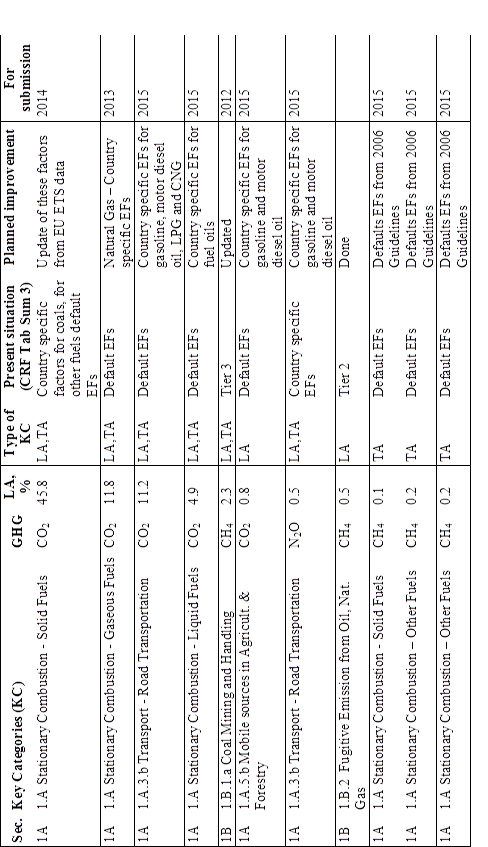
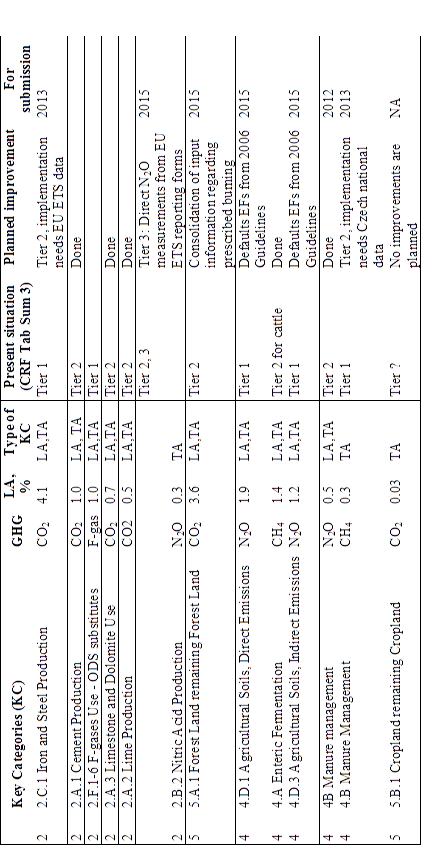
In addition to the planned
introduction of the procedures of the higher Tiers in the individual sectors,
the Improvement plan also includes a more general aspect. Here, it is planned
to gradually refine the individual uncertainties in the emission factors and
activity data in accordance with the ERT recommendations formulated in
paragraph 37 of the expert review (ARR 2011). Substantial improvements should
appear in the 2013 submission.
Specific suggestions for improvements
in the individual sectors are described in the sections entitled
“Source-specific planned improvements”, which are included in all the sector
chapters.